
Healthcare Data Company: Analytics, Engineering & AI for Clinical Needs
DATAFOREST acts as your healthcare data company. Your clinical, claims, lab, and imaging data sit in separate systems. We transform fragmented pieces into a single data layer for AI. The team delivers end-to-end healthcare data analytics services. Engineers and scientists operate as a single unit to build integrations, platforms, AI/ML models, and dashboards.
Our healthcare data analytics company applies 18+ years of experience across 250+ projects. Operating as a Databricks consulting partner, we build systems that perform.



Healthcare Data Analytics Services We Deliver

Clinical Data Analytics and Reporting

Healthcare Data Platform and Warehousing

Predictive Analytics and Machine Learning

Medical Imaging and Computer Vision

Healthcare Data Integration and Interoperability

Clinical NLP

Generative AI for Healthcare Workflows

DataOps, Data Quality and Governance
Data cleaning and standardization
Integration
Platform
Analytics
Visualization and monitoring

Healthcare Data Solutions by Use Case
Projects begin by connecting fragmented systems. Clinical records, billing claims, and diagnostic scans each require separate processing paths. Engineers deploy medical data analysis services to organize inputs. The new infrastructure predicts risk, automates manual chart abstraction, and tracks operational capacity.
Pharma and life-sciences teams apply the same technical approach to drug research using data science models on Databricks architecture.


Business Outcomes of Healthcare Data Analytics

Tired of the same old healthcare routine?

AI Platform Revolutionizing Healthcare Insights
Problem: The company relied on manual workflows for medical research and analytics. This approach limited output speed and restricted growth capacity.
Result: Research and analytics teams achieved a 2× productivity increase. The platform processes information faster and removes manual extraction tasks.
Solution: DATAFOREST developed an AI-powered enterprise platform. The architecture handles automated data collection and integrates GenAI enrichment. The system feeds directly into new reporting workflows.


AI Platform Revolutionizing Healthcare Insights
Medical Lab Achieves 50% Compute Savings via Databricks Migration
Problem: The laboratory maintained fragmented records across separate databases. They faced high operational expenses. They also needed strict HIPAA compliance for all patient data operations.
Results: The new platform maintained complete HIPAA compliance. The optimized architecture reduced pay-per-use compute costs by 50 percent.
Solution: Engineers migrated to Databricks using a Medallion Architecture. The infrastructure unified 21 distinct sources into one secure pipeline. The team automated core analytics functions.
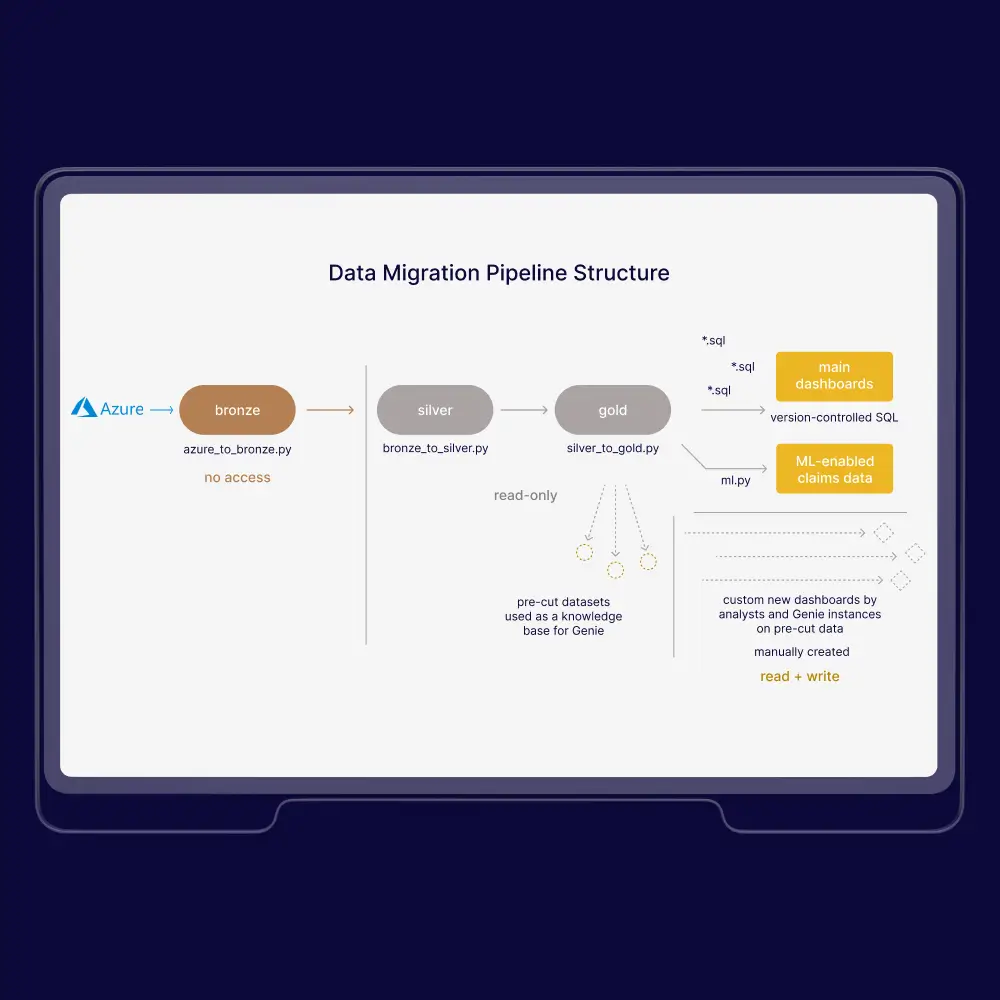
Medical Lab Achieves 50% Compute Savings via Databricks Migration
AI Test Automation Reduces NHS ERP Testing Time by 80%
Problem: Quality assurance teams spent hours manually testing NHS systems. Slow verification delayed software deployments.
Result: The platform reduced ERP testing time by 80 percent. It cut the process from hours to minutes. The system achieved 99.5 percent accuracy. It enabled scalable quality assurance across NHS systems.
Solution: The engineering team delivered an AI-powered automated testing platform. The system applies computer vision to inspect and validate enterprise resource planning software.

How a UK IT Company Achieved 150× Workflow Efficiency with AI Automation
How to Choose a Healthcare Data Analytics Company
A common question is: what separates a top healthcare data analytics company from a general software vendor? Buyers must verify specific experience and case studies before signing contracts. Security evaluation requires proof of compliance and secure PHI handling protocols. Engineering teams must support interoperability standards like HL7 FHIR to connect separate EHRs. Vendors should demonstrate the ability to run systems with clear pricing and transparent delivery models.
How We Work: From Data Audit to Production


Technology Stack for Healthcare Analytics
Data Platform and Cloud


Interoperability and Data Standards



Data Science and ML


Related articles
All publications
Healthcare Data Integration and Interoperability: A Complete Guide

AI In Healthcare: Healing by Digital Transformation
Data Science Cases in Healthcare
Questions for The Healthcare Data Analytics Company
We protect patient records with data encryption and enforce role-based access control and multi-factor authentication. We also log every system action to maintain full HIPAA compliance.
Yes, our teams process protected health information. We sign a Business Associate Agreement before any project starts. This contract defines legal responsibilities. We use automated pipelines to strip patient identifiers for safe data analysis.
Let’s discuss your project
Share project details, like scope or challenges. We'll review and follow up with next steps.

