Home page / Decision Support System
Decision Support System: Automate the Math You're Already Doing
DATAFOREST builds AI decision support systems that handle real data from real sources—scraped, piped, cleaned. We add AI/ML models that predict, rank, or suggest—just math customized to your domain. The result fits into decision support system dashboards or workflows, where choices get made under pressure, not in theory.


PARTNER

PARTNER

FEATURED IN

.svg)


.svg)
.svg)
.svg)
Decision Support System in Business: Stop Making Calls in the Dark
Your data is scattered everywhere. Your decisions take too long. A global decision support system fixes both problems without the marketing promises.
- Connect all your data sources into one place that actually works through data orchestration
- Build decision support system dashboards that pull from everything without constantly breaking
- Break down data silos to ensure real-time team alignment

- Set up an instant response system that alerts you when something important changes
- Run scenarios to see what happens if you do X instead of Y using future trend prediction
- Get time-sensitive insights in minutes instead of weeks of back-and-forth

- Replace the boring stuff with automated analytics pipelines
- Create reports that update themselves through report generation automation
- Cut down meeting time by delivering data analysis and insights everyone can understand

- Use historical data and machine-learning models to spot patterns early
- Model scenarios with business intelligence integration tools to understand potential outcomes
- Get early warnings from business-critical analytics to make proactive choices

- Put everyone on the same decision support system in business with the same information
- Create decision support system dashboards that show each department what they need to know
- Ensure decisions in one area don’t break others via customizable decision workflows

- Track outcomes using enterprise reporting tools
- Measure what happened through data-driven decisions backed by numbers
- Learn what worked using management support analytics and optimize future strategies

Either fix your data problem or keep explaining why you missed the apparent trends—your choice.
Real-Life Examples of Decision Support Systems (DSS) across industries
25% Increase in Sales Conversion for E-commerce Retailer
An online retailer faced challenges in converting website visitors into paying customers. Their product recommendations were based on fundamental algorithms and lacked personalization, leading to a high bounce rate and missed sales opportunities.
They implemented an AI decision support system integrated with their e-commerce platform, which:
- Tailored BI capabilities to analyze behavior and purchase history for tailored product suggestions
- Used machine learning models to adjust recommendations in real-time based on customer interaction dynamically
- Integrated seamlessly with the website’s shopping cart to provide personalized upsells and cross-sells
Results:
- 25% increase in sales conversion rates, enhancing revenue per visitor
- Improved customer satisfaction and engagement through personalized shopping experiences

18% Reduction in Energy Consumption for Regional Utilities Provider
A regional utility company with 400 employees in the U.S. struggled with managing energy distribution during peak hours, leading to overconsumption, inefficiencies, and higher operational costs. Their existing systems could not forecast demand spikes, resulting in unnecessary energy production and wasted resources.
They implemented an enterprise decision support system that:
- Used real-time data aggregation from SCADA, weather, and smart meters into a centralized platform
- Used machine learning models to predict peak energy demand and optimize energy distribution across the grid
- Provided operational decision support in real-time for balancing load efficiently
Results:
- 18% reduction in energy consumption during peak hours, lowering operational costs and minimizing waste
- Improved grid stability and reduced the need for expensive peak-time energy generation
- Enhanced customer satisfaction by maintaining a stable energy supply and reducing outages during high-demand periods

40% Improvement in Operational Efficiency for Logistics Company
A logistics company managing a fleet of delivery trucks struggled with route optimization and fuel efficiency, leading to high operational costs and delays. Their manual scheduling system was unable to adapt quickly to real-time changes like traffic or weather conditions.
They implemented a decision support system model that:
- Integrated real-time GPS data, traffic patterns, and delivery schedules into a centralized platform via ETL pipelines
- Used machine learning algorithms to suggest the most efficient routes and delivery windows
- Enabled real-time team alignment for route changes in response to traffic or weather disruptions
Results:
- 40% improvement in operational efficiency by reducing fuel consumption and delivery times
- Enhanced customer satisfaction through on-time deliveries and faster response times
.webp)
50% Reduction in Data Processing Time for Financial Institution
A major bank was dealing with slow data processing for its customer transactions and financial reports. Their legacy infrastructure and manual data entry methods led to delays in reporting and compliance issues.
They implemented a real-time data processing system using a decision support system (DSS) that:
- Integrated transaction data from multiple systems into a unified cloud platform
- Data architecture redesigned for scalability and real-time reporting using AI-driven data pipelines
- Dynamic dashboards give executives the ability to monitor key financial metrics
Results:
- 50% reduction in data processing time, allowing the bank to generate real-time reports
- Improved compliance and auditability by ensuring timely, accurate financial data
.webp)
How Enterprise Decision Support System Works
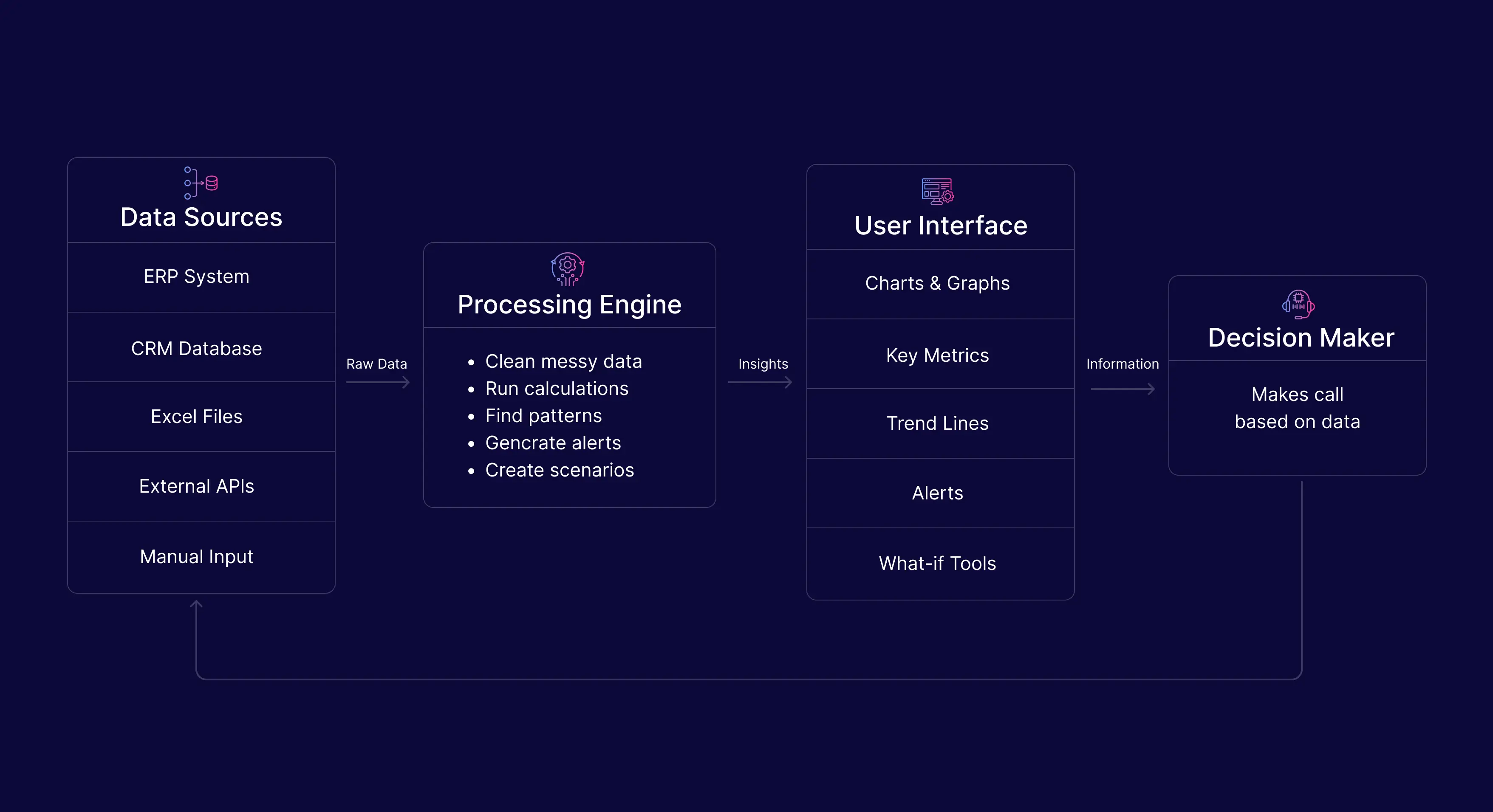

DSS (Decision Support System) Across Industries

E-Commerce
- Forecast demand accurately to avoid overselling and reduce excess inventory, ensuring products are available when needed without overstocking.
- Predict customer churn and deliver personalized engagement strategies to boost retention and lifetime value.
- Automate product recommendations via AI decision support systems to personalize the shopping experience, increasing conversion rates and average order value.

Energy & Utilities
- Predict energy demand fluctuations to optimize grid operations and reduce strain during peak usage hours, improving grid stability.
- Optimize asset management by evaluating the health and performance of infrastructure, prolonging asset lifespan.
- Automate real-time alerts through enterprise decision support systems to field teams for critical system issues, reducing downtime and improving service reliability.

Retail
- Forecast product demand accurately to maintain optimal inventory levels, minimizing stockouts and overstock situations.
- Segment customers intelligently for personalized marketing campaigns, improving engagement and conversion rates.
- Automate pricing with the help of a decision support system, business intelligence based on competitor analysis, demand fluctuations, and inventory levels, ensuring competitive pricing strategies.

Fintech
- Optimize investment strategies using an AI decision support system to predict market trends and recommend personalized portfolios.
- Enhance customer experience by offering personalized financial advice and recommendations based on transaction behavior and goals.
- Predict credit risk for customers based on financial history and behavioral data, helping institutions make informed lending decisions.

Healthcare
- Predict patient admission rates to optimize resource allocation in hospitals and healthcare facilities, ensuring adequate staffing and availability.
- Monitor patient health trends in real-time, flagging early signs of deterioration and providing alerts for timely interventions.
- Optimize treatment plans using an intelligent decision support system and suggest personalized healthcare options, improving patient satisfaction and treatment success.

Manufacturing
- Forecast production demand to optimize raw material purchasing and avoid shortages or excess inventory.
- Optimize production workflows by dynamically adjusting schedules to accommodate equipment availability and workforce shifts, improving overall efficiency.
- Analyze supply chain risks using a global decision support system to prevent disruptions and identify alternative suppliers, ensuring smoother operations and on-time deliveries.
.svg)
.svg)


Reporting & Analysis Automation with AI Chatbots
The client, a water operation system, aimed to automate analysis and reporting for its application users. We developed a cutting-edge AI tool that spots upward and downward trends in water sample results. It’s smart enough to identify worrisome trends and notify users with actionable insights. Plus, it can even auto-generate inspection tasks! This tool seamlessly integrates into the client’s water compliance app, allowing users to easily inquire about water metrics and trends, eliminating the need for manual analysis.


Automating Reporting and Analysis with Intelligent AI Chatbots
Gen AI Hairstyle Try-On Solution
Dataforest developed a top-on-the-market Gen AI hairstyles solution for US clients. It consists of the technology for the main product and the free trial widget. The solution generates hairstyle try-ons using the user's selfie. We had two primary objectives. The first was to ensure high accuracy in preserving the user's facial features. The second one was to create hairstyles that showcase the most natural hair texture. Our vast experience in Gen AI and Data science helped us achieve 94% model accuracy. It guarantees high-quality user face resemblance and natural hair in the generated photos. And it results in much higher user satisfaction, making it #1 on the market.

Gen AI Hairstyle Try-On Solution
Enhancing Content Creation via Gen AI
Dataforest created an innovative solution to automate the work process with imagery content using Generative AI (Gen AI). The solution does all the workflow: detecting, analyzing, labeling, storing, and retrieving images using an end-to-end trained large multimodal model LLaVA. Its easy-to-use UI eliminates human involvement and review, saving significant man-hours. It also delivers results that impressively exceed the quality of human work by having a tailored labeling system for 20 attributes and reaching 96% model accuracy.
.webp)
Revolutionizing Image Detection Workflow with Gen AI Automation
All Success Stories

Your board wants answers.
Your systems give you puzzles. Connect the dots.
Steps to Build a Decision Support System
.svg)
Audit Your Data Mess
You have more data sources than you think. Most are broken or inconsistent. Start by mapping what you have, where it lives, and how reliable it is.
01

Define What Decisions Matter
Not every choice needs a system. Focus on decisions that cost money when you get them wrong. Write down the questions you need answered weekly.
02
.svg)
Build the Data Pipeline First
Connecting systems is more complex than anyone admits. Budget three times longer than your IT team estimates. Test with real data, not sample files.
03

Start with Basic Analytics
Skip the AI for now. Get good at simple trends and comparisons first. Most business value comes from obvious patterns you're currently missing.
04

Design Decision Support System Dashboards People Will Use
Your executives won't log into seventeen different screens. Build one place with the five numbers they check every morning. Make it load fast.
05

Add Predictive Tools Gradually
Once basic reporting works, add forecasting to the decisions that have the most significant impact when wrong. Start simple. Get one prediction right before building ten models.
06

Train People and Fix Problems
The system will break. Users will complain. Data will be wrong. Plan for months of debugging and training before people trust it enough to use it.
07
Decision Support System Related Articles
All publications
July 7, 2026
11 min
DSS Integration: Making Blind Systems See
July 20, 2026
11 min
Data Pipeline Optimization: Real-time Spotting of Broken Data Flows
.webp)
August 21, 2026
18 min
ETL in Action: Real-world Examples of Extract, Transform, Load Processes
FAQ On Decision Support System Solution
How does the DSS decision support system support collaborative decision-making across different locations and time zones?
Multiple people can log in and work on the same analysis simultaneously. Comments and changes sync in real-time, so remote teams see updates immediately—the system tracks who made what decision and when for accountability.
Can multiple departments use the same DSS with different access levels and dashboards?
Each department gets its own view of the data with controls on what it can see. Finance sees financial data, operations see operational metrics, and marketing sees customer data. IT controls who has access to what through role-based permissions.
How does the DSS integration handle regulatory compliance and audit requirements?
Every data change and decision gets logged with timestamps and user IDs. Reports can be generated to show audit trails for compliance reviews. The system maintains data lineage so auditors can trace numbers back to their original sources.
Can the intelligent decision support system handle both structured data (databases) and unstructured data (documents, emails)?
The system processes database tables, spreadsheets, and text documents through different pipelines. Unstructured data gets parsed and converted into searchable, analyzable formats. Both types feed into the same analytics engine for unified reporting.
What's the difference between your decision support system in business and off-the-shelf business intelligence platforms?
Off-the-shelf BI tools tell you what happened. We go further—transforming decision-making with AI. Our systems include machine learning models, future trend prediction, and customizable decision workflows tailored to your specific challenges.
How customizable is your enterprise decision support system to our needs?
Models get trained on your data and adjusted for your industry's patterns. We build custom algorithms for your unique KPIs and business logic. The system learns your business rules and applies them to new data automatically.
How does the decision support system business intelligence engine manage data quality??
Automated validation catches common errors like duplicate records and missing fields before they enter reports. Inconsistent data gets flagged for manual review or cleaned using predefined rules. The system shows data quality scores so you know how reliable each metric is.
Let’s discuss your project
Share project details, like scope or challenges. We'll review and follow up with next steps.


