

Read our latest guide on how to choose the right data science consulting provider for your company. The market for providers has moved beyond basic analytics and into full AI implementation, data restoration engineering pipelines, and generative AI integration by 2026. Evidence bears this out: companies that don't collaborate with providers of data science services will be left behind by competitors implementing machine learning, predictive analytics, intelligent automation, and other advanced technology in their day-to-day business operations.
Whether you're a smaller scale startup trying to find your first consulting company, or an enterprise looking to move the needle and switch to a more capable Data Science company -- this guide has got you covered with any variable that you may need in order to make a sensible decision when hiring among providers: from assessing technical ability and adherence to protecting privacy of their customers as well as themselves all the way through giving insights into ways pricing models can work, and what contractual configurations are realistic for them.
5 Reasons Why You Need a Data Science & AI Firm in 2026
The role of consulting providers has grown exponentially, and choosing the best data science consulting providers is a high priority for business leaders today. The world market for data science is expected to surpass $300 billion by 2030, fueled by the explosive growth of artificial intelligence and big data analytics.
By collaborating with seasoned consulting providers and consultancy practices, incumbents are equipped with specialized skill sets, cutting-edge tools, and validated methodologies (which would, on average, take years to construct). In 2026, there is a deficit of skilled data scientists and AI engineers.
A good data science vendor assembles the talents from computer science, statistics, and domain knowledge into a single group of experts for you—so that while your team focuses on what really matters to the business, your partner is there to deal with all the complexities of evidence-based decision making. Work with a trusted provider like DATAFOREST, and you'll have a strategic partner who not only knows the technology but also your industry challenges.
Then, the best partner for your business will assist you in going past descriptive analytics into predictive and prescriptive intelligence—this is where raw data becomes meaningful action.
Understanding Your Data Science Requirements: Needs, Goals, and Services that Providers Offer
There are a number of important considerations when deciding among data science services. For starters, articulate what you need and how you envision that your service provider will serve those needs. Next, establish quantifiable business objectives to help hold the provider accountable and measure whether the promised results are realized.
Before actually approaching any provider of data science, you need to understand whether you really require an expert for this job. Clarifying needs early simplifies the evaluation of providers, provides guidance for identifying a good match, and ultimately reduces the time to add value to your consulting investment.
Consider performing an audit of your current data sources, infrastructure, and analytics abilities. Also, the DATAFOREST team can support you to evaluate your readiness and detect gaps that a provider could fill.
Defining the main targets of your project
“Define the main objectives for your project. What are you using this solution for? Are you looking for Demand Forecasting, Customer Segmentation, Fraud Detection, or Process Automation? (For instance, DATAFOREST showcases a demand forecasting case for a global luxury retailer).”
AI Forecasting That Saved $142M for Global Retailer


I think what is really special about the DATAFOREST service is its flexibility, openness, and level of quality and expertise.
Are you constructing a data warehouse for centralized reporting, or are you rolling out real-time advanced analytics dashboards? Establishing these goals is useful in establishing which consultants have experience with.
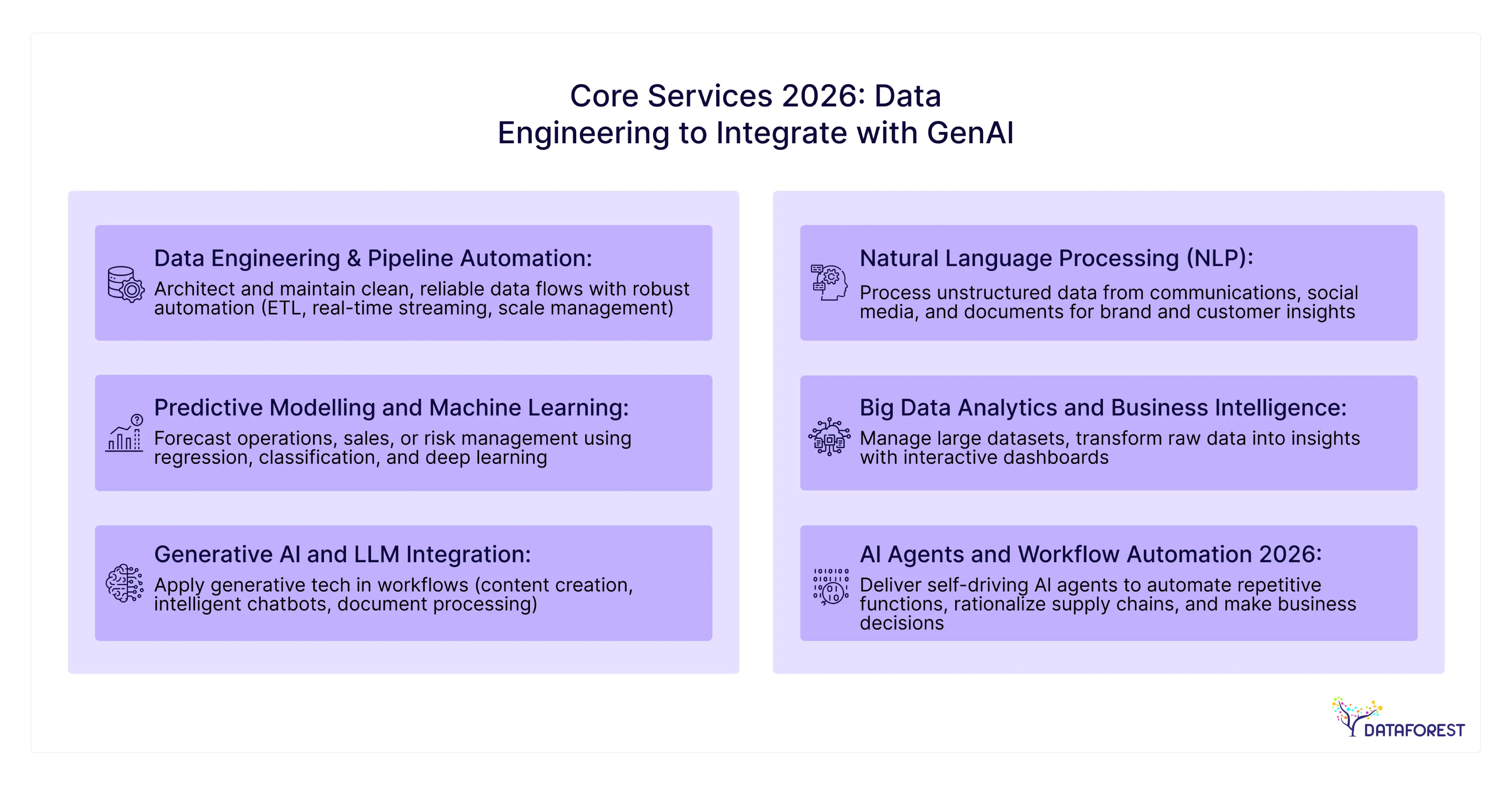
Core Services 2026: Data Engineering to Integrate with GenAI
The consulting space has changed a lot. Data analysis and data visualization still underpin everything, but the top providers in 2026 offer much more as part of the mix:
- Data Engineering & Pipeline Automation — An experienced data engineering company will help architect and maintain a clean, reliable flow of data from all your systems (application activity to billing to accounting) into your analytics ecosystem with robust automation. That includes ETL, real-time streaming, and scale data management.
- Predictive Modeling and Machine Learning: Businesses use predictive modeling to build a variety of models using regression, classification algorithms, and deep learning frameworks for generating insights that can help them forecast their operations, sales, or risk management.
- Generative AI and LLM Integration: Today's leading service firms provide integrated services with large language models, applying generative technology in business workflows that range from the automatic creation of content to intelligent chatbots, as well as document processing using machine learning created by AI.
- Natural Language Processing (NLP): Unstructured data from customer communications, social media, and internal documents can be processed to gain further understanding of how brands are perceived in the marketplace and how customers feel.
- Big Data Analytics and Business Intelligence—companies provide solutions that enable managing large amounts of data (both structured and unstructured), transforming raw business data into meaningful insights by developing interactive dashboards & reporting.
- AI Agents and Workflow Automation 2026: Leading vendors deliver self-driving AI agents that automate away repetitive functions, rationalize supply chains, and make decisions in businesses across departments.
Whether you're looking to hire a full-service agency, a niche consulting firm, or you are considering a flexible data services outsourcing relationship, knowing what type of category the potential candidate fits into can be helpful in aligning with your specific business requirements.
Judging the Judges: The Quality of Data Science Service Providers
The importance of specialization in data science
Experience is the single most important criterion when choosing between service providers and consulting companies. The pace of the field changes quickly—by teaming up with a provider that keeps a finger on the pulse of technology consulting, you can be certain your project will take advantage of all the most current methods.
Review case studies, published research, and client outcomes to evaluate a provider's history. A company like DATAFOREST has at least 50 completed successful projects from mission-critical assignments of a variety of industries, arraying skills in both depth and breadth.
How to evaluate the skills of a data science candidate
When judging the team, there are a few major dimensions to consider:
- Education: Seek out degrees and certifications in computer science, mathematics, statistics, or a related field. Further credentials, such as AI machine learning or industry-specific analytics consulting programs, signify a sound theoretical footing.
- Hands-on experience: Evaluate the team's project history and portfolio. Seek out hands-on experience with your type of business problems and industry challenges.
- Problem-solving: The problems teams face in business don't come with clear solutions. Look for vendors that have proven to be forward-looking in their previous engagements.
- Communication: The most amazing data scientist in the world is unlikely to be highly impactful if they can't tell people what they have found in a manner that stakeholders and business owners can understand.
- Lifelong learning: The speed at which artificial intelligence and machine learning models change means that teams should be continually investing in their own education and research.

Assessing the Provider's Portfolio: Your Needs vs. The Provider's Experience
The portfolio of the service provider is a strong dynamic indicator that shows the extent of their work, the industries they have served, and how they tackle business problems.
Assessing Project Types and Industries
When evaluating a data science service provider's portfolio, seek projects of equivalent scale and complexity to your own. Look for results — did their work drive quantifiable business impact? One such provider is DATAFOREST, which presents comprehensive case studies that illustrate the process and the subsequent results for each client.
Delegated Types of Work: AI Agents, Predictive Analytics, and Automation
In 2026, the hot project types are driven by a convergence of intelligent automation and proactive analytics:
- AI for Customer Segmentation and Personalization: Utilizing workflows with machine learning to identify micro-segments and provide hyper-personalized experiences at scale.
- Predictive Analytics In Demand Forecasting: Creating models to predict market moves and minimize overstock costs.
- AI for Fraud Detection and Risk Management: Implementing sophisticated anomaly detection systems that can automatically learn in real time from new threats.
- Independent AI agents: Build smart tools that do the boring data processing and reporting and are able to make small, routine decisions.
- Predictive Maintenance and IoT Analytics: Using sensor data and machine learning to anticipate equipment breakdowns and optimize maintenance.
Key industries Industry-conveyed Expertise
Industry-specific experience is a pointer that a data science service provider has knowledge of your market, regulatory regime, and operational bottlenecks:
- Retail and E-commerce: Using data-driven insights to automate pricing strategies, personalize the customer journey, and keep supply chains in order.
- Health & Well-being: Investigating patient data, constructing models to predict disease diagnosis and optimize the outcome whilst ensuring adherence to very strict data privacy regulations.
- Finance and Banking: Fraud detection, credit rating scoring, algorithm trading, or portfolio optimization with advanced analytics.
- Manufacturing: Sensor data analysis, manufacturing optimization, quality control automation, and supply chain IQ.
- Transport: Optimal routing, prediction of demand, fleet management, and monitoring with big data analysis.
By aligning your needs with the provider's proven experience, you can choose a data science service provider that offers focused, high-impact solutions.
Security, AI Governance, and Data Privacy
Evaluation of the security risk that the emerging technology introduces
Integrating AI/ML ethics into existing enterprise governance frameworks
Understanding data privacy implications.
In 2026, security and privacy of data are even more important as companies roll out AI systems that take actions on their own. When deciding on a data science service provider, it is important to pay attention to whether their hands are clean in terms of security, governance, and ethical AI.
And over and above traditional cybersecurity, providers of contemporary data science must grapple with AI governance: the mechanisms to make sure models are transparent, fair, and in compliance with evolving regulations such as those that will be seen in the EU AI Act. The domain of compliance is key in any data science provider.
Key security measures
- Encryption: The data science service provider should apply end-to-end encryption for both data at rest and in transit, leveraging proven industry protocols.
- Access Control: Data should only be available for access if you are authorized to access it, and RBAC(must have), MFA, and ZTSec (should have) will reflect this fact.
- Data Anonymization and Pseudonymization: Methods for securing personally identifiable data while still being able to analyze the data in a meaningful way and train models.
- Data Protection and Disaster Recovery – Robust monitoring of your system's backups to ensure all required files are successfully backed up and can be recovered in the event of a disaster.
- AI Model Auditing: Ongoing auditing of model equity, bias, and performance to support ethical and appropriate outcomes for all of the science projects.
Compliance standards and certifications
- ISO 27001: Certification shows compliance with international best practices for Information Security Management Systems.
- SOC 2 Type II: Ensures that the service provider has sufficient controls and safeguards in place to protect customer information.
- HIPAA Compliance: Necessary for providers who work with health data and are subject to stringent patient data privacy standards.
- GDPR Compliance: Required to process EU citizen data, including storage, protection, and privacy.
- Compliance with European Union (EU) AI Act: By 2026, top science consulting providers will achieve compliance with new AI-specific regulations regarding transparency, responsibility, and risk categorization.
Select a data science services partner that has transparent, proactive data handling practices. DATAFOREST pays the closest attention to security and compliance, ensuring client data is secure throughout all of our engagements.

Assessing Technology: Making Sure Data Science Service Providers Are Compatible and Quality Tech Stack
A data science service provider's toolkit is what will make or break the quality and scale at which they're able to deliver solutions. Measure their skill set and the width of their tech stack.
Some of the tools, software, and infrastructure they rely on:
Knowing which tools and infrastructure a data science service provider uses is important to evaluate their potential to address your data science projects:
- Programming Languages and Frameworks: Look out for experience with Python, R, and Java, as well as skill in leading machine learning frameworks such as TensorFlow, PyTorch, and Hugging Face Transformers.
- Data Management and Analytics Tools: Assess their use of SQL and NoSQL databases, Apache Spark, Hadoop, dbt, and modern data orchestration platforms such as Airflow or Dagster.
- Cloud Providers: Evaluate their pay-for-use scalability on Amazon Web Services (AWS), Microsoft Azure, or Google Cloud Platform, where conditional-by-design infrastructure is available for data processing, model training, and hosting.
- MLOps and Deployment Infrastructure 2026: The established data science service providers apply MLOps practices to continuously monitor, version control, and automatically re-train models – keeping your solutions persistently accurate.
The power of integration with your current applications
Your source of data science services should be able to blend into your existing organization's data infrastructure and business tools. Compatibility decreases implementation time, reduces a barrier for the unknown, and enables insights to seamlessly feed into what you are doing today.
In the evaluation process, really dig into integration needs and find a data science service provider that has experience with tech stacks similar to your own.
Let There Be Data: Building a Better Relationship with Data Science Vendors for Successful Project Management
Good communication is key to any successful data science collaboration. Your data science provider needs to share your business context, articulate the findings, and share constant updates across all stages of the project.
Collaboration goes beyond status meetings. The leading data science service providers are true partners whose work is articulated in your long-term business interests. Seek out data science services that use contemporary project management tools, provide clear reporting, and want to hear from you.
A teamwork orientation like DATAFOREST adopts will make sure each and every delivery is on par with your expectations and adds sufficient value.
Utilize Client References and Testimonials in Order to Pick the Best Data Science Service Providers
When choosing a data science services provider, client references and testimonials are great tools to have. They provide real insights into the quality of work, communications, project management, and overall satisfaction.
The significance of the Previous customers' outreach
Don't trust only published reviews — if you can, contact previous clients directly. Inquire about their experience with the data science service provider: response rates, delivery times, budget constraints, and how problems were addressed. It is these things that your marketing materials can never possibly give.
Advantages of standing on the shoulders of giants
Learning from others who have worked with the data science consultancy sets a framework for what is realistic, the typical challenges faced, and how to work well together. Using this knowledge minimizes risk and increases the likelihood of a successful collaboration.
Pricing and Contractual Considerations with Data Science Service Providers
And finally, it's really important to be transparent about appropriate pricing and reasonable contract terms in order for trust to grow between you and your selected provider.
Different pricing models in data science service providers
Most data science service providers give you a few pricing options to suit a variety of projects and budgets:
- Hourly: Use this pricing model for projects that require ad-hoc changes or ongoing support outside of the scope of one-off analytics-consulting engagements. This is flexible and needs to be carefully controlled via scoping.
- Fixed-Price Contracts: For highly organized projects that have known deliverables. Everything is captured by the Contract, and both parties are aware from the start what it will all cost.
- Retainer Agreement: Clients pay a consistent rate in order to have perpetual access to the provider's services—i.e., this is ideal for ongoing data management, monitoring, and optimization-related tasks.
- Performance Pricing: The cost of the service is directly pegged to results, so you are only paying for the success that a partner achieves.
Transparency and clarity in the pricing.
The top data science consulting firms will give you a full cost breakdown that includes software licenses, cloud infrastructure, and data storage, among other add-on costs. Clear pricing eliminates surprises and allows for precise budgeting.
Look for SLAs, intellectual property clauses, termination, and data ownership provisions. These factors look out for your best interests and promote mutually agreeable, business-like partnership arrangements.
The Last Decision: How to Pick the Right Data Science Service Provider
Selecting the appropriate data science service provider requires thoughtful assessment. Rely on a scorecard that looks at skills, portfolio relevance, data security practices, tech capabilities, communication quality, client references, pricing transparency, and contractual details.
Measure each potential candidate through the lens of your particular business goals. Collect feedback from important parties within your organization (IT, operations, and businesses), ensuring they are in alignment.
Pick a vendor whose skill, principles, and manner are complementary to your broader data strategy. The right relationship will address immediate business challenges and move your organization towards long-term, data-driven progress.
Bring your Data Strategy to a Whole New Level with DATAFOREST – Premier Data Science provider and consultant.
Ready to revolutionize your data strategy and unleash the full power of AI for your business? DATAFOREST is a premium data science consulting company enabling small, medium, and large enterprises to leverage data engineering, machine learning, predictive analysis, and generative AI.
Our seasoned scientific team provides custom, evidence-based solutions UNIQUELY structured for YOUR specific business needs. Whether it's standing up your data warehouse and AI agents, to powerful data visualization dashboards, and whatever is in between, you can imagine, DATAFOREST is the trusted partner at every step of your journey.
Get in touch today and discover how we can help you achieve your business goals.
FAQ
How can I determine if my business needs a data science service provider?
If your company isn't in a position to leverage data for insights and decision-making because it doesn't have the skills, resources, or bandwidth, a data science service provider could help fill that void — especially for artificial intelligence, machine learning, or big data analytics efforts that require specialized capabilities.
What are the advantages of using a data science provider to build a model as opposed to bringing on your own team?
Engaging a third-party in data science allows for immediate access to experienced professionals, removes the time and expense of finding and onboarding talent directly, and offers flexibility to scale resources as projects require. It also offers various industry best practices and even cutting-edge technological consulting support.
Can the data science vendor operate within our own ecosystem of data and system infrastructure?
Yes. If you're considering partnering with a credible data science consultancy firm, it will also be capable of effortlessly fitting into the existing data infrastructure, cloud platforms, and analytics tools. Compatibility needs to be discussed when evaluating for integration.
What experience is necessary to have in a data science service provider?
Industry-specific experience is crucial. It shows that the provider has a clear sense of industry-related concerns, data peculiarities, and regulation constraints, all of which help guide its solutions to be more customized for impact. Select a data science consulting company with experience in your industry.
What does a data science solutions provider do to ensure the privacy and security of our data?
Providers should be using strong encryption, access controls, anonymization, and regularly auditing their security. They need to follow regulations, such as GDPR, HIPAA, and the EU AI Act, but also maintain a transparent data-processing policy.
How Data Science Service Providers Cope With Scalability And Future Growth?
The vanguard of players is using scalable cloud architecture, elastic resources, and modular design to accommodate an exponential increase in data. Outsourcing data science is probably an ideal choice for organizations that expect to keep growing.
What kind of various communications and reporting should I expect from a data science service provider?
He will continue to do progress updates and status meetings, as well as clear check-in channels. Reports often contain data insights, performance metrics, and action-based recommendations. A superior data science agency will keep in touch with you on a regular basis during all your projects.
How can a data science service provider contribute to data strategy and roadmap development?
Yes. On the high end of the spectrum, experienced providers will guide you to craft an end-to-end data strategy, set business objectives, choose critical data sources, and establish a go-live plan. Organizations in need of a clear path to data-driven transformation also benefit from consulting with experts in the field of data science.
What is the usual time frame to realize measurable outcomes and business benefits after hiring a data science service provider?
The period is contingent on the project complexity, data availability, and goals. Early actionable insights and business value should begin to appear within a couple of months, with refinements as more models are developed. Realistic expectation setting at the beginning is critical for a successful data science consultancy engagement.


%20(1).webp)
.webp)
.webp)


