AI Test Automation Reduces NHS ERP Testing Time by 80%
Noxcon, a UK-based ERP testing consultancy in the Healthcare sector, relied on manual testing processes that required extensive human effort and delivered inconsistent accuracy. By implementing an AI-powered automated testing platform with Computer Vision, Noxcon reduced execution time from 1–2 hours to 15–30 minutes, improved accuracy to 99.5%, and achieved scalable, repeatable QA operations across NHS ERP environments.
x
150
faster workflow testing
99.5
%
testing accuracy achieved
.webp)
Noxcon is a UK-based ERP Test Consultancy specializing in Healthcare IT programs. The company develops advanced testing scripts and frameworks for complex ERP platforms, supporting NHS clients with scalable, compliant solutions that streamline delivery and reduce operational risk across every testing phase.

Computer Vision

ChatGPT
)%2C.svg)
Tesseract OCR

Qdrant

Django Admin
THE CHALLENGE
Automating Manual Testing Workflows with Low Accuracy and 1-2 human hours
Noxcon faced challenges with automating their large-scale platform and NHS healthcare systems testing. They depended on manual processes to create and execute test scripts for verifying system functionality. Each workflow required 1-2 hours of human review, yielding only 70-75% accuracy. As testing volumes increased, the scalability, speed, and consistency of the processes deteriorated, and human errors became more frequent. Noxcon needed a solution to modernize this manual testing framework by implementing AI-driven automation to improve precision, efficiency, and reliability across complex ERP workflows.
.svg)
Workflow Recognition Limitations
The recognition of workflows in testing was slow and lacked the precision needed for complex systems, requiring substantial human input to identify steps and variations in the workflows.
.svg)
Difficulty Parsing Visual Test Elements
Some testing workflows were embedded in PDF documents containing complex block diagrams with overlapping or misaligned arrows. Traditional parsing tools struggled to interpret these visual elements accurately, requiring extensive manual corrections.
.svg)
Workflow and Script Misalignment
Manual test scripts frequently failed to align with complex ERP workflows, resulting in incomplete or inconsistent test coverage. Aligning hundreds of workflow variations with corresponding scripts demanded intensive human effort and frequent revisions.
.svg)
Manual Script Generation
Test scripts were created manually by humans, leading to slower generation times and a high risk of errors. Automating script generation was a key need, with human supervision required for quality control.

THE SOLUTION
Automated Test Management Platform Powered by AI and Computer Vision
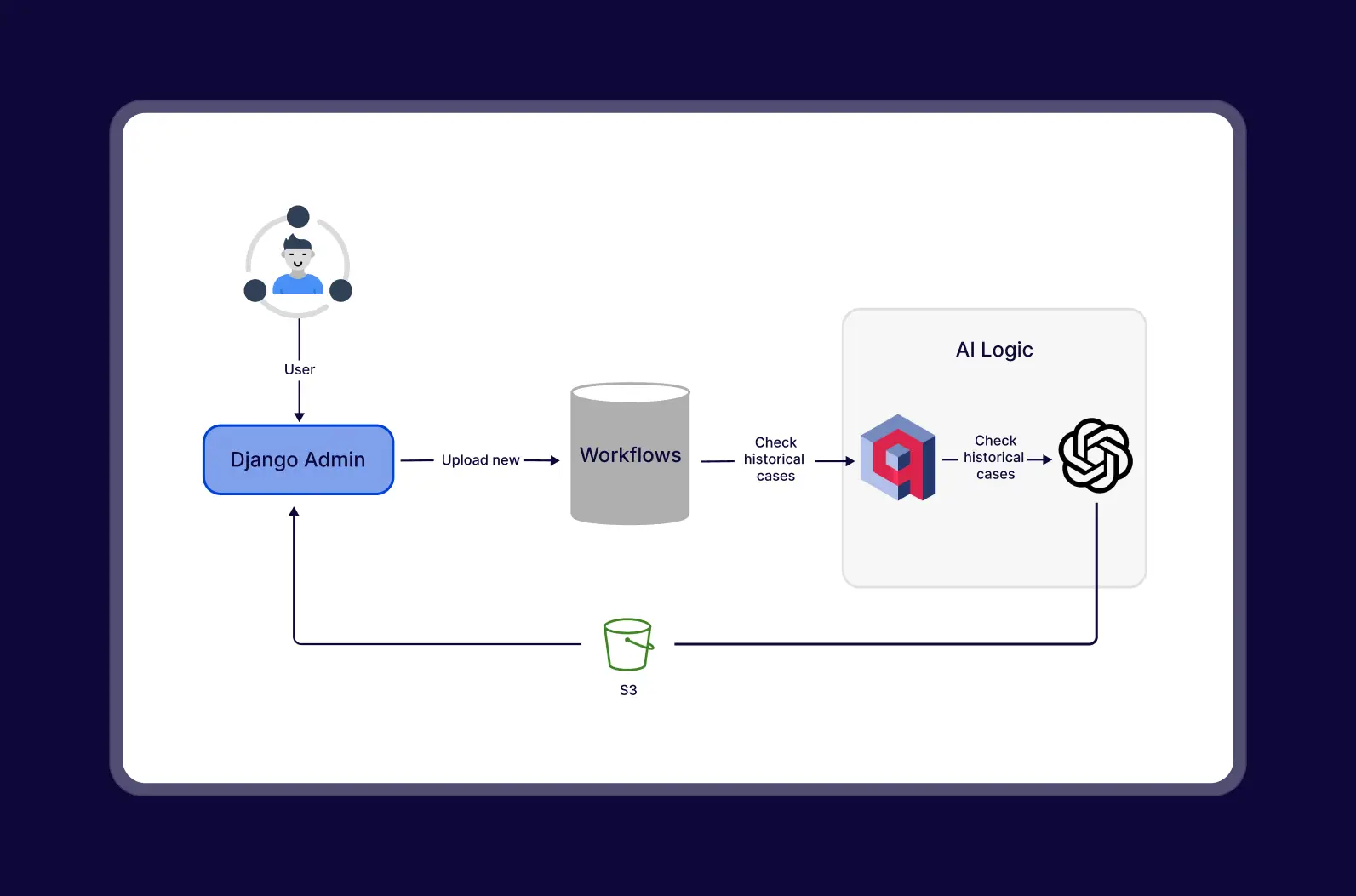
To overcome these challenges, we developed an AI-powered Automated Test Management Platform, integrated with Computer Vision, to replace Noxcon’s manual testing processes. The platform automatically generates and validates test scripts based on workflows, reducing testing time from 1–2 hours to just 15–30 minutes and improving accuracy to 99.5%. Although the scripts are generated by AI, they are executed under human supervision to ensure quality.
.svg)
AI-Assisted Workflow Recognition
We implemented ChatGPT to align workflows with test scripts and fill in any missing test steps. This allowed the system to identify workflow patterns, ensuring completeness and accuracy in script generation.
.svg)
Model Training and Missing Step Generation
AI analyzed workflows to detect missing test steps. Using ChatGPT, the system generated suggestions for these missing steps based on the workflow data. Over 5,000 scripts and workflows were used to train the model, achieving an accuracy rate of 99.5%.
.svg)
Computer Vision for PDF Workflow Parsing
We used Computer Vision to analyze and extract workflows directly from PDF documents. This enabled the system to accurately interpret complex visual elements and convert them into structured test scripts, ensuring full coverage of all workflows.
.svg)
AI-Generated Scripts with Human Oversight
AI now automatically generates test scripts based on workflows and system behavior, ensuring consistency and speed. Human review remains in place as a quality safeguard, allowing Noxcon to retain control while significantly accelerating execution.
THE RESULT
Streamlined QA Operations and 150× Faster Testing Performance
Implementing the AI-powered automated testing platform dramatically improved operational efficiency across NHS ERP testing workflows. Manual review time was reduced, execution became consistent and repeatable, and accuracy increased to near-perfect levels. The system now enables faster delivery cycles, higher release confidence, and scalable test coverage without increasing QA resources. Human oversight ensures governance while automation drives speed, precision, and reliability.
The solution also unified all testing workflows into a single system, enabling real-time monitoring and scalability for future integrations.
According to the client, the key advantage was that automation not only replaced repetitive manual tasks but also delivered significantly higher quality — allowing the company to take on more projects and scale operations efficiently.
- 80% reduction in testing time — from 1–2 hours to 15–30 minutes
- Accuracy increased from 70–75% to 99.5%
- Testing capacity scaled without additional headcount

How a UK IT Company Achieved 150× Workflow Efficiency with AI Automation
How an LLM-Powered System Streamlined Contract Analysis by 70%
.webp)
How an LLM-Powered System Streamlined Contract Analysis by 70%
AI Platform Revolutionizing Healthcare Insights

AI Platform Revolutionizing Healthcare Insights
Gen AI Hairstyle Try-On Solution

Gen AI Hairstyle Try-On Solution
How an LLM-Powered System Streamlined Contract Analysis by 70%
How an LLM-Powered System Streamlined Contract Analysis by 70%
AI Platform Revolutionizing Healthcare Insights
AI Platform Revolutionizing Healthcare Insights
Gen AI Hairstyle Try-On Solution
Gen AI Hairstyle Try-On Solution
Latest publications
All publications.webp)
Analytical Process Automation Streamlines Insights

Intelligent Document Processing: A Key to Business Efficiency
.webp)
AI-Enabled Accuracy: How AI Improves Project Cost Estimation
Latest publications
All publications
AI-Ready Data: Clean Internal Records to Prevent Costly Software Failures
AI-Enabled Accuracy: How AI Improves Project Cost Estimation
.webp)
AI in Transportation: Reducing Costs and Boosting Efficiency with Intelligent Systems
We’d love to hear from you
Share project details, like scope or challenges. We'll review and follow up with next steps.

