


A large hospital network implemented a machine learning tool to evaluate patient records for sepsis risk. The AI in hospital operations analyzed clinical data and alerted medical teams hours before physical symptoms appeared. This early detection strategy reduced mortality rates by 30% during the first two years of use. Hospital leaders then shifted their investment strategy to expand this technology across all emergency departments. If you think this is your case, then arrange a call.
Why Are HealthCare Systems Burdened Today?
Healthcare systems are facing significant pressures from rising costs and a lack of skilled workers. Worker fatigue has reached record levels, and nurses and doctors are already leaving the workforce. Patients expect faster and more digital services that many hospitals cannot currently provide. The increase in the cost of medical equipment and drugs has further affected hospital budgets and complicated healthcare cost management.
Traditional management models have struggled because they rely on slow, manual processes and rigid workflows. These old methods were unable to process the large amount of complex data generated in modern clinics, especially big data in healthcare and data analytics in healthcare. AI for hospital management helps organizations transform those data flows into insights rather than burdens.
Traditional IT systems often create silos, preventing organizations from sharing critical patient information. Relying on traditional tools also increases the risk of cyberattacks on sensitive medical records. Managers are realizing that top-down decision-making cannot keep pace with rapid changes in technology and regulations. Leaders must now embrace flexible, AI-driven decision-making and data-driven strategies—powered by AI for hospital management—to ensure long-term sustainability and improve patient outcomes through AI in patient care optimization.
Tommy Esposito, consultant and investment strategy specialist at Kaufman Hall, during our podcast:
“About 85% of the hospitals in the United States are nonprofits. And it's for a reason. It's because hospitals constantly struggle with making a profit. And that's because hospitals know- think of it this way. Imagine running a business where you don't control the price of anything. You have to go and beg the payers, which are the private insurance companies or the government, like Medicare, for money for the services that you provide patients.”
How Can Hospital Leaders Handle Investment Strategy During Daily Work?
Hospital managers must keep enough cash for bills and save for future growth using structured financial planning for hospitals. This method helps the facility pay debts and buy new equipment over time, when AI for hospital management projects—and broader AI in healthcare finance programs—require phased investments. If you need an individual approach to a solution, book a call.
Liquidity, reserves, and survival cycles
Expenses are very difficult to control because there is a limited number of doctors and nurses, and they're all highly in demand. And so, there's been an immense amount of pressure on hospitals just to keep afloat. And like any nonprofit, hospitals tend to keep large balance sheets with excess reserves of cash in the years where they do have a little bit of profit. When they go through periods of losses like we're experiencing now, they draw down those reserves to keep everything going and continue to provide services. They include future AI-powered financial insights and AI for hospital management aligned with financial risk assessment strategies.
Investment strategy as an operational function
Peter Drucker is a famous management guru who once said that the hardest business to run in the United States is a hospital. Think of it like this: everybody has a checking account, everybody has bills they have to pay every month, and you have to make sure you have adequate cash to cover your bills. And then there's this excess amount that you keep putting away, putting away, putting away in your 401K. It requires thoughtful predictive financial modeling and long-term healthcare budgeting.
That same mindset applies to hospitals: first, make sure there is enough cash; second, build something sustainable, including scaling AI-powered budgeting tools and AI in medical investments safely. If you ever want to buy a beach house, if you ever want to have a rental property or something like that, that comes into the long-term planning, as does scaling AI for hospital management safely.
Why Is Peer and Market Data Vital for Hospital Financial Success?
Hospitals must track internal finances and external market trends to stay stable. Accessing peer data helps leaders see how other systems position assets and how they fund AI initiatives tied to healthcare finance optimization and machine learning in healthcare finance. Successful managers filter through daily market noise to find smart investment choices with healthcare financial analytics.
You can’t manage what you can’t measure
Data is absolutely critical. You can't manage what you can't measure, first of all. You need a solid understanding of your balance sheet and income statement—alongside predictive analytics for hospitals that forecast future outcomes. Then you have to work with your clients on what your projections are for the future. And what are the assumptions that are driving your future? That's just the basic financial sort of approach. But then, in terms of other data, which is really key and not really widely available, is peer data.
The role of peer and market data
What are peers doing? Peer data is really key. Experts are able to draw peer data from banks that work with hospitals like JP Morgan, and others that publish information about hospital systems and how they have positioned their assets. That's a key data point. Meanwhile, markets generate vast volumes of data—similar to streams now flowing through AI decision support systems. There's so much published every day about the stock market. There are just copious amounts of data about every single stock, every single company, similar to the data now flowing through AI for hospital management.
Tommy Esposito, consultant and investment strategy specialist at Kaufman Hall, during our podcast:
“If you're going to lose money, can we do something about it? Maybe some performance improvements. And if we're going to need the balance sheet to support the hospital with cash increasingly, how do we do that, and how do we plan for that? And what's the right asset mix to ensure that if there is a downturn in the stock market, making sure it all works, hopefully this gives you an indication of the complexity of running a hospital and running its balance sheet.”
Can Executive Judgment Outperform Data in Hospital Investment Strategy?
Hospital managers must filter through vast amounts of data to find useful financial signals. Old strategies relied on rare information, but leaders now use experience to cut through constant noise. Accurate Databricks jobs and SQL automation reduce technical debt when tied to AI analytics and hospital revenue cycle automation within broader AI in revenue cycle management frameworks.
When data becomes a liability
Large datasets often become a heavy burden for medical staff. Teams fail to find facts. Information stays trapped in different systems. Untrained teams attempt to automate SQL scripts without cleaning the data first. Unclear goals for Databricks jobs create technical debt. Poorly planned SQL script automation spreads errors across the hospital network. Information stops being an asset. Storage costs exceed the gains, even inside AI for hospital management pipelines.
Executive judgment as a competitive advantage
They say Elon Musk is 100% signal, but 0% for those who have actually worked with him. And they said that Steve Jobs was something like 75% signal. And the point is that everyone wants to make is that there's signal, and there's noise. Most of the news, if you turn on CNBC or if you read the Wall Street Journal, a lot of it is noise. And it takes time and effort and experience to cut through the data that's streaming in, finding the really important information. That's the difference now versus, say, 20 or 30 years ago, when information was power. Few people had it, few people controlled all the information, and they were able to use it to get wealthy. Today, leaders must interpret AI for hospital management dashboards wisely.
Tommy Esposito, consultant and investment strategy specialist at Kaufman Hall, during our podcast:
“There are just copious amounts of data about every single stock, every single company. And a lot of people, you, and this is where we can get into investment theories and things like that. But my overriding point is that when it comes to data in markets, it's all about knowing how to cut through mostly noise to get to the signal.”
How Can Healthcare Leaders Get Value from AI Without Making Costly Errors?
Modern software helps doctors find tumors and manage surgery schedules. But humans must validate results to avoid cascading errors—across medical billing automation, SQL automation, and healthcare financial analytics workflows. Skilled teams catch small mistakes that automated tools often miss during daily operations.
Why should businesses validate AI solutions?
In June 2025, the Chicago Sun-Times published a list of the top ten books of the summer. An investigation found that nine of those books were inaccurate. Another contractor used an AI tool but did not validate the data. Several local newspapers shared the news before the errors were discovered. The publishers issued retractions for their journal catalogs.
AI users should validate each claim to avoid errors. People accept incorrect information without a deep understanding of a subject, such as brain surgery. Expert analysis prevents errors during hospital SQL script automation. Effective Databricks operations require human expertise to catch minor errors. Trust the machine, but validate the results before running SQL scripts when they drive AI for hospital management decisions.
Practical uses for modern health tools
- AI tools now help doctors find small tumors on lung scans much faster.
- These systems read thousands of images to flag problems that a tired human eye might miss.
- Medical teams use these models to predict which patients will need extra care during the night.
- This helps the nursing staff manage their time better without working more hours.
- New software also handles the scheduling of surgery rooms to reduce wait times for families.
- Clinics use these programs to transcribe medical notes so that doctors can talk directly to patients.
These real-world applications save time and help medical centers run more smoothly—exactly the promise of AI for hospital management.
Can AI Help Hospitals Recover Lost Revenue and Save Staff Time?
Nurses spend up to half of their work hours filling out insurance forms. Manual errors cause insurance companies to reject ten percent of hospital bills every year. AI for hospital management can cut paperwork time in half and help hospitals recover lost revenue.
The hidden cost of manual processes
When somebody comes to the hospital and needs surgery or whatever treatment, somewhere along the process line, a nurse has to go to a computer and type in these codes for the services provided. It's a very manual process. And often these billings get rejected. Only 85 to 90% of the billings that are submitted actually get paid. There's this huge gap. That's a massive gap, 10% or more of the $5 trillion that the US spends on healthcare. In some hospitals, it's even greater. If we could apply AI in hospital operations to help us figure out how to do this billing stuff in a way that you get up closer to 90–95% reconciliation of billings, it would be really great for hospitals.
What happens is that insurance companies get to keep that money rather than pay the hospitals for the services that the hospitals provided. All because of this Byzantine system of hundreds of thousands of codes for all the different types of care. Would it improve the efficiency of hospitals? Data that Kaufman Hall publishes suggests that something like 40–50% of the time for some doctors and nurses is spent on paperwork. Imagine if you could cut that down to say 25% with a better system, then you have more time for care, more time for serving patients, and less time on boring paperwork. That would be a really awesome opportunity for AI to help us fix.
Gains for hospitals and patients
- Computer programs study X-rays to find early signs of cancer.
- AI in hospital operations helps doctors spot problems before patients feel sick.
- AI in hospital operations checks insurance claims for errors to get hospitals paid ten days faster.
- New tools find missing codes in medical records to increase annual revenue.
- Smart calendars predict when a clinic will be busy.
- Digital note-takers record doctor visits, so staff spend less time typing.
- Robots and AI agents assist with small cuts during surgery to help people go home two days early.
AI Platform Revolutionizing Healthcare Insights


AI Platform Revolutionizing Healthcare Insights
How Can Digital Transformation Leaders Use Data and AI For Maximum Impact?
Leaders use AI in hospital operations to streamline slow processes and motivate their most talented employees. Progress starts with small wins in areas like billing and staffing. This approach helps organizations gain confidence before the hospital expands AI in hospital operations across clinical areas.
Start with high-impact areas, low resistance
Managers must prioritize new tasks such as medical billing and scheduling appointments. These offices often struggle with manual errors that slow down daily operations. Practicing these steps will quickly show that the technology is working as intended. Financial institutions can see accurate claims and prompt payments within months thanks to AI in hospital operations. Start here to lay the foundation for the funding and support needed for major medical projects later.
Build AI in hospital operations to enhance the human experience
The goal of the new program is to improve the roles of doctors and nurses. Digital tools understand trends in big data, and people make the final decisions. AI in hospital operations signals potential problems to medical professionals before a problem escalates. This collaboration allows staff to focus on direct patient care instead of dealing with outdated data. Leaders should make sure that each employer makes the process easier for first-time employees.
Tommy Esposito, consultant and investment strategy specialist at Kaufman Hall, during our podcast:
“You can't just go into ChatGPT because if you do, your brain will stop working. It won't. The greatest tool on the entire planet Earth is the human mind. And we have to continue to cultivate that mind. If we don't, we're going to go back to being monkeys.”
Accurate Data and AI Are Perfect for Healthcare Organizations
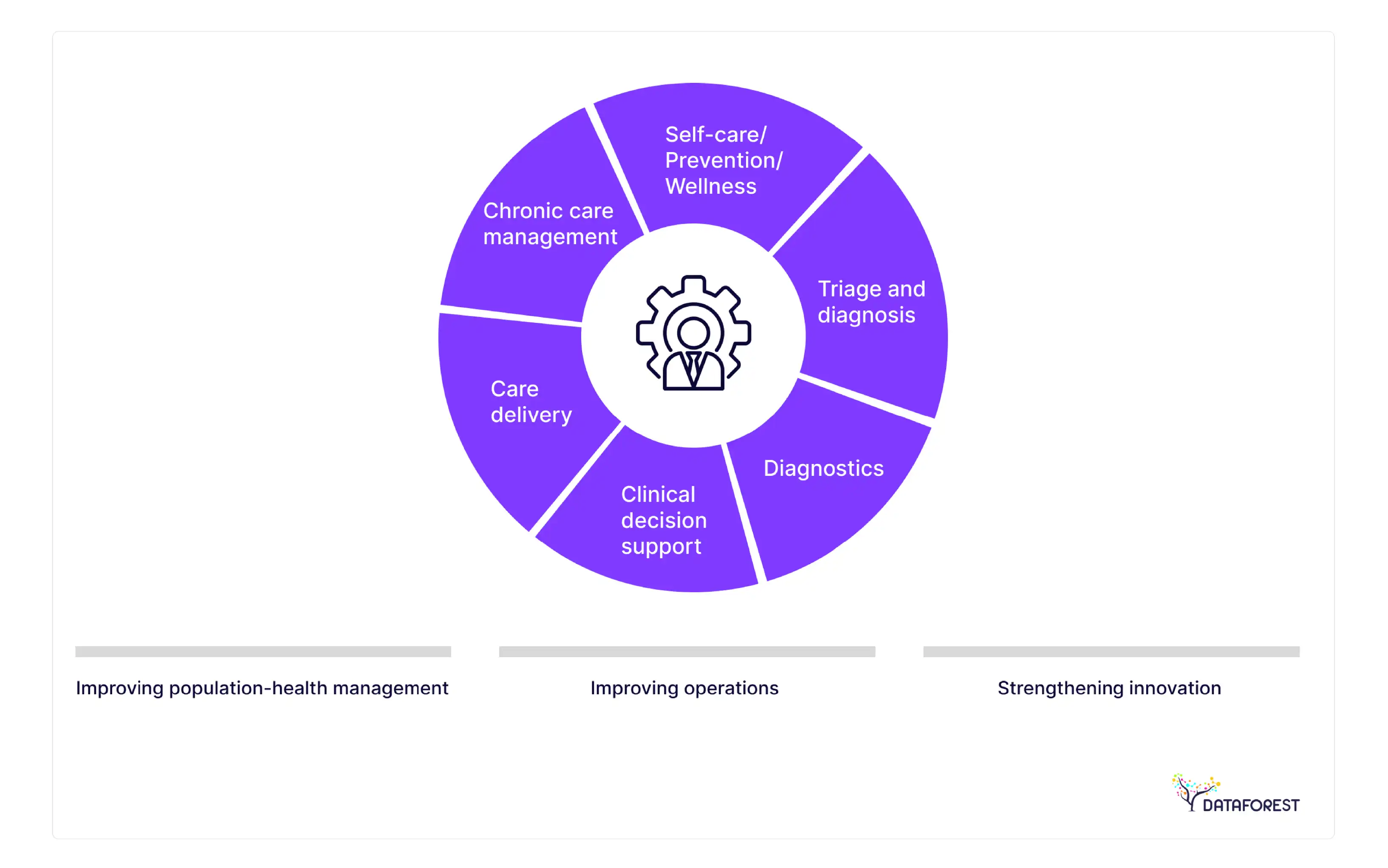
McKinsey reports that AI will be widely used in healthcare delivery and operations. From patient triage to cancer diagnosis and bed management to job optimization. Applications range from clinical support tools to population health analytics, but many solutions remain in the minority. Success is increasing usability by improving user experience and data integration.
DATAFOREST builds seamless data pipelines to pull records from EHRs, labs, and billing systems into a single, usable store. The team uses machine learning to reduce manual labor in reporting, coding reviews, and patient risk calculations, saving staff hours each month. Dashboards and clear forecasts help clinicians identify bottlenecks early and make quick decisions on staffing, capacity, and quality of care.
Fill out the form to apply AI in hospital operations.
Questions On AI in Hospital Operations
What role does predictive analytics play in hospital investment planning?
Hospital leaders use predictive analytics to shift from reactive to planned capital spending. AI for hospital management tools forecast when high-value medical machines will reach the end of their useful life. This foresight allows managers to align large purchases with annual budget cycles and prevent sudden equipment failures.
Which financial metrics are most improved by AI adoption in hospitals?
AI for hospital management tools lowers the rate of insurance claim denials by catching errors before submission. AI in hospital operations systems also reduces the time a hospital waits for payment, often cutting the billing cycle by thirty days. Hospitals see higher total revenue as automated coding finds missing charges in patient records.
How can AI in hospital operations improve the efficiency of budgeting in hospital systems?
Forecasters use AI in hospital operations tools to predict when medical equipment will need to be shut down. Directors move funds from underutilized rooms to rooms with high patient demand. Boards use AI in hospital operations data to spend money on programs that help patients better.
What are the challenges of integrating AI in hospital operations with traditional financial systems?
Legacy databases often store data in formats that modern software can’t read correctly. Professional organizations need to clean up dirty records before a machine learning tool can use the data. AI in hospital operations: technical hurdles drive up project costs and delay the launch of new programs.
How can clinics use AI in hospital operations to optimize long-term investment portfolios?
Algorithms guide diversification through predictive financial modeling and financial risk assessment. AI in hospital operations systems balances risks by spreading funds across different types of stocks and bonds. Hospital boards use these reports to build larger cash reserves for future expansions.
How can AI in hospital operations help executives make data-driven strategic decisions beyond finance?
Predictive models track population health trends to show where a city needs new clinics. AI in hospital operations analyzes staff turnover rates to help leaders improve workplace conditions for nurses. Executives use these facts to decide which medical services to offer in growing neighborhoods.

.svg)


.webp)
.webp)


