

An electronics producer in Europe used a CDP for customer data integration and marketing automation to connect data from online stores and physical shops. The behavioral data, clicks, and purchases flowed into a single customer view that enabled AI personalization and detailed profiles for every shopper. The brand sent tailored messages through email and mobile apps using automated customer journeys, and repeat purchases grew by 40%. The new campaign orchestration inside the CDP helped the company increase conversion rates by 55% through real-time personalization. Book a call to stay ahead in technology and strengthen your digital transformation strategy.
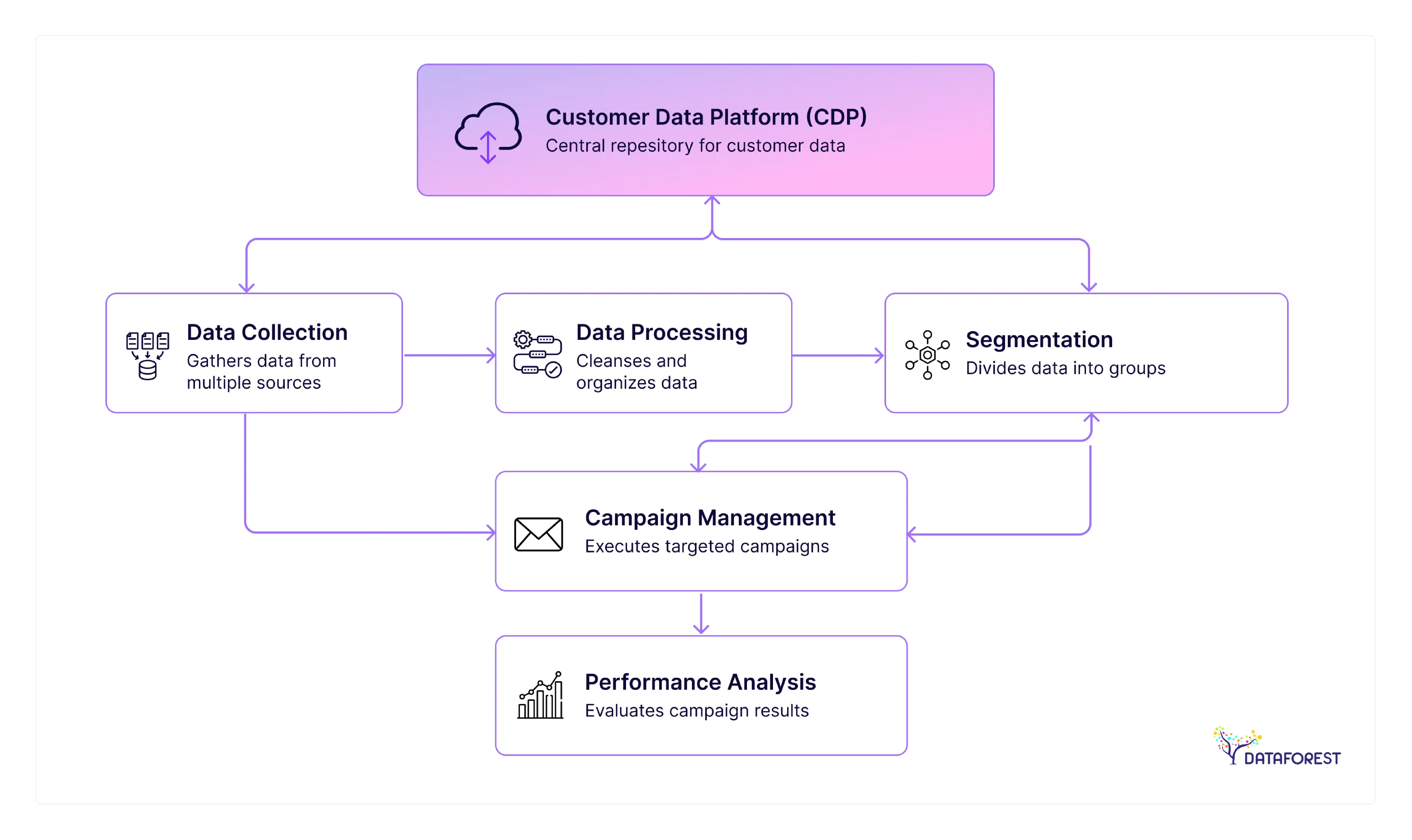
Why Does Poor Data Integration Hurt Your Omnichannel Results?
Old tech stacks keep your data in separate buckets and create blind spots. A CDP for customer data management joins these records to build a single view of your shoppers. Stop wasting your budget on the wrong audiences and start sending messages powered by smart segmentation that people actually want.
Data silos and speed
Old marketing tools keep data in separate buckets. Your email system doesn’t talk to your website or your mobile app. This gap stops you from seeing a unified profile and weakens omnichannel engagement. A CDP for customer identity resolution fixes this by joining all your first-party data points. Without it, you send the wrong message to the wrong person. High volume makes these errors happen more often. Marketing automation in CDP prevents these mistakes and keeps your brand message steady. Traditional stacks cannot move fast enough to match modern shoppers who expect real-time data processing.
The price of broken data
Fragmented data costs your business money and hurts your brand. Teams spend hours manually fixing errors in customer records instead of using business intelligence dashboards and customer analytics. This waste of time delays your campaigns and lowers team output. Poor data integration leads to duplicate emails and mismatched offers. Customers get frustrated when they see ads for items they already bought. A CDP for data activation stops expensive mistakes by unifying your records. Without clean data, your ad spend goes to waste on the wrong audiences. Accurate audience segmentation and predictive analytics help you target people who are ready to buy. High churn rates often stem from a disjointed customer experience. You save on operational costs when your data governance stays connected and clear.
Operating Supplement


DATAFOREST has the best data engineering expertise we have seen on the market in recent years.
What Is CDP Marketing Automation and Why Does It Increase Your Revenue?
This tool joins all your data points into one clear customer profile and powers customer experience optimization. CDP automation helps your teams act on live data from every shop and site. This connection stops the waste of your budget and builds a predictable engine for growth through retention optimization and stronger customer lifetime value.
Strategy over hype
Executive leaders view a CDP as a strategic asset for business growth. This tool builds a single customer view by linking all customer touchpoints. Standard tools often struggle in isolation. A CDP fixes this by pulling data from every department in real time and feeding it into your enterprise data platform. You gain full control over your first-party data to lower reliance on outside sources. This clear view helps you find new ways to increase customer lifetime value. Marketing performance analytics highlight which journeys drive ROI. CDP also manages data privacy compliance. Your teams move faster when they use CDP and automation together, creating personalization at scale.
The proper tool for the job
A CDP serves as your central hub for unified customer data. Your CRM tracks manual notes from sales and support calls. DMPs manage anonymous profiles for targeted digital ads. Automation platforms execute the actual emails and mobile alerts. A CDP for automation connects these separate tools into one view. Modern marketing automation in CDP uses live data to trigger messages at the perfect moment. Research shows companies with this setup see 2.9 times higher revenue growth thanks to better revenue attribution.
If you need an individual approach to a solution, book a call.
How Can CDP Marketing Automation Improve Your Engagement?
Static campaigns fail to reach your customers at the right moment. Marketing automation turns these fixed plans into live journeys that react to every click. You can now deliver personal messages across every channel without any delay.
Real-time data at scale
A CDP for marketing collects data from every touchpoint as it happens. This system builds a single profile that updates every time a customer acts. You no longer wait for batch updates to refresh your records. Data enrichment adds deeper context to each shopper. CDP then pushes these updates to your email, web, and mobile tools instantly. Your brand stays relevant by reacting to live shopper behavior across every channel. This speed prevents you from sending old or irrelevant offers to your audience. True omnichannel engagement relies on this constant flow of fresh customer data.
For example, a shopper leaves a pair of shoes in their online cart. The marketing automation sees this and sends a push notification to their phone within minutes via customer insights.
Moving towards powerful journeys
Standard ads target every customer at the same time. Marketing automation changes this by creating a unique approach for each individual. The system monitors how the user interacts with your brand across all platforms. It then adjusts the next step in the journey based on that specific engagement. The automation replaces busy schedules with real-time results. This change ensures that your messages are more personalized than usual. Your marketing becomes a two-way conversation that adapts to the buyer’s pace.
For example, a new customer signs up for your newsletter but doesn’t open the first three emails. Marketing automation detects this disinterest and stops the email flow. Instead, it activates a targeted social media ad with a special discount to win them back.
How Does CDP Marketing Automation Predict Your Next Sale?
Teams struggle to know which shoppers are ready to buy. A CDP for marketing uses AI to find your top customers and send them personal offers. Marketing automation in CDP helps you grow your revenue by acting on live data for every user. Global brands use scalable data architecture and data orchestration across millions of profiles.
Predicting customer value
Predictive tools analyze past habits to forecast what shoppers will do next. Marketing automation uses this data to score the likelihood of a customer leaving. You can then target high-value groups with special loyalty rewards. It automates these predictions to save your team from manual data work. This strategy helps you spend your budget on the people most likely to buy again.
AI and global scale
Large companies use AI to manage millions of customer profiles at once. Marketing automation provides the clean data these models need to work. Your system can now build unique product offers for every single visitor. CDP creates tailored content for every shopper in real time. This technology lets you run global campaigns and keep a personal touch.
BCG’s 2025 analysis of consumer experience in the age of AI shows personalization drives growth, with leaders achieving higher growth and shareholder returns by meeting expectations for tailored experiences. Achieving personalization at scale often means integrating data across channels and systems so marketing automation can act proactively rather than reactively.
What Results Does CDP for Marketing Automation Deliver?
Large companies see better results with marketing automation. These tools help you turn messy data into profit.
Revenue and growth:
- Teams work faster and spend less time on manual tasks.
- A CDP finds waste in your ad budget.
- Brands cut their cost to find new leads by 20%.
Experience and loyalty:
- Shoppers stay with your brand longer after they get personal offers.
- Marketing automation in CDP cuts churn by 15% in the first year.
- Teams build trust by sending the right message at the right time.
How Do You Choose and Secure a CDP for Marketing Automation?
Deciding to build or buy your tech stack is a major step for any brand. A secure marketing automation solution helps you follow privacy laws and keep customer trust. Use this guide to pick the right path and protect your data at scale.
Choosing your path
Executives must choose between building, buying, or customizing a CDP for marketing automation. Building from scratch gives you full control but costs more time and money. Buying a ready-made platform lets your team start campaigns in weeks instead of months. Customizing a hybrid model often works best for large firms with unique data needs. Marketing automation in CDP provides the most value when the framework matches your team's skills.
Managing risk and compliance
Data governance keeps your customer records accurate and safe for every campaign. A CDP for marketing automation manages user consent across all your digital channels in real time. The system ensures your team only uses data from people who agreed to be tracked. Your brand avoids heavy fines by following global privacy laws like GDPR or CCPA automatically. Marketing automation in CDP also protects your files with strong encryption and strict access controls. Strong security builds trust with your shoppers and keeps your brand reputation safe.
Why Should You Use a Data Partner for Your CDP?
A solid plan stops you from wasting budget on tools that do not talk to each other. Data-driven partners set up your CDP for marketing automation, so your teams can work faster. Expert support helps your marketing automation in CDP reach the revenue goals you set.
Building a strong foundation
A good strategy stops you from wasting money on tools you do not need. You need a clear plan to connect your CDP for marketing automation to your current tech stack. A data architect builds the pipes that let your customer data flow without errors. Without this design, your teams will still struggle with messy or slow data updates. Partners bring the skills to map out a path for your long-term business growth. They help you set up marketing automation in CDP, so it scales as your user base grows. A solid architecture keeps your system fast and reliable for every omnichannel campaign.
Complete support for your success
Data-driven partners guide you through every stage of your digital change. They start by auditing your current tools and finding hidden data gaps. These experts then set up your CDP for marketing automation with custom rules. They build the links that pull data from your web and mobile apps. You get help training your team to use marketing automation in CDP. Partners also monitor your system to keep the data clean and accurate. This full support ensures your CDP and marketing automation reach your revenue goals.

How Do Different Industries Benefit from CDP Marketing Automation?
Read these stories of brands that used a CDP for marketing automation to grow their revenue. These companies connected their data to stop customer churn and find new leads faster. See how marketing automation in CDP helps businesses in retail, banking, and software reach their goals.
Personalizing the global wardrobe
A global fashion brand used a CDP for marketing automation to unify data from 15 different countries. This system connected their mobile app, web store, and physical retail locations into one profile. Marketing automation in CDP then triggered custom emails based on the unique style and size preferences of each user. These live updates helped the retailer increase their customer lifetime value by 25% in one year. The company also saved time by launching new global campaigns in days instead of weeks.
Boosting retention in online banking
An online bank used a CDP for marketing automation to lower its user churn. This tool joined credit card data with mobile app behavior to spot people who were losing interest. The bank then sent personal financial tips and loan offers to those specific users. Marketing automation in CDP allowed the firm to react to risk signals in less than one hour. This real-time strategy helped the company grow its active user base by 30%.
Reducing churn with predictive data
A large telecom firm used a CDP for marketing automation to identify customers likely to switch carriers. The system merged call quality logs with billing data to spot signs of frustration early. Marketing automation in CDP then triggered special data plan offers to these at-risk users. This proactive outreach helped the company lower its monthly churn rate by 12%. The brand also increased its upsell revenue by matching new devices to the specific usage habits of each person.
Driving renewals for streaming services
A streaming service used a CDP for marketing automation to keep its viewers engaged. This tool tracked which movies users watched to build accurate recommendation lists. The service then used marketing automation in CDP to send personalized watch lists every Friday evening. These timely alerts encouraged users to start new shows before they decided to cancel. This smart use of CDP and marketing automation helped the company grow its renewal rate by 18%.
Winning complex B2B sales
A global software company used a CDP for marketing automation to track lead behavior across their website and demo portals. The system joined these online signals with historical data to score every potential client. Marketing automation in CDP then triggered custom follow-up emails based on the industry of the lead. This personal approach helped the sales team increase their meeting booking rate by 35%. The firm saved money by focusing its ad spend only on accounts that showed high intent to buy.
Forbes says that for marketing automation that supports omnichannel engagement, CDPs are highlighted as platforms that unify customer data and enable AI-driven automation across channels like email, mobile, SMS, web, and offline. Integration of predictive AI capabilities within CDPs allows brands to trigger automated messaging based on lifecycle stage, actions, and predicted value.
What Are the Top 10 Future Solutions for CDP Marketing Automation?
Instead of moving data into a new silo, future solutions will sit directly on top of your existing data warehouse (like Snowflake or BigQuery). This “zero-copy” approach ensures that your sales team is always using the most accurate, live data without waiting for syncs.
- Automated AI managers
Next-generation platforms will use “agentic AI” to build and manage customer journeys themselves. These agents can detect gaps in the journey and create email or SMS plans to address them without human intervention.
- Hyper-personalized generative information
Marketing automation will soon be able to create unique visuals and copy for each user in real time. Instead of choosing from three templates, CDPs will instruct AI to create a visual and message that matches the customer’s unique aesthetic.
- It is set to allow by default
Future CDPs will introduce “personality by design” into every automated workflow. The system quickly adjusts engagement levels based on changes in local laws and real-time user consent signals, ensuring 100% compliance.
- Best prediction engines
Instead of simple constraints, AI will accurately predict the product or message that will lead to sales every hour. It will change your mindset from “what did they do” to “what can they do in the next ten minutes?”
- Real-time online-offline integration
Advanced solutions will quickly bridge the gap between online browsing and a physical store visit. When a customer enters a store, the CDP will notify the sales team via a mobile app with a summary of that person’s new online “wish list.”
- Automated inbox management
Instead of “unresponsive” addresses, AI will handle two-way conversations in a big way. If a customer responds to an automated marketing email, an AI agent will answer their question or direct them to a human while updating their CDP profile with new information.
- “Strengthening Relationships” forum
The automation of the future will focus on multiple tasks rather than just one click. If a user visits a second pricing page and then watches a demo video, the system will “block” these distractions and start a serious relationship before the lead goes cold.
- Voice communications and IoT
As smart devices proliferate, CDPs will plan trips that include voice assistants and connected devices. Your copier or car dashboard could become a new conduit for automated notifications based on your usage data.
- Self-improvement budget allocation
Marketing automation in CDP ultimately drives its own ad spend. The system identifies the trends driving the highest direct value in real time and instantly redirects your money to the best hits.
How Can DATAFOREST Enhance Your Omnichannel CDP Marketing Automation?
DATAFOREST builds an integrated customer data platform that gathers all touch data into a single and reliable 360° view, helping customers understand individual journeys across web, mobile, email, social, and offline brands. It uses AI-driven segmentation and behavioral analytics to tailor messages and drive relevant campaigns at the right time on each channel. Reduce manual tasks with real-time automation and predictive insights, improve personalization, and increase omnichannel reach with smart workflows. Integrated data, predictive rules, and automated scheduling make each interaction relevant in real-time, increasing engagement, loyalty, and ROI.
Please complete the form to add CDP to your marketing automation.
Questions On CDP Marketing Automation
How does a CDP affect the collaboration between sales, marketing, and customer success?
A CDP provides an integrated sales database that ensures that all departments are working on performance data and working together in real time. This shared ranking helps market the right leads and allows sales and success teams to personalize their outbound communications around the latest digital customer interactions.
Can a CDP reduce reliance on multiple marketing tools and analytics?
Well, by centralizing the information solution and building the audience, a CDP often replaces redundant data silos and legacy management platforms. It simplifies the tech stack by allowing marketers to plan campaigns across multiple channels from a single interface, without the need for separate integration tools for each.
How does CDP adoption affect enterprise decision-making speed?
A CDP removes the need for manual data cleaning and shortens the time for data prep by 90 percent. Leaders use a single view of the customer to change tactics based on live facts rather than old reports.
What are the most common reasons CDP initiatives fail in large organizations?
Many projects stall because teams do not have clear goals, or they use messy data from the start. Failures also happen when the project stays within the IT department and lacks support from sales or marketing heads.
How can a CDP support experimentation and innovation in marketing?
A CDP lets you test new ideas by giving you a clean sandbox of real-time customer data. You can try different messages on small groups and see the results in minutes.
Is it possible to start with a CDP MVP and scale later?
You can start with one high-value data source and a single marketing channel to prove the concept. This approach lets you learn fast and add more complex connections as your team grows.


.webp)
.webp)
.webp)


