

.webp)
A project estimate is never just a number. It is a set of assumptions about scope, labor, materials, suppliers, productivity, schedule, risk, and market conditions — all compressed into a forecast that executives, customers, and delivery teams are expected to trust.
That is precisely why project cost estimation becomes difficult at scale. The more complex the project, the more quickly a spreadsheet can fall behind reality. Historical averages may ignore a new supplier constraint. A senior estimator may remember the last major overrun more vividly than dozens of normal projects. Procurement may be working with one set of prices while finance models another. By the time the estimate is approved, some of its inputs may already be stale.
AI changes the economics of that process when it is used correctly. Used well, it moves estimating closer to data-driven science: predictive models can analyze historical projects, current cost drivers, operational data, and risk signals far faster than a manual workflow. Generative AI can make those systems easier to query and explain. Monitoring can turn a one-time estimate into a forecast that evolves as the project changes.
The opportunity is not to replace estimators with an algorithm. It is to give decision-makers a faster, more consistent, and more auditable way to answer the questions that matter: What is this project likely to cost? What could move that number? How confident are we? And what can we change before the variance becomes expensive?
Substantial 2026 Updates
- Rewrote the introduction and conclusion around current buyer intent: better forecast accuracy, faster bidding, explainability, and continuous cost control.
- Replaced unsupported universal claims about ROI timing, minimum training-data volume, and guaranteed accuracy gains with measurable, project-specific criteria.
- Updated the project-overrun discussion with more recent McKinsey findings on large capital projects and megaprojects.
- Clarified the difference between predictive ML, generative AI, and explainability instead of treating all modern cost-estimation AI as XAI.
- Added uncertainty ranges, baseline-model comparison, drift monitoring, human approval, and data-leakage controls to the implementation guidance.
- Expanded ROI measurement with practical KPIs for forecast error, estimate cycle time, overrun rate, bid performance, and estimator productivity.
- Updated the future-looking section to reflect hybrid predictive + generative workflows and agentic automation with governance controls.
- Reduced repetition of exact-match SEO phrases and replaced keyword-heavy wording with natural expert terminology.
The Enterprise Cost Estimation Dilemma
Large organizations face a structural tension in estimating: they need speed to compete, but they also need enough rigor to protect margin and capital.
That tension is becoming harder to manage. In a 2025 review of more than 300 billion-dollar-plus megaprojects, McKinsey reported average cost overruns of approximately 80% and schedule delays of about 50%. Those figures describe exceptionally large capital projects rather than every project category, but they illustrate the financial consequences of weak forecasting and project control.
For a C-level team, estimation quality affects far more than the budgeting function. It influences pricing, bid/no-bid decisions, working capital, procurement strategy, delivery commitments, risk reserves, and ultimately the credibility of the business with customers and investors.
Why Traditional Estimation Breaks Down
Traditional cost estimating is not inherently obsolete. Experienced estimators, parametric models, quantity takeoffs, earned value techniques, and carefully maintained rate libraries remain valuable. The problem is that many enterprise workflows still depend on static, fragmented, and manually reconciled inputs.
Three weaknesses appear repeatedly:
- Static assumptions. A spreadsheet captures the assumptions that existed when it was created. Unless the workflow is actively connected to new labor rates, commodity prices, supplier quotes, scope changes, and schedule performance, the estimate decays as conditions change.
- Human inconsistency. Expert judgment is essential, but two capable estimators can weight the same risks differently. Recency bias, anchoring, optimistic assumptions, and defensive contingency padding can all affect the final number.
- Fragmented data. Cost history may be distributed across ERP systems, CRM records, procurement platforms, project-management tools, spreadsheets, BIM files, ticketing systems, and archived project folders. Without reliable data integration, teams spend time reconciling versions instead of analyzing cost drivers.
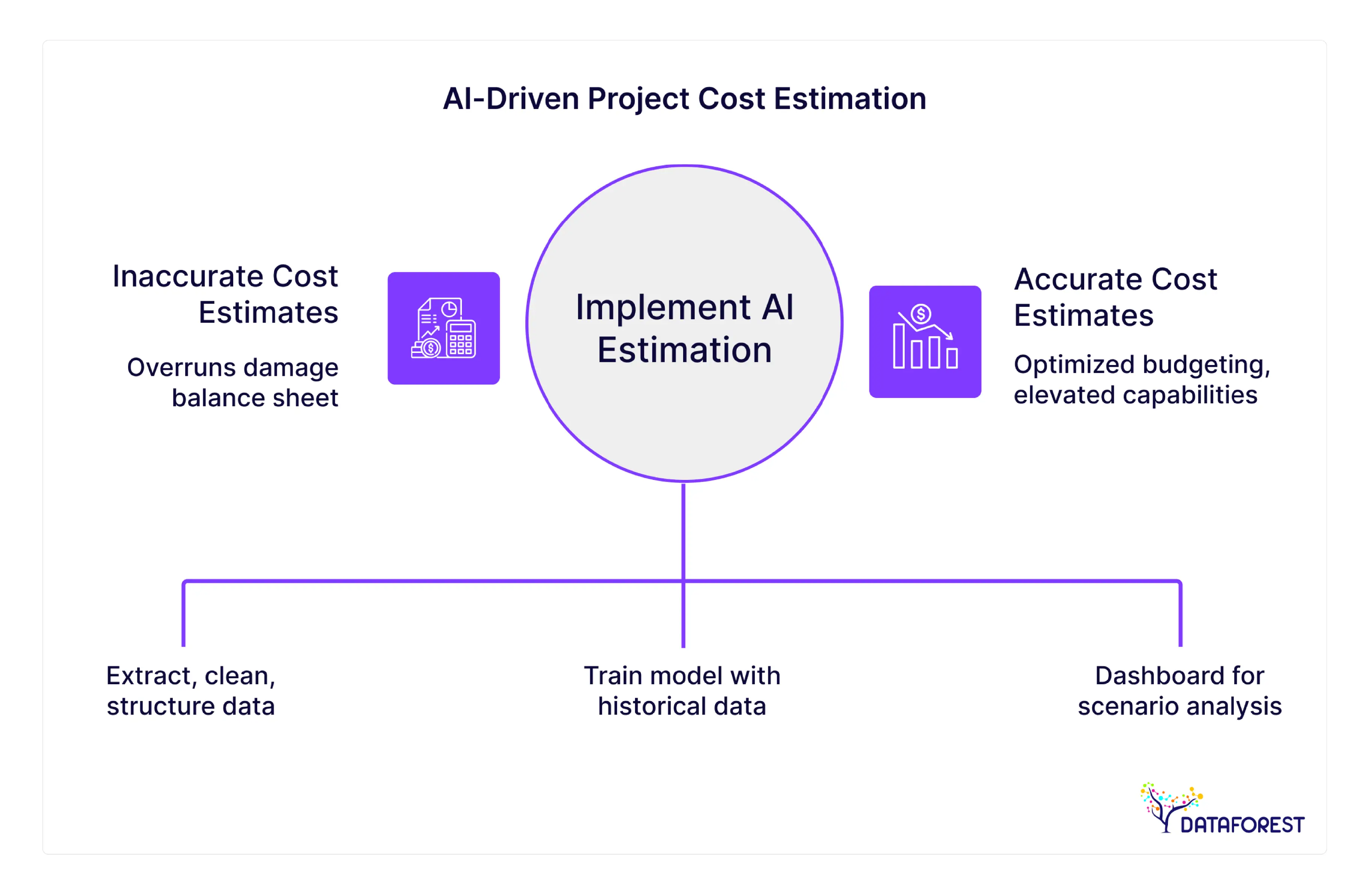
AI is useful because it can operate across those weaknesses simultaneously: extracting patterns from historical data, standardizing decisions, updating forecasts as new signals arrive, and surfacing the factors that materially changed the estimate.
What AI-Driven Cost Estimation Actually Means in 2026
The term “AI cost estimation” is often used too broadly. In a production environment, the most reliable architecture is usually not a single model and certainly not an LLM guessing a project price from a prompt.
A mature solution can combine several layers.
Predictive Models Estimate the Numbers
Predictive AI uses statistical and machine-learning methods to identify relationships in historical data and forecast an outcome. For project estimating, the target may be total cost, labor hours, procurement spend, contingency consumption, schedule-driven cost exposure, or the probability of exceeding a threshold.
Depending on the data and use case, the modeling layer may include:
- linear or regularized regression;
- gradient-boosted decision trees;
- random forests;
- neural networks;
- time-series forecasting;
- Bayesian models;
- survival or risk models;
- ensembles that combine several predictors.
The best algorithm is not the most fashionable one. It is the model that produces reliable out-of-sample performance, behaves sensibly under changing conditions, can be monitored in production, and gives stakeholders enough transparency to act on its output.
Generative AI Improves the Interface, Not the Ground Truth
Generative AI can add substantial value around the predictive engine. An LLM can summarize the assumptions behind an estimate, retrieve relevant historical projects, explain changes in plain English, draft a bid narrative, or let an executive ask, “What are the top three drivers of our cost increase?”
But generative and predictive AI solve different problems. Predictive systems are designed to forecast numerical outcomes from structured or semi-structured data; generative models are designed to produce or transform content. Treating an LLM response as the authoritative cost model introduces unnecessary risk.
A stronger pattern is hybrid: predictive models generate the forecast; generative AI helps people interrogate, explain, document, and operationalize it.
Human Expertise Remains Part of the Control System
A project contains context that may never appear in the training data: a novel regulatory requirement, an unusual customer dependency, a supplier relationship at risk, a political constraint, a one-off design decision, or a technology the organization has never delivered before.
That is why high-stakes estimates should preserve human review. The model can detect patterns and quantify risk; the estimator, engineer, procurement lead, or finance owner decides whether the assumptions are plausible.
The objective is not “human versus AI.” It is a controlled workflow in which each side handles the work it does best.
How AI Cost Estimation Can Help Win More Bids and RFPs
In competitive procurement, the cheapest proposal is not automatically the strongest. Buyers also evaluate credibility, delivery risk, assumptions, and whether the supplier appears to understand the work.
AI-assisted estimating can improve bid performance in four ways.
1. More Estimates in Less Time
Instead of manually rebuilding the same analysis for every opportunity, a system can pre-populate labor assumptions, retrieve comparable projects, normalize historical costs, flag missing inputs, and generate scenario ranges.
That does not mean every tender can be priced “in minutes.” Complex bids still require engineering, commercial review, legal input, and supplier validation. The practical gain is that automation removes repetitive analytical work and gives senior estimators more time for exceptions and strategy.
2. Better Use of Historical Evidence
A conventional estimate may depend heavily on the experience of the person preparing it. A data-driven model can compare the current opportunity with hundreds or thousands of past work packages, provided those records are sufficiently consistent.
This can reveal non-obvious patterns such as:
- certain integrations repeatedly generating extra engineering effort;
- specific supplier categories correlating with schedule volatility;
- change-order frequency rising above a particular scope threshold;
- certain project combinations consistently consuming contingency;
- regional labor or logistics factors affecting actual delivery cost.
The result is not perfect foresight. It is a more systematic way to turn corporate memory into a forecast.
3. Defensible Risk and Contingency
Blanket contingency percentages are easy to apply but difficult to defend. A stronger system connects risk allowance to identifiable drivers.
For example, instead of presenting a flat 12% contingency, the model might show that the P50 estimate is $8.4 million, the P80 estimate is $9.1 million, and the largest sources of uncertainty are supplier lead time, steel price exposure, and commissioning labor.
That gives management a better decision surface. It also makes commercial conversations more concrete: the team can decide whether to accept the risk, transfer it contractually, hedge it, redesign the scope, or price it explicitly.
4. Faster Bid/No-Bid Decisions
Not every opportunity deserves the same estimating effort. A predictive model can support early qualification by combining expected cost, delivery complexity, available capacity, historical win patterns, and margin requirements.
That is particularly useful for enterprises handling many simultaneous RFPs. The system does not need to “decide” autonomously; it can rank opportunities and show why some deserve deeper attention.
Collaboration: One Cost Model Across Finance, Engineering, and Procurement
One of the most valuable changes is organizational rather than algorithmic.
In many companies, engineering defines quantities, procurement manages vendor prices, finance owns budget assumptions, and project managers track delivery. If each function works from a different file, disagreements are inevitable.
An AI-enabled estimating platform can sit on top of a governed single source of truth and give teams a shared model of the project. When engineering changes a specification, procurement and finance can immediately see the expected cost effect. When a supplier quote changes, the forecast can be recalculated without rebuilding the entire estimate.
This turns cost estimation from an isolated pre-project activity into a cross-functional decision system.

Four Business Benefits of AI-Assisted Cost Estimation
Speed: Shorter Estimating and Planning Cycles
The most immediate benefit often comes from automation around data collection, normalization, comparison, and scenario generation.
For example, an engineering organization may spend days consolidating rate cards, historical work packages, supplier quotes, and scope assumptions before an estimator can even begin analysis. A well-integrated system can perform much of that preparation through workflow automation and route only exceptions to specialists.
The relevant KPI is not a generic promise such as “weeks to minutes.” It is estimate cycle time before versus after implementation, measured for comparable project types.
Accuracy: Better Forecasts Through Continuous Learning
Machine learning can improve forecasting when the business has a repeatable relationship between project features and actual cost outcomes.
The key is validation. The organization should compare the AI model not only with actual project results but also with its existing estimating baseline.
Useful error metrics include:
- Mean Absolute Error (MAE);
- Root Mean Squared Error (RMSE);
- Mean Absolute Percentage Error (MAPE), where the denominator is appropriate;
- Weighted Absolute Percentage Error (WAPE);
- percentage of projects completed within a defined estimate band;
- calibration of prediction intervals such as P50 and P80.
An AI model that looks sophisticated but does not outperform the current baseline on unseen projects is not yet a business improvement.
Transparency: Exposing the Drivers Behind the Forecast
Explainability matters because a forecast has to be actionable.
NIST’s work on explainable AI emphasizes that explanations should provide reasons or evidence, be meaningful to the intended user, and accurately reflect the system’s process. In cost estimation, that can translate into feature-level explanations such as:
- labor rate change: +$180,000;
- supplier substitution: −$95,000;
- expected schedule slippage: +$140,000;
- scope complexity: +$220,000;
- logistics route change: +$60,000.
Not every model is inherently explainable, and an explanation is not proof that the model is correct. But a well-designed system should make it possible to investigate why the number changed rather than asking users to trust a black box.
Control: Re-Forecasting as the Project Evolves
The initial estimate is only one point in the project lifecycle.
Once delivery begins, actual labor, procurement events, scope changes, schedule variance, and supplier performance can be fed back into the model. The system can re-estimate expected cost at completion and alert the team when the risk profile changes.
This is where predictive cost analysis becomes especially valuable: management can intervene while there is still time to influence the outcome.
How AI-Powered Cost Estimation Works
1. Data Collection and Integration
The foundation is historical and operational data.
Typical sources include:
- ERP and accounting systems;
- procurement and supplier data;
- CRM and opportunity records;
- project-management platforms;
- time tracking and resource planning;
- bills of quantities;
- BIM or CAD metadata;
- work-breakdown structures;
- scope and change-order histories;
- commodity and labor indices;
- logistics and lead-time data;
- actual cost at completion.
The difficult part is rarely “getting AI.” It is making these datasets consistent enough to train and operate a reliable model.
That usually requires entity matching, unit normalization, missing-value treatment, taxonomy alignment, duplicate removal, and clear definitions of what each cost field means.
2. Feature Engineering and Cost-Driver Design
Raw data does not automatically become useful input.
The team needs to convert project characteristics into features that represent the economics of delivery. These may include project size, location, material mix, complexity, resource seniority, number of integrations, supplier concentration, expected duration, change-order history, regulatory burden, or schedule criticality.
Domain experts are essential here. A mathematically predictive variable may still be inappropriate if it leaks information that would not have been known when the estimate was made.
3. Model Training and Baseline Comparison
Data scientists then train candidate machine learning models and validate them on projects the model did not see during training.
A common mistake is to celebrate a low training error. The real test is whether the system performs well on new work.
The organization should compare:
- the current manual or rules-based baseline;
- one or more statistical benchmarks;
- candidate ML models;
- the final production model.
The production model should earn its complexity.
4. Uncertainty Estimation
A single-number forecast creates false precision.
Executives often need a range: a central estimate, an expected downside, and the probability of exceeding the approved budget.
Depending on the use case, that can be produced through quantile regression, Bayesian methods, conformal prediction, Monte Carlo simulation, bootstrapping, or other uncertainty techniques.
The method matters less than the discipline: show decision-makers the uncertainty instead of hiding it behind one precise-looking number.
5. Integration Into the Estimating Workflow
A useful model should not require users to leave their existing process and become data scientists.
The prediction layer can be exposed through:
- an estimating dashboard;
- APIs inside ERP or project-management systems;
- a bid-management application;
- a procurement workflow;
- a conversational interface;
- scheduled forecast reports;
- exception alerts.
This is where data science-as-a-service and application engineering meet operational design.
6. Monitoring and Retraining
A model that performed well at launch can deteriorate.
Labor rates move. Supplier behavior changes. Project mix shifts. New regulations appear. An organization starts delivering a different class of work. This is model drift, and production ML platforms now treat monitoring as a standard part of the lifecycle.
Teams should monitor:
- input-data quality;
- feature distributions;
- prediction distributions;
- forecast error once actuals arrive;
- feature-attribution drift;
- outlier frequency;
- model latency and availability;
- approval overrides by human estimators.
Retraining should be triggered by evidence, not by an arbitrary calendar alone.
Industry Use Cases
Construction and Engineering
Construction has some of the clearest applications because estimating combines structured quantities with volatile prices and schedule risk.
AI can support:
- early-stage conceptual estimates;
- quantity and cost classification from BIM data;
- bill-of-quantities normalization;
- material-price forecasting;
- productivity estimation;
- bid comparison;
- change-order risk;
- cost-to-complete forecasting.
Research through 2025–2026 continues to show strong interest in ML and AI for construction cost estimation, including BIM-based methods, ensemble models, NLP classification, and uncertainty-aware prediction. The most important practical lesson is that performance depends heavily on the quality, consistency, and representativeness of the underlying project data.
For related applications, see DATAFOREST’s blog post about AI in the construction industry and its coverage of making construction cost estimation AI practical in project delivery.
Manufacturing
Manufacturers can apply AI to quote and forecast the cost of parts, assemblies, product variants, and production programs.
Inputs may include:
- geometry;
- material;
- tolerances;
- machine time;
- setup time;
- tooling;
- scrap rate;
- batch size;
- energy consumption;
- supplier cost;
- routing complexity.
For repeatable manufacturing categories, ML can help standardize quoting and reduce dependence on manual expert lookup. Explainability is especially useful when engineers need to understand which design characteristics are driving cost.
IT and Software Development
Software estimation is difficult because scope is intangible and delivery effort depends on architecture, integrations, team capability, technical debt, testing, and requirement stability.
AI can help by analyzing historical delivery data such as:
- epic and story characteristics;
- actual effort;
- defect history;
- integration count;
- team composition;
- rework;
- change frequency;
- deployment constraints.
The model should not be treated as a substitute for technical discovery. Its value is in identifying patterns, benchmarking assumptions, and quantifying uncertainty around delivery scenarios.
Financial Services and Other Regulated Industries
In finance, AI is employed to predict the cost and risk of complex initiatives; in banking, insurance, healthcare, and other regulated environments, major transformation programs may combine technology, compliance, data migration, vendor management, and organizational change.
AI-assisted estimation can help forecast the cost of large implementation programs and compliance work, but governance requirements are higher. Data lineage, access control, model documentation, auditability, human approval, and risk-management processes become part of the solution rather than optional add-ons.
Can AI Cost Estimation Support Sustainability and ESG Decisions?
Yes, but only if the organization has reliable non-financial data.
A cost model can be extended to evaluate trade-offs involving emissions, energy use, waste, supplier characteristics, transport routes, or material choices. For example, a scenario engine could compare two sourcing options on both direct cost and estimated carbon impact.
The important distinction is that financial cost and ESG metrics should not be collapsed into a single opaque score unless the weighting methodology is explicitly defined. Decision-makers need to see what changed, which assumptions were used, and how each metric contributed to the recommendation.
Enterprise Implementation Roadmap
A practical artificial intelligence in cost estimation roadmap should begin with the business decision to improve, then move through data readiness, baseline measurement, controlled validation, workflow integration, and production monitoring.
Phase 1: Define the Decision You Want to Improve
Do not start with “we need AI.”
Start with a specific decision such as:
- reduce error in conceptual estimates;
- shorten tender preparation;
- predict cost at completion;
- improve contingency sizing;
- identify high-risk bids earlier;
- standardize quoting across regions.
That decision determines the target variable, required data, model design, and success metric.
Phase 2: Audit Data Readiness
Map the data needed to reconstruct historical estimates and compare them with actual outcomes.
Questions to answer include:
- Can we identify comparable historical projects?
- Do estimates and actuals use consistent cost categories?
- Can scope changes be separated from estimating error?
- Are timestamps available?
- Do we know which information was available at the moment of estimation?
- Are supplier and labor rates traceable?
- Is the data legally and operationally usable?
This phase often exposes more value than expected because it reveals process inconsistencies even before a model is built.
Phase 3: Establish a Baseline
Measure current performance before introducing AI.
For example:
- median estimate cycle time;
- MAE or WAPE;
- percentage of estimates within ±10% of actual;
- average contingency utilization;
- overrun frequency;
- bid-to-win ratio;
- number of bids per estimator.
Without a baseline, ROI becomes anecdotal.
Phase 4: Build a Narrow Pilot
Choose one repeatable project family, region, product line, or work package.
A pilot should be large enough to test the economics but narrow enough to control for variability. Compare the model with the existing process on historical holdout data and, where possible, in a shadow-production period before it affects live commercial decisions.
Phase 5: Integrate and Add Human Approval
Connect the system to the workflow where estimates are created and reviewed.
Define:
- who can generate an estimate;
- who can override it;
- which inputs are editable;
- which scenarios require approval;
- when the system must refuse to predict because data is outside its training range;
- how overrides are logged.
This is the difference between a demo and an enterprise tool.
Phase 6: Monitor, Recalibrate, and Expand
Once the pilot is stable, add new project classes gradually.
Monitor both technical and business KPIs. A statistically accurate model can still fail operationally if users do not trust it, data arrives too late, or the forecast is not connected to a decision.
Measuring ROI Without Inventing a Universal Payback Period
There is no credible fixed statement that an AI estimating system “pays back in six months” or “reaches accuracy ROI in 12–24 months” across industries. Payback depends on project volume, current error, margin exposure, implementation cost, data readiness, and how much of the workflow can actually be automated.
A better ROI framework uses measurable business deltas.
Forecast Accuracy
Track the difference between estimated and actual cost for comparable work.
Use consistent error metrics and separate genuine estimating error from approved scope changes whenever possible.
Estimate Cycle Time
Measure the elapsed time from sufficient scope input to an approved estimate.
This captures productivity gains from automation, data retrieval, and scenario generation.
Overrun Frequency and Severity
Track how often actual costs exceed approved thresholds and by how much.
For capital-intensive projects, even a small improvement can have substantial value.
Bid Performance
Measure:
- bid/no-bid decision time;
- proposals completed per period;
- bid-to-win ratio;
- realized margin versus quoted margin.
Do not assume that more accurate estimates automatically increase win rate. They may instead help the company avoid underpriced work, which can be equally valuable.
Estimator Productivity
Measure how much high-value work estimators can handle after repetitive data preparation is automated.
The objective is not simply headcount reduction. It can be greater throughput, more scenario analysis, stronger risk review, or more time spent on complex opportunities through disciplined workflow optimization. Well-designed back office automation can remove repetitive preparation work without removing expert accountability.
Working Capital and Contingency Efficiency
More reliable uncertainty ranges can help management avoid both under-reserving and excessive “just in case” capital allocation.
The financial value should be calculated using the company’s own cost of capital and risk policies rather than a generic benchmark. Relevant case studies can help frame implementation patterns, but the ROI case should still be built from the organization’s own baseline.
Common Failure Modes
Poor Data Quality
The familiar “garbage in, garbage out” rule still applies.
If historical projects use inconsistent naming, costs are coded differently by region, scope changes are mixed into baseline estimates, or actuals are incomplete, a model may learn the organization’s data problems rather than the economics of its projects.
Data Leakage
Leakage occurs when the model is trained on information that would not have been available at the time of the estimate.
For example, using final change-order count to predict the original bid cost can produce impressive historical accuracy and useless real-world performance.
Time-aware validation is essential.
Black-Box Adoption
A model can be technically accurate and still fail if commercial teams cannot understand when to trust it.
Explainability, confidence ranges, comparable-project retrieval, and clear escalation rules improve adoption.
Automation Without Guardrails
A prediction should not automatically become a price, contract commitment, or procurement decision unless the workflow has explicit authorization rules.
For high-value decisions, require human approval and preserve an audit trail.
Model Drift
A model trained during one cost regime may become less reliable after major shifts in labor, materials, regulation, or project mix.
Production monitoring should detect these changes before the model quietly degrades.
Overfitting a Small or Narrow Dataset
There is no universal minimum such as “50–100 projects” that guarantees a useful model.
Required sample size depends on feature count, noise, project heterogeneity, model complexity, and how similar future projects are to the historical dataset. In some narrowly standardized environments, a modest dataset plus strong domain features may be useful. In highly heterogeneous portfolios, hundreds or thousands of records may still be insufficient.
Best Practices for a Production-Grade System
- Solve one estimating decision first. A narrow use case creates a cleaner target and a more interpretable ROI case.
- Preserve the existing baseline. The AI model should beat a real benchmark, not a straw-man spreadsheet.
- Use time-aware validation. Train on the past and test on later projects to better approximate production conditions.
- Separate estimate error from scope change. Otherwise the model may be punished for work that was never in the original scope.
- Return ranges, not false precision. Decision-makers need uncertainty as well as a point forecast.
- Make explanations role-specific. A CFO, estimator, engineer, and procurement lead do not need the same explanation.
- Log human overrides. Overrides are valuable feedback for retraining and governance.
- Monitor data and model drift. Production ML is a lifecycle, not a one-time deployment.
- Keep generative AI grounded. If an LLM explains an estimate, it should retrieve the actual model inputs and outputs rather than inventing rationale.
- Design governance before scale. Access rights, approval thresholds, audit logs, model ownership, and rollback procedures should exist before the tool influences major commitments. When selecting an implementation partner, use evidence such as delivery experience, technical capabilities, and the company’s About Us page as part of due diligence rather than relying on AI claims alone.
The Next Stage: Predictive Models, Generative Interfaces, and Controlled AI Agents
The future of project cost estimation is unlikely to be one giant model.
A more realistic architecture is modular.
Predictive models forecast cost and risk. Optimization engines compare alternatives. Generative AI explains assumptions and prepares decision materials. Retrieval systems find similar projects and supporting evidence. Workflow agents and generative agents can collect quotes, request missing information, update scenarios, and route exceptions to the right person.
The most valuable agent will not be the one that autonomously “sets the price.” It will be the one that compresses the analytical workflow while staying inside clear authority boundaries.
Imagine a project director asking:
“Re-estimate the program using the latest supplier quotes, assume a six-week delay in commissioning, keep the P80 budget below $25 million, and show me the three changes with the highest cost-reduction potential.”
A mature system could retrieve approved data, run the predictive model, test scenarios, explain the trade-offs, and prepare a recommendation. But the final commercial decision would remain controlled, reviewable, and auditable.
That is a far more useful vision than replacing professional judgment with a chatbot.
From Reactive Budgeting to Predictive Cost Control
The real value of AI in project cost estimation is not that it produces a more impressive spreadsheet.
It is that it changes when and how the organization sees risk.
Instead of discovering a cost problem after monthly reporting closes, teams can identify the drivers while there is still time to respond. Instead of relying on one expert’s memory, they can use the organization’s historical delivery data systematically. Instead of arguing over disconnected files, finance, engineering, procurement, and project leadership can work from the same cost model. And instead of presenting a precise number with hidden uncertainty, management can make decisions using ranges, scenarios, and explicit assumptions.
The practical starting point is straightforward: choose one high-value estimating decision, establish the current baseline, audit the data needed to reproduce it, and test whether a model can outperform the existing process on unseen projects.
If the economics are there, scale from evidence rather than ambition.
DATAFOREST can help organizations assess data readiness, integrate fragmented project information, build and validate predictive models, and turn them into production systems with explainability, monitoring, and human controls.
Frequently Asked Questions
How does AI improve project cost estimation accuracy?
AI can improve accuracy by identifying relationships across historical project data, current cost drivers, and operational signals that are difficult to evaluate manually at scale. The improvement should be demonstrated against the organization’s existing estimating baseline on unseen projects, not assumed in advance.
Is generative AI enough to estimate project costs?
Usually not. Generative AI is useful for document analysis, conversational access, explanation, and workflow automation, but numerical forecasting is better handled by validated predictive or statistical models. A hybrid architecture combines the two.
How much historical data is needed?
There is no universal minimum. The answer depends on how standardized the projects are, how many variables affect cost, how noisy the data is, and what accuracy the business requires. Data quality, relevance, and consistent definitions often matter more than raw record count.
Can AI integrate with ERP and project-management systems?
Yes. Production solutions commonly use APIs, data pipelines, or event-based integrations to read inputs from ERP, procurement, CRM, and project-management systems and return forecasts or alerts to the tools employees already use.
How should companies measure AI-estimation accuracy?
Use out-of-sample evaluation and compare the model with the current baseline. MAE, RMSE, WAPE, and percentage-within-tolerance measures are common options. For risk-aware estimating, also evaluate whether prediction intervals such as P50 and P80 are properly calibrated.
What are the main risks?
The major risks include poor data quality, leakage from future information, model drift, weak explainability, overfitting, automation without approval controls, and applying the model to project types outside its training domain.
Should AI estimates replace human estimators?
No. AI is most effective as decision support: automating repetitive analysis, identifying patterns, quantifying uncertainty, and highlighting risk. Human experts remain responsible for context, exceptional conditions, strategic judgment, and commercial approval.
Can the model keep learning after deployment?
Yes, but “continuous learning” should be governed rather than automatic. Teams should monitor model quality and drift, collect new actual outcomes, review human overrides, and retrain or recalibrate when evidence shows that performance is changing.

.svg)
.webp)
.webp)
.webp)


