

In the modern enterprise, moving at breakneck speed, the delay from customer conversation to system update is a silent revenue killer. For decades, business’s “voice layer” (calls with prospects, candidate screenings, support triage) has clung stubbornly to the mast while the rest of it got connected to CRM and ATS systems: the “data layer.” Knowledge is locked in the audio files or it depends on fragile memory to convert and type from human worker's end into uniform fields. This disconnect is no longer tenable.
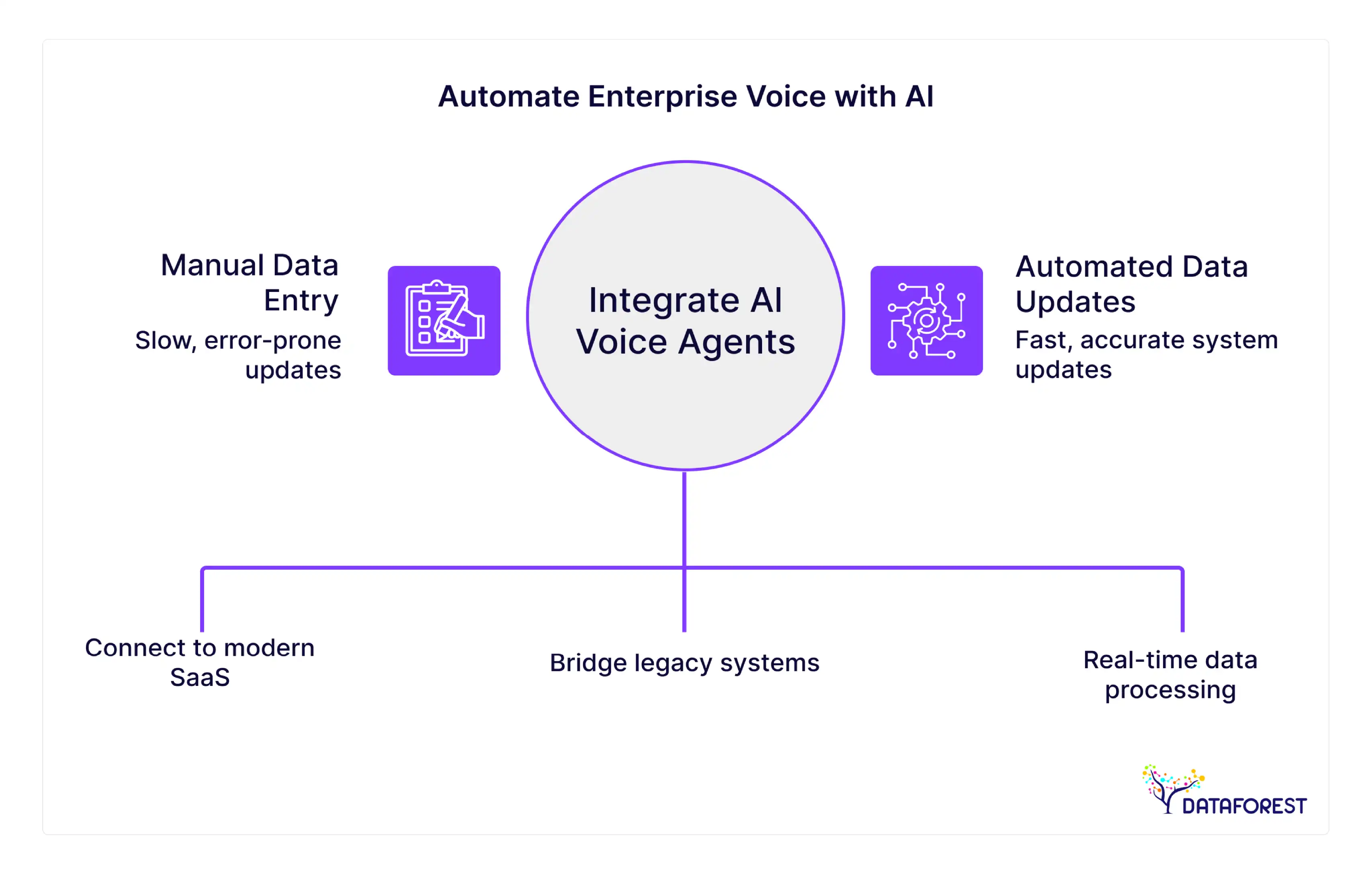
As we progress through 2026, the culmination of Large Language Models (LLMs) and ultra-low latency voice synthesis has resulted in a new tool that Speaking is Silent: AI Voice Agents. These aren’t the brittle, keyword-spotting IVR trees of yore. They are dynamic digital workers who understand the context to respond to complex negotiations, update systems of record on the fly, and run workflows with minimal human intervention.
Now that management and IT architecture must consider voice automation, it’s no longer a matter of whether to think about how they architect the integration when considering data security. This look will provide a technical and strategy roadmap to deploy AI voice agents integration with crm systems and Applicant Tracking Systems (ATS) beyond shiny object syndrome to operating arbitrage.
The Operational Imperative: Why Enterprise Must Take Voice AI Seriously
The contemporary institution leaks a unique kind of data. That’s why logging calls and updating CRM fields is typically a sales rep’s least favorite task. In recent industry analysis by McKinsey and others, it has been estimated that sales reps spend more than 70% of their time in administrative overhead—leaving less than 30% to do what they’ve been hired to do: SELL! Friction in recruitment automation is even worse; as many as 60% of candidates drop out of an application process because they’re fed up with poor communication or scheduling that’s too slow.
Integrating an AI voice agent on crm infrastructure addresses two important variables: Volume and Velocity.
- Volume: The Cognitive capacity of human agents is limited. An AI-powered voice assistant can simultaneously field thousands of calls— whether it’s to qualify leads or screen candidates — without compromise in tone or accuracy.
- Speed: The mix enables the exchange of data in real time. The second a potential customer says, ‘We only have X budget,’ or someone says, ‘I do have certification Y,’ it’s in the database.
This is not just about exchanging headcount; it’s about lifting the humans up to manage high-value deviations while the AI calling agents deal with the truck stop that is standard friction of voicemail and any data hygiene cleanup. Companies such as DATAFOREST are already leading the way in this area by enabling companies to move from manual logging to automated intelligence.
What AI Voice Agents Do, and Don’t Do
To grasp the integration architecture, let's first demystify what the agent can do. A voice agent in today’s world is a stack of three different technologies that work in near-real-time (it’s not uncommon to have latency below 500ms), and is entirely different from the “robotic” forerunners that we all remember from the 2010s.
Features at a Glance: Identification, Comprehension, Reasoning, and Application, Performance
- Automatic Speech Recognition (ASR): The system’s ‘ears’. It converts raw audio streams to text with remarkable accuracy, accounting for accents, breaks, and background noise. Looking forward, ASR in the future won’t simply transcribe (nor will speakers answer questions like a laboratory), but speaker diarization (going further to indicate who speaks when) is of crucial importance so that data can be properly assigned within your CRM.
- Natural Language Understanding (NLU): The “brain of the system.” It processes the transcribed text to understand intents (like, 'I want to reschedule') and to extract entities (like 'Next Tuesday at 2 p.m.'). This is where the magic of Generative AI takes over, and the system understands nuance and slang.
- Agent Logic & TTS (Text-to-Speech): The agent looks up its logic passes or Knowledge Base, generates a response, and speaks it back to the other user.
The "Decision-Making" model that queries the CRM or ATS to personalize content is all integrated into a system. It doesn’t guess; it knows the client’s history.”
What Makes Today’s Voice AI Different from Old-School IVR
Traditional IVR (Interactive Voice Response) systems present a deterministic tree to the user. If the user strays from the menu ("Push 1 for Sales"), the system fails.
AI voice agents are probabilistic and conversational. They use Generative AI to navigate non-linear chats.
- For instance, if a user asks a technical recruiting bot ‘How is the company culture’ during a tech screening, the bot can pivot and answer based on that organization’s Knowledge Base and then continue with the screening questions.
- For example, in a sales situation, if the prospect challenges pricing, the agent can pull up a competitor comparison card from CRM and counter-argue with approved enablement content instead of simply sending it to voicemail.
Why Voice AI Should be Combined with CRM and ATS
The real ROI of AI voice agents comes when they are integrated tightly into systems of record. Standalone voice bots are novelties; integrated agents are growth machines.
Removing the Burden of Manual Data Entry and Communication Bottlenecks
Reducing administrative drag is the main reason for CRM workflow automation. If it’s a human sales rep who hangs up the phone, they’re looking at 5 to 10 minutes of writing notes, defining a follow-up task (when there is one), and updating deal stages. This is what an AI agent does. All post-call work (ACW) is scaled to a value of zero.
In high-volume hiring, ATS workflow automation with AI eliminates the bottleneck of “phone tag.” An agent can dial 500 candidates in 10 minutes to screen interest and book interviews directly into platforms like Greenhouse, Lever, or a custom solution, either built with Custom Software Services, effectively deploying a voice assistant for applicant tracking system workflows.
Real-time Enrichment of Customer/Candidate Profiles
Data rot is a huge liability.” Auto-dialing CRMs will also make sure each call is one step closer to a more complete profile.
- Sentiment Analysis: The agent can annotate the lead as “skeptical” or “enthusiastic" in the CRM custom fields, given acoustic cues and lexical choice.
- Objection Mapping: If 40% of your leads say “implementation time” is blocking them, the AI records that as structured data, making it possible for the Product teams to understand high-level why lost deals are being lost in real-time.
Strengthening Analytics and Decision-Making
When an integrated AI voice agent with CRM strategy is executed, the Voice becomes a system of record. This unlocks advanced analytics. Management can shift from monitoring “Calls Made” (a vanity metric) to “Conversations Completed” and “Qualifying Questions Answered.” This then feeds into higher-level Decision Support Systems, where leadership can more accurately forecast pipeline velocity.
Integration Models and Architecture Overview
For the enterprise, voice AI integration is not a plug-and-play process, but rather one that demands stringent architectural planning. DATAFOREST generally provides three key integration models that it focuses on for the clients.
API-Based and Webhook-Based Connectivity
That's the norm in the world of modern SaaS ecosystems (e.g., Salesforce, HubSpot, Zoho).
- Trigger: The CRM triggers the outbound call through an HTTP POST to the voice agent platform (e.g., when lead status is changed to "New").
- Sync: Payloads are sent to the CRM API to update fields via Webhooks by the voice agent during or after the call.
Latency note: A websocket is superior for real-time CRM updates (and hence faster Agent Experience) compared to polling REST APIs, allowing the agent to pull customer context ("Last Purchase Date") the millisecond you connect the call.
Middleware & Custom Connectors to the Legacy Systems
A lot of businesses still run on premises ERPs or highly customized legacy CRMs (like your old Oracle or SAP instances). API integration directly here may not be advisable or doable without any middleman.
- Solution: A middleware layer, a custom-built microservice by Experts in API System Integration, designed as a translator. The voice agent is talking JSON, which the middleware translates into SOAP or SQL queries that the legacy system can comprehend.
Architecture Overview: ASR - NLU - Agent Logic - CRM/ATS
An optimized integration architecture appears as follows:
- Telephony Gateway: The call is received by SIP Trunking (Twilio/Vonage).
- Stream Processor: Audio is split. One stream for the user, one for the AI.
- Orchestrator: The AI asks the CRM model, “Who is calling? Do we have an open ticket?”
- CRM Response: (take two): “This is John, open ticket #90210.”
- Agent Logic: Richard the AI generates a greeting: “Hi John, is this about ticket #90210?”
- Post-Call: The transcripts, summary, and action items are pushed back to the CRM.

Enterprise Use Cases
Some of the most common uses for AI call automation for CRM cover the full range of customer and employee lifecycles. We have a lot of interest in Retail, Healthcare & Fintech, and are well disciplined in targeting how we get the performance numbers for these target clients.
Use Cases Customer Flyer use cases are organized into the following four categories.
Lead Qualification Automation:
ACME campaign delivers thousands of leads. An automated calling system CRM integration allows the software to make new lead calls immediately, assess BANT (Budget, Authority, Need/Problem, and Timing) qualities, and record them into the Lead Score. Not all of them will have the budget. In short, these leads are only passed on to human closers.
- Reference: Check out Real-time AI voice agent for a cold calling case study that explores how to use automated outreach as a way to scale lead gen without scaling headcount.
Automated Follow-up Calls:
Post-demo, or post-purchase check-ins, fall by the wayside. Hello, just want to make sure you got the proposal we sent yesterday? If the client agrees, the agent moves the deal to a Deal Stage of "Negotiation."
Conversational AI for Sales Summarization:
Rather than agents transcribing notes, the AI voice agent listens to the call dialogue, parses words extracted as key commitments ("Client committed that signing would occur by Friday"), which adds a Task in your CRM for the Account Executive.
ATS-Focused Use Cases (Recruitment)
Screening and Filtering:
AI voice bot for recruiting screens candidates with “knockout” questions: Do you have a work visa? Or “Are you immediately available? This voice workflow automation rejects 40-50% of unqualified candidates before a CV ever passes the eyes of a recruiter.
Scheduling Coordination:
The agent looks at the recruiter’s calendar through the ATS integration. "I am looking at hiring manager Sarah and see she has an open slot on Tuesday at 2 p.m. Does that work for you?" If confirmed, it will send an automated calendar request and change the status of the candidate in the ATS.
Candidate Updates:
Automated candidate outreach to keep applicants warm. "We have yet to reach a decision for you. Come check back in 48 hours." This does wonders for the employer brand.
Cross-Department Automation and Analytics
It is applicable to finance (collections) and operations. For example, when you add Voice Agents to ERP Data Integration, you can automatically ask for the vendor invoice statuses, which liberates the AP department. In addition, cross-departmental voice data analysis offers insights into systemic issues (if the word “Login Error” is being heard in Sales and Support calls, it's a product emergency).
Common Problems and How tp Fix Them M
The potential of AI voice agents is massive, but their road to realization includes understanding and overcoming various technical challenges, including seamless AI voice bot integration.
Data Quality and Legacy Infrastructure
An AI agent is as smart as the data it sees. The AI-powered voice assistant will hallucinate or give wrong information if your CRM is overwritten with doppelgangers or out-of-touch fields.
- Solution: Clean and structure data through Data Pipeline & ETL Intelligence audit, before deployment.
Security and Compliance Considerations
Voice data is biometric data. In regulated industries (Finance, Healthcare), voice recording and its processing involve strict compliance with GDPR, CCPA, and HIPAA.
- Answer: N1xEAI doesn’t have a perfect answer; unfortunately, voice agent onboarding in CRM, including PII redaction (automatically silencing or scrubbing credit card numbers from transcripts) and secure, encrypted storage.
Adoption and Change Management
The sales automation tools are often regarded as a threat by the sales force.
- Solution: Frame the AI calling agents as “Junior Associates” to take care of the grunt work (cold calls, data entry) and leave big deals for senior reps. Show them the bump in commission checks they receive as a result of having better lead qualification automation.
The Role of DATAFOREST in Enabling Enterprises to Deploy Voice AI
Here at DATAFOREST, we don’t believe in cookie-cutter bots. We are experts in custom data science and AI that fit the unique challenge of your enterprise architecture.
Custom AI Agent Development
Gen-AI Integration -We use Gen AI Integration to create dynamic agents that know your industries' lingos (It is not only for the legal industry; they also work for medical or complex engineering. AI Agent Development: Both our emphasis on and the process of AI agent development guarantee that the voice fits your brand - authoritative for finance, empathic for healthcare.
End-to-End CRM/ATS Integrations
We have years of experience with Data Integration, so we can connect the dots between state-of-the-art voice models (e.g., OpenAI’s Realtime API or custom voice models) and your existing system. Whether you are powered by Salesforce, Bloomfuse from HubSpot, Bullhorn, or Custom Agentic AI for Financial Advisors, we pipe it up, providing secure data pipelines, making data flow.
Analytics Enrichment and Workflow Automation
And we don’t just dump transcripts into your CRM. We leverage a Natural Language Processing Service to get our structured data, sentiment trends, and actionable insights from your voice interactions. Read more of our thoughts on The Future of Business CRM Data Integration for further insights on this topic.
The next enterprise standard: Voice AI
The honeymoon period for the “early adopter” advantage is ending. AI voice agents will become the de facto standard interface to Tier-1 support and Sales prospecting by 2027.
Competitive Advantage for Early Adopters
Those companies that are able to successfully incorporate these AI voice agents with CRM pipelines today are resulting in a decreased Customer Acquisition Cost (CAC) by 30% and an accelerated pipeline velocity. They are compelling heads of the leads class, while their competition is still pecking out emails.
What Companies Ready to Integrate Should Do Next
- Take stock of your workflows: Recognize high-volume, repetitive phone exchanges.
- Scrub the Data: Make sure that you are able to connect your CRM/ATS to an API.
- Collaborate with experts: Voice AI is difficult. With a partner such as DATAFOREST, you are one step ahead of latency and out-of-memory errors.
Ready to upgrade your communication?
Schedule a consultation to talk about your voice automation game plan.
FAQ
What does an AI voice agent mean for the workload and HC planning of huge organizations?
AI voice agents are a force multiplier, not a direct replacement. They are handling the high-volume, low-complexity tasks (Tier 1 customer support, lead prequalification/initial qualification calls, and qualification calls confirmations) that amount to 40-60% of an individual’s time. This also frees up the human to focus on higher-value, complex problem-solving and relationship creation. For headcount planning, this typically entails slowing the recruiter ramp for generalist positions but increasing productivity per recruiter.
Can AI voice agents use this type of sensitive or regulated communications (banking, medical, legal)?
It is, but this needs some customising. – Deploy AI voice agents at the enterprise level in HIPAA and SOC2 environments. They can be configured to stop recording during the transmission of sensitive information (for example, credit card entry in PCI-DSS) and apply PII (Personally Identifiable Information) redaction algorithms to transcriptions before they are sent off to CRM storage.
What are CRM/ATS data fields that should/could be required for a working AI voice agent integration?
The agent requires read/write access to the following major fields in order to work:
- Identification – Name, PhoneNumber, ComP/CandID.
- Context: Stage of the Deal, Status of the application, Date last contacted.
- Result: Call Disposition ('Left Voicemail', 'Qualified'), Next Actions, Short Notes.
- Custom Fields: Sentiment Score, Objection Type, Qualification (For Example, "ATG Visa Status").
Can an AI voice agent initiate CRM workflows, automations, and pipelines in the same way as a human user?
Absolutely. That is the crux of what CRM workflow automation offers. For example, you might use a resource to API triggers or webhooks for an AI agent to change a Lead Status from “New” to “Qualified,” which in turn can trigger internal automation sequences—sending of such a confirmation email, setting of tasks for sales reps, moving of potential candidates to the “Interview” stage in an ATS.
What are the limitations for companies trying to expose their AI agents to legacy, heavily customized CRM instances?
Legacy systems supported by weaker REST APIs or slower real-time webhooks are often slower in processing than SOAP Protocols / Batch Processing. This introduces latency. Similarly, very-custom CRMs may use non-standard data structures that out-of-the-box AI connectors can not even map. Custom API Development and middleware. If the answer is yes, you’ll need a way to connect the modern AI agent with older database systems.
How does an AI voice agent manage CRM permissions, user roles, and access control?
The integration just uses a special "API User" or maybe "System User" role in CRM, which is scoped for usage there. This way, the AI agent is only able to see what it needs to know in order to perform its function (least privilege principle), and cannot accidentally delete records or gain access to any unauthorized sensitive data. It is this User ID under which the AI performs all of its actions, so that everything can be traced in the logs later.
Can an AI voice agent write back to CRM/ATS in real time, or is it necessary to have batching/synchronization windows?
Modern integrations are predominantly real-time. Leveraging webhooks and low-latency APIs, the agent is able to write data (like setting “Do Not Call” or logging a booked meeting) in real time as events happen during the call. Batching is considered out of place for operational workflow, but may still have a purpose when heavy analytical aggregations need to be done in the middle of the night.
How do organizations verify the correctness of CRM records created by AI agents?
Verification is performed via a “human-in-the-loop” (HITL) process during rollout, in which human monitors check some fraction of the call transcript against CRM updates. Furthermore, you can run some Natural Language Processing Service logic to detect analogies – for example, if an AI agent tags that the deal is “Closed Won,” but the Transcript sentiment is negative, then it flags this for managerial review.


.webp)
.webp)
.webp)


