


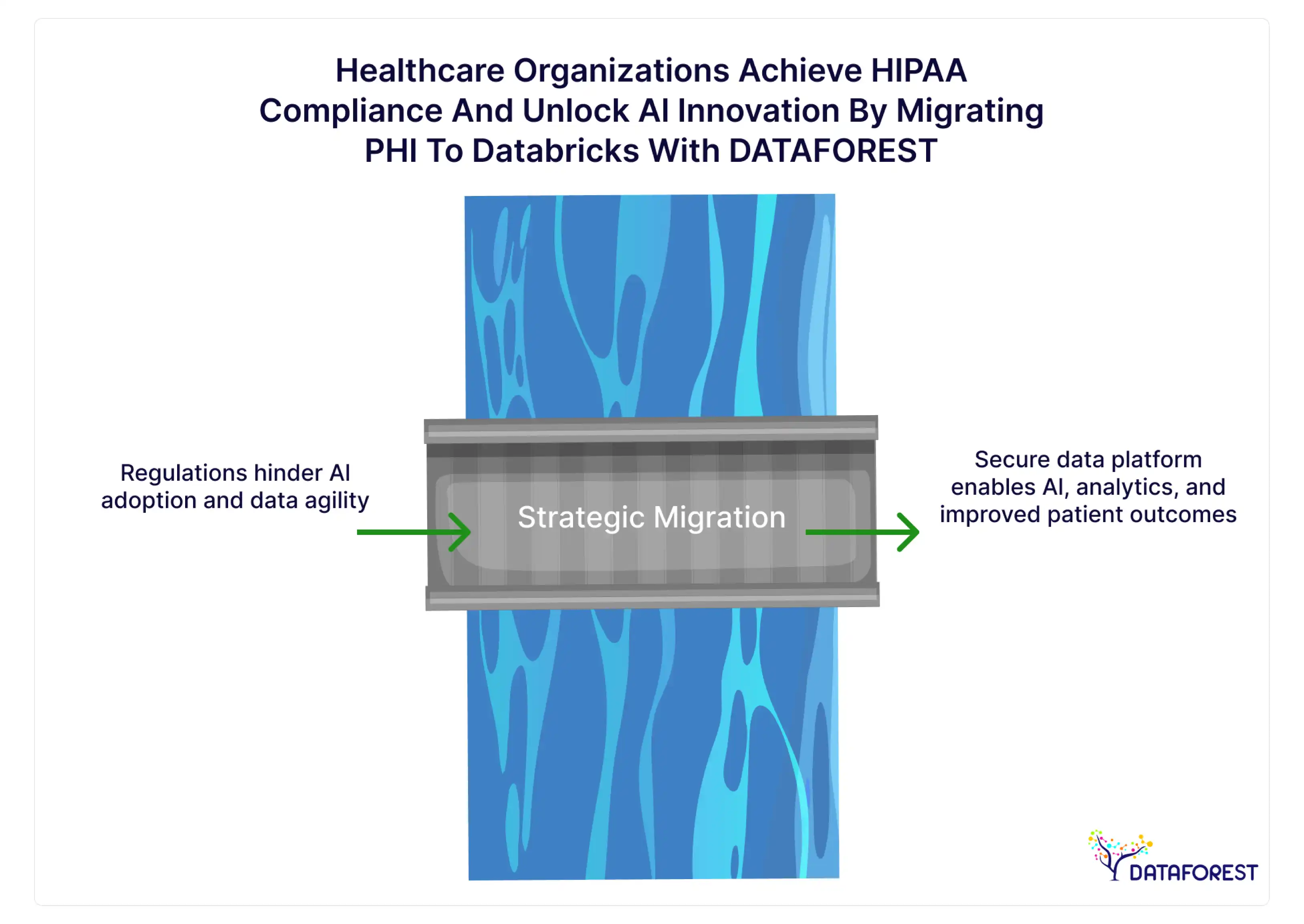
Key Takeaways: A strategic roadmap for becoming compliant with the Health Insurance Portability and Accountability Act (HIPAA) while migrating enterprise data to the cloud is essential.
Data is no longer merely a record of the past; it is the key currency for future innovation in healthcare. The answer is equally clear for C-suite executives: invest in the technology to take advantage of AI and predictive analytics, or die a slow death. But this impetus to speed-and-scale corporate transformation slams into an immovable force: regulations.
The transition of Protected Health Information (PHI) to the cloud is a critical inflection point where security weaknesses often emerge. It is the intersection where "tech debt" and legal liability collide. Moving legacy on-premises data to a modern platform such as the Databricks Lakehouse architecture delivers massive ROI gains, but one must be very surgical with security. A well-planned Databricks migration is not just about transferring workloads—it is about minimizing compliance risks while modernizing data infrastructure. The aim is not so much to move your data as to lower business and compliance risk while creating the foundation for ongoing agility.
Databricks HIPAA compliance, when done right, is not a barrier—it's a source of trust. Through a unified data platform for healthcare providers, organizations can overcome these silos without sacrificing patient privacy. This article describes a battle-tested guide to chart your course through the HIPAA cloud data migration landscape, drawn from best practices in the field and extensive architectural experience.
Migrating PHI to Databricks Without Slowing Down Digital Transformation
Speed Versus Security Dichotomy Does Not Apply to Modern Data Engineering.
The classic speed-versus-security dichotomy is a myth in modern data engineering. Healthcare organizations are often reluctant to move beyond the status quo with IT due to perceived regulatory implications during migration. Lack of movement is a double-edged sword, however: as long as you continue to run those legacy systems without patching them, any number of security issues remain ripe for exploitation.
Achieving this secure data lake requires a transition from "perimeter security" thinking to a "data-centric" security model. The HIPAA Security Rule requires various administrative, physical, and technical safeguards that apply not only after migration but also to the transportation of data.
Note: The healthcare industry has been the most expensive victim of breaches for 13 straight years, costing nearly $11 million per incident, according to a recent IBM Cost of a Data Breach Report. This is why a strong HIPAA risk assessment is the all-important first step in migration.
With the help of a cloud architecture design services pro, organizations can better practice zero-trust data migration principles. This guarantees that every byte of PHI is properly authenticated, authorized, and encrypted, making the migration pipeline itself a secure pipe for innovation.
Why Databricks Is Becoming the Core Platform for Healthcare Innovation
Top healthcare payers and providers have consolidated their tech stacks on Databricks. Why? It is precisely because the "Lakehouse" vision resolves this broken architecture problem of unwinding data warehousing from data science that has been an endemic issue throughout the industry's history.
Unified AI/ML, BI, and Governance Under One Architecture
With Databricks, organizations can handle all types of data—structured patient records, semi-structured claims data, and unstructured medical imaging—in one place. This consolidation is central to HIPAA compliance and Databricks' strategies, where governance needs to remain centralized. Instead of creating access policies for a dozen siloed databases, you create them once through Unity Catalog.
For companies building a clinical information system, taking this unified approach eases audit trails and clarifies that the same set of security policies applies whether a user is running a SQL query or training a machine learning model.
Enterprise-Grade Security and HIPAA Readiness
Speaking of PHI security requirements, Databricks has invested considerable time and resources to meet them. The service uses the shared responsibility model. Databricks is responsible for protecting the infrastructure (the interaction between compute and storage), and the customer owns the data. Capabilities such as customer-managed keys (CMK), private link connectivity, and detailed audit logs are crafted specifically to meet HIPAA cloud compliance requirements.
Scalable Data Foundations for Long-Term Transformation
Migration is economical in many ways, even after migration, because you can make the system scalable. It decouples compute from storage, enabling healthcare providers to scale computing power for intensive genomics sequencing workloads without overprovisioning and overspending. This cost efficiency in cloud migration is necessary to maintain a secure, financially sustainable Databricks governance model.
Pre-Migration Phase — Establishing a HIPAA-Ready Compliance Framework
Before a single data set is moved, the governance rails must be laid down. This is the stage that determines if the rest of your project will succeed.
Step 1 — Identify PHI and Assess Organizational Risk
You can't defend what you can't see. One common failure mode is the inadvertent movement of "shadow PHI" – meaning the hidden privacy-sensitive information in parts of text fields or unstructured notes.
- Risk-based data prioritization: Classify Data Assets by Sensitivity (Public, Internal, Confidential, Restricted/PHI).
- Discovery Scanning: Automate scanning of legacy databases for regex patterns that look like SSNs, MRNs, or insurance IDs.
Example: A regional healthcare organization working with DATAFOREST discovered that 15% of their "non-sensitive" log files that were fed into the development environment contained unmasked patient IP addresses and names. By catching this early in a HIPAA risk assessment, they avoided a huge compliance violation before the migration script was even written.
Step 2 — Build a HIPAA-Aligned Migration Strategy
If the cloud platform is going to be part of your toolbox, plan to identify and implement work from regulatory compliance standards, such as adding requirements as explicit or automated steps in the software development lifecycle.
Describe the approach you would follow during migration (Lift & Shift, Re-platforming, or Re-architecting). When it comes to HIPAA-compliant data migration, the best way to proceed is through "Re-platforming" since security controls can be "plugged in" during the data transfer process.
Data architecture consultants from DATAFOREST will be consulted to ensure that the strategy and roadmap are consistent with technical realities and business objectives, accelerating enterprise transformation.
Step 3 — Design a Secure Cloud Landing Zone
You must have a well-architected, consistently deployed set of AWS/Azure building blocks that follows best practices. The goal needs to be defended before it gets here. That is the cloud infrastructure on which Databricks resides.
- Encryption: Require encryption in transit (TLS 1.2+) and at rest (AES-256).
- Network Isolation: Deploy the Databricks workspace in a VPC, ensuring no public IPs on clusters that handle PHI.
Migration Phase — Executing a Controlled and Secure Data Transfer
This is the stage of implementation to test the Databricks protocol for the PHI data migration.
Step 4 — Ensure Secure, Fully Controlled Data Transfer
Leverage a private connectivity service (e.g., AWS PrivateLink or Azure Private Link) to ensure traffic never strays outside the secure perimeter of your corporate environment. Leverage special-purpose ETL (extract, transform, load) pipelines with checksum validation to verify the integrity of data – a requirement under the HIPAA Integrity standard.
Discover more about robust pipeline development in our guide to data pipeline and ETL intelligence.
Step 5 — Reduce PHI Exposure Using De-Identification
A great way to reduce regulatory exposure is to de-identify data early, often before it reaches the analytics layer at all—the second you get that data (Bronze layer).
- Masking/Tokenization: A substitution of direct identifiers with tokens.
- Redaction: Removing sensitive fields entirely where appropriate.
For example, in another scenario, a medical lab became more secure by using a dynamic masking policy. Those reviewing the data for trends see only the year of birth and the state, while billing departments can view the full date of birth and address. Data duplication and, therefore, additional attack surfaces are avoided by this dynamic view.
Step 6 — Enforce Strict Access Controls Throughout Migration
Apply the Principle of Least Privilege (PoLP). Production data should be accessible only to migration engineers, in a temporary and audited manner.
- Service Principals: Instead of individual user credentials, use auto-service principals for migration jobs.
- Just-in-Time (JIT) Access: Grant extended privileges only when migration tasks are running.
Step 7 — Real-Time Monitoring and Alerting
Deploy monitoring agents to monitor the migration flow. Any deviation—such as a surge in data egress, the appearance of unrecognized IPs accessing your servers, or unusual access patterns—should trigger the pipeline to be locked. This aligns with the principles of zero-trust data migration.
Post-Migration Phase — Ensuring Continuous HIPAA Compliance
Migration is a one-time event; compliance is an ongoing condition. There is a need to continue working on the Databricks governance model for routine operations.
Step 7 (Continued) — Validate Organizational and Technical Controls
Post-migration, conduct a "blitz" audit. Compare the number of rows in source and destination, checksums, and access logs. Test that the Protected Health Information handling defined in planning is operational in production.
Step 8 — Automate Monitoring, Policy Enforcement & Alerts
Manual reviews are not sufficient given today's healthcare data volume. Use the Databricks Unity Catalog to automatically enforce policy.
- Attribute-Based Access Control (ABAC): Tag data fields (e.g., tag: PII). Make policies that say "Only users in group Doctors can see PII-tagged columns."
- Audit Logging: Send Databricks audit logs to a SIEM (Security Information and Event Management) system for threat detection.
For a comprehensive view on the creation of these automated environments, you can read our DevOps as a Service offer.
Step 9 — Continuous Training and Governance Maintenance
Technology cannot fix human error. Data scientists and analysts will need training on the Databricks HIPAA protocols. Make sure your staff realizes what is behind exporting data or building derived datasets!

Avoiding the Most Common HIPAA Compliance Risks
Even with comprehensive planning, there are pitfalls. Awareness is the best defense.
Shadow PHI Data and Unaccounted Systems
Data is frequently found in "grey IT" zones — spreadsheets on shared drives, or local databases developed by researchers. A risk of copy-pasting this data is moving it without cleaning it up. These fringe systems should be included in a full-scale data integration and management process.
Misaligned Access Policies
One common mistake is copying on-premises Active Directory groups directly to the cloud without any review. "All employees" groups often have too broad a power. Cloud positions should be specialized and narrow. This focus on reducing business and compliance risk requires strategic technology adoption that aligns with your organization's maturity level.
Overloaded Internal Teams Without HIPAA-Cloud Expertise
Internal IT teams tend to be great at keeping the lights on and updating existing systems, but many lack the specialized knowledge needed for a secure journey to the cloud. This gap leads to misconfigurations. Specialized partners offering Databricks developer hiring services can help fill this void, ensuring configurations are industry-standard right out of the gate.
Weak Post-Migration Governance Discipline
The "Day 2" problem: Once the migration is "complete," security posture eases. Continuous monitoring and reviews are essential to make sure security settings don't drift over time.
Unlocking AI/ML and Advanced Analytics While Staying HIPAA-Compliant
Unlocking the value of data is ultimately the goal for enterprise data migration. With Databricks, you can innovate without breaking compliance.
Privacy-Preserving Machine Learning
Healthcare institutions will now be able to train models based on patient data without accessing individual records. Methods such as Federated Learning can enable algorithms to learn from data distributed across multiple sources without transferring PHI itself.
For example: An AI platform revolutionizing healthcare insights used Databricks to train a predictive model for sepsis. By adopting feature stores that served only aggregated, anonymized features to the data science team, they significantly reduced their compliance scope and increased model accuracy by 12%.
Controlled Access to Sensitive Features
Use Unity Catalog to limit what portions (columns) of ML models people can use. For example, a data scientist may be able to access "Diagnosis Code" but not "Patient Name", and they can use this information in their model without having seen any medical PHI.
Using Synthetic or De-Identified Data to Accelerate Innovation
Create artificial data that is statistically similar to the real patient data but does not contain any true PHI. In this way, decision support system applications can be prototyped and tested quickly without risk. This approach exemplifies Lakehouse architecture compliance principles in action.
Why Partnering With a Specialized Data Transformation Company Accelerates Results
Databricks HIPAA compliance is a multi-dimensional problem involving the legal team, security, cloud, infrastructure, and data engineers.
Proven Frameworks and Reduced Compliance Risk
DATAFOREST introduces prebuilt accelerators and compliance frameworks. We're not reinventing the wheel; we have built on countless battle-tested architectures that have undergone audits at leading healthcare institutions. As legacy systems experts, we ensure nothing slips through the cracks.
Faster Time-to-Value for AI/ML and Analytics
We take care of the "heavy lifting" of infrastructure and compliance, so your internal teams can concentrate on clinical insights and business value. Our data science blog posts describe many specific instances in which this collaboration model reduced time-to-market by 40%+.
End-to-End Ownership: From Data Engineering to AI Deployment
We're not just consultants, we are builders. We start with the very first digital transformation roadmap and deliver your AI model—we own technical execution.
FAQ
How can HIPAA compliance during data migration impact my company’s bottom line?
Violating it can mean huge fines (up to $1.9 million per year per violation tier), legal fees, and a skittish reputation that leads patients to go elsewhere. "Compliance-by-design," meanwhile, can reduce remediation costs down the line. As well as mitigating reputational damage, the bottom line is protected by ensuring the business does not need to go offline.
What are the hidden costs of non-compliance during cloud data migration?
Aside from the fines imposed by federal regulators, collateral costs include operational pauses for mandatory audits, credit monitoring services for affected patients, theft of intellectual property, and higher cybersecurity insurance premiums. And then there is the opportunity cost: cleanup efforts divert engineering resources from new products and money-making projects.
How does Databricks support enterprise-level risk management for healthcare data?
This "unified control plane" is delivered by Databricks through Unity Catalog and provides centralized access control for all data assets, regardless of which system holds them. It comes with end-to-end encryption and audit logging, and follows major standards (HIPAA, HITRUST, SOC 2). This consolidation makes it easier to manage risk and comes with a single pane of glass for governance.
Can migrating PHI to Databricks accelerate AI and predictive analytics projects?
Absolutely. Native machine learning support with MLflow and notebook integration enables your data team to work on PHI in a secure environment. By democratizing access to sanitized data, you can deploy predictive analytics for patient readmission, supply chain, and personalized treatment plans much more quickly than with legacy on-premise warehouses.
Is it better to manage HIPAA compliance internally or via a specialized data partner?
Your internal team knows the business field better than anyone, but they struggle to get into the nitty-gritty of HIPAA cloud compliance. A partner like DATAFOREST serves as a force multiplier by bringing external experience, proven templates, and focused resources. This fusion of internal understanding and external technical delivery is generally the most reliable and rapid way to drive success.
How does HIPAA compliance affect time-to-insight and operational agility in healthcare enterprises?
Historically, compliance slowed down operations. But with contemporary Lakehouse architecture governance, automated and manual gatekeeping is gone. And once that foundation of security is in place, end users have instantaneous access to data. This is no longer a bottleneck but a guardrail, and in fact, obtaining information that can be used with confidence helps remove fear and uncertainty.
Wanna secure your future with Data?
Moving to Databricks is a game-changer for healthcare entities. Do not allow compliance complications to stymie your advancement. Collaborate with DATAFOREST to confidently navigate the regulatory environment and enable data to not only be secure, but also a business enabler.


.webp)

.webp)
.webp)


