

A Strategic Imperative for the Modern Enterprise
In today's cutthroat world, the marching orders are straightforward: increase efficiency, minimize risks, and open up new channels for growth. The Internet of Things (IoT), in particular, is expected to provide a flood of data for doing so, linking everything from factory machinery to the global supply chain. There is no strategic value in data alone. The issue is how to convert all that raw, continuous data into strategic real-time decisions. This is where the combination of AI and IoT is a most powerful driver for enterprise transformation.
Consider a modern manufacturing environment. What does it mean when AI-based edge intelligence combined with IoT sensor data enables operational efficiency to leap forward? The solution is to transition from passive monitoring to active automated decisions. When AI algorithms run on or near IoT devices (the "edge"), they can interpret data — such as machine vibration and temperature — in milliseconds. Instead of just detecting bad behavior and waiting for a human to fix it, the system can forecast a failure before it happens, automatically change machine operating parameters to prevent a shutdown, reroute production schedules to hit targets, all on its own. That's not theoretical; it's the new standard for how well things should work.
The Data Dilemma — From Connected Devices to Connected Decisions
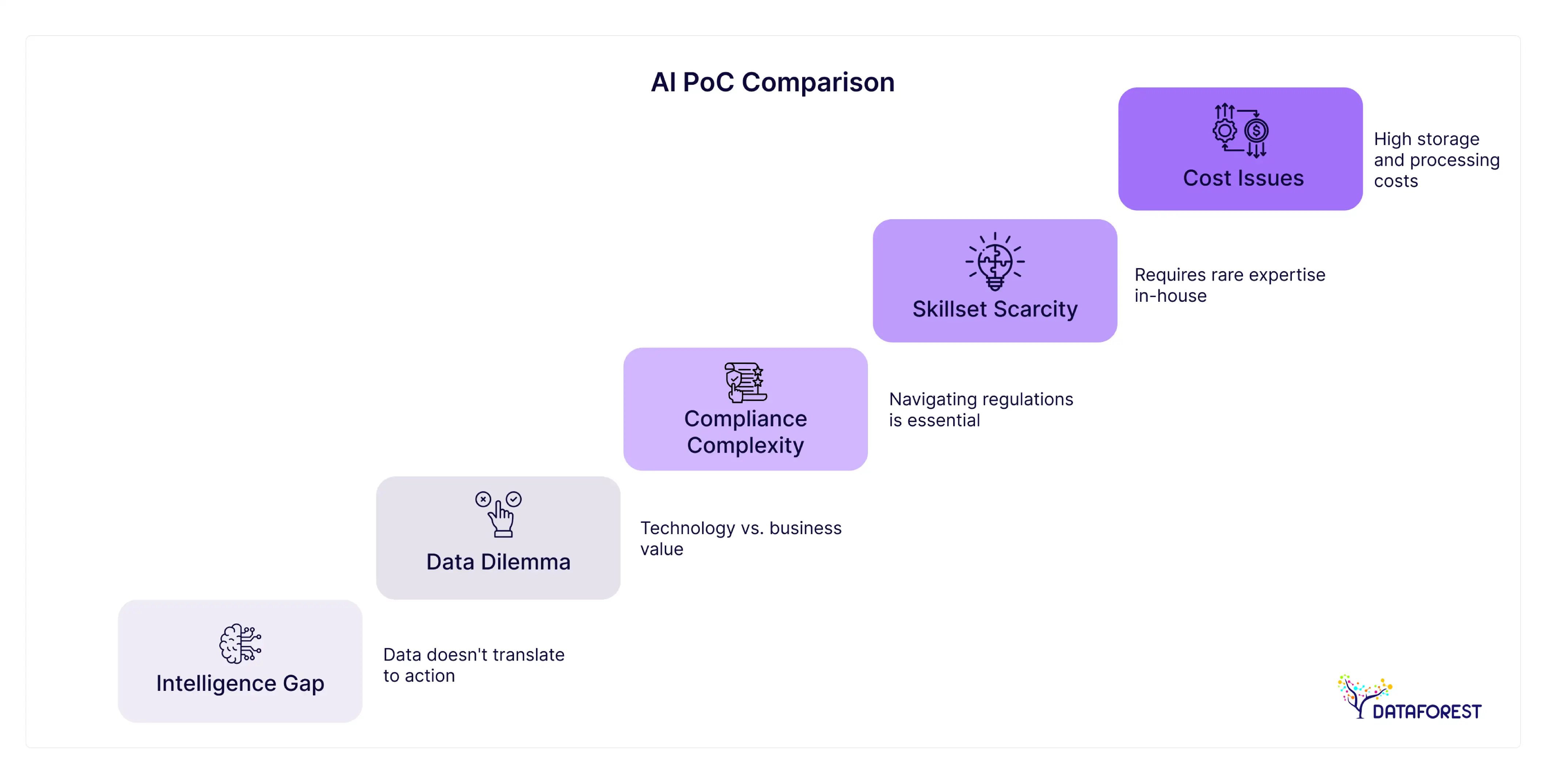
Unlocking opportunities with IoT is a strategic necessity, yet the journey from data ingestion to AI-based insight is complicated. "There's still a huge gap between the technology deployed to measure data and its direct contribution to business value." The time it takes to bridge this gap can be very different — it might be months for a targeted pilot, or years for an enterprise-wide transformation. The duration depends on data infrastructure maturity, well-defined business use cases and the technical skill to apply advanced AI models.
At DATAFOREST, we accompany companies in their quest to achieve this path more quickly. From overwhelming flood to decisive action, we make the process from insight to action fast and strategic with our deep experience in data science and industrial digital transformation. We know you don't just want to gather knowledge; you want intelligence integrated directly into the fabric of what you do.
The Explosion of IoT Data
The scale of the data problem is overwhelming. The pace of technology adoption varies, but manufacturing, health care and retail are the leaders of the pack. The numbers are expected to grow further, as per Statista and IDC projections more than 85 billion connected smart devices will produce over 100 zettabytes of data by 2026. This explosion of data presents a paradox: organizations have more visibility than ever, but also face the risk of being overwhelmed by information noise.
- Smart Factories: Enabled by Industry 4.0, manufacturers are developing AI in IoT for predictive maintenance, quality control automation and robotics. AI-based predictive maintenance can decrease machine downtime by up to 50 per cent and maintenance costs by almost 40 per cent, says a McKinsey report.
- Health and Wellbeing: The use of AI in IoT is transforming the way patient care is undertaken; remote monitoring devices, AI-based diagnostics, and optimized hospital workflows are just a few examples.
- Retail: The retail sector is leveraging IoT with AI for real-time inventory management, tailored in-store experiences, and flexible supply chain optimization.
The sheer volume of data raises serious cost issues. How can AI reduce locally stored data and cloud processing costs in an IoT ecosystem? The answer is edge computing. Local processing on the IoT device helps AI sift through non-critical noise and instead send only key insights to the cloud. This vastly reduces bandwidth, storage and cloud costs, enabling the large-scale deployment of IoT devices in a cost-effective manner.
The Intelligence Gap
It is not enough to just gather data — that would simply mean building a store of observations, not a competitive edge. The intelligence gap is the delta between what data tells you and how the business actually acts. This is where most IoT efforts die. Raw sensor output by itself has no meaning when action is concerned. Advanced AI and machine learning models are needed to bridge this gap, to recognize patterns, predict results, and then prescribe a course of action.
Which governance regimes should companies adhere to when applying AI to IoT data? It is essential to navigate the regulations. Regimes such as GDPR and CCPA have very stringent rules on personal data. For industrial applications, a standard like ISO/IEC 27001 may be best fit for most purposes. In addition, nascent standards such as the NIST AI Risk Management Framework ensure that AI models are trustworthy and open. It will help establish trust and compliance.
Such complexity raises a critical question: should we develop our own AI and IoT platform or work with a dedicated vendor? Creating an in-house platform involves a huge investment in rare skill sets such as data scientists, ML engineers and IoT architects. And it's a very long, risky cycle of development. Working with an expert such as DATAFOREST de-risks the program, providing immediate access to best-in-class expertise and a focus on speeding up time-to-value. We focus on building you a strong, scalable base for your digital future.

How AI Transforms IoT Ecosystems
AI integration doesn't just improve IoT; it reimagines it completely. It magnetizes sensor networks from passively collecting information to an actively thinking nervous system of the enterprise.
Real-Time Data Processing and Predictive Analytics
At its essence, AI IoT analytics is about speed and foresight when processing real-time data. Traditional analytics is based on batch processing, providing insights in hours or days. Instead, AI models analyze data streams from thousands of devices in real time. This enables predictive analytics—the ability to look forward and forecast events with high accuracy. Instead of responding to a pipe breaking or transportation system delay, a company can predict and avoid such problems.
Edge AI — Bringing Intelligence Closer to the Source
Edge AI is a revolutionary way of processing data. Connectivity is virtually instantaneous by "infusing" AI models directly into edge devices (such as smart cameras or industrial controllers), meaning decisions are made in milliseconds and cloud latency is a thing of the past. This is especially important for applications with real-time requirements such as autonomous vehicles or online quality control. It also adds security and privacy in that sensitive data stays on-premise – a big deal for industries such as healthcare and finance.
Automation and Smart Decision Loops
The vision of integration of AI into IoT assumes closed-loop systems that possess intelligence of their own. AI-powered solutions process and augment IoT data, make intelligent decisions that initiate the right action, and then fully or partially automate these in workflows. Imagine an AI system controlling elements of a smart-building infrastructure that incorporates data from occupancy sensors and weather prediction to automatically adjust the HVAC and the lights, optimising for both comfort and driving energy savings. This caliber of AI automation liberates human resources to prioritize higher-value strategic activities.
Business Impact — From Efficiency to Innovation
AI IoT solutions are now proving to deliver real business value, making the difference between profit and loss and impacting companies' existence.
Cost Reduction and Predictive Maintenance
Predictive maintenance is one of its most direct payoffs. Analyzing data from industrial equipment, AI can anticipate a failure weeks before it happens. This allows maintenance to be planned well in advance, eliminating expensive unexpected downtime and increasing the life of assets. As we discuss in our post on AI-Driven Predictive Maintenance, this change from reactive to predictive maintenance could mean saving millions.
Data-Driven Innovation
Beyond operational efficiency, the rich data insights generated by AI and IoT unlock pathways to innovation. Organizations can leverage this intelligence to deliver new services, tailor customer experiences and support dynamic business models. For example, an insurance carrier can leverage data from telematics for usage-based policies, while a retailer can use in-store sensor data to adjust layout in real-time. It's transforming an operational asset into a strategic vehicle for growth.
Compliance, Security, and Sustainability
AI is also a critical component for securing IoT. AI systems can also track network traffic to find anomalies and recognize cyber risks that would bypass conventional mechanisms. This type of hunting is critical for securing critical infrastructure. Moreover, process optimization can also directly contribute to corporate sustainability goals by driving efficiency gains, such as energy use optimization, which is increasingly a top priority for boards and investors.
Implementing AI in IoT — Strategic Roadmap for Enterprises
Achieving success means you need to be disciplined and strategic when it comes to embracing such transformative technology. We recommend a five-step roadmap.
Step 1 — Assess Your Data Ecosystem
Starting out with a clean slate, you first need to understand what's in place while introducing the concepts that will power the future of your enterprise.
Step 2 — Define Business Use Cases
Begin with specific business challenges. Find valuable points of entry where AI and IoT can address a particular pain point, such as minimizing downtime.
Step 3 — Build Scalable Data Architecture
Design a modern data pipeline capable of efficient data processing and storage for huge amounts of IoT data. This architecture must be designed for scalability, often involving both edge and cloud computing.
Step 4 — Integrate AI Models into Operations
Develop, train and deploy AI models that address your use cases. The success relies on the successful system integration into enterprise processes.
Step 5 — Measure, Iterate, Scale
Always measure your solution against KPIs. Leverage these learnings to optimize models and deploy enterprise-wide.
Case Studies — AI + IoT in Action
Manufacturing: Predictive maintenance and process optimization
The world's largest industrial manufacturer, Siemens, takes advantage of AI and IoT in its smart factories. An AI-based system at its Amberg plant processes data from 5,000 control points to predict machine tool failure with high accuracy and reduces downtime, leading to a quality rating of 99.99885%.
Retail: Real-time supply chain and demand forecasting
In its fulfillment centers, Amazon has a highly advanced IoT and AI environment. AI models are also used to direct autonomous robots moving through warehouses, where they plan their routes on the fly. IoT sensors monitor billions of things that go directly into predictive models that can forecast demand with unprecedented precision.
Healthcare: Smart monitoring devices and AI-driven diagnostics
Philips applies AI and IoT in its eCareCoordinator solution for remote patient monitoring. Wearable sensors gather vitals, and an AI platform processes the data so clinicians can spot patterns that signal patients are getting sick before they get very sick, which in turn should minimize hospital readmissions.
Why Partner with a Data-Driven Expert Like Dataforest
The path from raw IoT data to smart action is a difficult one; it depends on a combination of skills in data science, engineering, and business insight. It is an attempt at a transformation by yourself, and that's a high-risk approach with high cost.
This is what we do at DATAFOREST. We are not your typical technology providers - we become strategic partners in your digital journey. Our best-in-class team as described on our About Us page, partnering with you to architect and deploy custom ai in iot solutions that drive tangible business value. We guide you through the complexities of data integration and model deployment so that your investment delivers a real competitive edge.
Forging Your Intelligent Future
AI and IoT coming together is the lifeblood of industry leaders versus laggards today. Businesses who understand and harness this synergy will work at a radically more efficient pace, innovate faster, and create significantly more sustainable business models. It's no longer a question of whether you should invest in IoT data analytics with AI, but how quickly you can start scaling it. It is a journey that involves vision and planning, as well as expertise at your side.
Ready to tap the value of your operational data?
Frequently Asked Questions
How does integration of AI edge intelligence with IIoT enhance manufacturing decisions?
When AI is applied to edge devices, manufacturers can process instant machinery data in real time. This means real-time, automatic responses including altering settings to avoid defects or marking parts for maintenance – all of which can reduce latency and increase uptime.
How long does it take to move from IoT data collection to AI-guided insight?
The time frame varies between 3 months to 6 months for a pilot project and from 18 months to 24 months for full deployment. Some of the key factors are quality of data infrastructure, complexity of the business problem and access to talent that can do these things.
In which industry sectors is AI-driven IoT taking off most rapidly?
The early adopters are Manufacturing (Industry 4.0), Healthcare (IoMT), and Retail. These industries already show in industrial processes, quality control and supply chain optimisation clear and easy ROI cases.
How does AI help in saving storage and cloud for IoT ecosystems?
AI on the edge is the main technology. Rather than streaming raw data to the cloud, edge devices are able to process data on-site and push only relevant signals or aberrations. This is a huge saving in bandwidth, storage and compute costs.
What are the compliance frameworks for AI applied to IoT data?
Important frameworks are for example data protection laws as GDPR and CCPA. For security, we absolutely need standards like ISO/IEC 27001. Standards such as the NIST AI Risk Management Framework also help to ensure that AI systems are ethical and transparent.
Is build or partner a better strategy when implementing AI + IOT?
For the general firm, it is more efficient to work with a specialized firm. Developing an in-house solution demands a large investment in scarce resources and presents more risk. Because a partner like DATAFOREST brings proven experience, speed of value, and lets your team focus on what really matters.
How does predictive AI help prevent equipments from failing?
The predictive AI models learn from historical and real-time sensor data (e.g., vibration, temperature). These machine learning models learn characteristic patterns just prior to failure. When the machine learning system uncovers these patterns in real-time activity, it generates an alert mechanism that lets teams act before a disastrous failure.

.svg)
.webp)
.webp)
.webp)


