


Enterprises these days are not data-deprived; they are drowning in it. Petabytes of data are locked in reports, emails, chat logs, and legacy databases. And yet, for C-level executives, an enraging paradox persists — despite all this data out there, actual knowledge is nowhere to be found. The critical insight that one needs to seal the deal, mitigate a risk, is typically locked up or siloed away.
This is a crisis of knowledge accessibility, not one of storage.
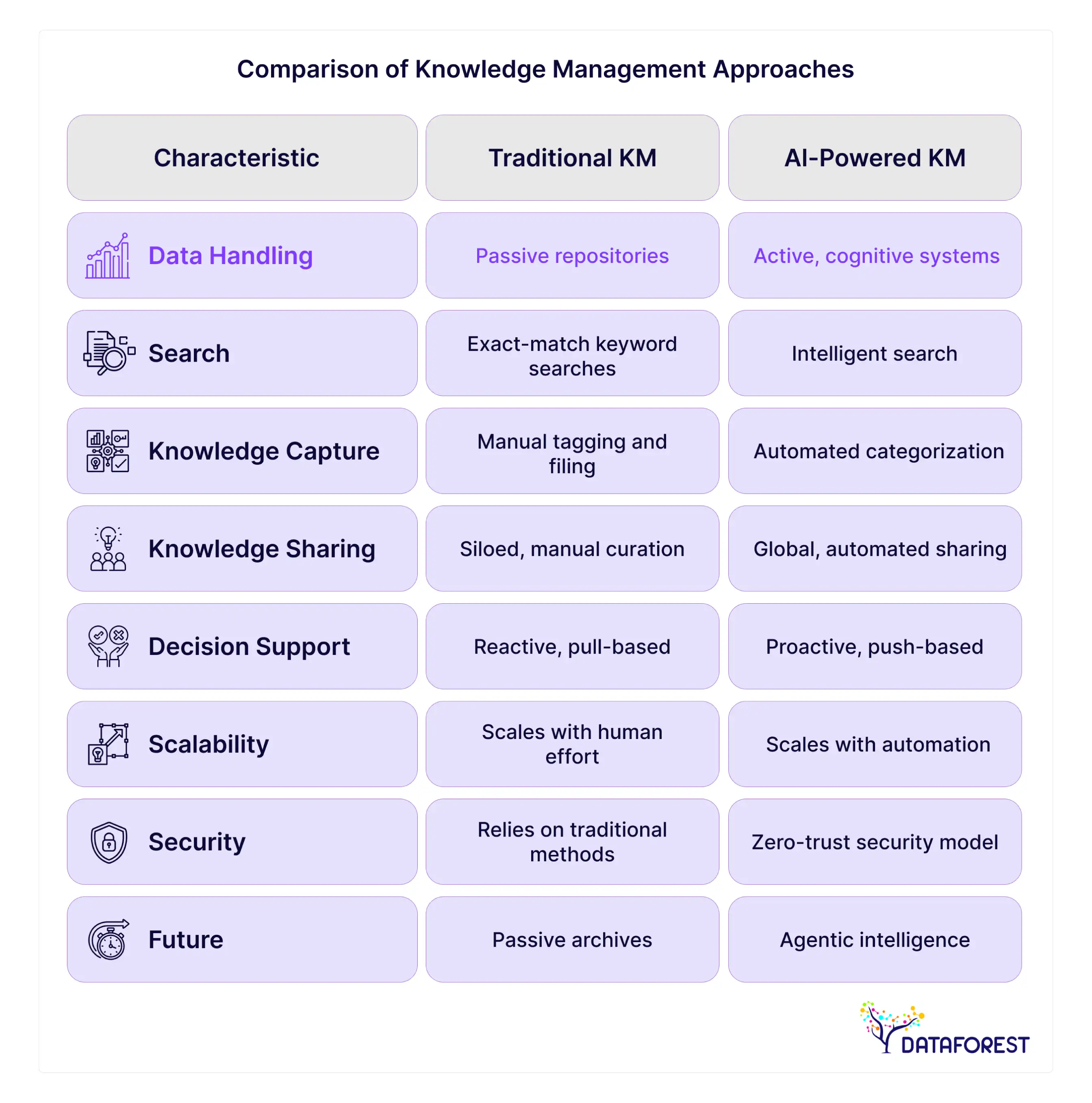
All along the way, innovators have been hurtling forward with new methods that make traditional enterprise knowledge management (KM) systems—static wikis, SharePoint folders, inflexible databases, and endless email threads (so so many) —digital filing cabinets. They couldn't solve the problem of real information access. They are passive repositories. In the era of digital transformation, passive doesn't pay. And the strategic requirement has changed from information captivity to knowledge utilization.
This is exactly where AI-based knowledge management comes into the picture. It is a radical shift from data banks to active, cognitive systems. Through AI, brands are in a position to finally move from information chaos to smart insights and turn corporate knowledge from a passive archive into an active strategic asset.
How does AI knowledge management help move enterprises away from tribal knowledge risk (ie, less reliance on individual employee expertise; less "knowledge loss" when people leave)?
This is the central problem: how to enroll tacit knowledge. These AI systems include new models such as those that employ Retrieval-Augmented Generation (RAG). They are designed to comprehend and be fed with unstructured content from experts – reports, design documents, complex support tickets. When an expert leaves, the record of their experience remains. More sophisticated systems like the one discussed in this DATAFOREST RAG article have far too much depth for such scenarios, but can still be appreciated for preserving clusters of concepts and the context in which they are expert. As The Diplomat in Spain points out, this process "is converting individual and 'tribal' knowledge into a corporate asset that is permanent, accessible and current."
The Evolution of Knowledge Management in Corporate/Enterprise
KM itself is not a new concept, but how it's being done is experiencing such a radical transformation that even partners like DATAFOREST are along for the ride.
- KM 1.0: The Digital Library. That was our first move from paper to digital (network drives, basic SharePoint). Storage and centralization were the goals. Browsing the data was done manually, reflecting poor data organization, and relied on exact-match keyword searches.
- KM 2.0: The Social Wiki. (And then with Web 2.0, platforms added social components (Confluence, Yammer). The idea was sharing and human curation by tagging and linking. It was better, but still siloed and required manual work.
- KM 3.0: The Intelligent Ecosystem. This is the new revolution, brought to you by AI for knowledge management and the broader strategy of knowledge management with AI. We now progress from goal to understanding, connection, and generation. This artificial intelligence system doesn't wait to be asked. It's a natural language understanding (true intelligent search), auto-taxonomizing, insight-enabling platform – delivered by a powerful generative AI-driven data infrastructure.
How is applying an AI-driven search tool different from creating a full knowledge intelligence environment?
This is important for strategy. An AI-based search tool, a Generative AI Copilot, is a great building block — a smart query layer for finding and summarizing documents more efficiently.
The knowledge intelligence ecosystem is the overall strategic knowledge management platform for managing knowledge. It comprises ingestion pipelines, vector databases, classifiers, and governance, as well as the search tool. As a Medium post explains, the ecosystem doesn't just search for information; it understands context and offers potential 'answers' rather than simply 'links.'
From Paper Repositories to Smart Systems
This transition to KM 3.0 is characterized by the shift that replaces "pull" with "push." In the former model, the user had to extract information, having some concept of what he was looking for and in which location.
The system in an AI in knowledge management model is a dynamically participating entity. It brings you whatever knowledge it has on the topic. In Salesforce, a sales executive might have up on his screen a smart summary of recent support tickets and relevant market news — all compiled by the AI as they were generated in real time. This Generative AI integration infuses knowledge into the workflow.
Could AI help to consolidate knowledge across worldwide teams working in different languages and regions?
Absolutely. Modern LLMs are inherently multilingual. A KM tool that is AI-based can read the technical documentation in German and marketing briefs in Japanese. Then one of your team leaders in Spain can ask (in Spanish), "What was the feedback about our last product launch in APAC?" How does it work?: The AI is able to discover relevant documents, synthesize the answer, and articulate it in Spanish, complete with citations. As platforms like PollyHelp show, this ability breaks down language siloes and now makes true global corporate knowledge sharing and automated knowledge sharing a reality.
Why Traditional KM Falls Short
Classical KM doesn't work because it scales with human effort. The more information you produce, the greater the burden on humans to tag, file, and locate it. According to a 2023 Interact report, the average knowledge worker spends 19% of their workweek hunting for information. This inefficiency leads to siloed data, poor decisions, and knowledge loss — a problem that AI-powered knowledge management directly addresses.
How can companies trust that what they know is true if the knowledge infrastructure is automated by AI?
This is why multi-layered engineering is crucial for reliability. Retrieval-Augmented Generation (RAG) ensures the AI knowledge management solution retrieves verified documents before synthesizing grounded answers. The AI system must back up its claims with credible citations, providing links to original sources for human validation. As TTMS points out, verifiable AI depends on confidence scoring and guardrails: when uncertain, it should respond "I don't know" rather than fabricate information. This dependency on objective data is the essence of sound knowledge analytics. You'll also find this principle explained in this RAG and Vector DB blog.
The Role of AI in Knowledge Management
AI is a set of functions that, when strung together with the right data, form a system that can understand your data, organize that information, and make sense of it. This AI transformation of corporate knowledge is at the heart of Generative AI solutions.
Can I combine AI knowledge systems with my existing software (eg, SharePoint, SAP, or Salesforce), without creating costly havoc?
Yes, that's the only possible way. A contemporary AI knowledge management system (or knowledge management system with AI) is not a "rip or replace" endeavor. It is running as a smart orchestration layer above your infrastructures. Through resilient APIs, the AI platform consumes data from SharePoint, SAP, etc., and homogenizes it into a central index without high-risk data migration. This gives a single unified interface (analogous to a decision support system).
Natural Language Processing and Enterprise Search
This is where NLP enables the advanced system to go beyond keyword matching and achieve semantic understanding of the content.
- Before (Keyword): A user enters "customer churn Q3." The system retrieves 200 documents containing those words.
- Post (Semantic): A user will ask: "What were the top reasons for customer churn in the enterprise segment for Q3?" The AI-powered knowledge management system gets what the question is asking, and it generates a simple answer – one paragraph long.
This is the essence of creating a truly intelligent knowledge base.

How does AI process sensitive or proprietary corporate knowledge without violating data privacy laws?
An enterprise AI platform is comprised of a "zero-trust" security model:
- Role-Based Access Control (RBAC): The AI takes over all user rights. It will only be able to access data that the user is already authorized to get at.
- PII Masking & Anonymization: AI can be used to automatically detect and mask or anonymize sensitive, personally identifiable information (PII) and much more.
- VPC / On-Premise deployment: The LLMs and data are installed on the entity's own VPC or on-premises infrastructure for ultimate security—proprietary data never leaves the firewall. This is why everyone needs a strong data management and security posture from day one, which is another part of training LLMs.
Fabric of Machine Learning for Context and Classification
This is where knowledge management automation with AI begins. You could also say this is knowledge automation, or intelligent automation at large. We can thus train an ML model to automatically:
- Categorize: Read a new document and tag it (e.g., "Legal Contract," "Marketing Brief").
- Abstraction: Excerpt the gist of a 50-page report.
- Routing: Automatically direct a support ticket to the right engineering team.
- Find Duplicates/Outdated: Mark as duplicate or mark outdated content.
Such a level of data automation effectively shifts the responsibility from human to machine. That's the magic of Business Intelligence with AI, it has come from manual tagging to self-organizing!
AI-Driven Knowledge Graphs
One example of this difference between how a KM system stores data versus how a web crawler may have done is that a knowledge management system with AI won't just store documents; it will keep track of relationships between everything on the entire internet. It knows that "Project Titan" is owned by "Jane Doe," and she's a "Risk Compliance" expert. This graph structure is what enables real digital intelligence, where an AI can answer truly multidimensional questions such as, "What are the names of engineers who are in our Berlin office with knowledge in 'Regulation XYZ'"? This personalised AI analytics unleashes tacit knowledge.
From Data Chaos to Smart Insights
The vision of knowledge management with AI is to move the organization from being reactive to proactive. This is the heart of optimizing knowledge management with AI, and it represents the dream for AI optimization in the enterprise.
Automating Knowledge Discovery
AI-driven KM effectively is a 24/7 research analyst. It can listen to all the incoming streams of data in order to find "weak signals," like an early customer complaint pattern amid 10,000 support tickets. It is an instance of cognitive automation in action. For instance, AstraZeneca employs a gigantic knowledge graph that links data from patents, clinical trials, and scientific literature to superhumanly rapidly identify novel drug targets.
Real-Time Decision Support
This is where AI expertise gets to where it's most needed.
- A call center agent making use of a real-time AI agent has at their fingertips the perfect answer to that complex customer question.
- Example: At a financial institution in an earlier Reporting & Analysis Automation case study, AI analytics can uncover very subtle client churn signals up to weeks before traditional BI tools can, which results in pre-emptive retention.
Enterprise Use Cases Across Industries
Manufacturing
In Manufacturing, It's Decades of Maintenance Logs Filled With AI. "They can say, 'This hydraulic press is displaying error 405 and making a grinding noise,' and get a three-click repair directed from past cases," he said.
Healthcare
Unstructured data is overwhelming healthcare. In this case, as with our own Healthcare Insights Platform, AI-enables systems can organically combine a person's full medical history and contrast their symptoms with the most up-to-date studies in order to recommend diagnoses for physician review.
Finance
Those who know how are at the top in Finance and Fintech. Morgan Stanley equipped its 16,000+ advisors with an AI tool that provides immediate, aggregated information on market data and complex financial products to deliver timely and compliant advice. This is consistent with DATAFOREST's financial performance tools.
Retail & E-Commerce
For Retail and E-Com, AI reads through product reviews and support tickets to answer questions such as "Why aren't people buying our new shoe line?" This realization is what powers product development, which is often facilitated through LLM-based recommendation systems.
Building the AI-Powered Knowledge Ecosystem
This isn't a one-time piece of software you buy, or whatever. It's an intentional plan."
Key Components
- Data Ingestion: Connectors to retrieve data from all sources.
- Data Preprocessing & Storage: Operations in which the data is cleaned, vectorized (a particular type of computational/data processing task), and saved (e.g., Vector DBs).
- The intelligence layer: The underlying LLMs, ML models (etc.), and knowledge graphs.
- Application Layer: The tools that you see (search, chatbot, alerts).
The Place of Data Governance and Security
"Garbage in, garbage out" is only compounded with AI. A project strategy for data governance, security, and lifecycle management is key to success. Data and infrastructure are the first steps to making it efficient.
Pro tip: Begin by automating document categorization for a single department at the scale you are comfortable with. A targeted pilot can bring insights to light, create executive buy-in, and set direction for a full-enterprise roll-out.
Overcoming Adoption Barriers
The biggest barriers tend to be human, not technological.
Cultural Resistance and Change Management
Staff may view a new system as slang. Successful adoption requires:
- Executive Sponsorship: Being the advocate for why—growth mindset, not a replacement of experts.
- Workflow Integration: The tool has to be where employees work (i.e., in Teams, Slack, or Salesforce).
Data Quality and Integration Challenges
Messy, siloed data can cause all of these projects to grind to a halt. That's where working with an experienced data engineer like DATAFOREST is key. CDP/CRM data integration is always job number one when it comes to any successful enterprise automation or AI initiative.
The Future of Knowledge Management: From Passive Archives to Agentic Intelligence
We are only at the beginning. Agency-based AI is the future of this knowledge ecosystem.
It will change from being a reactive partner (answering questions) to becoming proactive, an autonomous agent. A C-level executive isn't going to just "Order up a report." They will give a command:
Keep an eye on product releases for our top three competitors this quarter. Scrape customer sentiment from tech forum & compare with/ our own, draft a risk/opportunity summary report for the strategy team by Fri.
This vision of information automation, which is now possible with truly human-like AI innovation, represents the future for AI-powered productivity tools–turning the KM system into a force multiplier as never before.
Charting Your Course in the Knowledge Revolution
Information overload is a choice, an optional era. The capability to filter, distill, and mobilize knowledge at scale now exists. AI-powered knowledge management is the solution that propels this strategy forward, providing a bridge from information anarchy to knowledge intelligence, insight, and action.
This is not an IT conversion, it's a business transformation. It constructs a durable "corporate brain" that learns over time, allowing your whole company to become faster and smarter — thereby building a powerful competitive moat.
Ready to stop treating your corporate knowledge as a burden, but instead turn it into your greatest competitive advantage?
The path from information myopia to a real knowledge intelligence ecosystem needs a special partner. Schedule a meeting with our AI strategists to chart your pathway.
Frequently Asked Questions
What is AI-enabled knowledge management vs. traditional KM systems?
Traditional KM platforms are passive—they merely store documents, and users need to know how to get them. AI knowledge management is a "knowledge partner." It comprehends, correlates, and reasons learning to deliver clear, direct answers or actionable insights.
What are the main obstacles when it comes to implementing AI in knowledge management?
The top three challenges include:
- Data Quality — AI is only as good as its data ("garbage in, garbage out").
- Integration complexity — linking the AI to legacy systems (ERPs, CRMs) is a major data engineering effort.
- Adoption — overcoming cultural resistance and embedding the tool in daily workflows.
- Read the blog on choosing AI tools for more perspective.
How can businesses secure data on AI knowledge management systems?
Security is non-negotiable.
- Private deployment (VPC or on-premise) so the data never leaves the firewall
- Role-Based Access Control (RBAC), the AI inherits user permissions
- Data masking to anonymize PII and sensitive information
Can AI keep institutional knowledge in place during workforce transitions?
Yes, that is one of the primary advantages. AI systems ingest and index the "tacit knowledge" trapped in reports, project files, and chat logs. Because their work is recorded, knowledge doesn't get lost when an expert leaves. It is an integral part of enhancing Generative AI in the enterprise function.
Which industries gain the most from AI-driven knowledge ecosystems?
Knowledge intelligence is an insight-intensive capability that delivers dramatic ROI across industries, including:
- Finance & Insurance: Risk management and advisory service.
- Health: For the generation of patient data and clinical studies.
- Manufacturing: For predictive maintenance and engineering knowledge.
- Legal & Professional Services: To analyze case precedent and review contracts.
How does NLP enhance enterprise knowledge search?
NLP enables intelligent search. Not only does it simply match on keywords (e.g., 'sales report'), it understands the actual intent of a query (e.g., 'Compare our Q3 sales performance in EU vs NA'). This offers up the most relevant, synthesized answers, not just a list of documents. It's also revolutionizing how LLMs are applied in the customer service domain.
Where are AI-based KBMs heading?
The major trend is the shift from passive tools to proactive, agentic AI. Soon, your KM system will function as a self-driving digital assistant. You'll assign it complex, multi-step tasks such as "Monitor our suppliers for risk signals and compile a weekly summary," rather than simply asking questions. This development, supported by Advanced Planning Systems, represents the next step in AI evolution.

.svg)
.webp)
.webp)
.webp)


