

Large hospital networks struggle with slow queries on legacy SQL Server databases. IT teams move these records to the Databricks Lakehouse Platform to improve performance. Engineers use automated scripts and convert stored procedures into Python code. This change cuts report generation time from hours to just a few minutes. Data scientists build predictive models directly on the raw files without delays. The organization reduces licensing costs and processes patient admission data in real time. Book a call to stay ahead in technology with Databricks migration from SQL Server.
Why Are Healthcare Systems Replacing SQL Server?
Medical organizations struggle with slow databases every day. SQL Server often freezes under the weight of new patient records. IT managers pursue Databricks migration from SQL Server as part of broader healthcare cloud migration strategies to save money and simplify data architecture.
SQL Server performance protection for medical data
Hospitals collect terabytes of protected health information every month. As these patient records grow, SQL Server databases become slow. Physicians need immediate access to medical records and lab reports stored across fragmented data warehousing systems. Strict coding rules eliminate valuable manufacturing power. When thousands of patients query the tables simultaneously, the system crashes. Administrators cannot fix this delay by simply adding more equipment. License costs increase with each new server; Databricks' alternative avoided. Modern medicine relies on large files such as MRI scans and genomic data, which are handled more efficiently after Databricks' migration of record-level data from SQL Server. Delayed recovery time delays critical care for critical illnesses.
The problem of dispersed medical records
Hospitals store patient information in different areas. During healthcare data migration, hospitals consolidate EHRs, billing systems, and device telemetry into a single Databricks Lakehouse. Smart devices, such as heart rate monitors, are constantly transmitting data. This quick flow loads the standard connection tables. Engineers previously maintained fragile integrations manually. During healthcare Databricks implementation, these pipelines are unified and automated using Databricks workflows, enabling clinicians to access complete patient histories instantly.
The high cost of old data systems
Hospitals pay high fees for old SQL Server licenses—the software price increases with each new model. Engineers build software to move data between systems. These Extract, Transform, and Load processes often fail. Technicians spend nights repairing broken data links. In these regulations, they cannot work on new projects. Outside experts charge high fees to correct errors. Hardware bills increase as the system creates new copies. Maintenance budgets shrink as compute is used only when needed, making Databricks' migration financially sustainable.
Medical Lab Achieves 50% Compute Savings via Databricks Migration
.webp)

Medical Lab Achieves 50% Compute Savings via Databricks Migration
Why Databricks Is the New Standard for Healthcare Data
Medical leaders need a quick platform to connect to every department. Databricks migration enables Lakehouse architectures that preserve patient data while accelerating research. Hospitals are using these models to improve treatment decisions quickly. For the same purpose, you can book a call with us.
A single place for patient information
Databricks combines the storage of a data lake with the planning of a warehouse. Structured billing tables and unstructured imaging data coexist in one data warehousing environment optimized for healthcare analytics and Databricks use cases. Analysts write SQL queries on files that scientists use for Python. Teams don’t need to move or copy records between devices. The platform processes live signals from heart monitors instantly, which is a core benefit of Databricks' migration from SQL Server. Hospitals get a complete picture of a patient without delay.
Security restrictions on sensitive medical records
Databricks helps hospitals meet stringent federal privacy standards. Databricks migration supports HIPAA through Unity Catalog governance. These policies apply to every dashboard and raw file. The software automatically hides patient names and insurance numbers. Analysts track every observation and query through built-in logs. Security teams quickly detect unauthorized access attempts. Clinicians share research data securely without penalty for compliance.
Tools to predict patient outcomes
Databricks runs machine learning models where data is available. Following Databricks' migration from SQL Server, hospitals deploy predictive models for sepsis detection, admission forecasting, and readmission risk. They use popular tools like MLflow to track tests easily. The platform detects sepsis complications and quickly predicts new admission rates. Engineers train algorithms on large amounts of historical data. Hospitals integrate these new features directly into clinical procedures. Care teams receive alerts before a patient's condition worsens.
Deloitte partners with Databricks to accelerate enterprise migrations—helping assess, plan, and implement SaaS data modernization at scale.
How Are Hospitals Handling the Migration from SQL Server to Databricks?
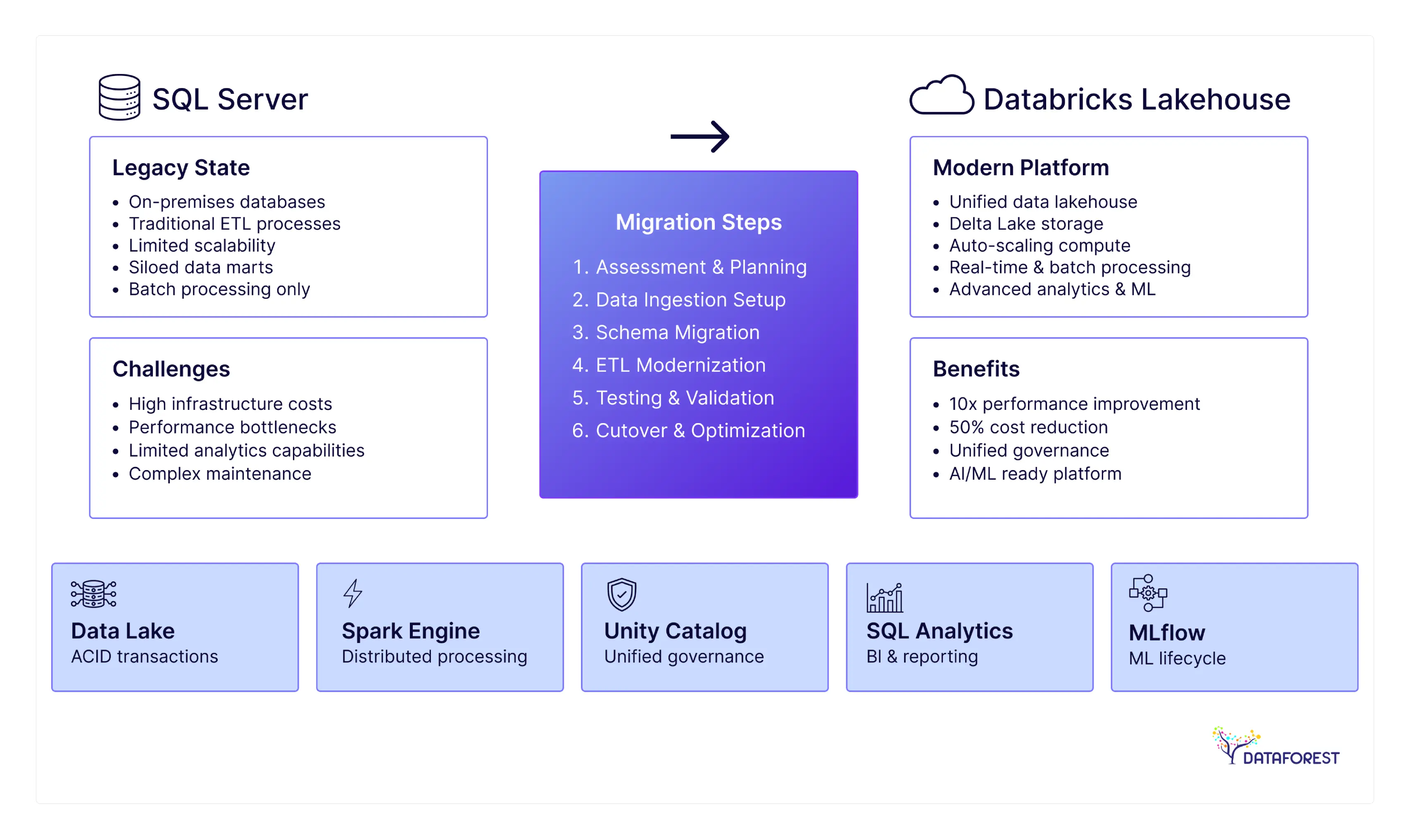
A structured approach ensures a successful Databricks migration from SQL Server while controlling cost and risk. Engineers prioritize important resource files and rewrite old code into clean modules. Careful management keeps cloud bills low in the process.
Start with high-impact data
- Quickly identify data that impacts revenue and patient care.
- Move the demand data first to record the financial transactions.
- Move electronic health records to a place that supports doctors at work.
- Transfer large image files after the system has processed the text data.
- Validate priority datasets before full Databricks migration from SQL Server.
For example, a hospital may advance its insurance claims schedules to stabilize cash flow. The IT team then links the doctor's notes so that medical staff can review patient records. The site has been verified as stable before transferring large MRI files.
Change the modular code
- See the logic behind the old SQL Server stored procedures.
- Rewrite these business rules using Python or PySpark.
- Break down long documents into smaller, single tasks.
- Keep these tasks in a shared folder for the entire team.
- Improve performance post-Databricks migration from SQL Server.
For example, an engineer takes a complex 500-line invoice and converts it into three small Python functions. The company reuses tax calculation logic for patient billing and insurance reports. A simple unit test quickly checks the math for errors without running the entire database.
Manage corporate costs from the start
- Set servers to shut down when no one is using them.
- Use low-level features for background work.
- Compare the computing power to the actual amount of data.
- Separate heavy automated tasks from day-to-day queries.
- Track spending by department after Databricks migration from SQL Server.
For example, a hospital runs a heavy billing report at 2 a.m. every night. The system starts the servers for that specific window only. These machines shut down immediately after the show ends.
What Are the Common Problems in Healthcare Data Migration?
Many failures occur when teams underestimate the complexity of Databricks’ migration from SQL Server. Hospitals often fail when they implement old rules in new systems. Simple mistakes like copying code or delaying security checks can lead to failure. Successful organizations identify these challenges before the project begins.
Escape the trap of old SQL code
Disadvantage: Reusing T-SQL slows Spark workloads after Databricks migration from SQL Server.
Solution: Engineers refactor the logic using native PySpark frameworks or Python functions. They test the new code to make sure it serves the same functions correctly. The group replaces loops with vector functions for better speed.
Prevention: Managers train employees early on about the accounting principles that have been announced. Senior authors review each document to avoid legacy issues.
Leaving the data rules until last
Pitfall: Teams rush to move data and delay setting up security rules. This error exposes the patient's vital records to the wrong users, resulting in delayed security during Databricks migration from SQL Server.
Solution: Administrators define access policies in the Unity Catalog before files are moved. They automatically associate each piece of data with important personal labels.
Prevention: Defense leaders include security checks at the first project stage. The company prevents any data transfer until restrictions are put in place. Automatic compliance checks are run daily from the start.
Misunderstanding Lakehouse's Direction
Disadvantage: Organizations maintain the platform as a standard operating system. They make small updates frequently, creating thousands of small files. These fragmented records slow down the system.
Solution: Optimize for analytics post-Databricks migration from SQL Server. Engineers change batch processing for data consumption. The company adds small changes to the new content every day.
Avoidance: Architects design the system for heavy analysis reads instead of fast writes. Employees learn the difference between transactional and analytical workloads during onboarding.
McKinsey Tech Trends 2025 highlights strategic digital transformation drivers. Modern data infrastructure (including migrating from legacy SQL systems to cloud/Lakehouse platforms like Databricks) is part of broader enterprise modernization pressures globally.
What Benefits Will Hospitals Gain from Moving to Databricks?
Medical teams work faster with real-time data access. Algorithms predict patient problems before symptoms appear. This platform supports advanced research without the need to purchase new equipment. Databricks migration delivers faster access, predictive insights, and scalable AI.
Quick answers for physicians and administrators
After Databricks' migration from SQL Server, lab results appear in real time. Hospitals are quickly processing patient data after moving to a new site. Medical teams see lab results and critical findings as they come in. Algorithms quickly scan charts to detect early signs of disease. Nurses adjust staffing schedules based on real-time attendance numbers. Data scientists build accurate predictive models in minutes instead of weeks.
The system appends text messages to X-ray images for complete information. Administrators monitor equipment usage and reduce waste immediately. Doctors make treatment decisions with confidence based on a complete history. Researchers comb through years of records to identify long-term health trends. Improved data speeds lead directly to improved survival rates for patients.
Predicting health problems in real time
- Identify high-risk patients immediately after Databricks migration from SQL Server.
- The system calculates a sepsis risk score after each new lab result.
- Machine learning models tell patients to return to the hospital within thirty days.
- Care teams receive notifications on their phones when a patient's condition worsens.
- Optimize bed capacity using analytics enabled by Databricks migration from SQL Server.
- To improve these predictions, the platform combines doctor notes with test scores.
- Officials adjust nursing schedules based on the number of incoming patients.
- The software detects the types of infections to prevent emergency visits in the future.
- Researchers test new health models without disrupting the daily operations of the hospital.
- These tools provide time for employees to act before an emergency occurs.

Advancing AI for better care
Medical imaging, NLP on doctor notes, and clinical trials scale efficiently following Databricks' migration from SQL Server. Hospitals are using AI to read complex medical images. The new system analyzes thousands of scans for tumors. Radiographers look at complex cases, while computers take care of the common ones. Machine learning models read doctors' notes to look for hidden symptoms. The platform facilitates these tools on large data sets without fail. Clinical trials run faster because the data is clean and ready. Engineers periodically update the diagnostic software for the entire network. Performance improves when computers sort through infected files faster. Experts have the right information when they need it. The company expands its research capacity without buying new servers.
Internal problems
Migrating large SQL Server databases to Databricks poses real challenges for many local organizations. There is often a significant gap between internal staff when it comes to Databricks, Spark, and the cloud. Your team may already understand SQL, but lacks experience in Python, Scala, and distributed database management. Experienced Databricks developers are needed to bridge this visual gap and prevent the overall movement time from slowing down.
Data protection and security pose a major challenge in healthcare. When moving patient data to the cloud, organizations must adhere to HIPAA and other regulations. Mistakes in scheduling can lead to serious legal issues and significant fines. Ensuring comprehensive data management in both fields requires separate and in-depth technical knowledge.
The local time to value is very long, frustrating for business leaders. Building the necessary infrastructure and building data pipelines can take more than a year. Partnering with a specialized company can help reduce this time significantly. Internal team training directly leads to these long and expensive delays.
Benefits of Databricks migration integration
Partnering with experienced specialists in data migration and modernization services accelerates Databricks migration and reduces risk. The outsourcing provider brings in proven experts who already know Databricks, Spark, and cloud platforms. This pre-engineered expertise quickly fills existing skill gaps in your local organization. The team effectively manages the complex data exchange and pipeline construction and minimizes errors.
A specialized partner shortens Databricks migration timelines, ensures HIPAA compliance, and minimizes costly mistakes. They use proven and repeatable systems to speed up the moving process. This speed means your organization can quickly deploy advanced analytics, generate revenue, or rapidly improve patient care. The partner also ensures that it complies with all applicable healthcare data protection laws. They have a safe and secure data transfer experience that is regulated by HIPAA. The local team learns from these experts and improves its skills for future projects. This collaboration saves your team time and reduces overall risk.
Partner selection list for physical health data migration
- Partner must have proven and successful experience migrating SQL Server data to Databricks.
- They should demonstrate a deep understanding of building scalable data pipelines with Spark, Delta Lake, and more.
- The company should have a long history of dealing specifically with Protected Health Information, or PHI.
- They should have a business partner agreement or a ready BAA to be signed.
- Look for the right Databricks certification and related cloud experts.
- The partner must provide a clear and detailed plan for information transfer to your internal organization.
- Explore robust and automated processes to ensure proper HIPAA compliance and data management.
- The company must demonstrate the ability to deliver work products to meet time targets quickly.
- Ask for specific examples of cost optimization and cost-effectiveness in the cloud.
- Ongoing support post-Databricks migration from SQL Server.
Partner with DATAFOREST for Migrating from SQL Server to Databricks
DATAFOREST specializes in Databricks migration for healthcare organizations. They can build a local team and work with a professional company like DATAFOREST. It has healthcare data engineering capabilities. We integrate different data sources into one managed Databricks Lakehouse. This framework uses the Medallion Architecture and supports business analytics, reporting, and machine learning.
In one example, we migrated lab data from old SQL systems. They integrate multiple data sources and automated data pipelines. They completed the task, reducing the computation costs by 50 percent. DATAFOREST also builds scalable pipelines based on the needs of the organization. The team brings expertise in Spark, data migration, management, and cloud architecture. We ensure compliance with HIPAA regulations.
Working with an external provider helps bring teams together. We use existing tools and methods to control the workflow. This reduces the risk of data migration and system migration. Experts can train the internal team, lead DevOps activities, and quickly implement the new system. This accelerates the time to identify real business needs.
Internal development gives the company full control over the new platform. This method will result in slow delivery times. Local companies face a steep learning curve. The right choice depends on your company's current experience and how quickly you need to achieve your business goals. It also depends on your long-term plan for data.
Please complete the form to start your Databricks migration from SQL Server.
Questions On Databricks Migration Best Practices
What KPIs should C-level leaders track to evaluate the success of the migration to Databricks?
During Databricks' migration from SQL Server, executives should focus on business-aligned KPIs rather than purely technical metrics. Leaders should pursue the reduction of the overall cost of data storage. Query performance improvements—measured in seconds or minutes—clearly demonstrate the impact of Databricks migration from SQL Server on operational efficiency. The rapid deployment of new data models demonstrates the value of the technology. The reliability and uptime percentages of the system show the stability of the platform. The high reception numbers prove that the company appreciates the new creations.
How does the Lakehouse architecture affect long-term customer lock-in compared to traditional SQL systems?
The Lakehouse model stores data in open formats like Parquet. This design differs from SQL Server's self-maintenance methods. Businesses have their data files stored directly in the cloud. They can change computing engines without moving the underlying data. This separation reduces the cost of keeping one customer. As a result, Databricks' migration lowers long-term dependency on a single vendor.
What organizational changes (roles, skills, internal processes) are often needed after adopting Databricks?
Successful Databricks migration usually requires changes in roles, skills, and internal processes. Companies need engineers who are proficient in Python, Scala, or SQL. Traditional database administrators often replace database design responsibilities. The organization should use DataOps processes for automated testing. Business analysts learn how to directly access raw data. Training programs focused on distributed computing and Spark fundamentals are essential to maximize the value of Databricks' migration from SQL Server.
How can healthcare organizations ensure that PHI is kept separate when multiple facilities are involved in the same pool?
Protecting patient data is a core requirement of Databricks' migration from SQL Server. Administrators use the Unity Catalog to enforce granular access restrictions. You record important columns with specific personalities. The policies document the features related to user rights and office requirements. This setting prevents unauthorized users from seeing patient names or IDs. The system checks each request to ensure compliance. This approach prevents unauthorized access while still enabling cross-hospital analytics made possible by Databricks' migration from SQL Server.
Are there any automation tools that can speed up the migration from SQL Server schemas to Databricks Delta format?
Yes. Databricks migration can be accelerated using native and third-party automation tools. Native utilities directly convert CREATE TABLE statements to Delta syntax. Engineers use the Databricks migration tool to map data types. Third-party platforms like Qlik model data streams in real time. Python scripts manage common logic for stored procedures. Together, these tools reduce manual effort and shorten Databricks migration from SQL Server timelines by weeks.
How should a healthcare organization plan for the ongoing use of Databricks, with compute spikes and data growth?
Long-term success after Databricks migration from SQL Server requires proactive cost and capacity planning. Financial institutions must estimate costs for Databricks Units (DBUs). Maintenance costs are always low compared to hourly compute rates. You set up automatic cancellation rules to stop inactive groups. Label each use of the resource path by business or project. This disciplined approach ensures that Databricks' migration from SQL Server remains cost-effective as healthcare data volumes continue to expand.


.webp)

.webp)
.webp)


