

History of the volume game and the affiliate landscape so far
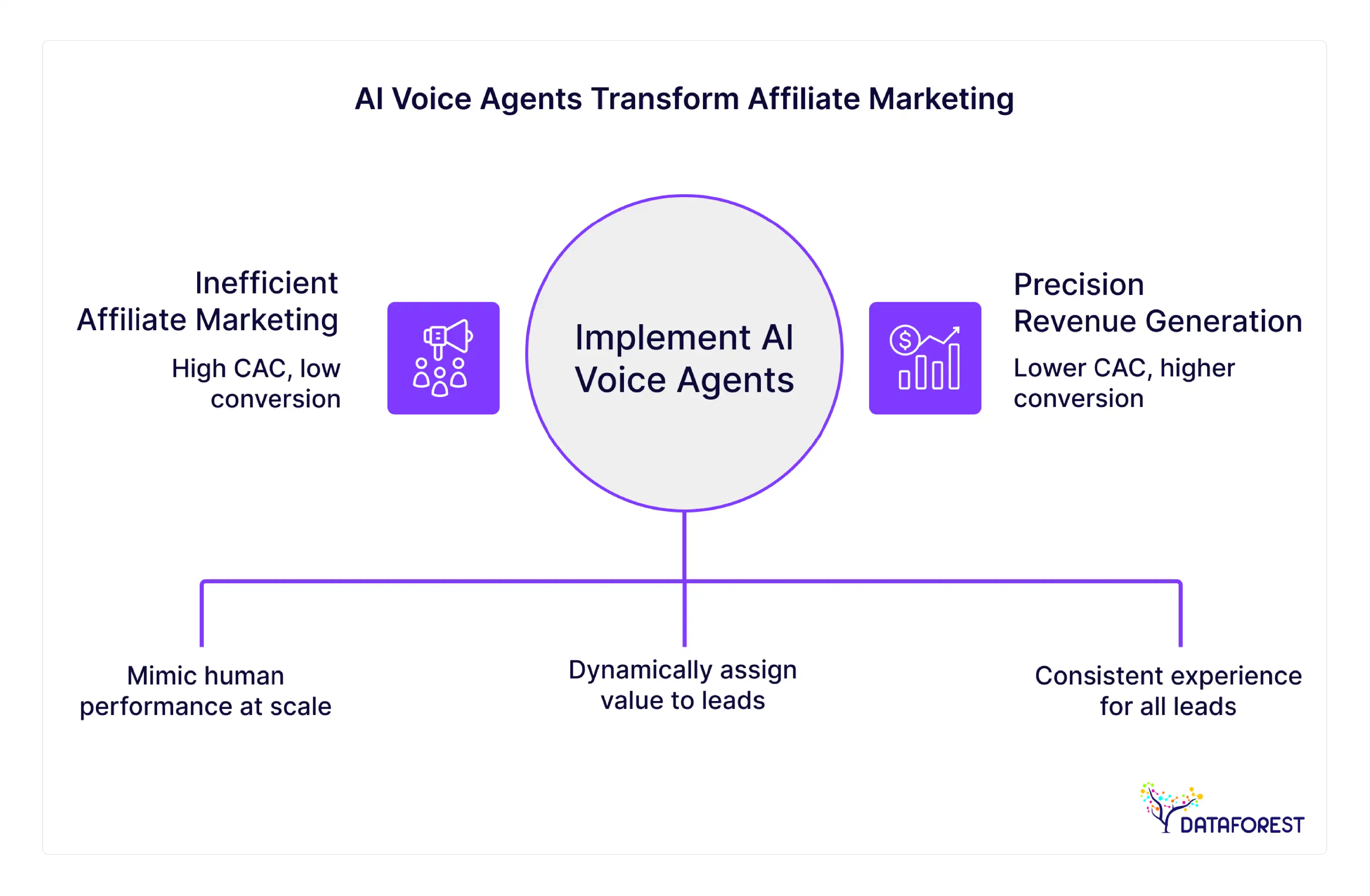
Affiliate marketing has traditionally been dominated by brute force. For years, the formula was simple: If you pour enough traffic into the funnel, a percentage will convert. But now, as we enter 2026, the unit economics of this model are breaking down. The cost to acquire a customer (CAC) has peaked, and the contemporary B2B & B2C buyer has become virtually immune to conventional outreach. At this high-intensity setting, AI voice agents become no longer just about being an efficient tool; they become the focal pivot for strategic survival and growth.
Those in the C-suite and marketing leaders have already started to realise that embedding conversational AI is not experimental—it’s a fundamental platform spend. We are transitioning from static lead generation—forms, clicks, and passive nurturing—to dynamic, two-way engagement. AI voice agents can manage hundreds, if not thousands, of simultaneous conversations with the artistry and subtlety of a top-end sales rep, bringing raw traffic to qualified revenue.
At DATAFOREST, we've noticed that businesses adopting these autonomous operations are doing more than simply saving money; they are reorganizing their entire revenue models. Through advanced NLP and low-latency voice synthesis, companies can now deploy automated sales calls that mimic human-like performance while operating at a virtually limitless scale. In this post, we're going to break down the strategic importance of Voice AI in the affiliate ecosystem and provide a blueprint for implementing, optimizing, and scaling it.
The Future of AI Voice Agents: The Rise of AI and Affiliate
After the release of Alexa and Google Assistant, demand for voice search features and voice-oriented applications skyrocketed.
The traditional performance marketing model has the "time-to-contact" delay as its inherent problem. Research also indicates that the likelihood of a lead being qualified is 400% lower after a contact within 5 minutes than before. This lag kills in an affiliate model, where lead quality is famously all over the map.
Increasing Lead Conversion and Revenue through Sales-Funnel Stages
The big business in AI voice agents is latency reduction. Unlike human Sales Development Representatives (SDRs), who are limited by bandwidth and time zones, the AI agent can fire off a call 1ms after the lead form is filled out. The ability to do so, referred to as speed-to-lead, is the number one factor predicting conversion success.
But speed is only half of it. It's all about the quality of interaction. Nowadays, conversational AI agents use Large Language Models (LLMs) to interpret conversation context, address customer objections, and follow non-linear sales scripts. They're not just reciting lines; they are acting.
For example:
- In the insurance industry, an agent can instantly assess coverage needs and qualify a prospect before routing them to a licensed broker, so high-value humans are only talking to high-intent leads.
- SaaS affiliate programs: Agents who conduct initial discovery calls can ask prospects for their tech stack and pain points before booking them a demo with sales.
With AI-powered lead conversion tactics, firms can double their throughput. A lead that a human team might have cold-stopped as “unresponsive” after two attempts can be incubated by an AI agent via persistent (but polite) sequences of calls and voicemails — squeezing every morsel from the fruit harvested with your marketing dollar.
Enhancing Efficiency Across Affiliate Programs
Affiliate networks are frequently flooded with mediocre or false leads. Manually validating these leads is not economically feasible. Qualified lead bots are your smart firewall. With real-time voice conversations with leads, these agents can evaluate intent and confirm ID far more effectively than a CAPTCHA or an email loop.
In addition, it is this granular data generated by these interactions that enables AI-based marketing optimization. It listens to each stall, hears every concern, and registers a win on every close. That creates a closed loop in which the affiliate program manager can see why leads from a particular partner are not converting. Is it the pitch? The price point? Or the traffic source itself? This transparency enables the relentless optimization of affiliate partners, allocating spending to those that drive actual engagement rather than just click volume.
For brands looking to simplify these workflows, Workflow Automation services provide an architectural underpinning to link voice AI successes directly to CRM and attribution-tracking systems.
Primary Business Benefits For Medium & Large Businesses
For the business, embracing AI voice agents is not just about sales — it’s about operational resilience and scalability. Amid increasingly tight labour markets and persistent wage inflation, the ability to decouple revenue growth from headcount is a major competitive advantage.
Cost Reduction Through Automation
The old school call centre is very capital-intensive. Costs can range from payroll and benefits to training, turnover, and facility needs. In contrast, AI telemarketing tools are based on a pay-as-you-go model. You’re only charged for the minutes you’ve used; there’s no active time charging.
Industry data suggests that using AI to replace Tier-1 support and initial qualification calls can cut operating costs by as much as 60%. So this capital can be reinvested in product development or to scale up your marketing to a superior level. This also makes it unnecessary for multinationals to run 24/7 shifts with separate teams of humans. Every language is spoken and every time zone is covered by an AI sales assistant running AI sales assistant software.
Data-Driven Insights for Smarter Decision-Making
Voice data has been, for too long, a “dark asset” — recorded but rarely analyzed at scale. That’s where voice AI for marketing comes in. Because you will be transcribing and analyzing 100% of calls, businesses can unlock insights like sentiment analysis and keyword trends that were previously hidden.
Predictive lead-scoring AI will then apply this data to dynamically assign a value to each lead. If a buyer says something that resonates with a targeted pain point, trigger slurp it!-Or if an AI agent picks up on a single buying signal (e.g., “enterprise pricing” or “API integration”), it can immediately surface that lead as a high bet. On the other hand, if leads from a specific affiliate repeatedly inquire about “free tiers” and are opposed to pricing, the score is reduced. This insight empowers revenue leaders to predict more accurately and adapt their CS Digital Transformation strategies on the fly.
Better Lead Engagement Without Scaling Staff
Human sales teams scale linearly and slowly. The expansion of an AI workforce is exponential and immediate. At the height of a season — Black Friday for retailers or open enrollment for insurers, say — the enterprise could spin up thousands of voice bots for affiliates' instances to accommodate traffic bursts, and scale back down just as suddenly when demand lulls.
This flexibility is what prevents smart lead nurturing from ever being a victim of volume. Each lead gets that “white glove” experience, whether you are the first or 10,000th person to call that day. Not only does this brand consistency enhance trust, but it also establishes that the affiliate channel is a consistent driver of growth.
Real-World Applications and Case Studies
Theory is important; execution is what separates the market leaders from the laggards. Such was the case at DATAFOREST, where we have developed tailor-made solutions that showcase the true potential of voice AI.
Affiliate Marketing: Examples of Effective AI Voice Agent Deployments
One of our top-notch executions is the Real-Time AI Voice Agent for Cold Calling. The client also encountered a problem typical in affiliate land: the AI response was taking too long, and prospects were hanging up because they knew they weren’t talking to a real person.
To address this in-house, we developed a VAD system with optimized LLM pipelines to achieve response times below 500ms. This "interruptibility"—where the AI could stop talking as soon as the human started—gave a sense of normality. The result was that transfers to human closers became an absolute boon. You can find more about the very technical solution in our case study here.
Sassa too has a similar example on its hands in the case of LeadMarket. In this context, the problem involved handling large volumes of diverse leads. The system used smart cold follow-ups that, at a funnel level, sorted and automated the top of the funnel. This freed up the client’s human agents to focus entirely on closing and dramatically increased revenue per employee.
AI appointment scheduling in the Real Estate Lead Generation space has been an absolute game-changer. For agents, that includes parsing complex schedules, negotiating times with potential buyers, and booking a showing straight into the realtor’s calendar, all of which minimize the friction and back-and-forth that can scuttle deals.
Lessons and Traps to Avoid
The road to automation isn't entirely clear. A key takeaway is that business voice assistants must be honest. Pretenses, pretending that an AI is a person, typically backfire and damage the reputation. A much more efficient strategy is to get the agent seen as a “virtual assistant” whose purpose, above all else, is to facilitate the transaction.
Weak data integration is another stumbling block. If the AI voice agents can’t look up to your CRM to see who the leads are, it will feel fragmented. The AI's brain must be equipped with Seamless integration with CDP, CRM, and data. An AI should have “memory” and remember Demographics. We need the customer experience to provide a personal & seamless touch.

Implementation Strategy for Enterprises
AI-powered lead generation at enterprise scale requires a disciplined architectural approach. This isn’t a plug-and-play software installation; it’s a systems integration project.
Building AI Voice Agents into Your Current Systems
The technical infrastructure is necessary. The AI agent must be placed at the intersection of your telephony provider (Twilio, Vonage), CRM (Salesforce, HubSpot), and affiliate-tracking platform.
We recommend a modular approach. Begin by using Gen AI Integration services to create middleware that manages these connections. The audio stream is passed to a Speech-to-Text (STT) engine, which is fed into the LLM (such as GPT-4o or Claude 3.5 Sonnet) for reasoning, and then back out through Text-to-Speech (TTS). And all of this happens in milliseconds.
At the same time, the agent needs to send data back to the Custom Retail Customer Data Platform or a database like that. The customer who says they are switching from a competitor presents so much vital need-to-know right there that this information just has to be tagged in the CRM on the spot and funneled into the selling strategy.
Integrating AI Automation With Business Objectives
Define what you want to achieve before writing any code. Is the aim to deflect bad leads and book appointments?
For example:
- If it is selling low-ticket items on autopilot, then the AI must have permission to collect payment safely over the telephone.
- If your goal is to nurture the lead, then Smart lead nurturing logic should be used, asking open-ended questions and building rapport rather than going for a hard close.
Alignment also implies training the AI's “brain.” With Natural Language Processing services, companies can build models from their best historical sales calls, literally cloning their top performers.
Selecting the Right Vendor and Technology Partner
There’s a glut of off-the-shelf wrappers on the market, but enterprise-wide custom development is almost always required. When choosing a partner, search for Intelligent call routing and low-latency architecture.
DATAFOREST excels at creating durable, personalized products. Whether it is an AI Voice Agent Solution or a more general Decision Support System, your partner must understand both the data science and the business context of affiliate marketing.
Measuring Impact and ROI
Whatever you can’t measure, you can’t improve. With the move towards AI customer engagement, new KPIs arise.
For Lead Generation and Affiliate Performance: Key KPIs
In addition to regular conversion rates, businesses need to monitor:
- Length of Conversation: The longer someone talks, the more committed they are.
- Sentiment Score: How angry seemed the lead - was it neutral, excited?
- Containment Rate: What % of our call volume did the AI handle without human involvement?
- Appointment Show Rate: Did the AI appointment scheduling schedule the appointments actually kept?
Good performance on these measures suggests that the Conversational AI agents are doing well in building trust.
Leveraging Analytics to Iteratively Improve AI Campaigns
The script's iteration should be based on the analytics. If your AI call automation data shows that 30% of consumers drop off when you ask for their budget, the script is too direct. The AI prompts can be tested A/B-style, like landing pages.
By using a custom e-commerce portal dashboard that visualizes these voice analytics, Marketing directors can rapidly pivot strategy.
Challenges and Strategic Considerations
According to Wikipedia, the benefits are huge, but the risks are not zero.
Data Privacy, Compliance, and Risk Management
Data sovereignty will be key in 2026. AI Voice Agents Compliance with GDPR, CCPA, and Industry Regulations such as HIPAA (Insurance Sales Automation).
You must ensure that:
- Recording consent is acquired on the spot.
- PII is redacted from transcripts before preservation.
- AI doesn’t dream of breaking promises.
Balancing Automation with Human Interaction
Over-automation can alienate premium clients. The strategy should be "human-in-the-loop." The AI handles repetitive qualifications, but it needs to know exactly when to escalate to a human. This transition should be smooth, with the summary delivered to the human agent immediately.
Different Ways to Take AI Solutions to Scale Across Markets
And for global affiliate programs, voice bots for affiliates must be localized, not translated. Negotiations and greetings differ in cultural nuances. An American-style “hard sell” could fall flat in Japan. LLM-powered chatbots and voice agents with cultural fine-tuning are a must-have for success cross-border.
Future Trends and Strategic Opportunities
AI voice agents are moving towards greater autonomy and multimodality.
Artificial Intelligence and Machine Learning for Predictive Affiliate Marketing
The next additions will not simply respond to leads; they will anticipate them. Plug-in AI + ML systems will scan voice patterns to forecast churn risk or upsell potential months in advance. Businesses that leverage Data Scraping and Lead Generation Solutions can bring in information from the external marketplace and have voice agents pull up competitor prices on the fly during calls.
Omnichannel Strategy with Voice AI Integration
Voice will not live in a vacuum. It will combine text, email, and video. An engagement could begin with a Virtual Assistant on a website, move to a voice call for qualification, and end with an SMS confirmation, all in one flow. This connected omnichannel experience is what all AI customer engagement seeks to achieve.
Long-Term Competitive Advantage Through AI
Those who hook on their AI voice agents now are creating a proprietary data asset — millions of conversations that will teach the models to be smarter than their rivals’. This data moat will be the competitive edge in the late 2020s.
The Strategic Imperative
The implementation of AI voice agents in affiliate lead generation is a seismic change in the way value will be extracted from the digital economy. It turns the distracting affiliate traffic madness into a simple engine of predictable revenue. Automated affiliate sales can emerge naturally from this model when qualification and routing become autonomous. By automating the drudgery of qualification and follow-up, companies free up their human capital to do what they do best: building relationships and closing nuanced deals.
There has never been a better time for organizations that are willing and able to lead, not follow, to construct this infrastructure. DATAFOREST is ready to help you make this transition your reality, with domain knowledge in data science, generative AI, and enterprise integration.
Did You Like This? Ready to do lead generation differently? Schedule a consultation now with our AI architects.
FAQ
How Would AI Voice Agents Discover New Affiliate Lead Segments?
AI voice agents, by analysing conversational data, can spot patterns and trends in the data that human analysts working for traditional insights agencies just don’t notice - and through the analysis of thousands of calls, predictive lead scoring AI begins to provide insight at the keyword level or pain point level, ensuring it never disqualifies a lead before. For instance, if all "rejected" leads are avoiding one of your competitor features you have not already implemented, you may realize from AI that this untapped market exists, so perhaps adjusting your affiliate targeting, or product offering can also help you secure more revenue as well.
To what extent do AI voice agents affect the longer-term retention of affiliate partners?
As a result, they have upped the partner retention game by offering transparency as well as high-conversion rates. Many affiliates get pissed off when their leads are not followed up on properly. Dynamic voice follow-up calls. Every affiliate's traffic is guaranteed with a 100% connection rate. Affiliates love seeing that their leads are being “white gloved” through smart lead nurturing, as well as getting granular data on why a lead accepted or failed, and will be more loyal (i.e., direct higher quality traffic your way).
Would AI voice agents even be able to identify fake or subpar affiliate leads?
Yes, they are very good filters. Lead qualification bots can talk an intent to verify (a cosmic Turing test). Whereas simple form fills are easily spoofed by bots, a voice agent can pose complex and non-linear questions. Should the respondent fail to answer contextual questions or if voice identification features resemble known patterns from bots, the lead gets marked. That way, your budget doesn't go to waste on fake affiliate traffic: The solution has a pay-as-you-go policy with absolutely no minimum deposit limit. Get the lowdown on our quality aspirations in a case study of LeadMarket.
How can AI voice agents be used for A/B testing of affiliate outreach scripts?
AI marketing optimization enables fast, scalable A/B testing. You can toss two versions of a sales script to the AI agent: Version A, where price dominates, and Version B, where speed rules. The system monitors the result of thousands of calls on the fly. Unlike humans, who may or may not stick to the script, AI leads generation voice agents perfectly stick to the variables and give clean data on which messaging actually delivers AI-driven lead conversion optimization.
What is the significance of AI voice agents in cross-border affiliate programmes?
They function as a universal translator and cultural go-between. Affiliate voice bots can speak in dozens of languages and sound like native speakers. Doing this means a company in the US can ramp up its affiliate program aggressively in Latin America, Europe, or Asia without hiring local call centers in every country. This scalability is critical for worldwide Affiliate marketing automation.
How do you ensure multi-language or multi-cultural leads engage using AI voice agents?
Above and beyond basic translation, advanced Conversational AI agents are trained on a culturally relevant corpus. They know local slang, customs, and argot. For example, an agent for the UK market will have a different dialect and pacing vs. one for the US market. Enterprises should continue to test varying degrees of localization from full machine translations to human corrections applied on top. They can now also use NLP-based services such as Lexalytics for more precise control.

.svg)
.webp)

.webp)
.webp)


