

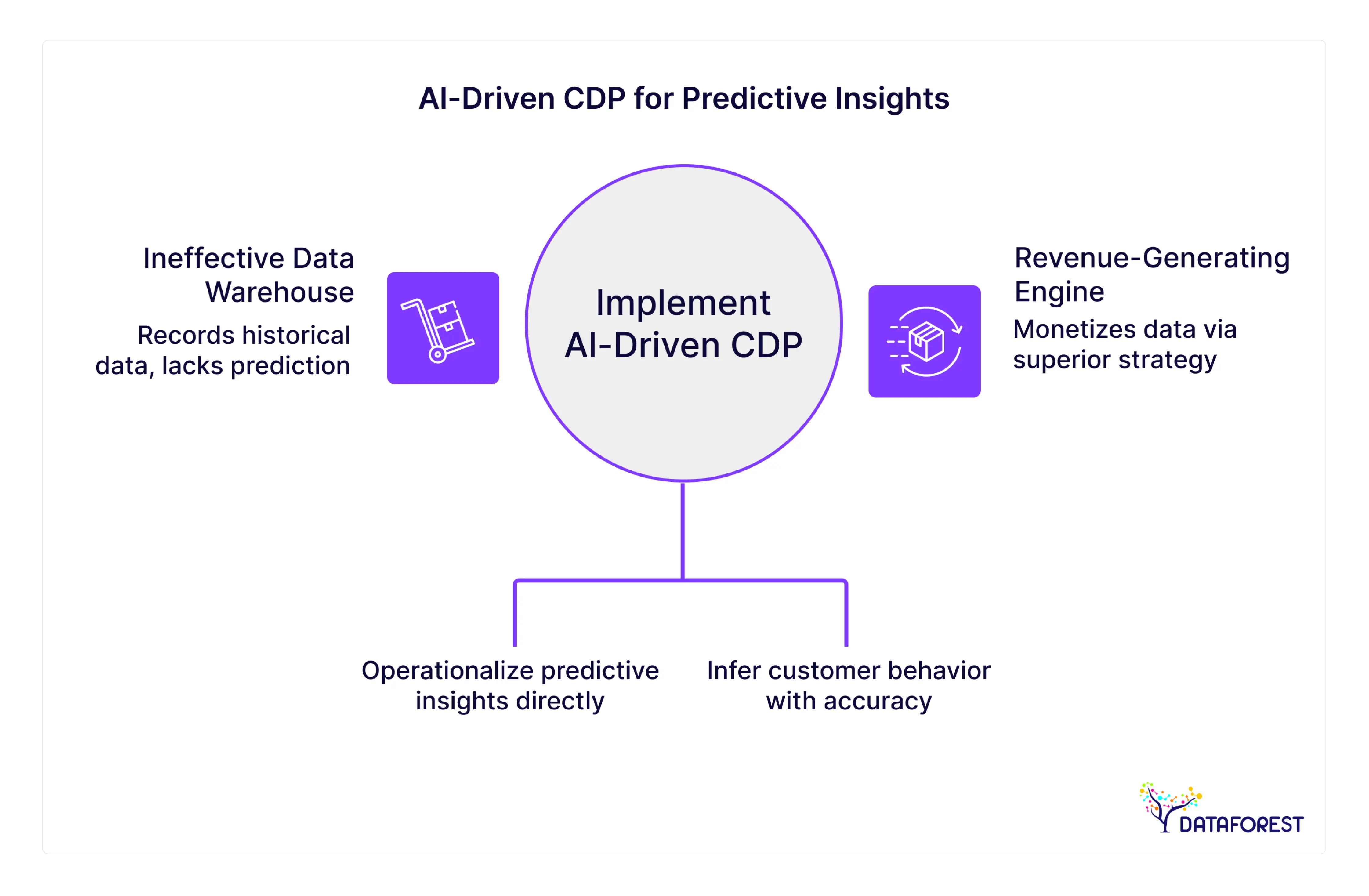
As we enter January 2026, the value proposition of a Customer Data Platform (CDP) has fundamentally changed. For nearly a decade, C-suite executives were sold on the promise of the "Single Customer View"—the seamless consolidation of fragmented data into a single, unified record. However, for many organizations, this resulted in an expensive data warehouse that was effective at recording historical data but failed to offer predictive capabilities.
The game has changed. We've gone from the age of aggregation to the age of intelligence. The contemporary, AI-driven CDP is no longer a dumb silo; it is an intelligent, inferential brain placed at the centre of your enterprise architecture. It doesn't just tell you what a customer did yesterday; it essentially predicts, with very high accuracy, what a customer will do tomorrow.
The crucial point is that the bar to entry for this kind of sophistication has fallen. In 2026, the use of AI in CDP workflows no longer involves a small army of PhD data scientists having to fashion custom models from scratch. The commoditization of AutoML and off-the-shelf generative agents means Chief Marketing Officers (CMOs) and Chief Revenue Officers (CROs) can now operationalize predictive customer insights directly.
This article walks you through how to turn your data infrastructure into a revenue-generating engine, and not just one that manages to keep its head above water in the face of the data deluge while also monetizing it via a superior data-driven customer strategy.
The CDP Evolution — From Data Storage to Decision Engines
To fully comprehend where we are today, we need to recognize at least some of the limitations of recent history. The entire history of enterprise data platforms has been one of minimizing the time between capturing data and acting on that data in business, because every minute between the two leads to lost opportunities. The gears, however, have changed a good deal.
What a CDP Originally Set Out to Do
In the early days, a CDP's principal responsibility was to be the system of record for data. For organizations struggling with data silos (CRM data in Salesforce, behavioral data in Google Analytics, and transactional data in SAP), they still needed a way to connect these different identities.
The traditional CDP excelled at:
Identity Resolution: Rule-based matching (email to email) for the creation of profiles.
Audience Segmentation: Constructing static lists with backward-looking rules (Customers who have purchased X in the last 30 days).
Activation: Sending these lists to an email service provider or ad platform.
And they're just table stakes, even if essential. They provide us with the answer to the question, "Who is my customer?" but not, "Who are going to be my best customers?"
What Makes Traditional CDPs Incapable of Delivering Predictive Value
The "Gen 1" CDP is flawed for relying on pure historical data to derive the data. A typical CDP is a rear-view mirror. It can inform you that there's a high-value account that hasn't logged in for three weeks, but by the time you generate that report and send out a win-back campaign, the churn has already happened.
Moreover, all the manual rule generation was embedded into traditional platforms. If your marketing team didn't go out of its way to create a rule capture for any behavior pattern, it's gone. The human-bottlenecked design used in the wake of such analysis is unscalable to the orders-of-magnitude amounts of signals that are produced by today's digital ecosystems.
The AI-Based CDP Mode in 2026
The AI-powered CDP of 2026 turns that script on its head. Unlike waiting for a human question, the system automatically sifts through customer data pipelines looking for interesting anomalies and possibilities. It utilizes artificial intelligence in customer data platforms to convert raw event streams into propensity scores.
The CDP sort of functions as a "brain" in this structure. It consumes data, uses machine learning in CDP layers to infer intent, and then orchestrates the next best action in milliseconds. This is not automation but autonomy.
For companies seeking to update their infrastructure, DATAFOREST's digital transformation services give a corporation the architectural plan necessary to shift from this static storage model to a predictive and dynamic one.
AI use cases in CDPs that affect revenue and retention
The integration of AI in customer data platform (CDP) environments isn't about adding "magic dust" to your data. It's about targeting specific, high-value use cases that directly impact the P&L.
Anticipatory Customer Analytics (Not Only Predictive BI Dashboards)
In Business Intelligence (BI), you see a report that includes this chart of sales going down. Predictive customer analytics, in the CDP, locates those individual customers causing that dip before it actually materializes on the ledger.
Today, AI CDP powers can score propensity-to-buy as well. Using tens of thousands of micro-interactions — how long someone spends on a pricing page, whether they've used a particular feature, how often they file support tickets — the AI system assigns every user a probability score.
Take a B2B SaaS company targeting users who export data; the company may find that users who have exported three times in their first week are 40% more likely to upgrade to an enterprise tier. The AI sees this pattern immediately and generates a sales alert without requiring manual review.
Customer (LTV) Life Time Value Modelling with AI
LTV modeling driven by AI is the nirvana of spend efficiency. Traditional LTV calculations (Average Order Value × Purchase Frequency × Lifespan) have a fatal flaw in assuming that past behavior is a linear predictor of future behavior.
Non-linear regression models, which operate on measured data, are used in certain AI models to predict the potential lifetime value of a new customer from early interactions.
Early Detection: Identifying "whales" (heavy spenders) during their first session, based on acquisition channel and browsing behavior.
CAC Optimization: Enabling marketing teams to bid more aggressively for leads that AI predicts will have a high LTV, regardless of the size of their first purchase.
This turns marketing into a profit center, not a cost center. Discover how this works in actuality by examining how DATAFOREST delivers predictive analytics offerings in order to improve LTV predictions.
Churn Prediction and Proactive Retention
Churn doesn't happen overnight; it's a gradual decay of engagement. AI-powered CDP-based churn prediction models track the customer health in real-time.
Crucially, AI detects non-obvious correlations. A rule-based system would target "zero logins in 30 days." An AI system could detect "user moving from mobile usage to desktop and ceasing to export reports," for instance, as a leading indicator of churn 85% of the time.
As soon as the risk is detected, an action is triggered by the CDP (this could be a retail discount code or an account check in with a Customer Success Manager for a B2B company).
"No Data Scientist Needed": How This Can Be Reality
The big change in 2026 will be that these tools are now available for everyone. Until now, predictive churn analytics could only have been carried out by a team of data scientists working in Python or R, building models, extracting data, and training these same models, then trying to figure out how to pipe the results back into the CDP.
Emergence of Pre-Built AI Models and AutoML
The first is model reuse — this AI fits into the wider world of modern CDPs that have "Model Zoos" but which are designed for data scientists to solve common business problems (churn, propensity, clustering) quickly. It used to be that execs could choose a model goal (say, "Maximize email open rate") and point the system at the data sets of interest.
AutoML (Automated Machine Learning) does the grunt work: Choosing an algorithm, tuning its hyperparameters, and testing its accuracy. This gives brand technologists almost full-blown data scientist superpowers without writing a line of code.
Feature engineering at scale is no longer a manual bottleneck for large datasets.
As of late 2019, up to 80% of a data project could be "data wrangling" or feature engineering. Now it's automated by AI-driven customer analytics platforms. It can be "days since last purchase" or "average session duration trend, sentiment score of the last 3 support tickets", which are built on the fly by our system from raw log data.
AI Interfaces for Business and Tech Leaders
The AI CDP's UI has come a long way, from SQL editors to NLP. Now, a VP of Sales can ask the CDP: "Show me a segment of retail customers with high churn risk but high LTV, and sync them to Salesforce."
This function fills the void between technical availability and strategic business execution. For businesses that struggle to overcome this hump, having a Machine Learning offering is also seen as an entry point into using these user-friendly interfaces.
Monolith Data Store You Actually Need to Know About to Get Started
And even with the no-data-scientist claim, you still have to have a strong data foundation. AI is what it eats.
Minimal data set(s) for predictive CDP use-cases
They don't all have to be there from the beginning. You need the right data.
Identity Data: Who are they? (CRM data).
Behavioral Metrics: What are users actually doing? (Web/App logs).
Transaction Data: What It's Worth (ERP/POS data).
Eighty percent of high-value predictive modeling comes from these three pillars.
Company-wide Data Dilemmas (and How to Overcome Them)
The lack of data quality is the most significant challenge. Dirty data can give an AI model hallucinations.
Duplicate Profiles: Skew LTV calculations.
Taxonomy Mismatch: 'buy' vs 'purchase' events are confusing the model.
Depth and Automation: Enterprises — Automatic Data Cleaning Pipelines are required. DATAFOREST's data integration and management solutions include the ability to cleanse, normalize, and deduplicate data prior to being analyzed by predictive CDP.
Data Governance, Security, and Compliance
AI governance and compliance are essential in 2026. Transparent automated decision-making (eliminating "black box" bias) and adherence to GDPR, CCPA, and AI Act regulations are required.
Track lineage in an enterprise data architecture—exactly which data point made what contribution to an AI decision. This is essential for auditing and preserving customer confidence.
Where AI-Driven CDPs Belong in Enterprise Architecture
An AI CDP does not exist in a vacuum. The stack sits on top of it.
Integration with Existing Tech Stack
And, the CDP must consume data from the Data Lake (Snowflake, Databricks), and distribute intelligence to the Edge (Salesforce, HubSpot, TikTok Ads).
Modern connectors are bidirectional. From the ERP, the CDP extracts a purchase history, and it calculates an engagement score (predicting churn), and that churn score is then pushed back into the CRM so they are able to see that as soon as they connect with this person.
And, in more complex environments such as these, where low latency is mission-critical, a custom CDP and CRM integration should be implemented.
Build vs Buy – Strategic Considerations
Do you purchase the out-of-the-box CDP with AI capabilities (like Segment or Tealium) or do you invest in building a Composable CDP which sits on top of your Data Warehouse?
Buy: Faster time to value, easier for marketing teams, but possible vendor lock-in.
Build (Composable): Most flexibility, all your data under control, but you will have to engineer and manage it.
A lot of organizations in 2026 are taking a hybrid approach — leaning on a commercial CDP for activation but allowing the heavy AI modeling to happen in their own cloud. DATABRICKS architecture solutions by DATAFOREST are perfect to support this composable way of working.
Real-World Enterprise Scenarios
Let's examine how AI-driven decision-making pans out across various industries.
B2C Enterprise — Reducing Churn at Scale
One global fashion retailer believed that it had a 15% annual churn rate. With the introduction of an AI-enabled CDP, they transitioned from generic please-come-back "We Miss You" emails to predictive personalization.
The Tactic: The AI looked at rates of return. It was discovered that a customer who sends back 50% of the items they order in their first purchase is at high risk of churning if they then do not receive guidance on which sizing to use for their next purchase.
The Outcome: a 20% decrease in churn over six months.
Check out a Retail CDP Solution that uses this type of methodology.
B2B Enterprise — Early Detection of High-Value Accounts
One SaaS company leveraged predictive customer analytics to crunch the numbers on free trial customers.
The Tactic: The AI CDP looked past all leads as equals and instead scored leads based on the complexity of features used. Users with integrations set up (API usage) were labelled as "High LTV."
The Outcome: Sales optimized their focus on the top 10% of leads; Conversion uplift by 35%.
Use case example: Chargeback Management B2B SaaS Platform.
Subscription-Based Businesses — Maximizing LTV
For a media streaming service, it's cheaper to retain one user than it is to acquire a new one.
The Tactic: They rolled out an LLM-powered recommendation system via their CDP. The AI wasn't simply suggesting content, but suggesting the moment (push notification or email) to suggest that content based on when the user was most likely to be feeling dull.
The Outcome: LTV up by 12% in 12 months.
Quantifying Success – The KPIs Executives Really Care About
Tracking the right metrics is key to proving the value of artificial intelligence investment in customer data platforms.
Revenue and Growth Metrics
Additional Revenue: Revenue directly traceable to AI-recommended products.
CAC/LTV Ratio: This should get better as AI goes after better leads (LTV up) and reduces ad spend waste (CAC down).
Retention and Customer Health Metrics
Correct Churner Prediction: % of churn predictions that are actually churns. (The aim is to reduce real churn, of course — but the model needs to be calibrated).
Retention Rate Improvement: Month-over-month stability.
Operational and ROI Metrics
Time-to-Insight: The lag between adding data and an actionable segment? (Should be minutes, not weeks).
Campaign ROI: How efficient is my marketing investment?
Common Pitfalls and How Companies Overcome Them
Even in 2026, projects fail. Here is why.
Overengineering AI Without Business Alignment
It is garbage to build an intricate neural network to predict something that doesn't mean anything in the business case. And it should all stem from the business question (e.g., "How do we minimize cart abandonment?"), not the technology.
Meaning AI as a project done once
The AI-based LTV modeling and churn prediction just work. Models decay shape over time (model drift) as consumer behavior changes. You need a way to keep measuring things and retraining. It's where MLOps services are crucial.
Ignoring Change Management and Adoption
The best customer predictive analytics has no value if the marketing department doesn't believe it. You need to make the investments in training and "explainable AI" dashboards so that human operators feel empowered, not replaced.

Why Data & AI Expert is Your Partner in This Endeavor
While "No Data Scientist Needed" is certainly the case for running these tools, there's often a need for deep expertise in their setup, strategy, and architectural alignment.
Strategy to Execution in Data and AI
DATAFOREST specializes in this intersection. We are more than just pipeline builders; we're revenue engines. Data Strategy consulting to implementation, ensuring you capitalise on your CDP.
End-to-End CDP and AI Enablement
Need a CDP integrated online retail storefront or want to deploy an entire Decision Support System? Working with an expert shaves 12-24 months off your roadmap.
The Path Forward
The question is not whether to use AI in your CDP in 2026, but rather, "How soon can we operationalize it?" This intersection of practical AI, robust data infrastructure, and predictive modeling is opening a new chapter in the battle for customer retention and LTV growth.
By moving from custodians of data to AI-powered decision makers, brands can finally unlock real value from their customer datasets. You don't need a PhD to get started, but you do need strategy, a sturdy data platform, and the courage to transform.
Are you ready to turn your CDP into the predictive revenue engine?
Get in touch with DATAFOREST now, and get an appointment.
FAQ
What are the business problems that composable CDP addresses better than other traditional CDP platforms?
In 2026, AI in customer data platform CDP architecture is what allows large enterprises to keep their data flexible while still running advanced predictive models on top of a unified warehouse. A composable CDP addresses both the data fluidity and vendor lock-in challenges. Unlike a classic rigid platform, which requires you to store the data in its proprietary format, a composable CDP is right atop your current Data Warehouse (such as Snowflake, Databricks, etc.). This solves the "single source of truth" problem, as you don't have to copy data into a different CDP silo. It also helps with cost control and customization of AI models when the data is retained within your controlled infrastructure.
How does a composable CDP accelerate AI and ML use cases for large enterprises?
Composable CDPs are also more naturally well-suited to AI-powered customer analytics, as they have direct access to raw, granular data that can be used to train models. You see, classic CDPs aggregate or summarize data, losing the nuances needed for predictive churn analytics at high precision. Leveraging the computational capacity of the underlying data warehouse, a composable architecture enables data science teams (or even an AutoML agent) to execute complex AI-based LTV modeling on the full dataset without incurring costly data egress fees or latency issues.
What is the average implementation time for a Composable CDP in an enterprise setting?
At its most simple, a data warehouse to connect your marketing activation channels could be implemented in just 4-8 weeks. But a complete enterprise rollout of AI governance and compliance, advanced identity resolution, and predictive CDP analytics across global teams typically lasts 4 to 6 months. This still represents a significant improvement over the typical 12-18-month deployment cycle of monolithic legacy CDPs.
Ok, what are the most prevalent architectural patterns for composable CDPs in 2026?
The "Reverse ETL" is the predominant model of 2026.Storage: Data Lakehouse (Databricks/Snowflake) is the storage tier.Transformation: Model the data; this can either be a logical model or SQL-style modelling to clean up and prepare the data.Intelligence: An AI cdp layer / AutoML Service calculates scores (churn risk, LTV).Activation: A Reverse ETL tool (such as Hightouch or Census) takes these segments and scores and pushes them to operational tools (CRM, Ad Platforms, Email).
This is a pattern that ensures the Data Warehouse is the brain and the operational tools are the appendages.
What are the governance and privacy challenges we need to solve to build a composable CDP?
Main issue: It is more of the politics of consent and access on a very distributed architecture. Given that data is flowing into multiple endpoints, the "Right to be Forgotten" (GDPR) needs to be done on the warehouse and all connected SaaS tools! There's also a need for AI governance to oversee bias in predictive models—the idea that an algorithm is unintentionally leaving some demographics due to bias in the training data.
How does a composable CDP fit with your existing CRM, marketing automation, and product analytics stacks?
It is connected through the API-first connectors, which are normally handled by the Reverse ETL. And instead of classic integrations that sync point-to-point (e.g., Salesforce talking directly to Marketo), the composable CDP is pushing a unified view from the warehouse to every downstream tool at once. Upgrade a customer, and the warehouse updates; it is then instantaneously pushed into CRM (for sales), Support Desk (for priority routing), and Marketing tool (to stop upgrade emails). Total sync!

.svg)
.webp)

.webp)
.webp)


