

.webp)
The Tough Business of Change
In 2026, perpetual volatility is the operational baseline for transportation and logistics. Heightened trade shifts, extreme weather disruptions, fluctuating energy costs, and strict Scope 3 decarbonization mandates have made legacy supply chain models completely obsolete.
Enterprises still constrained by siloed data, manual handoffs, and reactive decision-making are no longer just facing a disadvantage—they are being priced out of the market by AI in transportation-orchestrated networks.
For the C-suite, margin preservation requires far more than surface-level cost-cutting; it demands autonomous resilience, real-time adaptability, and predictive foresight. AI has fully evolved from experimental pilots into the core operational nervous system. By deploying agentic workflows, dynamic route generation, and real-time asset optimization, industry leaders are driving levels of throughput, cost containment, and precision that were unimaginable a few years ago.
The phase of evaluating whether to digitize has passed. In 2026, businesses must scale enterprise-wide predictive intelligence and automated decisioning immediately, or cede market share to competitor networks built on real-time AI.
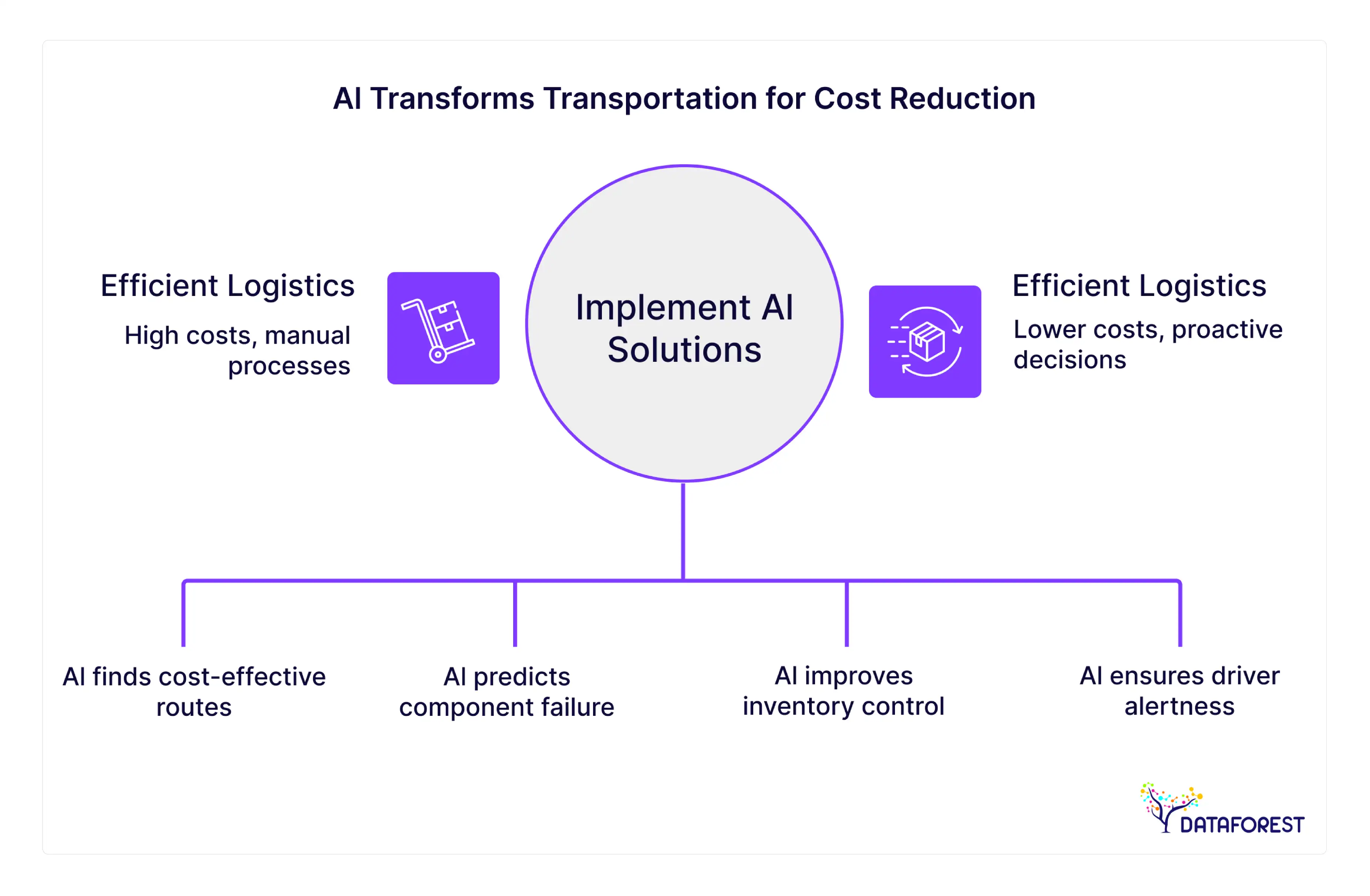
AI in Transportation to Reduce Costs
The flow of information across modern logistics pipelines has transformed into a continuous stream of real-time telemetry that legacy systems cannot digest. Siloed architectures prevent cross-functional visibility, leaving traditional operations trapped in reactive decision-making. Machine learning and multi-agent AI networks have completely inverted this equation. Operating continuously in the background, AI enables businesses to convert reactive supply chains into predictive, self-optimizing operations. Modern market leaders no longer treat enterprise data as a dormant log; they deploy agentic workflows that dynamically reallocate resources, eliminate operational bottlenecks before they manifest, and secure consistent margin protection across all transport corridors.
The Economics of Efficiency
The economics of the AI in transportation logistics business case are compelling.
Every truck inefficiently routed, hour of downtime not detected, and packing list inaccuracy unnoticed translates directly into bottom-line losses.
AI-driven solutions eliminate these inefficiencies, delivering substantial cost reduction in fleet operations. Fuel is a prime example – it can account for more than 30% of operational expenses – but AI-driven algorithms, drawing on telematics data, traffic flows, and local terrain, adjust routes on the fly.
The American Transportation Research Institute reports that this technology can slice 20% off fuel costs alone. Across a large fleet, such savings are immense. Similarly, AI predictive maintenance in transportation addresses the problem of unscheduled, expensive repairs. However, this kind of maintenance can be five times as costly as regularly scheduled maintenance, and it directly impacts asset availability.
From Data to Decisions
The strength of AI in transportation management lies in its ability to take vast amounts of data and make it useful through predictive analytics in transport.
For this reason, if only for this, digital twins – digital recreations of physical assets and supply chains – are a game-changer. Digital twins, utilizing deep learning for transportation systems, fuse data generated by IoT sensors, GPS, and enterprise systems and become a living model of operations.
Deloitte states that digital twins allow operators to model the consequences of decisions before they are made. For example, a logistics manager may shut down a port and see the downstream impact and utilize AI to prescribe a global backup plan in minutes.
No longer is data a dormant log – it predicts what will occur next, providing strategic control to both the manufacturing and retail sectors.

Core Applications of AI Across the Transportation Ecosystem
The spectrum of AI innovations in logistics is broad – the tools out there now touch nearly every part of the transportation life cycle, and are increasingly working together to create a more cohesive, smarter operational fabric.
Predictive Route Optimization
Outside of the traditional GPS application, AI-driven route optimization systems are scanning a multitude of variables in real time—traffic, weather forecasts, delivery windows for customers, and driver productivity.
This smart routing, however, doesn't just find the shortest path; it finds the cheapest one. Companies using AI for transportation report faster cycle times and lower costs, while teams also adopt AI route optimization techniques to refine dispatch decisions and boost fuel efficiency using AI algorithms.
In complex networks, intelligent route planning becomes a force multiplier. For businesses with complex routes, this may represent astronomical improvements in fuel efficiency, reduced person-hours, and reduced emissions to the atmosphere.
Generative AI is also helping systems design completely new network configurations for supply chain changes – a topic we covered in our post about generative AI in logistics.
Fleet and Asset Management
AI is the cornerstone of modern fleet management. Predictive maintenance algorithms in transportation can predict part failure with astonishing accuracy from sensor data.
This results in reduced downtime, less maintenance, and improved safety. AI-enhanced telematics can monitor driver actions, including hard braking or idling, and recommend coaching opportunities, leading to better fuel economy and continued safety.
Demand Forecasting and Load Optimization
Poorly planned demand is, quite simply, a waste of money.
In the context of demand forecasting, AI in transportation gives companies a better chance to scrutinize their historical sales data within the context of market conditions and third-party data in order to gain more prescience into future demand than ever before.
Many organizations now deploy AI for demand forecasting to sharpen S&OP cycles and improve service levels.
This results in improved warehouse inventory and load consolidation. Optimization problems also include how to pack the goods into the space available and send as few shipments as possible.
Its impact is huge, with one DATAFOREST case study showing that an AI system saved a retailer $142 million.
AI-Powered Safety and Compliance
AI systems, such as in-cab cameras, can notify drivers if they appear drowsy or distracted and guarantee the AI functions as a co-pilot.
On the compliance side, AI also automates Hours of Service management, removing administrative burden and decreasing exposure for violations by leveraging the efficiencies we have rolled out in our back-office automation programs.
Data-Driven Infrastructure
AI technologies are already impacting the infrastructure itself.
AI-based traffic control is fundamental to the AI and smart cities transportation vision. Cities are piloting AI traffic management platforms to harmonize corridors and reduce congestion, while AI-powered traffic management further tunes intersections dynamically with connected sensors.
It also advances AI for transportation, which is a good thing for us all when it comes to cutting down on our commute times. For logistics companies, it could mean a more reliable schedule.
Autonomous and Semi-Autonomous Technologies
Autonomous freight transition has shifted from regional pilots to scaled commercial deployment. Fully autonomous middle-mile networks now operate routinely across major highway corridors, managing hub-to-hub transport with high precision, zero downtime, and lower operating overhead.
Across regional routes and last-mile networks, AI in transportation serves as an active co-pilot through Advanced Driver Assistance Systems (ADAS) and real-time cab monitoring. Modern mobility platforms seamlessly integrate multi-sensor perception, predictive modeling, and control algorithms to coordinate hybrid fleets—combining autonomous long-haul capacity with human-driven local delivery for optimal safety and speed.
Measurable Business Outcomes of AI Adoption
Cost Reduction and ROI
Chief among the reasons driving AI adoption are its proven impact on the bottom line via:
- Reduced Fuel Expenses through perfect routing and driver behavior tracking optimized by AI in transportation.
- Lowered Maintenance Costs through predictive maintenance.
- World-Class Savings on Manpower via task automation and increased productivity.
- Reduced Compliance Penalties by way of self-documenting.
Companies can anticipate a quick return on investment, usually within 12–18 months.
Operational Agility and Predictive Control
But in a volatile market, nimbleness is everything.
What AI does is give the prescriptive analytics necessary to be able to predict those disruptions. Whether rerouting a fleet or realigning inventory, AI-powered Intelligent Transportation Systems (ITS) give decision-makers the visibility they need to be in control — a single, one-stop-shop supply chain dashboard for truth-based agile decision-making.
Sustainability and ESG Alignment
Environmental, Social, and Governance (ESG) criteria have never been more important.
AI represents a clear route to that improvement. By optimizing routes and minimizing downtime, AI can cut down on fuel waste, helping a fleet reduce its carbon footprint — and in doing so, help meet legal regulations as it builds brand recognition.
Implementation Roadmap: From Pilot to Enterprise-Wide AI
Assessing Readiness and Defining Goals
The first is understanding organizational readiness. That includes identifying the hardest business problems AI for transportation might solve, evaluating an existing data infrastructure, and scoping a pilot project that can produce an early win.
Building the Data Infrastructure
The performance of an AI transportation system relies essentially on the quality of the data that is fed into it.
The first phase is about breaking the silos and delivering these clean, accessible data streams that are required for machine learning in transport engines.
As our discussion of effective data integration indicates, this foundational layer is key to success.
Developing and Deploying AI Models
Modeling one's own specific operating condition presumes the ability to understand and implement data science.
The pilot has to be phased in in a 'safe environment,' and after this, it needs to be evaluated and tested to see the required results.
Scaling and Continuous Optimization
When a pilot has been proven, the next step is to scale across the enterprise.
This implies a sound IT architecture and solid change management. AI systems are not "set and forget" — they need constant retraining and monitoring to perform at their best.
Overcoming Challenges in AI Adoption
Data Silos and Integration Gaps
Noise in the data is a serious issue for AI for transportation. That requires a judicious data governance strategy and investment in modern platforms capable of bringing information together.
Organizational and Cultural Shifts
Success demands an embrace of a new culture where data-driven decision-making feels as comfortable in the boardroom as it does on the frontlines.
This also means teaching staff and integrating workflows into intelligent systems.
Technical and Ethical Considerations
The application of AI triggers issues associated with model accuracy and security.
Eventually, ethical issues such as data privacy and algorithmic biases should be addressed early on to enable responsible deployment.
The Future of AI in Transportation
The next steps for AI in transportation will offer even more integration and autonomy with "hyper-automation," the desired outcome where connected AI transportation systems manage complete logistics networks.
Advanced techniques like digital twins will facilitate prescriptive management of global supply chains.
The reality is that the AI in transportation market is destined to grow because of how hungry consumers are for efficiency and resilience.
Partnering for Success: How DATAFOREST Enables Intelligent Transformation
Getting started with an AI transformation means establishing the right partnership.
We at DATAFOREST are specialists in tailored AI and machine learning systems that help you solve even the most difficult logistics problems.
We roll up our sleeves at every level of the AI journey – from strategy to data infrastructure, model innovation, and into the industrial functionality of our products inside corporations.
We create custom decision support and automation systems, made to measure for you.
Working with DATAFOREST means having technical expertise and strategic vision that allows you to transform your data into your most powerful competitive weapon using AI for transportation.
Discover more by visiting our documented case studies.
The Strategic Inflection Point
The transportation sector is operating in an environment of non-stop structural disruption. The leadership mandate for 2026 is clear: enterprises must aggressively scale enterprise-grade AI for transportation and agentic automation, or watch hyper-optimized rivals dominate the market.
AI in transportation is baseline infrastructure required for operational survival. By embedding predictive intelligence and real-time decisioning into supply chain orchestration, industry leaders are securing margin protection, driving peak productivity, and building end-to-end network resilience.
Ready to turn your logistics infrastructure into an autonomous competitive engine? Contact our specialists and schedule your 2026 AI transformation strategy session today.
Frequently Asked Questions
How can AI support strategic decision-making beyond operational optimization in transportation?
Utilizing highly developed scenario modeling and network design, it synchronizes more strategic decision-making.
Artificial intelligence can help with more than just optimizing daily routes — it can also allow shippers to model the impact of bigger decisions, such as whether or not to open a new distribution center or enter a new market.
Based on past statistics and projected market estimates, the platform can forecast capital and operational expenditures to allow for necessary investment strategies – as shown in analyses from Maddevs.
These are the primary features of contemporary AI transportation Decision Support Systems.
Can AI predict the impact of external factors like fuel price fluctuations or global supply disruptions?
Yes. Predictive analytics, which are part of AI in transportation and logistics, are built for this.
Machine learning models can be trained on huge datasets that incorporate historical fuel prices, geopolitical risks, and weather patterns.
By identifying trends, these models can anticipate the effects of a supply disruption and recommend proactive actions — such as hedging fuel prices or switching modes of transportation — turning a reactive supply chain into a predictive one, as shown by industry reports.
How can enterprises integrate AI into existing ERP, CRM, or TMS systems without rebuilding their IT infrastructure?
Today's AI tools are typically made to be easily integrated using APIs (Application Programming Interfaces) with the rest of a corporation's tech stack.
Instead of a 'rip and replace' strategy, companies have the option for a gradual one — adding AI to the existing IT system.
For example, an AI-driven route optimization engine can integrate with your ERP to receive order information and send the most optimal routes back to a TMS. AI with transportation systems can therefore augment existing workflows without requiring a complete technology replacement.
The linchpin is efficient data integration — ensuring data flows freely.
What role do digital twins play in optimizing transportation and logistics operations?
Digital twins act as virtual live counterparts of a supply chain within an AI transportation framework.
Their main purpose is to emulate a clean virtual platform for testing and optimization.
For instance, before rolling out a new process in a warehouse, you can test it on the digital twin to identify bottlenecks.
When there's a disruption, you can model possible responses and choose the best one.
This is explored more in our post on Data Science in the Supply Chain, which connects planning and execution.
How can AI help companies balance cost optimization with service quality in logistics?
AI frees companies from the ancient cost-service trade-off.
An AI transportation model might determine that the cheapest shipping option still meets a customer's delivery promise — balancing customer value, shipment urgency, and delivery cost.
It optimizes consolidation of flows by Full Truck Load, planning routes in all delivery windows, preserving service quality — one feature that makes expert solutions such as those of DATAFOREST stand out.
How can AI-driven analytics improve contract negotiations with carriers and suppliers?
AI transportation analytics provide a potent competitive advantage.
By benchmarking carrier pricing and performance using historical data, AI evaluates offers across multiple criteria — cost, timeliness, damage rates — to ensure the company secures the best balance of price and service.
This data-driven insight gives companies leverage to negotiate better terms with carriers and suppliers.
What are the key steps to ensure ethical AI adoption in transportation?
AI transportation needs an ethical framework for adoption.
- Transparency: All stakeholders, especially workers, must know what data is collected and how models use it.
- Fairness: Regular audits prevent bias and ensure drivers or employees are not penalized unjustly.
- Data Privacy: Compliance with regulations like GDPR is essential.
- Governance: Maintain a clear human-in-the-loop process for all critical decisions involving AI in transportation.

.svg)
.webp)
.webp)
.webp)


