Home page  /  Services  /  Generative AI  / Multi-Agent Orchestration

Give Your Enterprise AI Agents the Manager

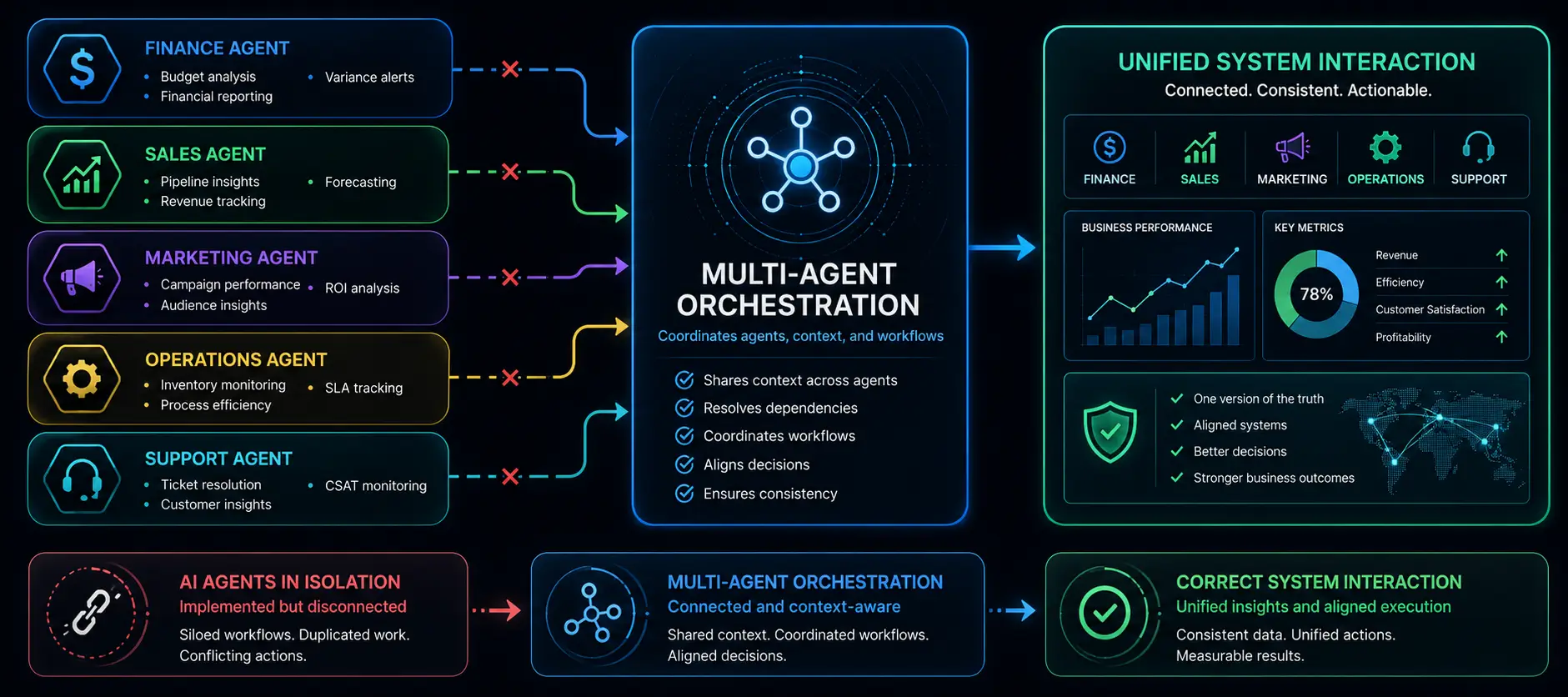
Your finance, sales, and operations departments run completely separate enterprise AI systems. These smart agents work in complete data isolation. Multi-agent orchestration links all isolated software programs into a single central network. This direct control layer cuts your total daily enterprise operations expenses.

60 minutes · Architecture review · We map what to build first for your specific stack.
This step creates your multi-AI agent orchestration.

Book a Strategic Session


Not ready for a call? Download the free whitepaper

clutch 2023
Upwork
clutch 2024
AWS
PARTNER
Databricks
PARTNER
Forbes
FEATURED IN
Multi-Agent Orchestration for Enterprise AI

250+

projects

1,950 TB+

processed

8

years

92%

client retention
Multi-Agent Orchestration

Sound familiar?

AI agents are live, but results are missing

You implemented agents in finance, sales, operations, or analytics — but the business still doesn’t move faster. The tools exist, but the workflow impact is unclear.
case 2 bgr

Every agent creates more output to verify

The finance agent gives an answer. The sales agent gives another. Now your team spends time checking which one is correct instead of making decisions.
case 4 bgr

Agents work in isolation

Each agent sees only its own data, context, and task. They don’t share findings, resolve conflicts, or understand how their output affects other departments.
case 1 bgr

Humans still connect the dots

Instead of replacing manual coordination, agents create another layer of work. Analysts still compare results, validate logic, clean up inconsistencies, and prepare final answers manually.
case 6 bgr

No shared business context

Agents may be technically functional, but they don’t operate from one trusted source of truth. Without shared data, rules, and context, every output becomes questionable.
case 3 bgr

AI adoption feels slower than expected

The promise was faster execution. The reality is more checking, more reconciliation, and more uncertainty — because individual agents were implemented without orchestration.
case 2 bgr

The Architecture That Makes Agents Work Together

A set of distributed agents is not a product that you can buy. It is a method that you build with proper planning. This requires a strong multi-agent orchestration architecture.
data icon
Level 1: Data Lake
You include all sources. These sources are structured tables, unstructured documents, sensor feeds, PDFs, and call logs. The data moves through three distinct stages.

1. Bronze: We store the raw data.
2. Silver: We clean the data.
3. Gold: We make the data ready for analysis.

Your AI agents receive complete and consistent information for their work.
01
steps icon
Level 2: Data Warehouse—A Single Source of Truth
Finance, sales, jobs, and marketing read from one place. There is no correction. There are no objections. One reliable version from every company, every agent, every report.
02
Data-driven
approach 
Level 3: A multi-agent coordination
Specialized agents per department. A coordination process that combines routing questions, collecting results, and delivering a consolidated answer. "Why did revenue drop in the third quarter?"—answered in minutes.
03

WITHOUT ORCHESTRATION

WITH DATAFOREST

5 analysts · 5 tools · 5 days
1 orchestrator · 5 autonomous agents · minutes via AI workflow automation.
2-hour meeting to reconcile conflicting numbers
One unified answer, traceable to the source.
AI proof of concept to production fails
Foundation first. You scale agents using scaling AI agents enterprise standards.

Real Architectures for Real Results

01

Chemical Manufacturing

U.S. industrial manufacturer · 10+ acquisitions · fragmented ERP data → 70% faster data injection · 80–90% reduction in manual processing
02

SaaS / Chatbot Platform

50,000+ companies · scaling to 200M users · non-technical builders → 32% improvement in client experience · 43% faster workflows
03

eCommerce

480+ hours/month manual reconciliation · stale reports · slow decisions → 480 hours saved/month · reports delivered same night instead of 3 days later
04

Healthcare

Fragmented EHR + billing + manual inputs · regulatory reporting by hand → 9,600 hours eliminated per month · They fully automated regulatory reporting using multi-agent systems orchestration.
05

Retail

Fragmented forecasting · inventory on 2-week-old data · no unified view → 88% accuracy increase · $142M in savings identified via AI-powered decision-making.

Where Are You Right Now in the Enterprise AI Orchestration?

Your current state 

What’s risky

What we recommend first 

You don’t have one unified data layer
❌ Agents will pull from disconnected systems and return unreliable answers 
✔️ Build a Data Lake to collect structured and unstructured data in one foundation 
You have a Data Lake, but no trusted Warehouse 
❌ Reports still don’t match, and teams keep debating which number is right 
✔️Build a Data Warehouse / Single Source of Truth so every team and agent works from the same business logic 
You have a Warehouse, but no AI agents yet
❌ Decisions still depend on analysts manually checking reports and building summaries 
✔️ Start with department-level agents for Finance, Sales, Operations, Support, or Marketing 
You already have agents in different departments
❌ Each agent works alone, outputs conflict, and humans still reconcile everything manually 
✔️Add a Multi-Agent Orchestration Layer to coordinate agents and produce one unified answer 
Your agents hallucinate or miss context
❌ They don’t have access to contracts, PDFs, emails, call transcripts, or other unstructured data 
✔️ Expand the Data Lake and retrieval layer before scaling orchestration 
customers

Not sure where you are?

Let's find out together
Book a Free Strategy Call

The Cost of Coordination Overhead Is Measurable

480h

saved/month · eCommerce

9,600h

eliminated/month · Healthcare

88%

forecast accuracy · Retail

$142M

savings identified · Retail


For most organizations we work with: 8–20 people, 4–8 hours per week on manual data reconciliation.
At $80–120/hour loaded cost—that's $160K–$1.2M per year. This ignores the cost of delayed decisions. Multi-agent systems orchestration removes this overhead from your enterprise workflows.


ABOUT DATAFOREST

DATAFOREST builds the data foundations and AI architectures that make enterprise agents work in production — not just in demos.

Our teams have delivered AI systems with 9,600+ manual hours eliminated per month, 43% faster AI-powered workflows, 80–95% reduction in manual data handling, and 99.5% automation accuracy.

250+ projects · 1,950 TB+ processed · 8 years · 92% client retention

We help companies connect fragmented data, coordinate AI workflows, and scale agentic systems with one trusted operational foundation.
Clutch logo and 5 stars review
Most Reviewed IT Services Company Estonia
mackine learning company Estonia
award
Top 100 cloud consulting companies 2025
Artificial Intelligence (AI)
Data Science

Questions On Agent Orchestration

What is multi-agent orchestration, and how is it different from just using AI agents?

Finance and sales departments run separate autonomous AI agents for the enterprise in complete data isolation. Multi-agent orchestration links every isolated software program into one central network. This coordination process delivers a consolidated answer in minutes.

When does a company need multi-agent orchestration?

A company requires the service when individual specialized AI agents create conflicting data outputs across separate departments. You need it when manual data reconciliation consumes too much employee time each week. This AI orchestration architecture serves teams that struggle to scale their pilot projects into reliable production deployment.

Why do AI agents fail or give conflicting answers in production?

AI agents fail because they operate in data silos without a shared foundation. They pull facts from different sources, so finance and sales agents return conflicting results. They lack a central controller. This layer of multi-agent AI orchestration reconciles these differences before they deliver an answer.

Do we need a full data platform before implementing multi-agent orchestration?

You must build a unified data foundation before you deploy agentic AI implementation at scale. Agents require accurate, consolidated data to prevent bad results. You can start with one department, but the scalable AI systems must connect those systems to one reliable set of facts.

How do you connect agents across CRM, ERP, spreadsheets, and other systems?

You build a centralized data lake to pull information from disconnected sources. This AI orchestration architecture maps raw data into a clean, unified format. Your orchestration layer for AI agents manages agent routing to produce a single, verifiable answer.

Can this be built if we don’t have internal AI or data engineers?

You do not need internal engineering teams to build this. DATAFOREST builds your data foundations and deploys the AI agents’ architecture for you. Your team gains the results of a finished system immediately.

How do you know whether a company needs a data lake, warehouse, or orchestration layer first?

Start with a data lake if your organization lacks a unified foundation for raw information. Build a data warehouse if you have data, but your reports display conflicting versions of the truth. Add orchestration for AI agents only after you secure these foundations to stop them from contradicting each other.

Let’s discuss your project

Share project details, like scope or challenges. We'll review and follow up with next steps.

form image
top arrow icon