Home page  /  Services  /  Data Engineering  / Data Orchestration Services

Trusted Data for Every Report, KPI, and AI

Synchronize business logic, automate data movement, and ensure every department works from the same trusted information.
‍
Most growing companies already have ERP, CRM, finance systems, cloud platforms, and AI initiatives. The challenge isn't collecting data - it's making every report, dashboard, and AI application use the same trusted information. DATAFOREST modernizes enterprise data architecture and orchestrates data so leadership can trust every decision.
‍

clutch 2023
Upwork
clutch 2024
AWS
PARTNER
Databricks
PARTNER
Forbes
FEATURED IN
Enterprise Data Orchestration Services for Trusted Business Data

92%

Client Retention

70+

Data Engineering Projects

1,950 TB+

processed

50+

Enterprise Data Platforms Delivered

What’s Data Orchestration

Think of data pipeline orchestration as the coordination layer behind your business data. It automatically moves, validates, and synchronizes information between systems so reports, dashboards, and AI always use consistent business data. This ensures absolute data accuracy.

Your Systems Are Connected. Why Do Reports Still Conflict?

You have the right systems in place. But duplicate business logic still leaves your leadership struggling. You face conflicting reports, unreliable AI, and endless manual reconciliation. We bridge this gap through intelligent data orchestration. We transform your fragmented infrastructure into unified, trusted enterprise data for AI.

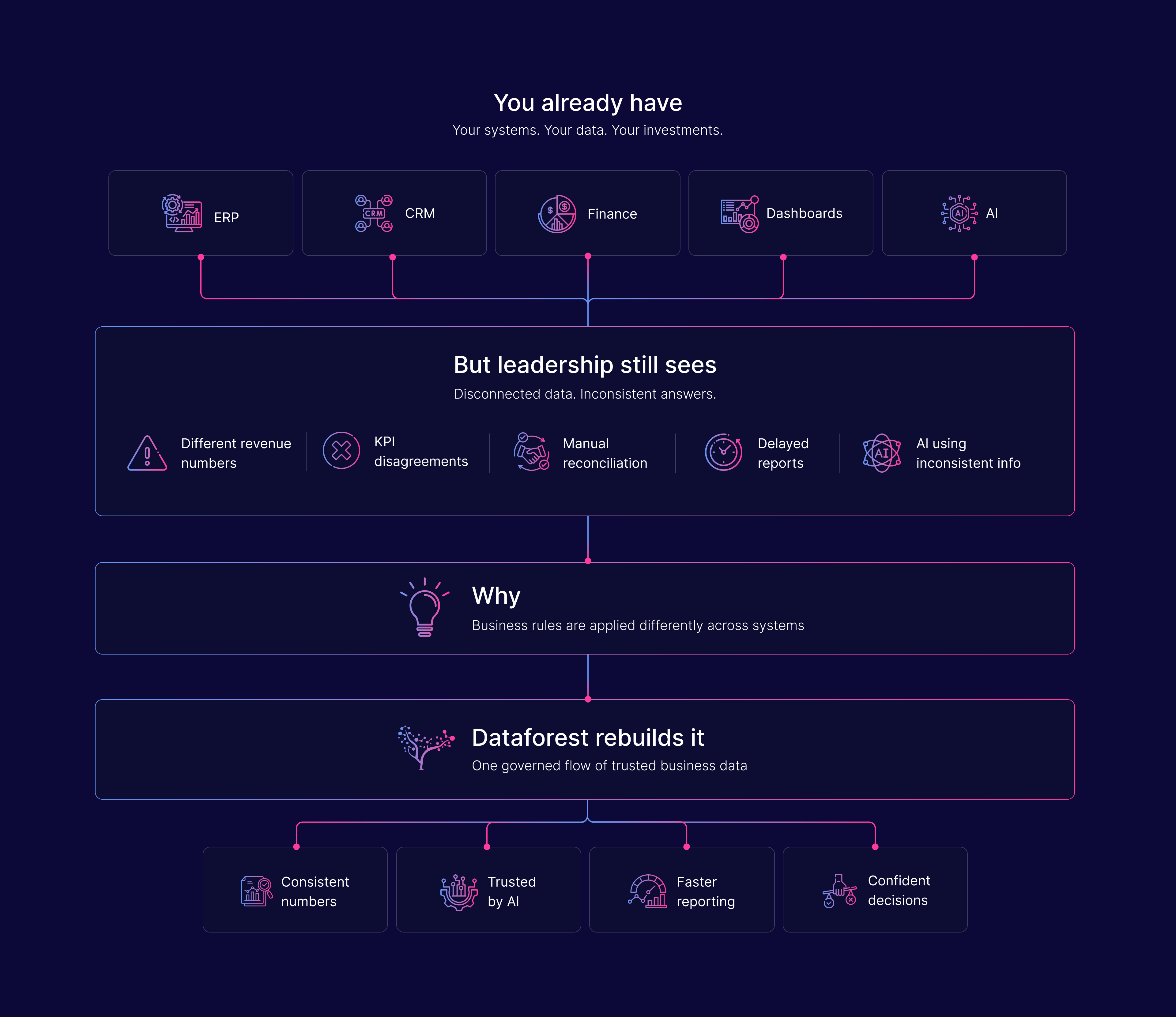
Most organizations already have:

Data Engineering Solutions

ERP

dashboard

CRM

Enhanced Data-Driven Decision-Making Processes

Finance systems

data icon

Cloud platforms

analytics icon

Dashboards

data solution icon

APIs

phases icon

AI tools

Yet leadership still experiences:

grid icon

Conflicting reports

dashboard

Manual reconciliation

services icon

Inconsistent KPIs

solution icon

Duplicated business logic

services icon

Unreliable AI outputs

That's usually not an integration problem. It is an enterprise data architecture problem.

Why reports conflict

01

Because every department prepares data independently.

02

Marketing transforms customer data in one way.

03

Finance calculates revenue differently.

04

Operations use another schedule.

05

Executives end up comparing reports built from different business logic—not different facts. ‍

✅️ Data Orchestration standardizes how information flows. We enforce business logic standardization before reports and AI consume it.

E-Commerce Retailer Achieves Centralized Performance Reporting with a Data Warehouse Processing 450K Daily Records

How One U.S. Manufacturer Reduced Manual Processing by 90%

After acquiring multiple businesses, fragmented ERP systems created disconnected reporting, slow onboarding, and heavy manual work.
‍
After 10+ acquisitions, executive reporting depended on manual reconciliation across disconnected ERP systems.
‍
DATAFOREST orchestrated data across operational systems into one automated pipeline powering executive reporting.

Business Results

  • 80–90% Less manual reporting

  • 70% Faster New acquisition onboarding

  • One Automated Data Flow
    Across multiple ERP systems

Does This Sound Familiar to you?

01

Leadership Lacks Data Trust.

Finance shows one number, Sales shows another, and Operations relies on a separate version. Executive meetings turn into report reconciliation instead of decision-making.
02

Teams Still Reconcile Data Manually

Analysts and managers spend hours exporting, cleaning, and comparing data across systems before leadership can act on it.
03

Different Teams Calculate KPIs Differently

Marketing, Finance, Operations, and Product define metrics differently, creating inconsistent KPIs, duplicated work, and unreliable dashboards.
04

AI Initiatives Inherit the Same Data Problems

Models, copilots, and RAG systems cannot produce reliable outputs when they depend on incomplete, outdated, or inconsistent business data. You lack data quality for AI.
05

You're Spending More to Maintain the Same Data

Duplicate processing, unnecessary compute, inefficient scheduling, and constant troubleshooting waste budget that should go toward new business capabilities.

Why Now

Data Complexity Grows Faster Than Your Business

As Your Business Grows...

Without Data Orchestration

data icon
More ERP and SaaS systems
Benefit icon
More conflicting reports
phases icon
More acquisitions
accordion icon
Longer integration projects
solution icon
More business units
steps icon
Different KPI definitions
Across Business icon
More AI initiatives
steps icon
Inconsistent AI outputs
accordion icon
More operational data
customers icon
More manual reconciliation

Enterprise Data Orchestration keeps reporting, analytics, and AI aligned as your business evolves.
‍

Book a free 30 min consultation

Transform Your Data Operations with a Trusted Foundation
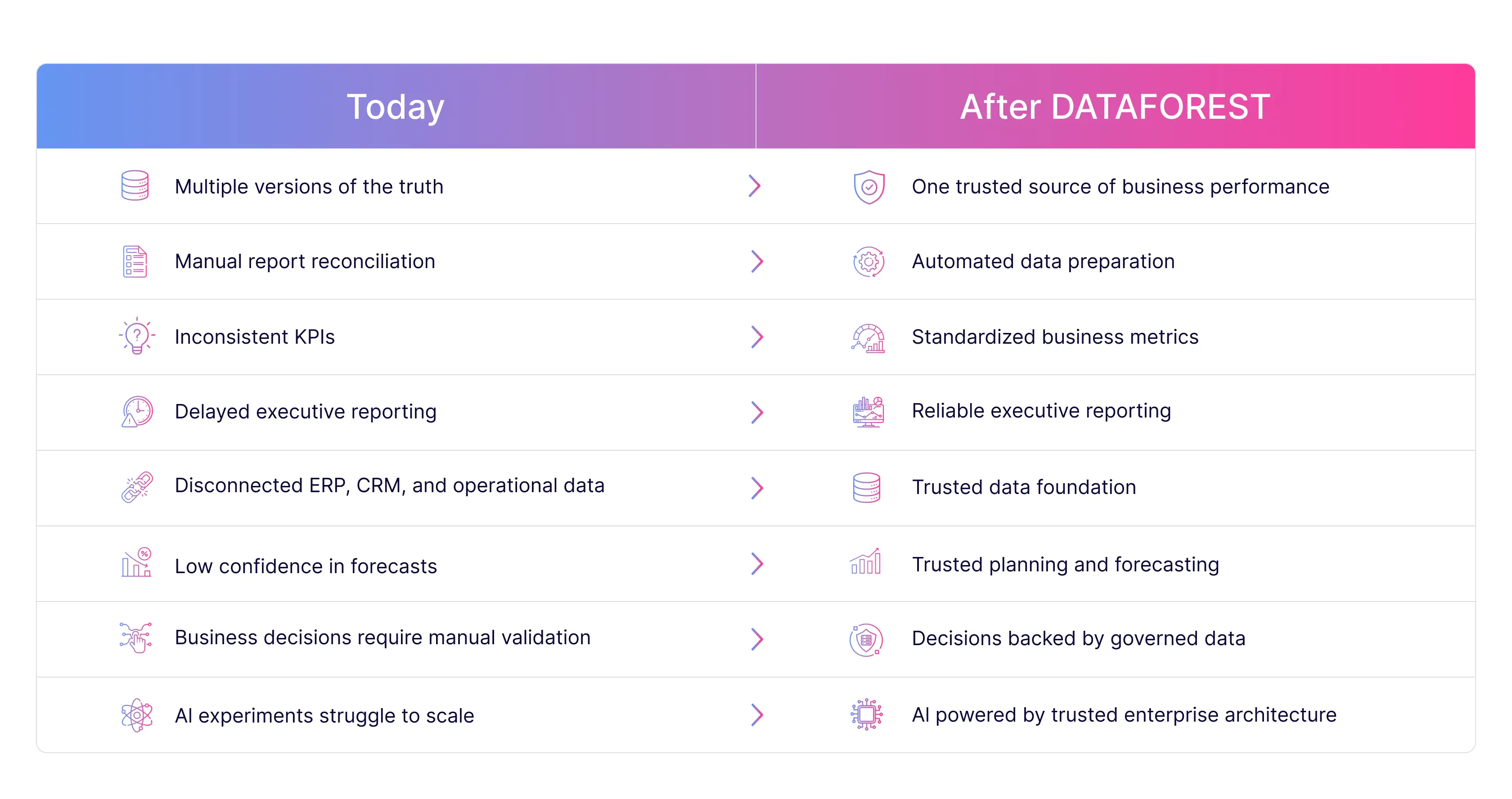
Transit your organization from fragmented systems and manual reconciliation to an automated architecture. DATAFOREST empowers leadership to make confident decisions and scale AI initiatives across the enterprise.

Your Reports Are Automated. Are They Trusted?

Automated reporting doesn't guarantee trusted decisions.

Hidden inconsistencies across business systems create conflicting KPIs, unreliable analytics, and AI that leaders can't confidently use.

DATAFOREST modernizes enterprise data architecture by rebuilding legacy data foundations, standardizing fragmented data, and implementing governance that enables trusted reporting, analytics, and future AI initiatives.
No Real-Time Operational Visibility
Modernize Enterprise Data Architecture
We redesign the architecture behind your existing ERP, CRM, operational systems, and analytics platforms to eliminate technical debt, simplify data flows, and support future business growth.
01
steps icon
Rebuild Legacy Data Lakes & Platforms
Modernize fragmented data lakes, warehouses, and pipelines into a scalable, governed platform that delivers faster reporting, lower maintenance costs, and improved performance.
02
steps icon
Standardize Fragmented Business Data
Different systems often store and calculate the same business information differently. We unify fragmented data, standardize business logic, and create consistent KPI definitions across the enterprise.
03
Overloaded Intake and Administration
Build a Governed Data Foundation
Implement enterprise-grade governance, metadata management, lineage, observability, and data quality controls so every report, dashboard, API, and AI application works from trusted data.
04
accordion icon
Enable Trusted Reporting & Analytics
Give every department the same trusted view of the business by eliminating conflicting reports, hidden inconsistencies, and manual validation before data reaches decision-makers.
05
Across Business icon
Prepare Your Business for Enterprise AI
Create an AI-ready data foundation that provides reliable, governed, and explainable data for copilots, AI agents, RAG systems, predictive analytics, and future AI initiatives.
06

What's happening now?

What’s Happening Now

Business Impact

What DATAFOREST Recommends

Teams use manual scripts and spreadsheets
❌ Reports fail, arrive late, or require manual reconciliation
✔️Automate data workflows and reporting processes
Legacy ETL exists, but reports are still slow
❌ Leadership waits for outdated numbers
✔️Modernize pipelines and reporting architecture
Different teams use different tools and logic
❌ KPIs don’t match across Finance, Sales, and Operations
✔️Apply metrics governance and establish shared business definitions
Batch and real-time data are handled separately
❌ Dashboards, operations, and AI use inconsistent data
✔️Build coordinated data orchestration across batch and real-time workflows
AI initiatives rely on fragmented data
❌ Models, copilots, and RAG systems produce unreliable outputs
✔️Create an AI data readiness with data governance for AI

What changes after implementing data orchestration solutions
‍

Manual Follow-Ups Create Care Gaps
Trusted reporting
    Overloaded Intake and Administration
    Automated data reconciliation
    generative ai
    Confident business decisions
    Unique delivery
approach
    Reliable business data
    Big Data Analytics in Healthcare
    Trusted enterprise data
    Increased Operational Efficiency and Cost Reduction
    Lower operational costs
    AI Possibilities icon
    Enterprise data governance services
    data icon
    Faster integration of new systems

    Proven Across Manufacturing, Healthcare, and Enterprise Data Platforms

    Water Compliance Platform Achieves Automated Analysis Resulting in Under 30-Second Insights Delivery

    Problem:
    A water compliance platform lacked automated reporting and forced users to track sample trends through slow manual calculations.
    Solution:
    DATAFOREST built an intelligent chatbot and integrated time-series analysis for automated data interpretation.
    Results:
    • 100% processing of valid inputs
    • Under 30-second insights delivery
    • Total elimination of manual calculations
    • Automated inspection task generation
    Water Compliance Platform Achieves Automated Analysis Resulting in Under 30-Second Insights Delivery

    U.S. Industrial Manufacturer Achieves Unified Operational Visibility Resulting in an 80–90% Reduction in Manual Processing

    Problem:
    A U.S. industrial manufacturer had fragmented ERP data after 10+ acquisitions, creating slow manual processing and inconsistent data access.
    Solution:
    DATAFOREST achieved enterprise data unification into a cleaner foundation for reporting, automation, and analytics.
    Results:
    • 70% faster injection
    • 80–90% reduction in manual processing
    • Better visibility across acquired systems
    • Scalable foundation for analytics and AI
      ‍
    U.S. Industrial Manufacturer Achieves Unified Operational Visibility Resulting in an 80–90% Reduction in Manual Processing

    Healthcare Client Achieves Automated Regulatory Reporting, Resulting in 9,600 Hours Eliminated Per Month

    Problem:
    Healthcare data was fragmented across EHR, billing, manual inputs, and reporting workflows. Regulatory reporting requires heavy manual work.
    Solution:
    DATAFOREST unified healthcare sources and automated reporting workflows on a governed foundation.
    Results:
    • 9,600 hours eliminated per month
    • Regulatory reporting is fully automated
    • Cleaner operational visibility
    • Stronger foundation for analytics and AI
      ‍
    Healthcare Client Achieves Automated Regulatory Reporting, Resulting in 9,600 Hours Eliminated Per Month

    Medical Lab Achieves 50% Compute Savings via Databricks Migration

    Problem:
    Sagis Diagnostics, a leading U.S. pathology lab, was constrained by a fragmented Azure SQL setup. Their data was scattered across 21 disparate sources, which created silos, hindered transparency, and drove up computing expenses.
    Solution:
    DATAFOREST orchestrated a migration to a unified Databricks Lakehouse. We consolidated all 21 sources into a single, highly governed, HIPAA-compliant platform and fully automated their analytics workflows.
    Results:
    • Delivered complete visibility across the entire organization through the new architecture.
    • Achieved a ~50% reduction in compute costs by leveraging a scalable, pay-per-use model.
    • Dramatically improved overall operational workflows and efficiency.Stronger foundation for analytics and AI
      ‍
    Medical Lab Achieves 50% Compute Savings via Databricks Migration
    40% Increase in Customer Engagement for Western Gas Utility

    WHY DATAFOREST

    We build data platforms that deliver measurable business outcomes—not just modern architectures. We deliver a solid enterprise data foundation.
    ‍
    Measured business impact
    ‍
    Our projects have delivered:

    • 80–90% reduction in manual data processing

    • 70% faster enterprise data onboarding

    • 50% lower infrastructure compute costs

    • 9,600 hours are eliminated every month through reporting automation

    • 450K+ records processed daily in automated data platforms

    AI and Machine Learning for Healthcare
    Business-first architecture
    We design data platforms around executive reporting, operational efficiency, governance, and AI—not around specific tools or vendors.
    AI Possibilities icon
    Built for AI from day one
    Every architecture is designed to support trusted analytics today and AI initiatives tomorrow, including RAG, AI agents, predictive analytics, and enterprise automation.
    Data engineering expertise
    Technology independence
    Whether your stack runs on Databricks, Snowflake, BigQuery, Azure, AWS, or Microsoft Fabric, we recommend the architecture that best fits your business.
    finance icon
    Enterprise governance built in
    Security, monitoring, data lineage services, observability, and data quality monitoring are integrated from the start. We do not add them later. We also implement comprehensive metadata management.

    Databricks

    Partner

    70+

    Data Engineering Projects

    1,950 TB+

    of data processed

    92%

    client retention

    Enterprise AI

    and data engineering experts

    Proven across

    healthcare, manufacturing, retail, finance, technology, and operations
    For more than eight years, DATAFOREST has helped organizations modernize fragmented data environments into trusted platforms for reporting, automation, and AI. From acquisition-driven manufacturers to healthcare providers and digital businesses, we design enterprise data platforms that improve operational visibility while reducing engineering effort.
    Clutch logo and 5 stars review
    Most Reviewed IT Services Company Estonia
    mackine learning company Estonia
    award
    Top 100 cloud consulting companies 2025
    Artificial Intelligence (AI)
    Data Science

    Explore Related Data Foundation Services

    Unique delivery
approach
    Create one unified business data view across teams, systems, and leadership reporting.
      Data-driven
approach 
      Build scalable systems, lakehouse architecture, and an AI-ready data foundation on Databricks.
      digital cta
      Organize raw data into Bronze, Silver, and Gold layers for analytics, BI, and AI.
      Flexible & result
driven approach
      Build a trusted, governed business data foundation that powers analytics, reporting, AI, and enterprise data orchestration.

      Questions on Enterprise Data Orchestration

      What is enterprise data orchestration?

      Enterprise data orchestration controls when data jobs run and how they depend on each other. It links ETL or ELT jobs, quality checks, batch schedules, streams, and deliveries. The control layer tracks the state of each task. It can also start retries, send alerts, and show who owns a failed step.

      How is orchestration different from ETL?

      ETL and ELT move and change data. Orchestration manages the jobs around that work. It sets times, checks job links and results, and decides when to retry, pause, or backfill. One tool can manage batch loads, streams, model updates, and API calls without replacing the code that changes the data.

      Which orchestration platforms and cloud environments do you support?

      DATAFOREST supports AWS, Azure, GCP, Databricks, Snowflake, and Microsoft Fabric. A cloud scheduler may fit one cloud. A neutral tool may fit a mixed stack. We choose it based on current tools, job links, speed, security, monitoring needs, and cost.

      Can you orchestrate real-time and batch data together?

      Batch jobs and streams can share one orchestration graph. Time or job links can start batch work. Kafka events or change data capture (CDC) can trigger fast updates. Checkpoints record finished work, while safe retries and watermarks help prevent duplicate records and handle late events.

      How do you monitor pipeline failures?

      DATAFOREST tracks freshness, run time, data volume, errors, and job links against set service-level agreements (SLAs). Past runs can warn of a likely breach. The system can retry a task, restart from a checkpoint, switch paths, or fill missing data. Broken access keys or business rules still need human review.

      Can orchestration improve AI readiness?

      Orchestration keeps data current for AI agents. It runs checks, adds context, builds embeddings, and updates search indexes or features. The same flow carries business terms, owners, lineage, and freshness tags. If agents use MCP tools, orchestration keeps the data behind those tools up to date.

      How long does an implementation take?

      DATAFOREST sets the schedule after it reviews the workflows. The review covers job links, failure risks, service levels, owners, and data users. A small setup may take several weeks. A move across several tools takes longer when it adds streams, strict controls, or parallel runs.

      Can DATAFOREST modernize our existing pipelines?

      Yes, DATAFOREST first lists current jobs, schedules, dependencies, failures, and users. We keep reliable transformation code and add clear monitoring and job controls around it. Brittle scripts move in stages. Old and new flows can run in parallel until their outputs match, which lowers the risk of a large one-time switch.

      How is data orchestration different from your ERP integration and API integration services?

      Data orchestration controls the order, checks, and recovery of jobs. ERP integration maps data and tasks inside or between ERP systems. API integration builds the links that exchange data. A project may need all three, but it can start with the main issue: system links, data maps, or job control.

      What is the first step?

      Start with a 30-minute review of your data workflows. Bring a list of source and target systems, schedules, job links, recent failures, data freshness needs, and owners. DATAFOREST uses this information to select the first workflow to fix. The team can then separate quick changes from larger migration work and estimate the scope.

      Let’s discuss your project

      Share project details, like scope or challenges. We'll review and follow up with next steps.

      form image
      top arrow icon