bgr image

AI Document-to-Catalog Matching: an AI case study in retail and e-commerce back-office operations

E-commerce and retail operators often hand a core back-office function, matching inbound shopping lists (arriving as images, PDFs, spreadsheets, and other unstructured formats) to an internal product taxonomy, entirely to a third-party outsourced team. A generative AI pipeline can take that function back in-house: it ingests the same unstructured inputs, maps them against the taxonomy, flags low-confidence results for human review, and improves from every correction fed back into it. Across two documented cases, the approach cut per-batch turnaround from over 24 hours to about 30 seconds and reduced processing cost by roughly 84% in year one, after evaluation infrastructure proved the AI more accurate than the outsourced team it replaced.

When your back office runs on a vendor's tribal knowledge, you don't own your own process

The Challenge

E-commerce and retail operators often depend entirely on a third-party outsourced team for a core back-office operation, matching inbound shopping lists arriving as images, PDFs, spreadsheets, and other unstructured formats, to an internal product taxonomy. The outsourced team accumulates all the institutional knowledge, creating vendor lock-in and fragility. Turnaround exceeds 24 hours per batch, degrading the customer experience, and there's no visibility into how accurate the manual work actually is.

Any company with a significant outsourced or offshore cost center performing repetitive document-to-catalog matching carries the same exposure. The business also can't improve a process it doesn't own: it can't see error rates, can't change turnaround, and can't build new real-time features on top of a 24-hour batch. Contract renewals become negotiations from weakness, because the vendor holds the knowledge.

  • Vendor lock-in — the outsourced team holds all the institutional knowledge for a core process, so every contract renewal is negotiated from weakness.
  • Slow by design — a 24-hour-plus batch turnaround degrades the customer experience and rules out any real-time feature built on top of it.
  • No visibility into quality — the business has no way to measure how accurate the manual matching actually is, until it looks.
  • A process you don't own — error rates, turnaround, and improvement are all in someone else's hands, not the business's.

The Approach

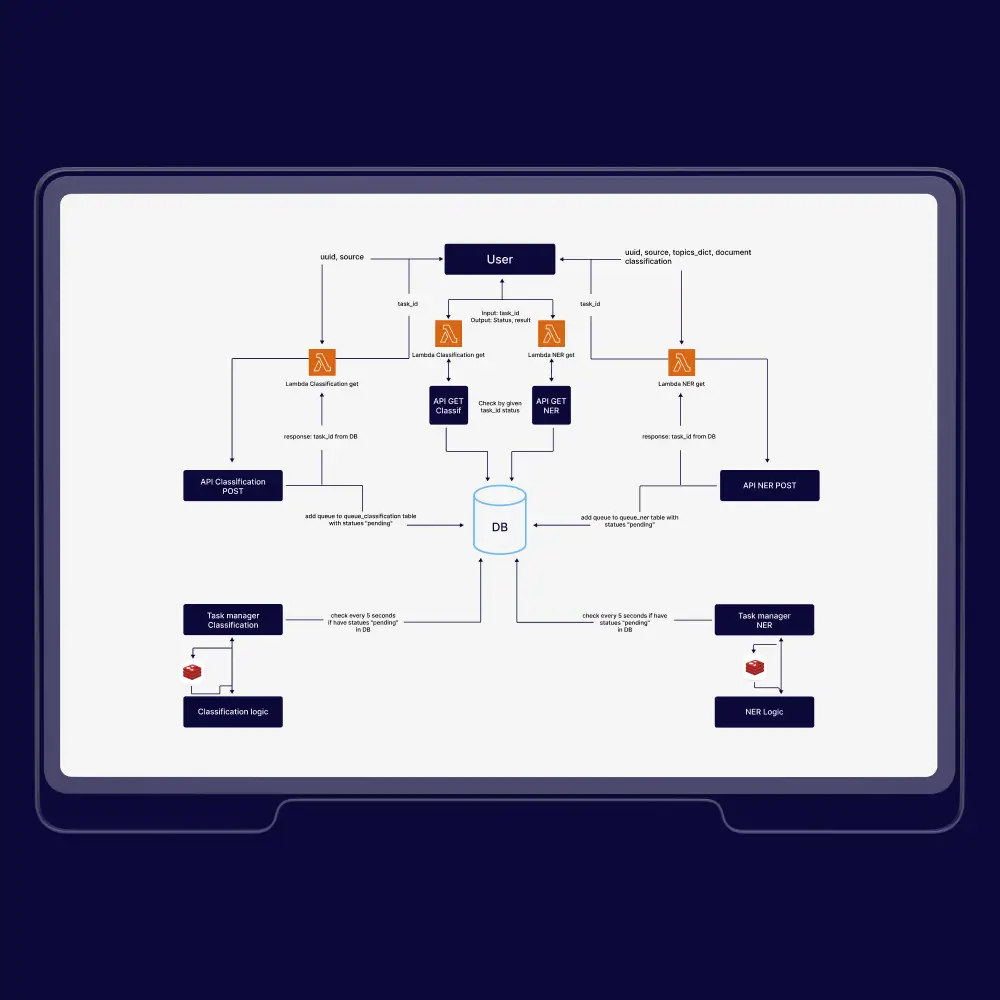
A custom generative AI pipeline automates the workflow end to end, from ingesting unstructured inputs to outputting items mapped against the standard product taxonomy, using a mix of models for classification, text extraction, and intermediate steps. Evaluation infrastructure is established early to measure accuracy objectively and guide iteration; a blind side-by-side comparison proves the AI outperforms the outsourced team before go-live, which also reveals how inaccurate the manual process had actually been.

A confidence-scoring layer flags low-certainty outputs for human review, and a feedback loop saves corrections back to the database so the system improves automatically over time. An optional QA layer is retained in year one and phased out as confidence grows. Ownership of the process, the accuracy data, and the improving model returns to the business, which can now build real-time features on top of a 30-second turnaround that were impossible with a 24-hour batch.

Multi-model document classification · Text extraction · Taxonomy mapping · Confidence scoring · Human-in-the-loop feedback retraining

AI Role

AI classifies unstructured inbound inputs and maps them to the company's internal product taxonomy end to end, with a confidence-scoring layer flagging low-certainty outputs for human review and a feedback loop saving corrections back to improve future accuracy automatically. AI Automation Scope: Full unstructured-input-to-catalog matching workflow, replacing an entire outsourced processing function.


84%

— cost reduction in year one, trending toward near-100% as the optional QA layer phases out in year two

24+ hours to ~30 seconds

— per-batch turnaround

Beat the human baseline

— AI accuracy proven to exceed it in blind testing before the outsourced team was decommissioned

In-house again

— an entire outsourced/offshore cost center brought back in-house

ROI types: Cost Reduction · Headcount Avoidance · Risk & Compliance · Time Savings

Evidenced in: documented in retail and e-commerce back-office operations. The pattern applies to any company with a significant outsourced or offshore cost center doing repetitive document-to-catalog or document-to-record matching; the related evidence base also spans healthcare recruitment document processing and legal/contract document analysis, built on the same classify-extract-score-feedback architecture.

Why Companies Are Fixing This Now

How Dataforest Would Deliver This

The first deliverable is two error rates, your vendor's and the pipeline's, measured on the same few hundred real documents. The answer key can't come from the vendor, since its output is what's being tested, so your own experts label the sample twice and settle every disagreement. The confidence threshold for human review is then calibrated on that key and set by cost: the price of a wrong match against a minute of a reviewer's time.

Items below the threshold go to a stronger model first, then to a person, and personal data is stripped before any document reaches an LLM. Through the vendor's notice period both run in parallel; that is when we capture the exception rules their team never wrote down.

Book a call to scope the comparison: we'll agree on the sample, the labeling rules, and the error metric.

From our projects: LLM contract analysis with document-type routing for a US SaaS platform

A US company founded by former Amazon and Microsoft engineers was building a document platform for construction and legal teams. Reviewing its customers' NDAs, change orders and project agreements by hand was slow, inconsistent and hard to scale.

‍

We paired an LLM with decision-tree logic: each document category gets its own prompt template, so change orders are not read like NDAs. Analysis starts on upload and returns clauses, dates and obligations as structured data, and large document sets run in batch. After several rounds of fine-tuning and testing, document analysis is up to 70% faster, and review takes seconds per file instead of several minutes.

‍

The engine reads contracts; it does not calculate tax, apply jurisdiction rules or prepare returns. What it shows is the step before any tax logic: identify the document type first, then extract with logic built for that type. The intercompany agreements behind a transfer-pricing file are contracts too. Read the full case: LLM contract analysis with document-type routing.

"Teams worry about whether the AI is accurate enough to replace a vendor. The harder question is whether anyone ever actually measured the vendor. Once you build the evaluation harness, the AI side of that comparison is usually the easy part."

Related case studies

All publications
All publications

Frequently asked questions

What does this pattern actually replace?

An AI pipeline that takes over document-to-catalog matching currently done by an outsourced or offshore team, ingesting the same unstructured inputs (images, PDFs, spreadsheets) and mapping them to the same product taxonomy.

How do we know the AI is actually more accurate than our current vendor?

Evaluation infrastructure is built before go-live specifically to answer this: a blind side-by-side comparison measured both systems objectively, proved the AI outperformed the human baseline, and incidentally revealed how inaccurate the manual process had been all along.

How much does this actually save, and how fast?

In the documented deployments: an 84% cost reduction in year one, trending toward near-100% as an optional QA layer phases out, and turnaround cut from 24+ hours to about 30 seconds per batch.

What if the AI gets something wrong?

A confidence-scoring layer routes uncertain outputs to a human reviewer, and every correction feeds back into the system to improve future accuracy. An optional QA layer is kept through year one and phased out only as confidence grows.

Where do these numbers come from?

This pattern is aggregated from 2 real, verified deployments of AI-driven document-to-catalog matching in retail and e-commerce back-office operations. Company names are withheld per confidentiality practice; the figures themselves are not altered.

We’d love to hear from you

Share project details, like scope or challenges. We'll review and follow up with next steps.

form image
top arrow icon