
AI Integration Services: Connect AI to Your Data, Systems, and Workflows
DATAFOREST provides AI integration services for companies with stalled AI ideas. We connect models, LLMs, agents, and APIs to your daily business workflows. Your core systems keep running during deployment. One team handles data preparation, system connectivity, AI strategy, and production monitoring. Proper AI integration places intelligence directly inside your internal platforms.
Trusted by
500+ companies
Stop running isolated AI demos and schedule a call to wire intelligence directly into your active workflows.
Why Companies Choose DATAFOREST
Executives hire our AI integration company to build reliable intelligence into their daily operations. We turn standalone algorithms into secure systems.
Data engineers, integration specialists, MLOps, and developers build systems under one roof.
DATAFOREST connects AI to your ERP, CRM, databases, and apps without operational disruption.
The team selects models, cloud platforms, vector stores, and tools matching your stack.
We build live systems with real-time monitoring, model evaluation, guardrails, and human-in-the-loop review.
Access controls, data privacy, isolated environments, and encryption protect sensitive files.
As a Databricks Consulting Partner, our AI integration company brings 18+ years of experience across 250+ projects.
AI models can perform well in isolated demonstrations but still fail to deliver value in production. The problem is the gap between the model and the company data, applications, and processes it needs to work with. APIs, data pipelines, and workflow automation close that gap by bringing AI into the systems employees already use. This approach lets teams apply machine learning and language models to live business information and operational tasks. It also gives leaders a way to connect AI investments to measurable outcomes. Companies need reliable connections to corporate data and operating systems, while existing workflows and core structures keep running.
What Are AI Integration Services?
AI integration services connect AI models, large language models (LLMs), and agents to company data, applications, and workflows. They cover the work needed to make those capabilities operate in production: strategy, data preparation, API and system integration, secure deployment, and performance monitoring. The goal is to embed AI in business processes rather than leave it in a separate tool.
AI integration vs. building AI models and generative AI projects
Building a custom model or chatbot creates a technical capability. AI integration puts that capability into the systems where people and processes work. A data science team might develop a specialized language model, while integration engineers connect it to your generative AI integration framework and Data Integration pipelines. This distinction separates the creation of an AI capability from its use across business operations. The integration layer can also connect your LLM-Powered Chatbots and projects to the databases and tools they need.
Our AI Integration Services
Our engineering team connects ML models and AI agents to your data platforms and workflows. We handle the entire process — from technical strategy to secure production deployment.
AI Integration Consulting and Roadmap
Our AI integration consulting begins with a readiness assessment of your current platforms. We prioritize specific use cases by business value and technical feasibility. The engineering team designs a target architecture, maps data flows, calculates costs, and builds a proof-of-concept plan. This AI-driven digital transformation details how algorithms will fit your operations.
AI Data Integration
Machine learning models require clean information. Our AI data integration service prepares and connects your corporate records. We build custom data pipelines, run automated quality checks, configure vector databases, and manage strict access controls. This work creates an AI-ready data infrastructure that continuously feeds accurate context directly to your production algorithms.
AI System Integration
We connect intelligence to your existing software. We perform AI API integration using secure webhooks, custom middleware, database connectors, and REST endpoints. This API and system integration links models to your SaaS tools and ERP systems. Our API development supports targeted sales, marketing routines, customer service operations, and CRM use cases.
AI Workflow Integration and Automation
This service embeds intelligent steps into your daily processes. We handle document processing, configure smart approvals, manage automated routing, and build reliable RPA hand-offs. The resulting workflow automation includes human-in-the-loop checkpoints. Your staff reviews complex decisions before the system executes them — this setup keeps operators in full control of critical actions.
Generative AI and LLM Integration
We embed large language models into your business platforms. We deploy secure retrieval-augmented generation over your private records. Read about our generative AI integration and structured knowledge base creation services for detailed deployment steps.
AI Chatbot and Conversational AI Integration
We connect custom conversational interfaces and automated voice assistants to your CRM, enterprise helpdesk, active directories, and internal databases. Learn more about our LLM-powered chatbots and conversational virtual assistants to see full system capabilities.
AI Agent Integration
Autonomous programs require strict boundaries. Our AI agent integration connects intelligent actors to your internal tools and APIs. We define exact system permissions, set hard API limits, configure automated alerts, and build complete audit trails. We also deploy multi-agent orchestration for complex environments where several distinct agents share related corporate tasks.
AI Governance, Security and Monitoring
We protect your deployments with continuous oversight. The team implements access controls, protects data privacy, monitors model quality, and tracks API costs. It also maintains compliance with GDPR and HIPAA standards. The MLOps service evaluates model drift over time and generates audit logs for every system action.
Calculate your project costs and book a call to turn your AI pilot into a production system.
AI Integration Challenges We Solve
Companies struggle to turn AI experiments into working business tools. We remove the technical barriers that keep models out of production.
Stalled AI Pilots:
They stall in the testing phase and never reach production. We build live systems that operate across your company.
Disconnected Tools:
Standalone AI applications remain disconnected from your ERP and CRM platforms. We connect algorithms to your core operating systems.
Messy Data:
Fragmented corporate data stops machine learning algorithms from working correctly. We clean your records and build unified data pipelines.
Untrustworthy Answers:
Unsupervised models generate errors without human review or quality evaluation. We install rules and human-in-the-loop validation checkpoints.
Security Risks:
Unsanctioned AI tools expose private company files to security threats. We implement access controls and secure data environments.
Unclear ROI:
Hidden cloud costs grow quickly after the initial software launch. We track API usage and control your computing expenses.
Base of AI Integration
Corporate teams build our AI integration solutions upon four technical layers. This architecture connects raw information to your workflows: each level performs a specific operational function.
It manages custom information pipelines, automated quality checks, vector databases, and dedicated feature stores.
The environment houses large language models, custom algorithms, autonomous agents, and prompt frameworks.
The section connects intelligence components using APIs, database connectors, orchestration tools, and event triggers.
The framework controls system access, tracks cloud costs, evaluates output accuracy, and monitors performance.
AI Integration Patterns — How AI Connects to Your Systems
AI integrations follow one of a few core technical patterns. Selecting the right connection early determines operational costs, response latency, data security, and long-term solution scalability. Each pattern links models to existing enterprise architecture in a distinct way to match specific business requirements.
Enterprise AI Integration — Legacy Systems, Security and Scale
Enterprise AI integration requires working with ERP platforms, legacy systems, governance policies, and large corporate teams. The engineering work focuses heavily on access control, data residency, full auditability, and phased rollouts.
Our enterprise AI integration services connect machine learning algorithms to your oldest corporate databases and active records. We configure single sign-on, role-based access, audit logs, and data privacy controls for every user.
You dictate exact data locations to maintain complete regulatory compliance. We manage the organizational change process and execute phased rollouts across all your business units. A smaller proof of concept with a single department is the better first step to test basic technical assumptions before full expansion. Our data engineering group covers data, infrastructure, integration, and AI.
AI Integration for Your Industry — Where We Apply It
We connect algorithms to the systems that run your industry. Our engineering team adapts data pipelines to match exact market requirements.
Physical stores link foot-traffic data with live pricing algorithms. Read about our retail integration.
Digital storefronts integrate product databases with autonomous agents to manage inventory. See our e-commerce solutions.
Medical providers maintain data privacy when connecting machine learning to electronic health records. Explore our healthcare integration.
Banking institutions link predictive risk models to active trading platforms. Discover our finance services.
Agencies integrate automated document processing models into their claims management workflows. View our insurance capabilities.
Production plants connect computer vision algorithms to factory floor robotics. Review our manufacturing projects.
Engagement Models — From AI Readiness Assessment to a Dedicated Team
Choose where to start. You can request an assessment to find the right use cases, build a fast PoC, launch a full integration project, or hire specialists who join your team.
AI Integration Cases
We build machine learning algorithms into active platforms. Our engineers connect trained models to your operating systems. Here are some clear examples.
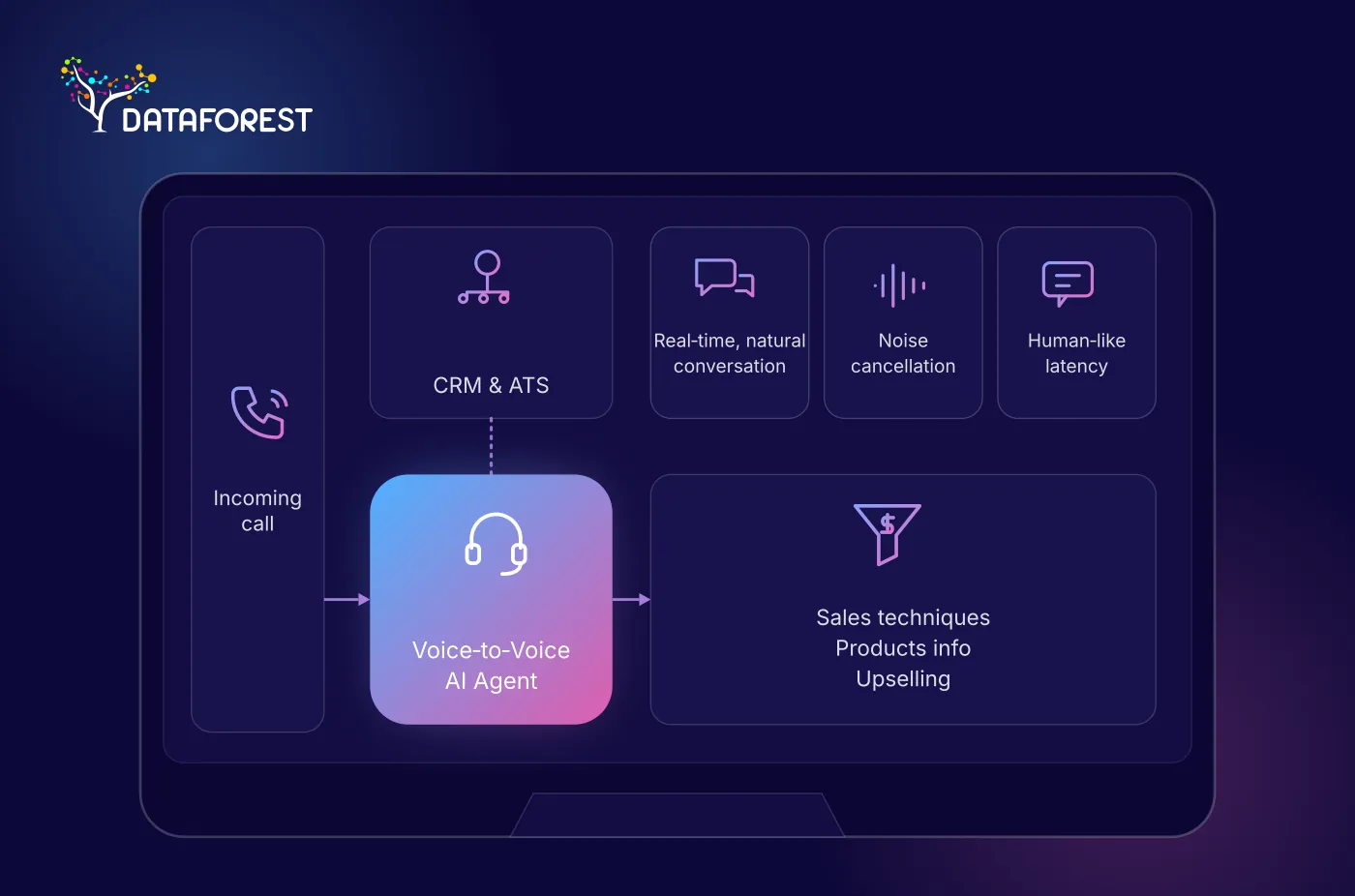
For a CPA network, we deployed a real-time voice agent. We integrated this system with their CRM and ATS platforms. This live connection automated outbound calls. It delivered a 1.5x increase in sales quality.
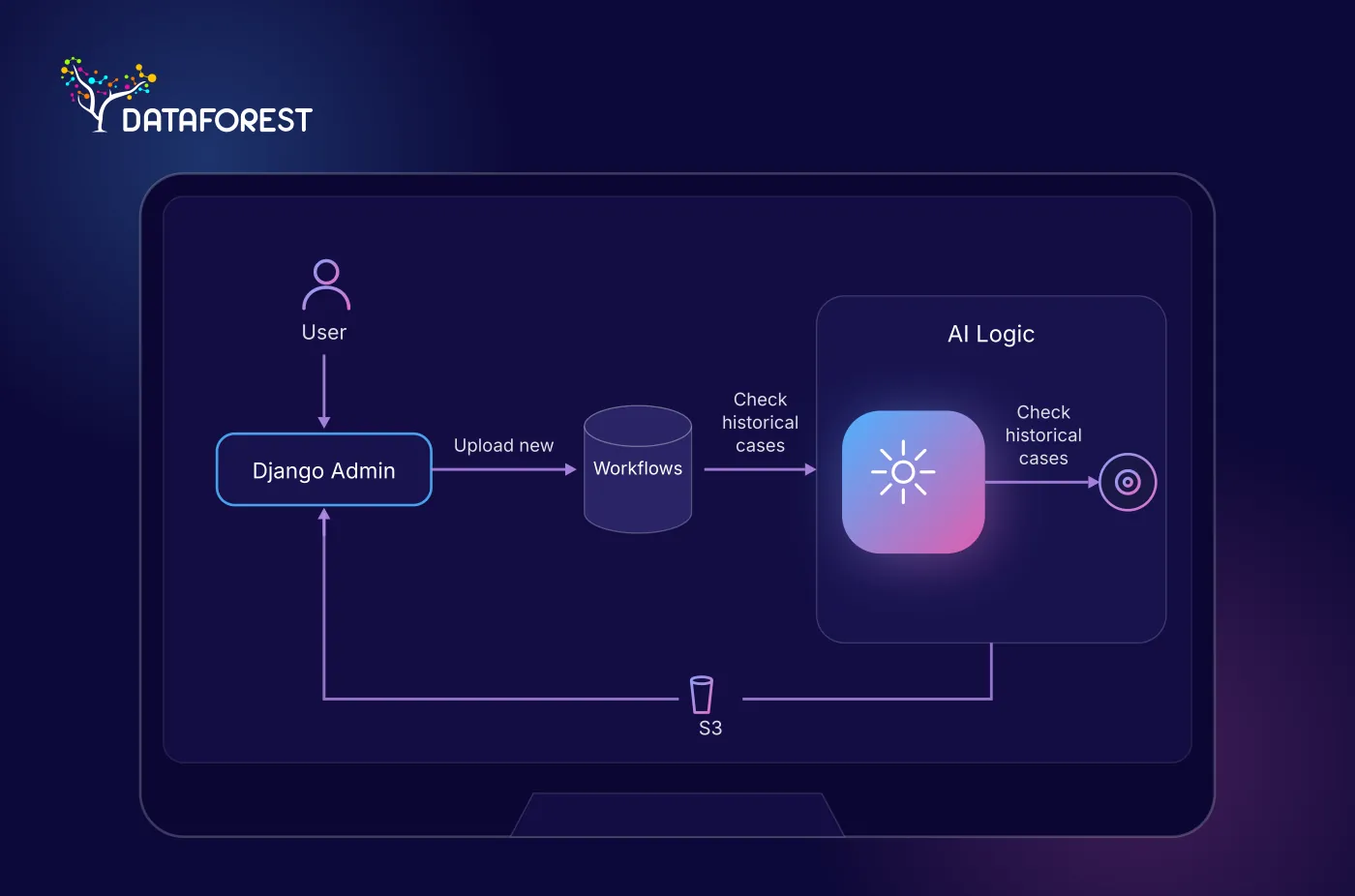
For a UK healthcare consultancy, we built an automated testing platform. Our team integrated computer vision algorithms with their NHS ERP systems. This technical deployment reduced ERP testing time by 80 percent. The connected system achieved 99.5 percent accuracy.
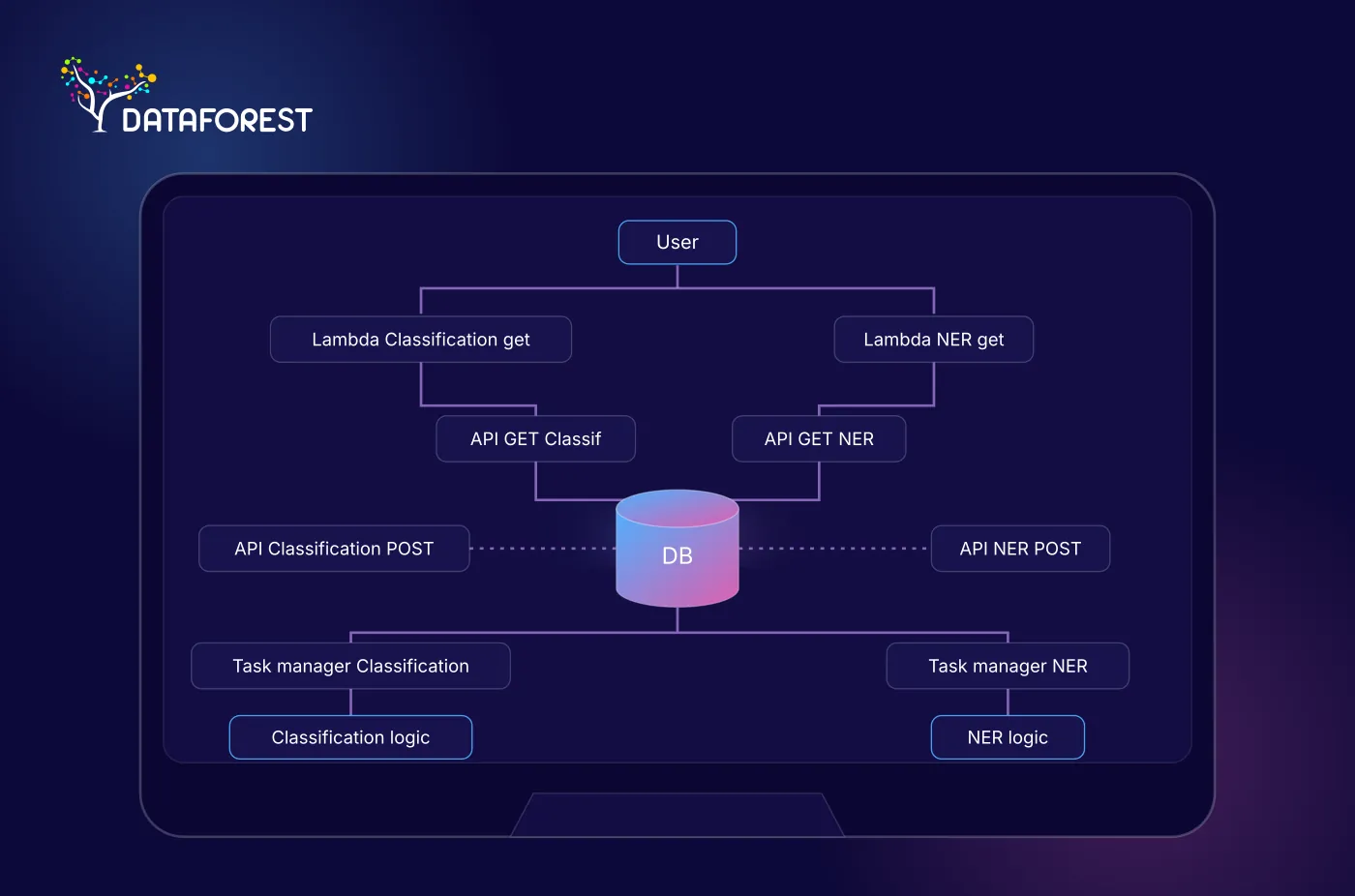
For a U.S. SaaS provider, we embedded an analysis engine into their software. This integration automated their contract review workflows. It increased processing speeds by 70 percent.
AI Integration Results
Our integration projects deliver measurable business outcomes.
Connected language models speed up document analysis by 70 percent.
Automated platforms cut manual workflow time by 80 percent.
Direct system connections reduce response latency below 450 milliseconds.
Modern data architecture cuts compute costs by 50 percent.
Technologies and Tools We Work With
We choose tech and creative resources to fit your stack, corporate rules, and the budget. Our team evaluates your internal architecture first. We stay completely vendor-neutral during the process. We select the right platforms to run your custom data pipelines. So we configure the best algorithms to support the MLOps service.
Our AI Integration Process
We provide a production-first process to prove value on a single use case; we then scale operations. And connect new models to your existing systems without interrupting daily work.
Discovery and use-case prioritization: business goals, expected value, technical feasibility, and project risks.
Data and systems audit: information sources, record quality, API availability, and security access.
Proof of concept and pilot: a working prototype on your data, evaluation criteria, measured outcomes, and launch decisions.
Integration and deployment: the software, tests, human-in-the-loop reviews, and the final rollout.
Monitoring and scaling: output quality, computing costs, technical improvements, and next use cases with our MLOps service.
Articles About AI Data Integration
How to Choose an AI Integration Company
Choosing a strong partner requires careful evaluation of technical capabilities and project management style. A reliable team starts with a specific business use case, works directly with your data and legacy systems, proves value in an initial pilot, builds in security and evaluation, stays vendor-neutral, and leaves you with full ownership of the code and documentation.
Questions on AI Integration Services
Why hire an AI integration partner instead of buying a ready-made AI tool?
Off-the-shelf software works for standard tasks, but it fails when your internal databases require secure data access, custom permissions, or strict process fit. Our AI integration services build custom connections so models interact directly with your proprietary infrastructure rather than running in an isolated window.
Do we need a custom model, or can we integrate an existing one?
The decision depends on data sensitivity, specific tasks, compute costs, and response latency. Companies connect pre-existing foundation models to internal systems instead of training algorithms from scratch.
Can AI connect to systems with no modern API?
Engineers connect legacy software using database access layers, middleware, scheduled file transfers, event queues, and RPA. We implement these mechanisms through a phased migration schedule. This approach preserves existing system stability while establishing automated data flows across older enterprise architectures.
What should we prepare before an AI integration consulting engagement?
Internal teams must define goals, assign owners, grant system access, and identify technical constraints. Gathering these documents beforehand helps our consultants map target data architectures without disruption.
How long does it take and what drives the price?
Project timelines and costs depend entirely on scope, connected system count, data cleanliness, security requirements, and pilot scale. Simple proof-of-concept setups finish fast, whereas enterprise-wide rollouts across multiple legacy databases require extended engineering sprints.
How do you keep our data private when AI models are involved?
Engineers protect corporate privacy using access control lists, private data centers, on-device anonymization protocols, and detailed audit logs. Model providers operate under data-processing addendums. This configuration prevents third-party training on your proprietary company files.
Is it realistic for a small or mid-size company to start with AI?
Small companies start successfully by targeting a single workflow, launching one pilot, and connecting a single system. Review our engagement models table to select a project scope that matches your current operating budget.
Do we have to change our cloud or AI vendors?
We remain completely vendor-neutral and start every project with an infrastructure audit. As a Databricks consulting partner, our team builds solutions on top of the cloud providers, developer tools, and machine learning models you already use.
