bgr image

AI Procurement Spend Analytics & Supplier Intelligence: an AI case study in manufacturing and government procurement

Procurement teams typically can't see total spend across suppliers, categories, business units, and geographies, because the data sits in inconsistent records across many systems. AI-driven spend analytics unifies that data, flags savings opportunities and compliance gaps, predicts supplier reliability, and optimizes the purchasing mix across suppliers and locations, with category managers still making the final sourcing calls. Across 7 documented use cases, this pattern has identified savings worth tens of millions of dollars, including one global industrial conglomerate that saved $80 million over several years by integrating its supplier data with machine learning.

You can't negotiate what you can't see — and most procurement teams can't see their own spend

The Challenge

Procurement teams cannot see total spend across suppliers, categories, business units, and geographies because data sits in many systems with inconsistent supplier records. Savings opportunities, maverick spend, and compliance gaps go unidentified. Supplier reliability is judged from experience rather than data, and decommits surprise planners. Price comparison across suppliers and locations is manual.

Large government agencies face the same problem at greater scale, with acquisition rules that staff struggle to apply consistently. Manufacturers, retailers, healthcare systems, and government agencies all face fragmented supplier data and rising supply risk, and procurement savings identified through analytics typically exceed the cost of the program many times over.

  • Invisible total spend — data sits in inconsistent records across many systems, so nobody can see what the organization actually spends with a given supplier across units and geographies.
  • Experience-based risk calls — supplier reliability gets judged from memory rather than data, so decommits catch planners by surprise.
  • Manual price comparison — comparing prices across suppliers and locations is a manual exercise, not a standing capability.
  • Rules nobody can apply consistently — large agencies run on acquisition rules staff struggle to apply at scale, creating compliance gaps nobody notices until an audit.

The Approach

Machine learning integrates and de-duplicates supplier data across business units and third-party sources, enabling spend analytics that identify savings, compliance gaps, and strategic sourcing priorities. Models predict supplier performance and reliability and monitor commitments and decommits. Purchasing mix is optimized across suppliers and locations to lower input costs, and AI assistants help staff apply acquisition and procurement rules.

Recommendations feed sourcing strategy, with category managers still negotiating and deciding. Supplier master data is unified with governance for ongoing quality, analytics are validated with category managers, and recommendations feed sourcing events and negotiations. Supplier-risk signals route to owners with escalation protocols, so a reliability warning reaches a person who can act on it rather than sitting in a dashboard.

Supplier data de-duplication · Spend analytics · Supplier reliability prediction · Decommit monitoring · Purchasing-mix optimization

AI Role

AI unifies supplier data, analyses spend, predicts supplier reliability, monitors commitments, and optimises purchasing mix, with procurement professionals executing sourcing decisions. AI Automation Scope: Spend analysis, supplier management, and purchasing optimisation across the enterprise.

$80M

— saved over several years by a global industrial conglomerate that integrated supplier data across business units with machine learning

Tens of millions

— in savings identified simply by unifying fragmented supplier data

US military department

— planning an AI system to help staff apply acquisition and procurement rules

Risk surfaced early

— supplier risk shown before it disrupts supply, instead of after

ROI types: Cost Reduction · Risk & Compliance

Evidenced in: documented in large-scale manufacturing/industrial procurement (agriculture & food supply chains) and government and public-sector acquisition. The broader pattern spans retail, healthcare, and any enterprise running procurement across multiple business units or suppliers.

Why Companies Are Fixing This Now

How Dataforest Would Deliver This

Ask a procurement team how many suppliers they work with, then count the supplier records across their ERPs; the two numbers rarely match. We'd close that gap first, matching records on tax IDs, bank details, addresses, and parent–subsidiary links rather than names alone, because group-level volume discounts hide in those links. An LLM then classifies invoice lines such as "misc parts" into one category taxonomy, scoring its confidence and sending uncertain lines to a person.

The first output is a spend cube for one category, meaning spend broken down by supplier, category, and business unit, plus two numbers: how many supplier records collapsed into one, and what share of spend got classified. From there we track identified and realized savings separately, since the gap shows where negotiation or contract compliance stalls. Category managers keep the sourcing call.

Pick the first category with us, and we'll map the ERP and accounts payable sources the first cube needs.

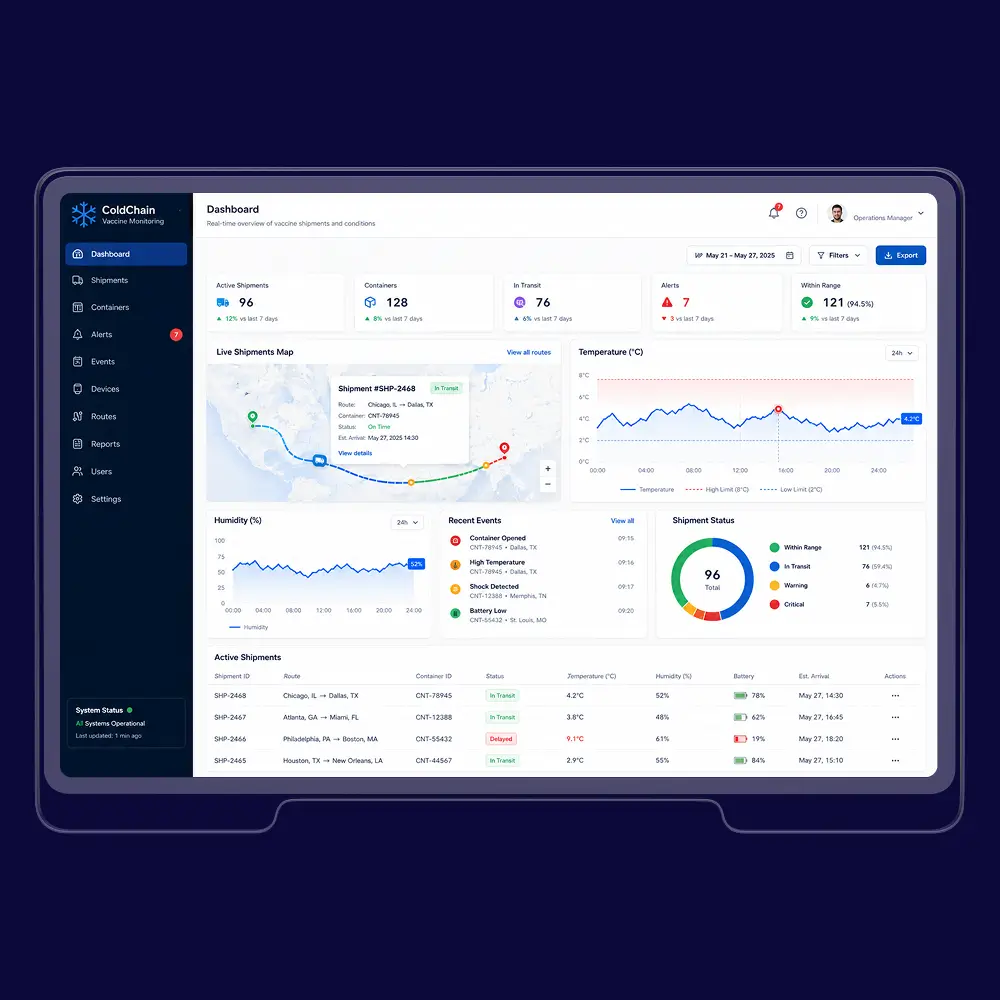
From our projects: 80% faster cold-chain deviation detection for a vaccine manufacturer

We built a centralized monitoring platform for its thermal containers. Sensors stream temperature, humidity, GPS location, battery status, shock, tilt, and opening events over encrypted MQTT; alerts fire when predefined thresholds are crossed; operators reconfigure loggers remotely; and every event lands in a central database as a digital audit trail. Deviations are now detected 80% faster, manual transportation checks fell 65%, and 95% of shipments are visible throughout transport.

‍

The boundary matters here. This project is the monitoring and data layer that track-and-trace analytics sit on. Its alerts are rule-based, and it did not include scenario modeling, network stress-testing, or diversion and counterfeit detection. What it shows is that we can get reliable, real-time shipment data out of a regulated cold chain, which every other part of this pattern depends on. Read the full case: Real-time cold chain monitoring for a vaccine manufacturer.

"The $80 million case didn't come from a smarter prediction model. It came from finally knowing that three variants of a supplier's name in three different systems were the same supplier. Clean that up first, and the savings analysis practically writes itself."

Related case studies

All publications
All publications

Frequently asked questions

What is AI procurement spend analytics and supplier intelligence?

AI that unifies supplier and spend data across systems, surfaces savings opportunities and compliance gaps, predicts supplier reliability, and recommends an optimal purchasing mix, while category managers still make the sourcing decisions.

How much can this actually save?

One global industrial conglomerate saved $80 million over several years purely by integrating its supplier data across business units with machine learning; across the documented use cases, savings worth tens of millions are a recurring result.

How does the AI know which suppliers are reliable?

It predicts performance from historical data on cost effectiveness, timeliness, order completeness, quality, and compliance, monitors commitments and decommits, and routes risk signals to an owner with an escalation path.

Does the AI make purchasing decisions on its own?

No. Recommendations feed sourcing strategy and negotiations; category managers review the analytics and make the final call.

Where do these numbers come from?

This pattern is aggregated from 7 documented use cases in enterprise procurement, including large industrial and government examples. Company names are withheld per confidentiality practice; the figures themselves are not altered.

We’d love to hear from you

Share project details, like scope or challenges. We'll review and follow up with next steps.

form image
top arrow icon