bgr image
AI in
Finance & Accounting
Case Studies
/
Unified Data Warehouse & Natural-Language BI

Unified data warehouse with natural-language BI: an AI case study across private equity, healthcare and real estate

AI can sit on top of one governed warehouse and let any employee ask a business question in plain English, so the data team stops being a queue. Across 27 source cases, a PE portfolio company cut median time-to-answer from about 4 days to 14 seconds and identified $3.6M in run-rate savings in 90 days, a healthcare media company built about 140 data models in 6 weeks instead of 6–9 months, and a 50-site real estate operator cut monthly reporting by 85%.

Five systems, five definitions of revenue, until one warehouse answers in plain English

The Challenge

Operationally complex organizations, from real estate portfolios and multi-clinic healthcare groups to manufacturers, restaurant chains and PE-backed software companies, keep their data in a different system for every function: ERP, CRM, EMR, marketing, billing, product and operations. The systems rarely share definitions, so even a simple question about revenue, margin or churn has several competing answers. Building an enterprise-wide view takes analysts days or weeks, and by the time it arrives the decision it was meant to inform has often been made.

The small BI team becomes the bottleneck. Ad hoc questions wait four to seven days in a queue, dashboards go unused because they never match the question being asked, and board questions go unanswered. Leadership cannot compare sites, spot leaks or see churn risk early, while sponsors push for an 8–10% cut in SG&A within 180 days. Traditional data programs take six to nine months, which is longer than the pressure allows.

Systems that do not talk to each other. Data sits in ERP, CRM, EMR, billing and operations tools with no shared definitions, so the same metric has several answers.

The enterprise view takes weeks. Analysts assemble cross-system reports by hand, and the answer arrives after the decision.

The BI team is a queue. Ad hoc questions wait four to seven days, dashboard adoption stays low and board questions go unanswered.

Savings exist but stay out of reach. Without a trusted view of freight, inventory, pricing or site performance, leadership cannot find the leaks that fund a cost-reduction target.

The Approach

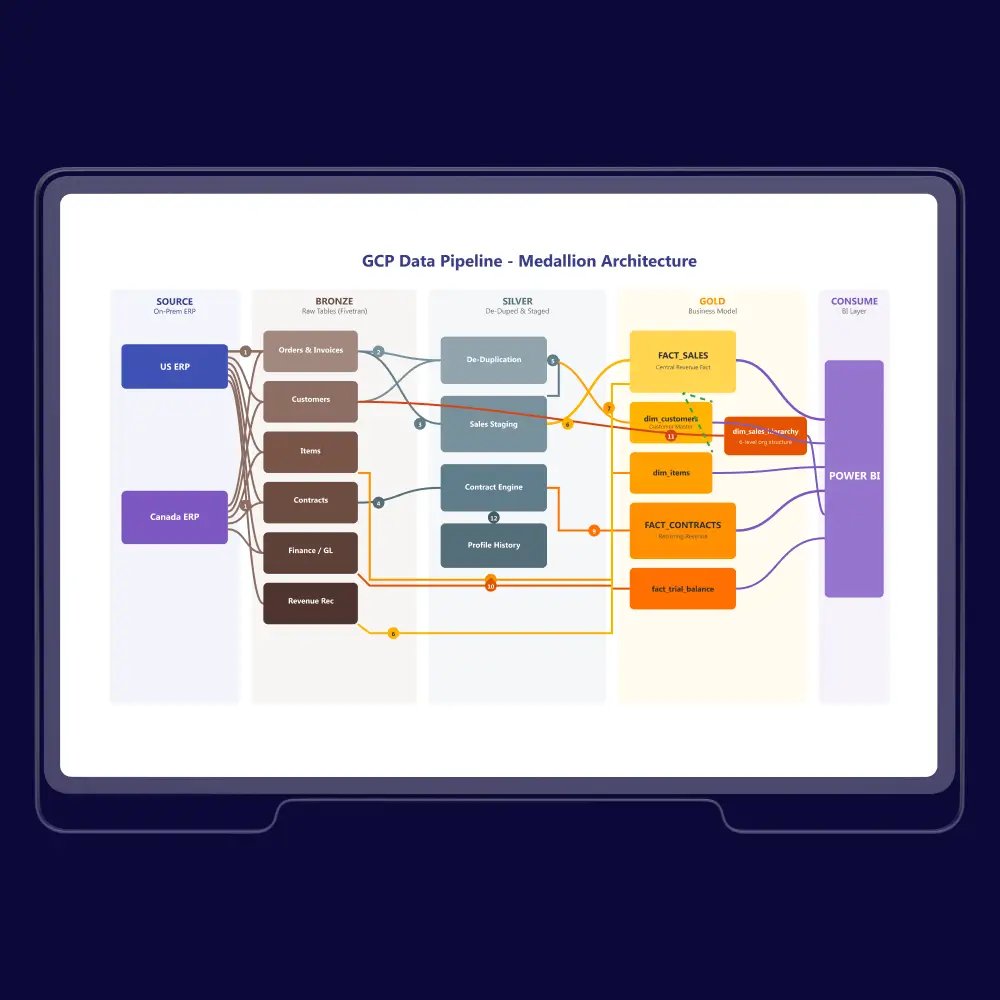
The work starts with people, not tooling: leadership agrees on a handful of KPIs and what each one means. The data is then consolidated into a governed data warehouse with a semantic layer, built with AI-assisted data engineering that, in several cases, wrote the large majority of transformation code and documentation. Entity-resolution and business-key logic reconcile records across systems, and extraction is read-only so source systems are never disturbed. The result is a single source of truth on which everything else depends.

On top sits a natural-language query layer delivered where people already work: Slack, Teams, the web or an existing AI assistant. It generates governed SQL behind guardrails such as cost limits, PII redaction and role-based access, and returns tables, charts and short narratives with source lineage. Anomaly detection, churn and revenue prediction, and alerts that feed operational workflows, such as a missing pre-procedure record or a failed eligibility check, extend the same foundation through BI and analytics. Governance is treated as a product, with approved tools, access requests, usage dashboards and versioned context, and AI features are deliberately held back until the data foundation is proven.

Techniques: Entity resolution and business-key matching · Governed warehouse with semantic layer · Natural-language-to-SQL with guardrails · Anomaly detection and churn/revenue prediction · Alerts routed into operational workflows

AI role

AI turns plain-English questions into governed queries that return tables, charts and narrative with lineage, and proactively surfaces anomalies, trends and correlations that nobody asked about.

Automation scope: Enterprise-wide data unification and self-serve reporting across finance, operations and executive decision-making.


$3.6M run-rate savings in 90 days

— identified at a PE portfolio company across freight, inventory, pricing and analytics, traced through SQL lineage and signed off by finance

~4 days to 14 seconds

— median time-to-answer at the same company, with 120+ monthly active users

~140 data models in 6 weeks

— built at a healthcare media company against a typical 6–9 months

85% less monthly reporting

— across a 50-site real estate operator, reclaiming 350+ analyst hours a year

ROI types: Cost Reduction · Customer Experience · Revenue Growth · Risk & Compliance · Time Savings

Evidenced in: Consumer Goods & CPG, Energy & Utilities, Financial Services, Healthcare & Life Sciences, Hospitality & Travel, Manufacturing & Industrial, Media & Entertainment, Non-Profit & Social Impact, Real Estate, Technology & Software

Why Companies Are Fixing This Now

How Dataforest Would Deliver This

The first thing we build is a line between certified and exploratory answers. A question is first matched to a certified metric, and the answer shows its definition, its owner and when the data was last refreshed. When a term is ambiguous, such as gross or net revenue, the agent asks back instead of guessing. Free-form SQL is still allowed, but those answers are labeled as not certified.

Access rights and query-cost limits are inherited from the source systems. The first domain is 20 to 30 finance metrics, each with a named owner in a KPI dictionary. We track two adoption numbers: the share of questions answered without an analyst and the share of answers a metric owner disputes.

Book a metric definition workshop: we'll take your top 20 KPIs, find where your systems disagree and propose one definition for each.

"Write down the ten questions your CFO asks every month and the answers you already trust, then run them against the new layer on day one. If it cannot match those, no amount of clever querying will earn the team's confidence."

Related case studies

All publications
All publications

Frequently asked questions

What must be agreed before building a unified data warehouse for natural-language BI?

Leadership must agree on a handful of KPIs and what each one means, so that "revenue" and "active customer" mean one thing across systems. Data is then consolidated into a governed warehouse with a semantic layer, entity resolution reconciles records across systems, and extraction is read-only. Reported delivery ranged from about 21 days for a first BI agent to roughly 6 weeks for a full set of data models.

Which business questions still go to the data team after natural-language BI is in place?

Routine questions move to the natural-language layer, which turns each into governed SQL and returns a table, chart or short narrative with source lineage. Exceptions still go to a named reviewer, and savings figures are checked by finance before they are counted. Definitions, lineage and access rules need owners, and Dataforest treats them as the product.

How do you validate the accuracy of a natural-language BI layer before rollout?

Write down the ten questions your CFO asks every month and the answers you already trust, then run them against the new layer on day one. If it cannot match them, it will not earn the team's confidence. In the source cases, a Fortune 500 consumer goods team reached 100% query accuracy in a P&L pilot, and users at one PE portfolio company rated 92% of first-attempt answers as useful.

What guardrails control natural-language-to-SQL queries on company data?

Guardrails include cost limits, PII redaction and role-based access, with single sign-on in front. Every answer carries lineage back to the source query, and definitions come from an agreed semantic layer. Governance is treated as a product, with approved tools, access requests, usage dashboards and versioned context, and AI features are held back until the data foundation is proven.

Which analytics capabilities can be added on top of a unified data warehouse?

The same foundation supports anomaly detection, churn and revenue prediction, and alerts that feed operational workflows, such as a missing pre-procedure record or a failed eligibility check. The query layer is delivered where people already work: Slack, Teams, the web or an existing AI assistant. The evidence spans 10 industries, from real estate and healthcare to manufacturing and software.

Why does a natural-language BI layer give wrong answers on unreconciled data?

A question-answering layer on top of unreconciled data simply produces wrong answers faster. When ERP, CRM, EMR and billing hold no shared definitions, one metric has several competing answers, and mismatched records distort every aggregate. The source cases that held up deliberately delayed AI features until the foundation was reliable.

We’d love to hear from you

Share project details, like scope or challenges. We'll review and follow up with next steps.

form image
top arrow icon