A regional retail bank invested two million dollars to build a churn prediction model. The engineering team extracted five years of transaction records from three separate legacy systems. Missing customer IDs and duplicated entries corrupted the training set. The algorithms processed outdated information and produced inaccurate risk scores. Leadership canceled the project after six months, losing the entire initial investment. If you don't want to follow this example but want to do it right, please contact us.
Is Your Internal Data Ready for Artificial Intelligence?
Vendors sell immediate cost reductions to chief information officers. The leaders soon discover that fragmented databases block automated tasks. Data architects must build a clean knowledge layer before algorithms can make accurate decisions. AI-ready data provides the foundation that connects those systems to reliable AI applications.
The gap between slides and servers
Software vendors promise immediate cost reductions and perfect task automation. Chief information officers expect rapid platform deployment across their departments. The leaders quickly discover fragmented databases and undocumented legacy code. Data engineers manually clean millions of historical customer transaction records. The new algorithms demand constant human supervision for acceptable accuracy. Cloud computing bills regularly exceed the original software licensing fees. Actual financial returns appear after years of quiet infrastructure work. Organizations also discover that poorly designed ETL / ELT workflows create a fragile data pipeline that is expensive to maintain. Building AI-ready data is often the hidden infrastructure effort behind those promised results.
The intelligence illusion
An AI agent requires exact facts to execute automated tasks. Poor data engineering feeds these systems corrupted information. A customer data platform filled with duplicate records produces incorrect customer profiles. The agent then makes terrible financial decisions from those errors. Companies move their raw information into structured storage like Databricks. A modern data lakehouse can combine governed analytical storage with access to structured and unstructured data, giving AI systems a broader and more reliable information base. Clean storage gives the agent an accurate map of company operations. The final output reflects the exact quality of the internal records. AI-ready data gives the agent a trustworthy foundation instead of forcing it to reason through inconsistent source material.
Alexandr Sheremeta: «An agent inside is just a prompt communicating with an LLM. Whenever you don't have the proper data, whatever you put in the prompt, you won't get anything meaningful. Organizing the data is the first step for adopting AI. »
The layer between raw and ready
Infosys published the AI First Value Framework in August 2026. Data architects prepare all structured and unstructured enterprise records. Companies build a dedicated knowledge layer between legacy source systems and AI agents. This digital infrastructure cleans raw internal information for immediate access. The platform applies data fingerprinting alongside strict governance guardrails. Synthetic data services protect sensitive customer records during model training. These engineering steps turn basic files into trusted corporate assets and create AI-ready data. CxOs make real-time decisions from this verified material.
Medical Lab Achieves 50% Compute Savings via Databricks Migration
.webp)

Medical Lab Achieves 50% Compute Savings via Databricks Migration
Can Your AI Agent Trust the Company Records?
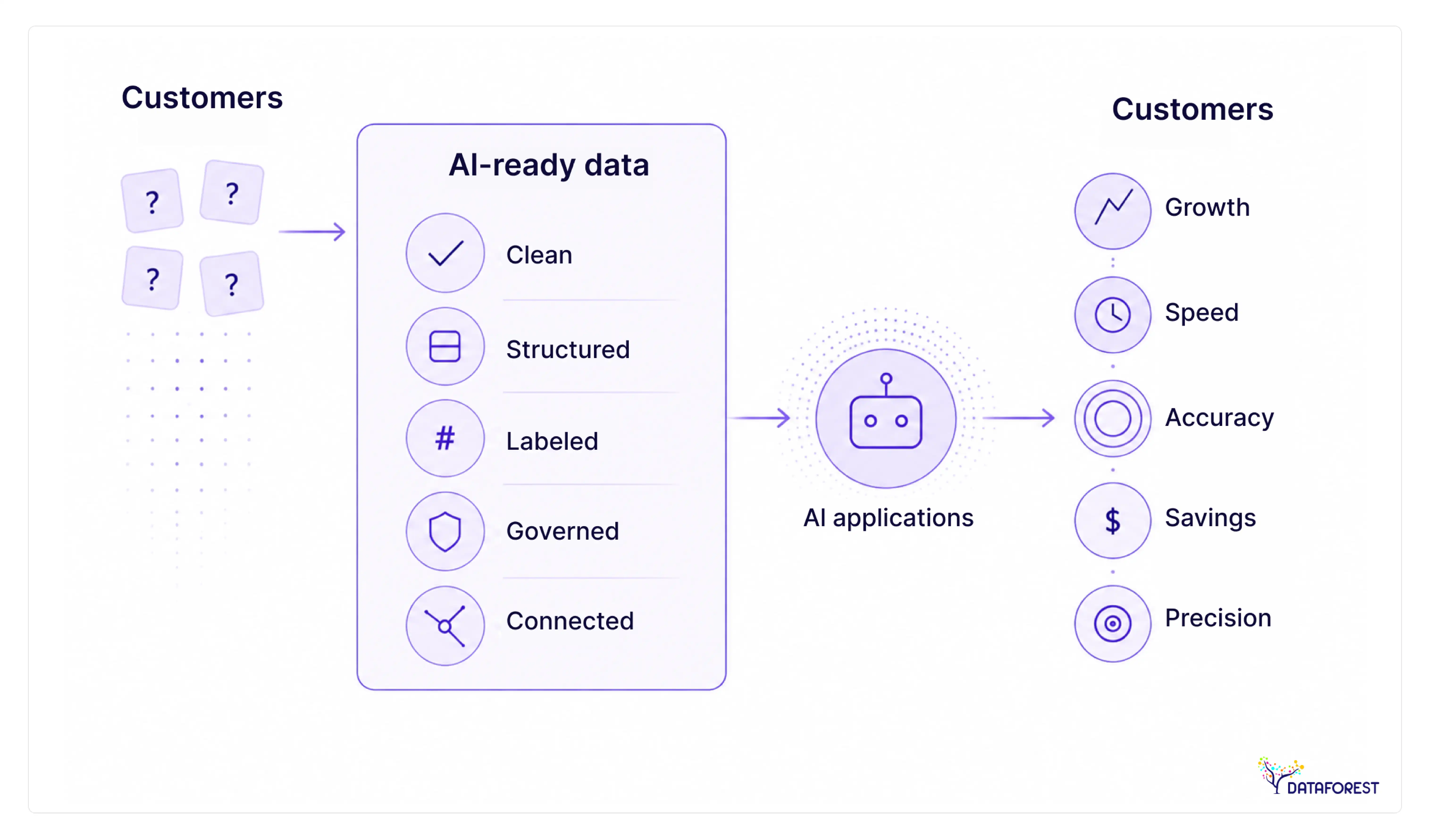
AI-ready data is clean information that machine learning algorithms can process immediately. Data engineering teams remove duplicate records and fix missing internal values. Companies organize standardized files inside a central cloud storage platform. This structured format gives the artificial intelligence model exact business facts. Strict internal governance protects all sensitive customer records from unauthorized access. Chiefs can then trust the software to automate daily operations.
Data architects measure internal information against specific requirements:
- Accuracy: Data engineers verify every customer transaction record for factual correctness. The storage platform rejects corrupted files before model training begins. This strict validation prevents algorithms from making false financial predictions and helps maintain AI-ready data. These controls are fundamental to data quality and trustworthy training data.
- Completeness: A reliable dataset contains no missing fields or blank entries. Data teams complete these gaps using verified historical numbers. The artificial intelligence requires a full map of company operations to automate daily workflows. Complete datasets are a core requirement for AI-ready data.
- Consistency: Data teams format all internal dates and currencies to a single standard. The software processes identical layouts across every corporate department. This rigid structure stops unexpected errors during automated tasks and keeps AI-ready data consistent.
- Timeliness: Cloud platforms update the internal business records in real time. Chief Information Officers base their strategic decisions on today's actual transactions. Stale database information feeds algorithms outdated facts and produces poor business results. Timely updates help preserve AI-ready data for current decisions.
- Governance: Strict corporate policies protect all sensitive customer profiles from exposure. System administrators grant file access only to authorized machine learning tools. Synthetic data services replace real personal names during the testing phase. Strong governance makes AI-ready data usable without compromising sensitive information.
Why Do Your Departments Bring Different Math to the Meeting?
Isolated databases feed your executive team conflicting revenue numbers. Data engineers fix this costly operational problem and construct central lakes. One trusted storage architecture aligns your whole business on concrete facts and clear targets. This architecture creates a shared foundation for AI-ready data across departments.
Scattered files destroy your bottom line
Isolated databases cost large enterprises millions of dollars every year. Sales and marketing departments build separate records for the exact same customers. This constant data duplication wastes hours of valuable employee time. Executives read conflicting business numbers from these disconnected software systems. A central data repository repairs these specific communication failures. Engineering teams pipe all company metrics into one shared technical architecture. Every business department acts on information from one identical company database. The result is a stronger foundation for AI-ready data and reliable automation.
Stop arguing about whose spreadsheet is right
Conflicting metric reports cost modern companies millions of dollars daily. A shared data architecture solves this expensive operational problem fast. Engineers pipe all software applications into one trusted storage location. Every corporate department pulls numbers from the exact same tables. Marketing and sales teams stop counting the identical customers twice. Chief officers make fast decisions based on concrete revenue facts. The whole organization builds deep trust in the new system. A single database aligns the business on clear financial targets and supports AI-ready data at scale.
Alexandr Sheremeta: Nowadays, for those clients we build data lakes, creating easier ways of working with data — a medallion architecture with different levels of storing data properly, so you understand how data is transformed and processed — and ultimately building dashboards from a more classical point of view, or AI capabilities that let you communicate with the data: flexible reports, analytics, correlations, calculations. But the core is a single source of truth.
Can Your New Algorithms Trust Your Old Spreadsheets?
Modern artificial intelligence algorithms require a massive volume of clean corporate records. Broken source systems feed your mathematical models incorrect financial facts. Data teams construct strict storage pipelines to block these expensive machine errors. These pipelines are essential for turning legacy records into AI-ready data.
Data lake vs. data warehouse
Data warehouses store structured information in rigid tables for fast historical reporting. Data lakes hold raw text and image files in their native states. Strict warehouse limits starve the massive algorithms behind modern artificial intelligence. Lakes offer the huge unstructured volumes that train new neural networks. Engineers combine both systems to prepare raw files for machine consumption. Teams filter loose text from the open lake into clean storage tiers. This neat setup feeds your software models accurate facts at high speeds and produces AI-ready data.
Choose what matters to you and schedule a call.
The Medallion architecture
Databricks invented the Medallion architecture to explain data pipelines. It operates as a completely open design pattern. You can build this three-step system on any modern data platform:
- Raw company files enter the bronze layer in their original formats. Engineers dump unstructured text and loose images directly into this initial storage zone. This layer is the starting point for building AI-ready data.
- The silver layer forms a strict filter for this messy input. Data teams fix broken customer records and missing transaction dates here. This middle stage builds a clean factual foundation for corporate intelligence tools and AI-ready data. Data normalization, validation, and data modeling typically happen here so downstream systems can work with consistent entities and relationships.
- The gold layer delivers the final polished product to the entire business. Analysts arrange the clean facts into specific departmental categories. Artificial intelligence algorithms read this refined tier for their exact mathematical calculations. This final layer makes AI-ready data accessible for analytics and automated decisions.
Give your AI a good rulebook
Artificial intelligence models amplify the exact information you feed them. Bad input records create catastrophic automated decisions across a company. Data governance teams build strict rules to prevent these digital disasters. Engineers block unauthorized users from accessing customer financial details. Automated scripts check every new file for mathematical errors and missing dates. Clean information flows freely into the central machine learning pipeline. Executives trust the final mathematical outputs from these protected systems — a solid governance strategy turns chaotic files into reliable AI-ready data.
Alexandr Sheremeta: With AI being able to consolidate systems, it's super valuable, while supporting data integrity — because one issue is always that when you pull data out of a system, it either comes over wrong, or you have to modify it, or the source system wasn't set up for success to begin with. So, it's important to have the right systems from the beginning.
Is Your Data Making You Any Money?
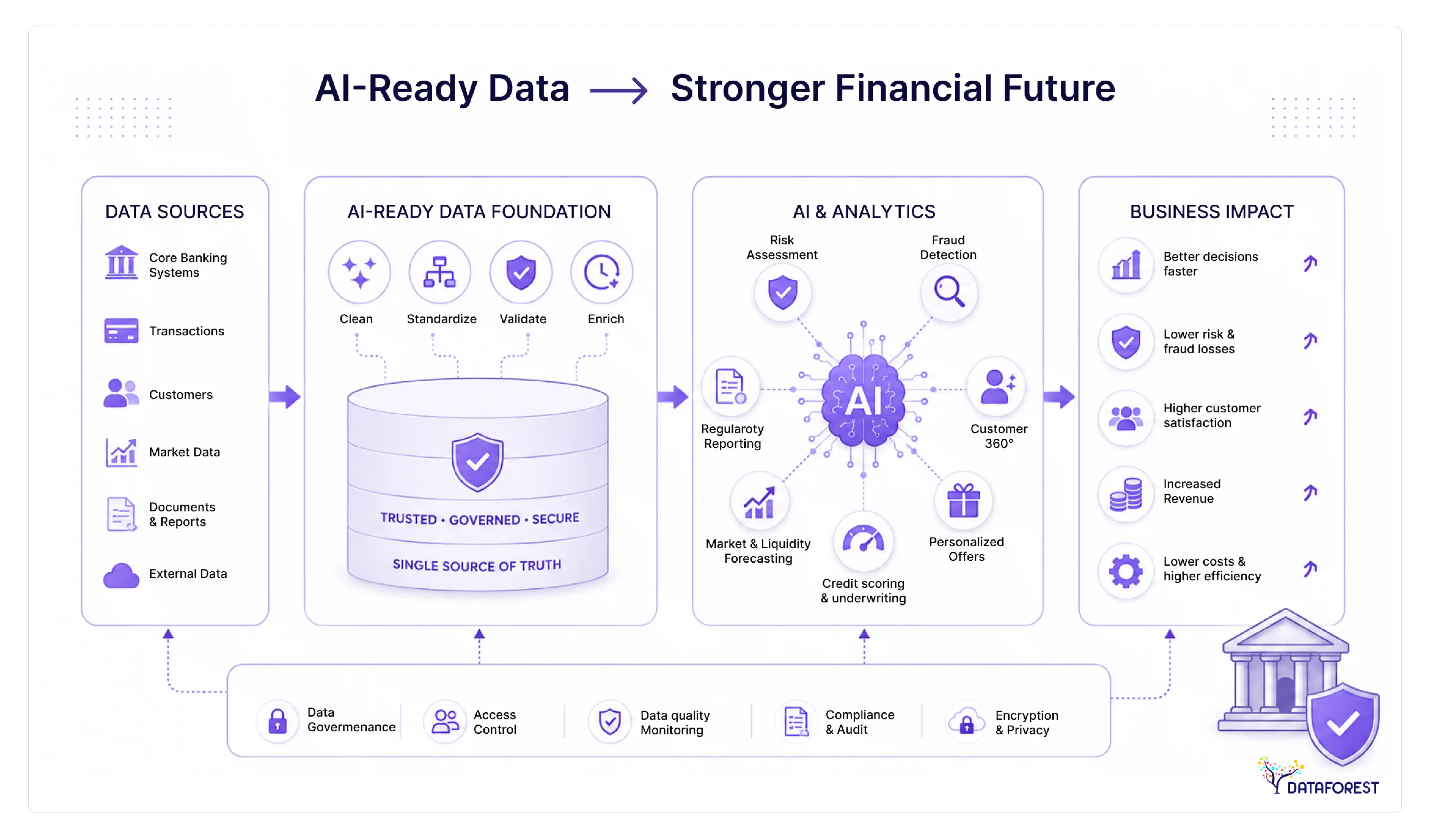
Broken information systems cost every corporate department thousands of hours. A central data architecture repairs these manual processes across your entire company. Clean pipelines turn scattered metrics into immediate financial gains. AI-ready data makes those gains repeatable by giving automated systems reliable inputs.
Catch financial errors before the quarter ends
The Problem: Financial planners waste days hunting for mismatched revenue numbers across fifty regional software systems. Manual spreadsheet updates introduce basic mathematical errors into the final quarterly forecasts.
The solution: Data engineers build a central medallion architecture to process every global transaction daily. Automated pipelines clean this raw input and feed a single corporate dashboard. The architecture creates AI-ready data for financial analysis and forecasting. These workflows combine data ingestion, data integration, and controlled transformation so finance teams work from a single source of truth.
The result: The chief financial officer reviews accurate cash flow metrics on demand. The finance department cuts weekly report generation time by eighty percent.
Find your best customers faster
The Problem: Disconnected tracking systems hide the best corporate prospects from your sales team. Representatives waste valuable hours calling bad leads and miss ready buyers.
The solution: Data specialists pipe all regional customer records into one central silver layer. Machine learning models read this clean information to rank new prospects. Master data management can align customer identities across systems, improving the quality of the inputs used for predictive analytics.
The result: The sales department calls the most profitable target accounts first. This clear priority list raises total closed revenue by thirty percent. It depends on the quality of the AI-ready data beneath the models.
Reach the right buyers every time
The Problem: Marketing departments blast generic digital advertisements to unengaged consumer lists. These blind campaigns waste massive budget allocations on the wrong people.
The solution: Engineers connect all website clicks and email history into one central lake. Artificial intelligence algorithms scan these unified files to predict exact buyer preferences.
The result: A richer stream of AI-ready data for personalized targeting. The marketing team sends specific product offers directly to ready shoppers. This exact targeting cuts total customer acquisition costs in half.

Does Custom Architecture Create Reliable AI?
Standard commercial packages force technical teams into rigid workflow limits. These generic tools leave dangerous security gaps and isolate company files. Custom development removes these exact bottlenecks to prepare growing businesses for machine learning and AI-ready data.
Buy off-the-shelf, pay in custom pain
Off-the-shelf software forces your growing enterprise into rigid compromises. They create data silos, security gaps, and hidden costs. Custom architecture shatters those limitations, delivering the precise operational flexibility and AI readiness your business demands.
- Standard software packages force your internal workflows into rigid vendor boxes.
- Pre-built applications fail to process unique company data formats.
- Generic products leave dangerous security gaps in corporate compliance rules.
- Out-of-the-box templates create messy data silos across different departments.
- Commercial tools charge hidden fees for basic custom feature adjustments.
- Standard platforms lack the deep flexibility required for advanced artificial intelligence models.
- Custom architectures solve these exact operational bottlenecks for growing enterprises and help create AI-ready data. They also provide the flexibility to implement fit-for-purpose data modeling, metadata management, data lineage, and governance processes.
The triangle works best when nobody cuts corners
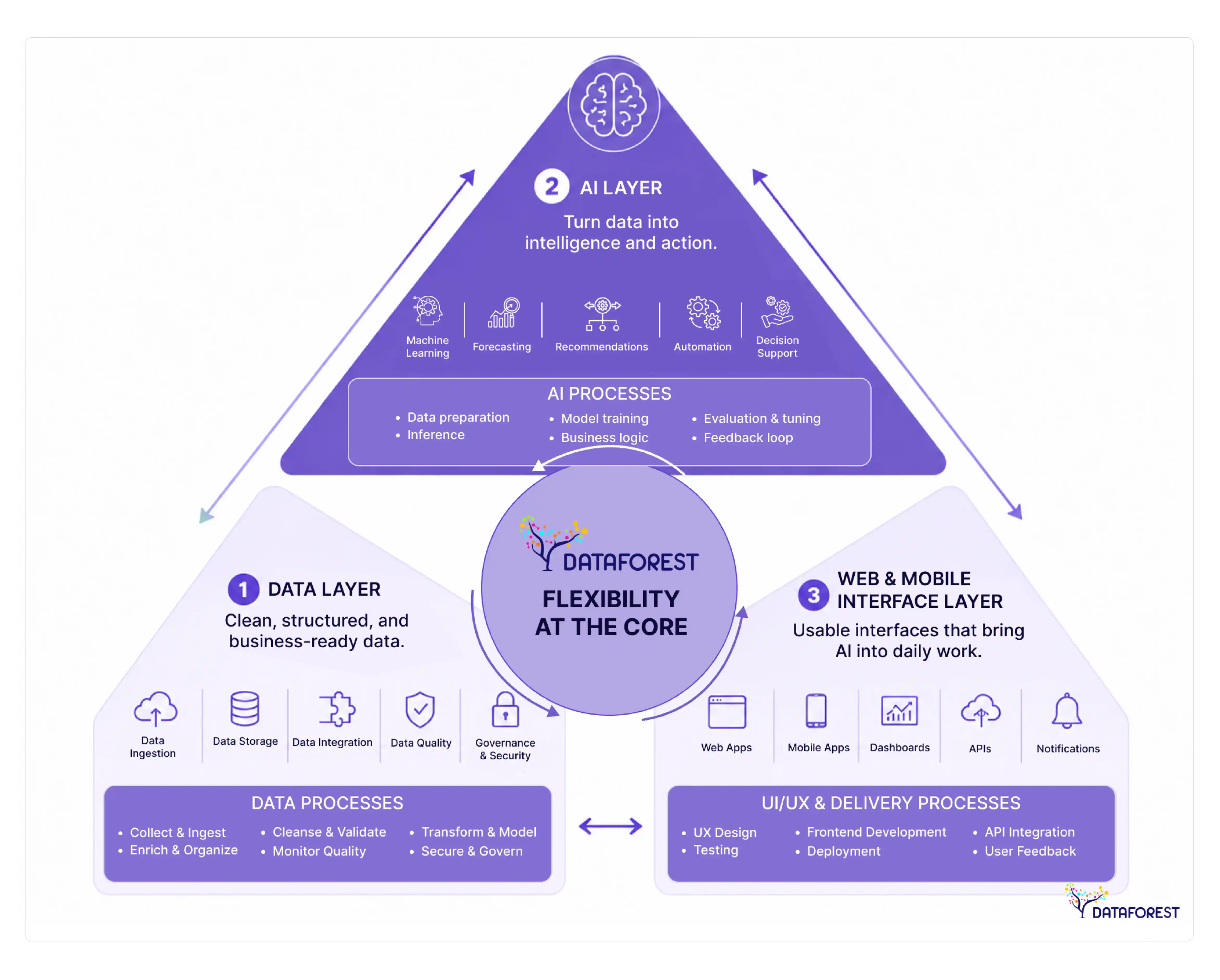
DATAFOREST builds around three connected layers: data, AI, and web or mobile interfaces with a usable UI.
- The data layer provides AI with access to clean, structured information that reflects real business processes and creates AI-ready data for downstream systems. It includes the data infrastructure required for data ingestion, data integration, storage, data cleansing, and governed access to both structured and unstructured data.
- AI then turns that data into forecasts, recommendations, automation, or decisions that users can act on.
- Web and mobile products bring those capabilities into daily work, so the technology has a place beyond the backend.
This triangle matters for AI-ready data, since an isolated model rarely fixes a weak data foundation or a clumsy user experience.
The DATAFOREST method is built on flexibility, ensuring that our technical architecture serves your business goals. We use custom Python development to overcome the limitations of off-the-shelf software, building tailored solutions for data engineering, AI, and application logic. This approach guarantees a cohesive system designed entirely around your specific data, processes, and users, with AI-ready data at its core.
Alexandr Sheremeta: “We make custom solutions because many frameworks and tools in the market have constraints. When you try to build a flexible process — and flexibility is one of our core values — those constraints bring a lot of complexity. Eventually, you'd have to tell your client, «This is impossible for us. Instead, we want to be able to deliver anything we might be asked, depending on resources and time. For that, we need a lot of flexibility to create what the client needs.”
Does Your Company Have the Discipline for Artificial Intelligence?
Technical executives spend money on new artificial intelligence platforms. These advanced models break immediately against disorganized internal text records. True machine learning success requires a complete redesign of daily operations and a deliberate path toward AI-ready data.
Buying algorithms cannot fix bad habits
CIOs view artificial intelligence as a simple software purchase. They buy new platforms and ignore their raw data feeds. New language models break under the weight of unstructured text. Data architects must mandate strict categorization habits across their technical teams. Organizations fall behind competitors without a total redesign of daily operations. Without disciplined processes, companies struggle to maintain AI-ready data over time.
Alexandr Sheremeta: “Whenever you don't have proper data, whatever you put in the prompt and send to the LLM, you won't get anything meaningful out. That's the reality we solve for our clients: we need to properly organize all of this as the first step for adopting AI or building any platform. This is the red line in how organizations rise, change, and grow — or go down. Some organizations won't survive. The AI paradigm is a big thing for us too — it's changing how we approach programming and architecture, so we run a lot of AI transformation programs across the organization.”
Fixing our own plumbing
DATAFOREST builds data systems for clients and applies these exact standards internally. Purchasing an algorithm fixes nothing without a structured data foundation. Our architects are rewriting data protocols across all internal departments. This mandate forces our technical teams to abandon outdated storage habits. We treat unorganized metrics and scattered text files as toxic assets. True readiness demands a complete redesign of daily business operations. The internal restructuring proves that machine learning requires strict human discipline and AI-ready data.
Do Not Scale a Mess
DATAFOREST team requires clients to fix their raw records prior to any machine learning deployment. Engineers map out every existing database to spot missing numbers and broken text. We build a central storage system to standardize this scattered information. Language models need this strict categorization to return accurate answers. Companies can then safely add more processing power to their servers. Feeding unorganized files into a large server cluster causes expensive system errors. Clean records give business leaders the confidence to expand their artificial intelligence operations. The objective is a trustworthy data pipeline, reliable data observability, and stable data quality that can scale with AI workloads.
Please complete the form to start the journey to AI-ready data.
Questions On AI-Ready Data Journey
How long does it take to make enterprise data AI-ready?
Restructuring enterprise data takes six to eighteen months. Data architects first inventory thousands of scattered databases and loose text files. Engineering teams then build central servers to standardize this raw information. Initial testing with clean records requires at least eight weeks. Businesses fail fast when they skip this mandatory structural work. The goal throughout the process is to establish reliable AI-ready data. Organizations may also need to establish a data catalog, document data lineage, define ownership through data governance, and improve metadata management before AI workloads can operate reliably.
What's the ROI of investing in a data foundation before AI?
A strong data foundation stops companies from burning cash on broken machine learning projects. Clean records reduce server processing costs by shrinking the volume of useless text. Accurate predictions drive direct revenue growth through targeted sales campaigns. Technical teams avoid expensive system failures down the line. This initial structural work returns millions in saved engineering hours and creates AI-ready data that can support future AI initiatives. The return also comes from better data-driven decision-making.
Data lake or data warehouse — what does AI actually need?
Artificial intelligence requires access to both structured numbers and raw text files. Data lakes store massive volumes of raw audio, images, and text. Data warehouses organize clean financial records and clear customer metrics. Technical teams build a lakehouse architecture to combine these two storage methods. Language models demand this combined structure to read text and calculate facts. Together, these systems provide the foundation for AI-ready data. A data lakehouse can provide a practical bridge between the flexibility of a data lake and the governed analytics capabilities of a data warehouse.
What is a single source of truth, and why does AI need one?
A single source of truth centralizes all company records into one definitive database. This structure eliminates conflicting reports across different business departments. Contradictory numbers from separate servers break artificial intelligence algorithms. Machine learning models need exact facts to generate accurate answers. Unified data foundations protect companies from costly software failures and support AI-ready data across the organization.
Should we build a custom data platform or buy an off-the-shelf tool?
Buying commercial software saves time for companies with standard operations. Complex businesses require custom databases to support their specific internal processes. Pre-built systems force technical teams to alter their daily workflows. Custom architecture demands a large upfront investment in engineering hours. Data architects pick a direction based on their exact business rules and the requirements for AI-ready data. The decision should also consider the organization's data strategy, integration requirements, governance model, data security and compliance obligations, and long-term data infrastructure costs.
Can AI work with messy or unstructured data?
Artificial intelligence algorithms have the technical capacity to process messy text files. Advanced language models generate false answers from disorganized corporate records. Unstructured inputs force servers to burn expensive computing power to find basic facts. Technical teams spend thousands of hours fixing these automated mathematical mistakes. Companies need clean digital storage systems to prevent these costly software failures and build dependable AI-ready data. RAG still depends on trustworthy source data, effective metadata management, and reliable data lineage
What are the first steps to becoming AI-ready?
Companies must audit their existing storage systems to find broken records. Data architects then build a central database to gather scattered text. Technical teams mandate strict rules for naming and saving new files. Engineers test the clean information against a basic language model. This structural foundation prevents expensive software failures during full deployment and creates AI-ready data for broader adoption. A practical sequence is to assess data quality, map data silos, establish data governance, build the data pipeline, introduce observability, and then expand into predictive analytics, large language model (LLM) applications, retrieval-augmented generation (RAG), and agentic AI / AI agents.


.webp)

.webp)
.webp)