

A mid-size fintech requests "a data platform" and receives proposals ranging from $80K to $600K—for what sounds like the same project. The spread is not random. It reflects fundamental differences in platform type, project complexity, engagement model, underlying data architecture, and a dozen cost variables that most budget conversations never surface.
The problem is not that data platform development cost information is unavailable. The problem is that it is fragmented, outdated, and almost never written from the perspective of a team that actually builds these systems. Generic "software development cost" guides mix data platforms with mobile apps. SaaS vendor content frames every answer as "buy our product." Nobody connects the real cost drivers—data infrastructure cost, data warehouse development cost, data engineering services cost—to the decisions you need to make this quarter.
This guide changes that. It draws on real project data, current 2026 market benchmarks, and hard-won experience in delivering data platform development services to give you a comprehensive, honest breakdown of what custom data platform development actually costs—and where the hidden budget risks live.
You will learn: (1) how to estimate costs accurately based on your specific platform type and complexity tier, (2) which engagement model and geographic sourcing strategy fits your budget, and (3) how to prevent the budget overruns that derail 75% of IT projects.
Key Takeaways
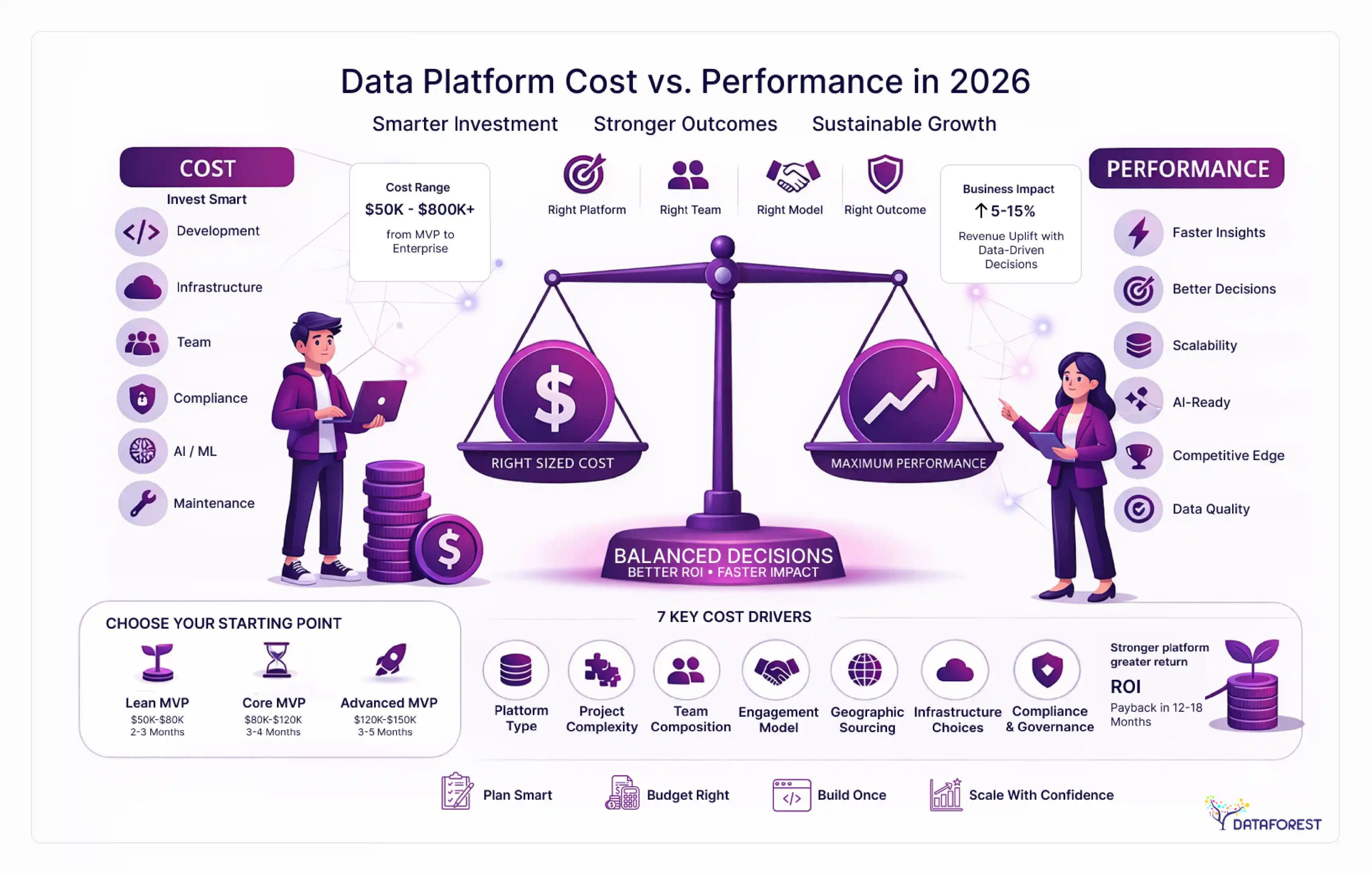
- Data platform development costs range from $50K to $800K+, with platform type (not team size) as the primary cost driver—a data lake costs 3–4× more than a basic analytics dashboard (see Cost by Platform Type section below).
- Budget for 15–25% above your base development estimate to cover compliance, data governance, and AI/ML integration—three cost layers that most budgets miss entirely (see Hidden Costs section below).
- Roughly 75% of IT projects exceed their original budgets, according to AgileEngine/Standish Group research—yet a structured First-Year Budget Planner that accounts for discovery, infrastructure, team, and contingency reduces surprise overruns dramatically (see First-Year Budget Planner section below).
- Choosing the wrong engagement model (T&M vs. fixed-price vs. dedicated team) can significantly impact your total cost for an identical project scope—the decision depends on how well you can define requirements upfront (see Engagement Models section below).
- Sometimes the right answer is not to build at all: if your data volume stays under 50TB and you need standard dashboards, an off-the-shelf platform will cost you a fraction of a custom build (see When NOT to Build section below).
What Determines Data Platform Development Cost? The 7 Drivers That Shape Every Budget
The enterprise data management market reached $123 billion in 2026, growing at an 11.5% CAGR according to Fortune Business Insights. Worldwide IT spending hit $6.15 trillion, up 10.8% year-over-year per Gartner's February 2026 forecast. Companies are pouring money into data infrastructure—and many are spending it poorly.
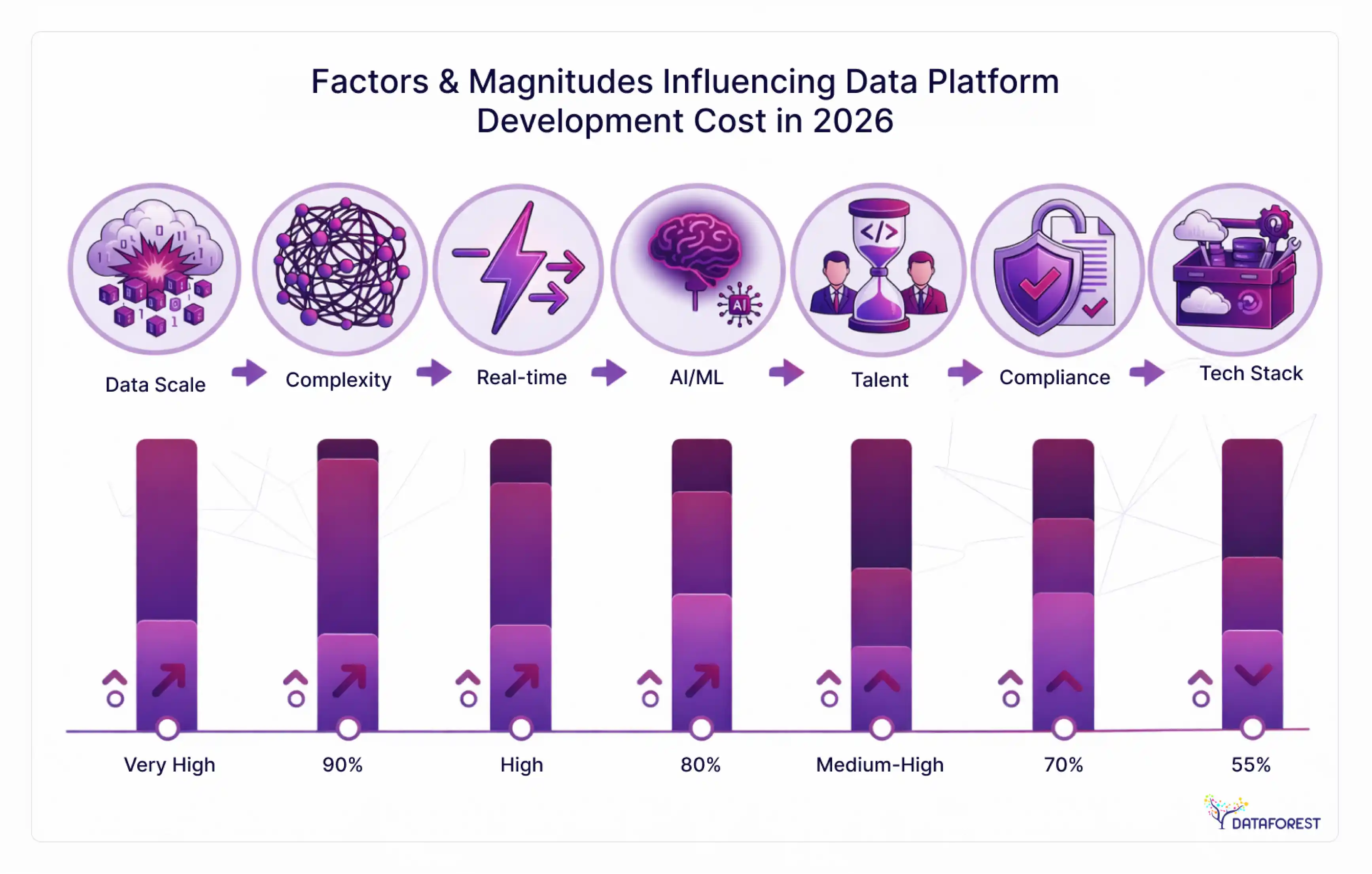
The cost to build a data platform is not a single number. It is an output of seven interdependent variables, and misjudging any one of them can push your budget 2× or 3× past your original estimate.
The 7 cost drivers:
- Platform type. A data warehouse, a data lake, a customer data platform, and an IoT ingestion system have fundamentally different architectures, toolchains, and cost profiles. This is the single biggest determinant of total cost.
- Project complexity. An MVP with 3 data sources and a single dashboard is a different project than an enterprise platform with 50+ integrations, real-time streaming, and multi-tenant access control.
- Team composition. A lean team of 3–4 engineers produces different results (and bills) than a full squad with a data architect, ML engineers, DevOps, QA, and a project manager.
- Engagement model. Time-and-materials, fixed-price, and dedicated team models carry radically different risk and cost profiles for the same scope.
- Geographic sourcing. Hourly rates for a senior data engineer range from $25/hr in South Asia to $250/hr in the United States—a 10× spread for nominally similar work.
- Infrastructure choices. Cloud provider selection (AWS, Azure, GCP), compute vs. storage allocation, and managed vs. self-hosted services compound into significant cost differences over 12–24 months.
- Compliance and governance requirements. GDPR, HIPAA, SOC 2, and industry-specific regulations add 15–25% to platform costs, according to Acceldata research. Most teams discover these requirements mid-project, not during planning.
Understanding these seven drivers before you request a single proposal is the difference between a project that lands within budget and one that spirals. The sections below break each one down with specific numbers.
Cost by Platform Type: Data Lake vs. Warehouse vs. CDP vs. Analytics vs. IoT
No two data platforms cost the same because no two data platforms are the same thing. The term "data platform" encompasses at least five distinct architectures, each with its own cost profile. Treating them as interchangeable is the fastest way to produce an inaccurate budget.
Here is what each platform type typically costs to build from scratch, based on our experience:
The ranges above reflect custom development—not licensing an existing SaaS product. The difference between the low and high end of each range comes down to three factors: number of data sources, real-time vs. batch processing requirements, and whether you need AI/ML capabilities integrated from day one.
Why this matters for budgeting: A CTO who requests "a data platform" without specifying type will receive proposals ranging from $80K to $600K for the same conversation. Define the platform type first. Everything else flows from that decision.
According to Business Research Insights, cloud-based big data platforms now account for 60% of deployments in 2026, which means most new builds run on managed cloud services rather than on-premises infrastructure. This shifts cost from upfront capital expenditure toward ongoing operational spend—a distinction your CFO needs to understand before approving the project.
Build vs. Buy: When Custom Development Makes Financial Sense
The big data platform market reached $88.5–$101.5 billion in 2026, according to Business Research Insights. That market includes both off-the-shelf platforms (Snowflake, Databricks, Fivetran + dbt) and custom-built solutions. Before you budget for development, you need to answer whether you should build at all.
The Build vs. Buy Decision Matrix
The break-even rule of thumb: Custom development starts making financial sense when your annual licensing and integration costs for off-the-shelf tools exceed $80K–$120K, and you still need significant customization on top. Below that threshold, the speed and simplicity of a managed platform usually wins.
Four scenarios where "build" is the clear answer:
- You need proprietary ML pipelines that process data in ways no existing tool supports.
- Your data governance requirements demand full control over data residency, encryption, and access patterns.
- You are building a data product—your platform is the product, not a support function.
- Your integration landscape includes legacy systems that no off-the-shelf connector handles cleanly.
Two scenarios where "buy" wins every time:
- Your team needs standard business intelligence dashboards from well-known SaaS tools (Salesforce, HubSpot, Stripe) with under 50TB of data.
- You need results within 4–8 weeks and do not have a dedicated data engineering team in-house.
Data Platform Development Cost Breakdown: Team, Infrastructure, Tools, Compliance & AI/ML
This is the section that answers the core question: where does the money actually go? Based on our project data, a typical custom data platform budget is allocated as follows:
Development Labor: The Largest Line Item
For a mid-complexity data warehouse build ($200K total), development labor typically consumes $80K–$100K. That breaks down to roughly 4–6 engineers working 4–7 months, depending on team seniority and location.
According to Fivetran research, average data pipeline maintenance costs $520,000 per year, and data engineers spend approximately 50% of their time on pipeline maintenance rather than building new capabilities. This means your ongoing operational cost is not a fraction of development cost—it can rival or exceed it within two years.
Infrastructure: Cloud Provider Cost Differences
Cloud infrastructure costs vary significantly by provider and architecture. General benchmarks for data platform workloads:
AI/ML Integration: The Cost Layer Most Budgets Miss
Data center spending surpassed $650 billion in 2026, up 31.7% according to Gartner—driven largely by AI workloads. If your platform includes AI/ML capabilities, budget for a distinct cost layer:
These numbers are in addition to your base platform development cost. A $200K data warehouse becomes a $260K–$400K project once you add predictive capabilities.
Compliance: The 15–25% Multiplier
According to Acceldata research, data governance and compliance requirements add 15–25% to total platform costs. The exact premium depends on your industry:
Most teams discover compliance requirements mid-project rather than during discovery. Building compliance into your architecture from day one costs 30–40% less than retrofitting it later.
Cost by Project Complexity: MVP, Mid-Market & Enterprise Tiers
Not every data platform requires enterprise-scale investment. Here is how costs map to three distinct complexity tiers:
The discovery phase deserves special attention. It is the single best investment you can make for budget accuracy. A properly scoped discovery (2–10 weeks depending on complexity) maps data sources, defines architecture, identifies compliance requirements, and produces a realistic cost estimate—before you commit a significant development budget.
Discovery typically costs $5K–$50K+, depending on project scale. It pays for itself by preventing the mid-project scope explosions that cause budget overruns.
Engagement Models & Their Cost Impact: T&M, Fixed-Price & Dedicated Teams
Choosing the wrong engagement model can swing your total cost by 30–50% for an identical project scope. Here is how the three primary models compare:
Engagement Model Comparison
Which Model to Choose: The Decision Framework
Choose T&M when:
- You are in the discovery or prototyping phase.
- Requirements will evolve based on what you learn from the data.
- You have strong internal technical leadership to manage the engagement.
Choose Fixed-Price when:
- Scope is fully documented and unlikely to change.
- Your organization requires budget certainty for procurement approval.
- The project has a clear end-state with defined acceptance criteria.
Choose Dedicated Team when:
- You need ongoing data platform development for 6+ months.
- You want engineers who learn your domain deeply over time.
- You plan to scale the team up or down based on project phases.
The hybrid approach: Many successful data platform projects start with T&M for discovery (2–6 weeks), transition to fixed-price for core development (3–8 months), and shift to a dedicated team for ongoing operations and feature development. This captures the best risk profile of each model.
Hidden Costs & Budget Overrun Prevention: The 8 Budget Landmines
According to AgileEngine and Standish Group research, roughly 75% of IT projects exceed their original budgets. Data platform projects are no exception. The most common budget mistake is not choosing the wrong vendor—it is budgeting for the platform you want instead of the one you need.
Here are the eight hidden costs that blow up data platform budgets:
- Data quality remediation → +10–15% budget for profiling, cleansing, transformation
- Scope creep → +20–30% from dashboards evolving into real-time and ML features
- Late compliance requirements → +15–25% when added mid-project instead of day one
- Data migration complexity → +3–6 weeks for schema mapping, conflicts, validation
- Integration surprises → +1–2 days per API or system beyond initial estimates
- Infrastructure cost escalation → 2–5× increase from dev to production workloads
- Knowledge transfer → +2–4 weeks for documentation and handoff
- Post-launch tuning → 80–120 hours for query, pipeline, and performance fixes

1. Data Quality Remediation
Poor data quality costs organizations an average of $12.9 million per year, according to Gartner and TBlocks (2026). When your platform connects to source systems, you will discover data quality issues that nobody warned you about. Budget an additional 10–15% for data profiling, cleansing, and transformation work that is not in your original scope.
2. Scope Creep from Stakeholder Requests
Every department that learns about your new data platform will want something from it. A dashboarding request becomes a real-time alerting requirement. A reporting feature becomes a predictive model. Without disciplined scope governance, these requests add 20–30% to your budget.
3. Compliance Requirements Surfacing Mid-Project
As noted above, compliance adds 15–25% to platform costs (Acceldata research). When this requirement surfaces in month 4 instead of month 1, the cost is higher because you are retrofitting rather than building natively.
4. Data Migration Complexity
Migrating historical data from legacy systems is consistently underestimated. Schema mapping, data type conflicts, and validation testing can consume 3–6 weeks of unplanned engineering time.
5. Integration Surprises
Third-party APIs change. Legacy systems lack documentation. Authentication mechanisms are more complex than the vendor claimed. Every integration point carries risk. Budget 1–2 extra days per integration beyond your initial estimate.
6. Infrastructure Cost Escalation
Cloud costs during development are a fraction of production costs. When your platform goes live with real data volumes and real query patterns, infrastructure bills can jump 2–5× from your development environment baseline.
7. Knowledge Transfer and Documentation
If your platform is built by an external team, budget 2–4 weeks for proper knowledge transfer, documentation, and handoff. This is rarely included in initial proposals but is essential for long-term operability.
8. Post-Launch Performance Tuning
The first 30–60 days after launch will reveal performance bottlenecks that testing could not fully simulate. Budget 80–120 hours of senior engineering time for query optimization, pipeline tuning, and architecture adjustments.
The Budget Buffer Checklist
Apply the relevant buffers cumulatively. A healthcare company building its first data platform with AI/ML capabilities should budget 50–80% above the base estimate for development alone.
How to Calculate ROI on Data Platform Investment
A data platform is not a cost center—it is infrastructure that compounds in value. But "it will pay for itself" is not a business case. Here is a framework for quantifying return.
The Data Platform ROI Formula
ROI = (Annual Value Generated − Annual Platform Cost) ÷ Total Investment × 100
Where:
- Annual Value Generated = Revenue uplift from data-driven decisions + cost savings from automation + cost avoidance from better data quality
- Annual Platform Cost = Infrastructure + maintenance + team allocation for ongoing operations
- Total Investment = Development cost + discovery + data migration + first-year infrastructure
Quantifying Value: Three Categories
1. Revenue uplift. Data-driven pricing, personalization, and demand forecasting typically generate 5–15% revenue improvements in the first 18 months. For a $50M revenue company, that is $2.5M–$7.5M in annual uplift.
2. Cost savings from automation. According to Fivetran research, data engineers spend approximately 50% of their time on pipeline maintenance. A well-built platform with automated monitoring, self-healing pipelines, and orchestration recovers 30–40% of your data team's capacity. For a team of 5 data engineers at $150K average salary, that is $225K–$300K in recovered productivity per year.
3. Cost avoidance. Poor data quality costs organizations an average of $12.9 million per year (Gartner/TBlocks, 2026). Even a 10% reduction in data quality issues through automated validation produces $1.3M in annual savings at that average.
Payback timelines depend on platform complexity and primary value driver—request a scoped ROI analysis based on your specific use case.
Most well-scoped data platform projects reach payback within 12–18 months. Projects that exceed 24 months to payback typically suffer from one of two problems: the platform was over-engineered for current needs, or the organization lacked the data literacy to act on the insights produced.
First-Year Budget Planner: Your Complete Cost Checklist
This is the tool you take to your CFO. Every cost category below represents a real budget line item from data platform projects. Check each one against your project scope to build a comprehensive Year 1 estimate.
Phase 1: Discovery & Planning (Weeks 1–6)
- [✓] Technical discovery and architecture design: $5K–$50K+ (scales with complexity)
- [✓] Data source audit and integration assessment: included in discovery or $3K–$8K separate
- [✓] Compliance requirements mapping: $2K–$10K (higher for regulated industries)
- [✓] Vendor and tool evaluation: internal effort, 20–40 hours of technical leadership time
- [✓] Project plan and budget sign-off: internal effort
Phase 2: Development (Months 2–8)
- [✓] Core platform development: 40–50% of total budget
- [✓] Data pipeline construction and testing: included in development
- [✓] Integration development (per source): $3K–$15K per integration depending on complexity
- [✓] AI/ML model development (if applicable): $20K–$500K+ (see AI/ML section)
- [✓] QA and automated testing: 10–15% of development budget
- [✓] Compliance implementation: 5–10% of development budget (15–25% for regulated industries)
Phase 3: Infrastructure & Deployment (Ongoing from Month 1)
- [✓] Cloud infrastructure setup: $500–$5,000/month during development, 2–5× at production scale
- [✓] Managed service licensing (ETL, BI, monitoring): $3K–$50K/year per tool category
- [✓] CI/CD pipeline and DevOps tooling: $200–$2,000/month
- [✓] Security infrastructure (WAF, encryption, access management): $500–$3,000/month
Phase 4: Launch & Optimization (Months 6–12)
- [✓] Data migration and validation: 5–10% of total budget
- [✓] Performance tuning: 80–120 hours of senior engineering time
- [✓] Knowledge transfer and documentation: 2–4 weeks of team time
- [✓] User training: 1–2 weeks, internal effort
- [✓] Post-launch monitoring and incident response: $2K–$8K/month
Phase 5: Ongoing Operations (Year 1 Annualized)
- [✓] Pipeline maintenance and monitoring: $3K–$15K/month
- [✓] Infrastructure costs at production scale: $2K–$20K/month
- [✓] Feature development and iterations: ongoing engineering allocation
- [✓] Security and compliance audits: $5K–$20K/year
Contingency
- [✓] General contingency: 10–15% of total budget (minimum)
- [✓] Additional buffers per risk factor: see Budget Buffer Checklist above
How to use this checklist: Walk through each item with your technical lead and finance team. For items that do not apply to your project, mark them as N/A. For items that do apply, use the cost ranges as starting points and adjust based on your specific complexity tier and regional rates. The sum of all applicable line items, plus contingency, gives you a realistic Year 1 total.

When NOT to Build a Custom Data Platform
Building a custom data platform is expensive, time-consuming, and operationally demanding. Sometimes the honest answer is: do not build. Here are five scenarios where off-the-shelf solutions are objectively better.
1. Your Use Cases Are Standard BI and Reporting
If your primary need is dashboards, scheduled reports, and ad-hoc queries against well-structured data, tools like Looker, Tableau, or Power BI (connected to a managed warehouse) deliver 90% of the value at 20% of the custom development cost.
2. You Do Not Have (or Cannot Hire) Data Engineering Talent
A custom platform requires ongoing maintenance. According to Fivetran research, data pipeline maintenance alone averages $520,000 per year. If your organization cannot sustain a dedicated data engineering function, a custom build becomes a liability the day the external development team hands it over.
3. Your Timeline Is Under 3 Months
Custom data platforms take 3–14 months to build. If your business needs are urgent and your timeline is under 3 months, off-the-shelf platforms with pre-built connectors will get you to production faster—even if they are not a perfect fit.
4. Data Is a Support Function, Not a Competitive Advantage
If data infrastructure supports your business but does not differentiate it — for example, internal operations reporting at a non-tech company — the ROI on custom development rarely justifies the cost. Invest in the configuration and integration of existing platforms instead.
The rule of thumb: Build custom when your data processing is your competitive moat, when no existing tool fits your data model, or when compliance requirements demand full architectural control. Buy when you need speed, your use cases are standard, or your data team is small.
Conclusion
The Most Expensive Platform Is the One You Rebuild
Data platform development costs range from $50K to $800K+—but the real cost of getting it wrong is measured in years, not dollars. The most expensive platform is the one you build twice.
As the enterprise data management market passes $123 billion and AI/ML becomes a standard platform component, the cost of building—and the cost of building poorly—will only increase. The teams that succeed are the ones that invest in discovery, choose the right engagement model, and budget for the hidden costs that derail 75% of IT projects.
Schedule a discovery call with DataForest
FAQ
How much does it cost to build a data platform?
Data platform development costs range from $50K for a basic analytics MVP to $800K+ for an enterprise-grade platform with real-time streaming, AI/ML capabilities, and multi-region compliance. The median for mid-complexity projects is $150K–$400K. Your actual cost depends on platform type, project complexity, team composition, engagement model, geographic sourcing, and compliance requirements.
How long does data platform development take?
Timelines range from 2–4 months for an MVP to 8–14 months for enterprise-scale builds. Discovery takes 2–10 weeks, core development takes 3–10 months, and post-launch optimization adds 1–3 months. Starting with a properly scoped discovery phase produces the most accurate timeline estimates.
What is the ongoing cost of maintaining a data platform?
Operational costs typically range from $3,000 to $20,000 per month, depending on data volume, platform complexity, and team model. This covers cloud infrastructure, pipeline monitoring, maintenance, and incremental development. According to Fivetran research, average data pipeline maintenance costs $520,000 per year—which is why many organizations underestimate their Year 2+ budgets.
Should I build a custom data platform or buy an off-the-shelf solution?
Build when you have unique data processing needs, require full architectural control, or your data platform is your product. Buy when your use cases are standard, your data volume is under 50TB, or you need results in under 3 months. The break-even point for custom vs. off-the-shelf typically falls at $80K–$120K in annual licensing costs—above that threshold, custom development starts to make financial sense over 3 years.
What team do I need to build a data platform?
A minimum viable team includes 2–3 engineers (senior data engineer + backend developer + part-time data architect). Mid-complexity projects need 4–6 engineers plus a project manager. Enterprise builds require 6–12+ specialists, including data architects, ML engineers, DevOps engineers, QA, and compliance consultants.
How can I reduce data platform development costs?
Six proven strategies: (1) Start with discovery to avoid mid-project scope explosions. (2) Choose the right engagement model for your situation. (3) Source talent from regions with strong quality-to-cost ratios. (4) Build in phases—MVP first, then scale. (5) Use managed cloud services instead of self-hosted infrastructure. (6) Invest in data quality profiling before development begins.
References
- Fortune Business Insights — Enterprise Data Management Market Report, 2026 (market size: $123B, 11.5% CAGR)
- Gartner IT Spending Forecast, February 2026 (worldwide IT spending: $6.15T, up 10.8%; data center spending: $650B+, up 31.7%)
- Business Research Insights — Big Data Platform Market Report, 2026 (market size: $88.5B–$101.5B; 60% cloud-based deployments)
- Fivetran — The State of Data Engineering Research (average pipeline maintenance: $520K/yr; 50% of DE time on maintenance)
- Gartner/TBlocks, 2026 — Data Quality Impact Research (poor data quality cost: $12.9M/yr per organization)
- AgileEngine/Standish Group — Software Development Cost Research (IT project budget overruns: ~75% average)
- Acceldata — Data Governance Cost Research (compliance adds 15–25% to platform costs)


.webp)
.webp)
.webp)


