Most companies buy a Customer Data Platform expecting revenue growth. What they get instead is a database nobody fully trusts and a backlog of integration tickets. One retail firm spent 18 months unifying its CDP data — and still missed 40% of its customers at the point of activation. The root cause was never the platform. It was the six structural barriers that prevent CDP investments from becoming growth engines. Schedule a call to turn your data infrastructure into a competitive advantage.

Why Your CDP Is Not Driving Growth
The Customer Data Platform was originally designed as a marketing database — a place to merge web behavior, CRM records, and transactional history into a single customer profile. That definition no longer holds. Organizations that extract real value from their CDP have repositioned it as an intelligence layer: a system that powers real-time decisions across every customer-facing function, not just email campaigns.
The shift looks like this in practice. Instead of asking "who bought last month?", AI-augmented CDPs answer questions like: which customers will churn in the next 30 days, which media channels are producing incremental revenue right now, and what is the next best action for each customer across every touchpoint. This requires connecting data engineering, machine learning, and activation pipelines into a single, outcome-oriented roadmap.
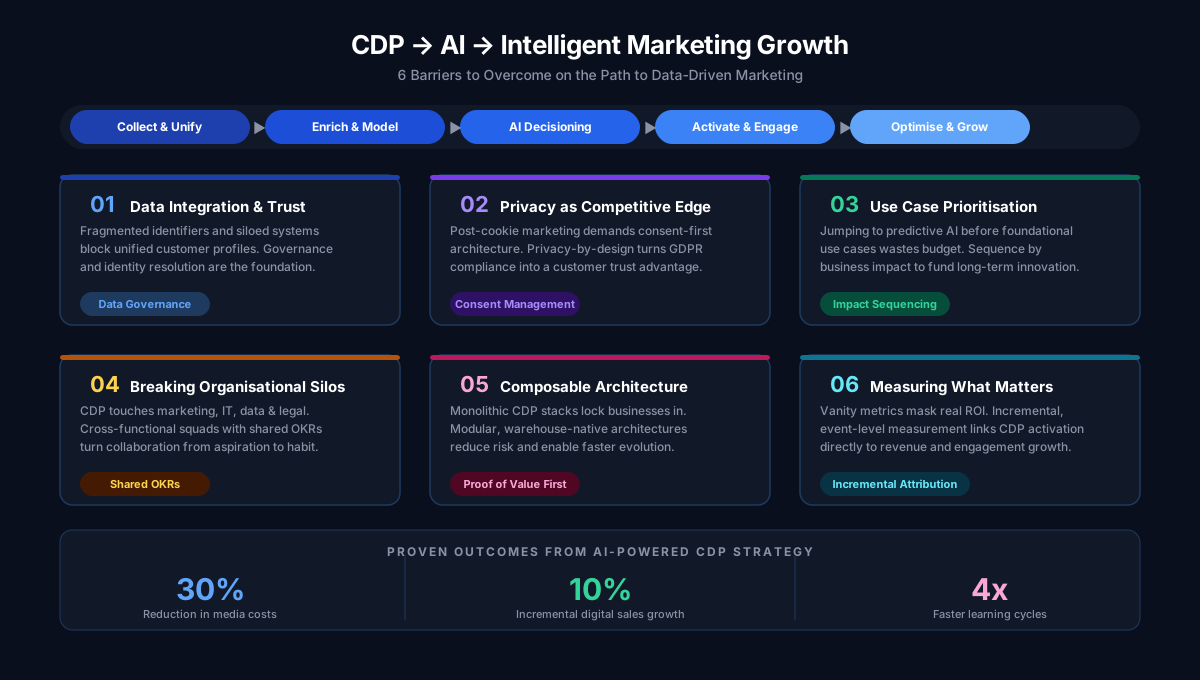
Companies that get this right treat their CDP not as a software deployment but as a strategic growth capability — one that links every data investment directly to measurable business outcomes. The ones that fail are usually blocked by six structural barriers, each rooted in something deeper than technology.
The 6 Barriers Between Your CDP and Real Marketing Growth
Across enterprise CDP projects, the same six problems surface repeatedly. Here is what each one looks like — and the leadership principle that breaks through it.
1. Data Integration and Trust
Fragmented, inconsistent data is the single biggest inhibitor of AI-powered marketing. When your CRM holds different customer identifiers than your e-commerce platform, and your data warehouse holds a third version of the truth, every downstream insight is suspect. Teams stop trusting the data. Activation stalls.
The fix is not a better ETL pipeline — it is data governance and stewardship. That means assigning clear ownership for each data domain, enforcing quality standards at ingestion, and building identity resolution protocols that create a persistent, reliable customer ID across all systems. Organizations that treat data as a strategic asset rather than an IT dependency build the foundation for AI-ready infrastructure.
2. Privacy as a Competitive Advantage
The post-cookie era has changed the economics of marketing data. Relying on third-party identifiers is no longer viable, and customers increasingly expect transparency about how their data is used. Many companies treat privacy compliance as a tax on innovation — a box to check before the real work begins.
The leaders treat it differently. Privacy by design — embedding consent management and purpose limitation directly into the CDP architecture — does not slow personalization. It accelerates trust. When customers understand how their data improves their experience, they share more of it. CRM and CDP integration built on first-party consent becomes a durable moat competitors cannot replicate with third-party data buys.
3. Strategic Use Case Prioritisation
A common pattern in data transformation projects: teams jump straight to predictive lifetime value models and omnichannel orchestration before they have proven the fundamentals. The result is an expensive, slow-moving AI initiative that cannot demonstrate ROI, loses executive support, and gets canceled.
Successful organizations anchor their CDP strategy in business impact sequencing. Start with high-confidence, fast-feedback use cases — lead nurturing automation, look-alike audience modeling for paid media — and generate the returns that fund the next stage. Each phase builds on the last technically, organizationally, and financially. Predictive analytics deployed on a proven data foundation converts. Predictive analytics deployed on broken data just accelerates the wrong decisions.
4. Breaking Organisational Silos
No CDP succeeds in a silo. The platform touches marketing (who owns activation), IT (who owns infrastructure), data science (who owns the models), and legal (who owns compliance). In most companies, these teams operate on separate roadmaps, separate budgets, and separate definitions of success.
The proven accelerator is the cross-functional CDP squad: a dedicated team with shared OKRs that spans all four functions, with executive sponsorship and a mandate to ship measurable outcomes quarterly. When data insights surface directly inside marketing workflows rather than in a separate analytics portal, the gap between insight and action collapses. That is where AI-driven automation starts delivering real value — not in the model, but in how fast the organization acts on it.
5. Navigating the Composable Architecture Shift
The martech landscape has decisively shifted toward composability. Vendors that once sold monolithic, all-in-one CDPs are under pressure from modular, warehouse-native alternatives that integrate best-of-breed components rather than forcing every capability through a single stack.
Companies that committed early to monolithic CDPs now carry significant switching costs. The alternative — a proof-of-value approach that tests interoperability between your cloud data warehouse and CDP layer before committing — reduces implementation risk and gives the business flexibility to evolve as AI and privacy ecosystems change. Start small, prove integration works, then scale. Data platform development built on composable principles adapts; monolithic stacks lock you in.
6. Measuring What Matters
Marketing budgets are under pressure everywhere, and vanity metrics — impressions, open rates, sessions — no longer justify CDP investment. Finance teams want to see incremental revenue. Leadership wants to understand which specific activations drove growth.
The most advanced organizations build incremental, event-level measurement into their CDP from day one. This means designing feedback loops that quantify the causal contribution of each campaign, not just correlation. Those learnings feed into the next sprint, compressing the time from hypothesis to proven growth lever. Organizations that get measurement right achieve outcomes including 30% reduction in media waste, 10% incremental digital sales growth, and engagement rates 20% higher than their control groups.
The Human Element: Why Technology Is Only Half the Answer
CDP success begins with technology and endures through people. The organizations that extract the most value from AI-powered marketing are not the ones with the most sophisticated models — they are the ones with the strongest test-and-learn culture.
Fast iteration cycles matter more than perfect models. Teams that run frequent, small experiments and feed results back into their CDP configuration outperform teams that wait for the perfect use case. In practice, this means halving time-to-insight and achieving up to four times faster learning cycles than organizations still running quarterly analytics reviews.
The deeper differentiator is judgment. AI and automation can process millions of behavioral signals simultaneously. Human teams determine which signals actually matter for the business, which insights are actionable in the next sprint, and which experiments are worth funding. The future of marketing belongs to organizations that combine analytical rigor with creative experimentation — not to those that outsource both to an algorithm.
The Next Frontier: From Personalisation to Prediction
Descriptive analytics answered "what happened?" Diagnostic analytics answered "why did it happen?" The next generation of AI-powered marketing systems answers the question that actually drives revenue: "what should we do next, for this specific customer, right now?"
CDPs embedded with real-time AI decisioning engines are already enabling this shift in enterprise marketing. Instead of campaign planning cycles measured in weeks, activation decisions happen in milliseconds — triggered by behavioral signals, enriched with first-party data, and optimized against live business objectives.
This is not future-state. AI-driven customer engagement systems built on reliable CDP foundations are reducing customer acquisition costs, increasing average order values, and compressing sales cycles for companies across e-commerce, financial services, and B2B software today. The prerequisite is always the same: a trusted data foundation, a clear measurement framework, and an organization structured to act on insight at speed.
| Industry | CDP + AI Use Case | Measurable Outcome |
|---|---|---|
| E-commerce | Real-time abandoned cart recovery with AI personalization | +15% recovery rate, -20% discount spend |
| Financial Services | Churn prediction models on unified CDP profiles | 30% reduction in high-value customer attrition |
| Retail | Look-alike audience modeling for paid media | 30% lower media cost per acquisition |
| B2B SaaS | Product-led growth signals routed to sales via CDP | 40% faster pipeline velocity |
| Healthcare | Consent-first patient engagement automation | 20% higher engagement, full GDPR compliance |
| Manufacturing | Distributor lifetime value scoring from CDP data | 10% incremental revenue from existing accounts |
If you are ready to turn your CDP investment into a measurable growth engine, book a strategy call with our team.
How DATAFOREST Builds AI-Powered Marketing Engines
DATAFOREST designs and deploys AI-driven marketing systems that connect CDP data directly to revenue outcomes. Our methodology links your customer data infrastructure to activation pipelines and measurement frameworks — so every marketing decision is grounded in real-time, trusted data.
We work in three stages:
1. Audit and align — we map your existing data flows, identify the gaps blocking reliable customer profiles, and prioritize use cases by business impact and technical readiness.
2. Build the intelligence layer — we connect your CDP to predictive models, AI decisioning engines, and activation channels, creating a system that learns and improves with every customer interaction.
3. Measure and scale — we instrument incremental measurement from day one, so you can prove ROI, kill what does not work, and confidently scale what does.
The result is a marketing engine that converts more customers, wastes less budget, and compounds in value over time — without requiring your team to become data engineers.
Fill out the form to start turning your CDP into an intelligent growth engine.
Questions on CDP and AI Marketing
What is the difference between a CDP and a CRM for AI marketing?
A CRM manages known customer relationships and sales interactions. A CDP unifies behavioral, transactional, and first-party data from every touchpoint into a single persistent customer profile — including anonymous visitors. AI marketing systems need the breadth of CDP data to build accurate predictive models; CRM data alone is too narrow to power real-time personalization at scale.
How long does it take to activate AI use cases on a CDP?
With a well-governed data foundation already in place, teams typically deploy the first AI use case — such as churn prediction or look-alike modeling — within 8 to 12 weeks. The bigger time investment is always the data integration and governance layer that precedes model deployment. Organizations that skip this step spend months debugging prediction errors downstream.
Do we need a new CDP to implement AI-driven marketing?
Not necessarily. Many enterprises already own a CDP with sufficient data. The gap is usually in the intelligence and activation layers — the models, decisioning rules, and feedback loops that turn raw profiles into revenue. DATAFOREST typically audits existing CDP infrastructure first and recommends an upgrade only when the current platform cannot support the required real-time throughput or composable integrations.
How do we prove ROI from CDP and AI investment?
Incremental measurement is the standard. This means running controlled experiments where one customer segment receives AI-personalized activation and a matched control group does not. The revenue difference between groups, measured at the event level, represents the causal contribution of the AI system. This approach eliminates attribution bias and gives finance teams the evidence they need to scale the investment.
Is first-party data sufficient to power AI personalization?
Yes — and in a post-cookie world, it is often more valuable than third-party data. First-party behavioral signals from your own properties are more accurate, more actionable, and more durable than purchased audience data. The key is capturing and unifying those signals systematically through your CDP, so AI models have the volume and consistency of data they need to generate reliable predictions.