

A software company integrated its Shopify store with HubSpot and Meta Ads using a CDP integration. The system synced purchase data and user behavior to create specific target lists. Meta Ads used these lists to find new buyers at a 50% lower cost. Sales teams closed 36% more deals by viewing real-time store activity inside HubSpot. For the same purpose, you can book a call with us.
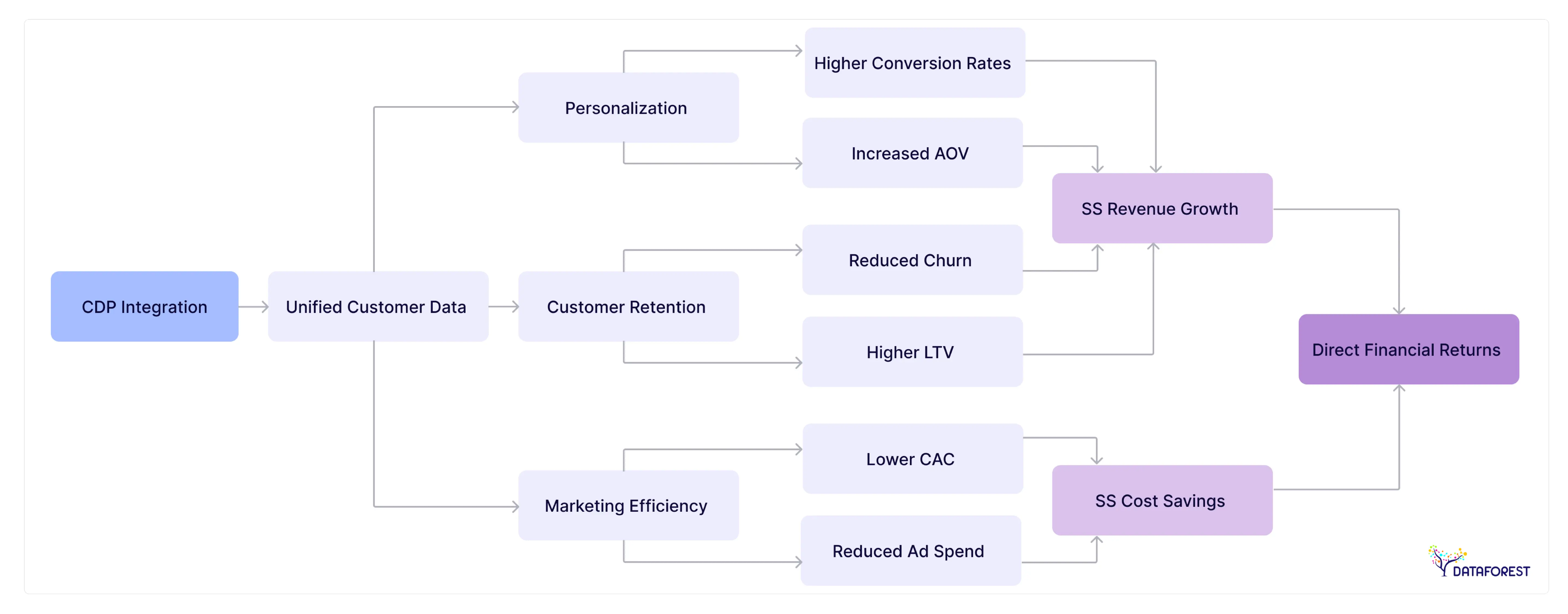
Why is CDP Integration Essential for Business Growth In 2026?
New technology companies need to connect their data sources to stay competitive. Manual data entry and isolated automated systems no longer support digital transformation for fast-paced sales teams. Companies are using the integration of CDP and centralized platforms to turn customer experience into revenue.
Single data for growth
Partial data creates gaps in customer records. CDP integration solves this by combining records into one page. Privacy rules in 2026 require secure and accurate data flows. Integrating Shopify with HubSpot improves CRM synchronization and eliminates manual entry errors. Companies use these direct pages to target Meta ads directly. Real-time updates prevent sales reps from calling the wrong leads. Businesses have a clear understanding of every dollar spent on revenue.
The shift to owned insights
Tech firms now rely on first-party behavioral data instead of cookies for web analytics. CDP integration connects this data directly to modern AI algorithms. These models predict future sales with 90% accuracy in real time. Platforms like Meta Ads use these signals to find high-value users. Automated flows in HubSpot send personalized offers based on Shopify behavior. This setup increases revenue by 25% through targeted upsells. Businesses without these connections fail to reach their sales targets in 2026.
Central intelligence for modern sales
Enterprises use a CDP as the business intelligence engine for omnichannel customer data. This system processes millions of events to find hidden buyer patterns. It connects siloed information from Shopify, HubSpot, and Meta Ads into one view. AI models within the CDP predict which leads will buy in the next 30 days. These insights guide sales teams to focus on high-priority accounts immediately. Marketing budgets shift automatically toward the most profitable audience segments in 2026. This intelligence layer turns raw data into clear financial growth.
40% Less Manual Work, Faster Decisions: AI SaaS Platform Transforms Construction Operations
.webp)

AI SaaS Platform Transforms Construction Projects
How Do Tech Companies Sync HubSpot, Shopify, and Meta Ads?
Successful brands connect their sales and marketing tools through a central hub. These businesses use first-party data to find new customers and keep current ones. The right setup turns scattered facts into a single plan for growth by CDP integration.
Maximizing customer lifetime value
HubSpot manages every stage of the customer journey from lead to promoter. The platform tracks every interaction to build a complete history for each contact. Automated workflows send targeted emails based on specific user actions or dates. Sales teams use these records to reach out at the most effective moments. Service tools resolve customer issues quickly to maintain high satisfaction levels. These features help companies keep clients for longer and increase total revenue with CDP integration.
The core transactional record
Shopify records every purchase and payment detail with total accuracy. The platform serves as the final authority for sales figures and inventory levels. It captures crucial first-party data directly from the point of sale. These records include customer contact info and specific order histories. Through CDP integration, external systems pull this data to verify revenue and tax compliance. Business owners rely on this data to make informed financial decisions.
The precision growth engine
Meta Ads serves as a powerful system for finding new customers and re-engaging old ones. The platform uses AI to analyze user behavior across Facebook, Instagram, and WhatsApp. Advantage+ campaigns automate targeting to find high-intent buyers with minimal manual input. First-party data from your CDP allows the algorithm to build highly accurate lookalike audiences. Retargeting ads follow visitors who leave Shopify carts without finishing a purchase. These tools ensure every ad dollar focuses on users most likely to generate revenue with CDP integration.
Data management from the control tower
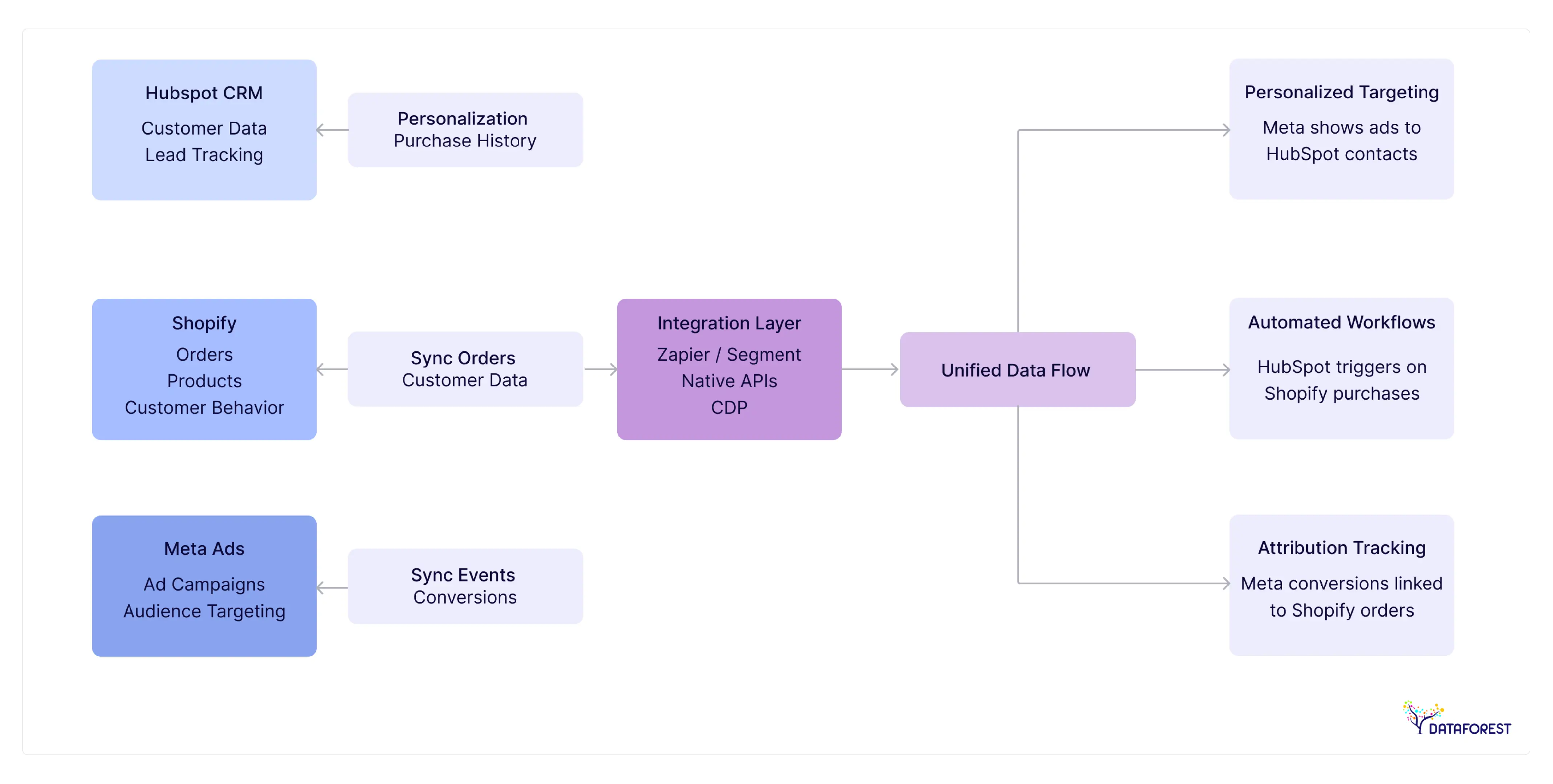
The CDP acts as a central hub that directs the flow of all customer information. It pulls data from Shopify and HubSpot to create a single source of truth. The system then pushes these cleaned records to Meta Ads for more accurate targeting. Managers use this central view to monitor performance across every sales channel simultaneously. Data integration allows for instant adjustments to marketing budgets based on real-time results. A unified control tower ensures all departments work with the same accurate numbers.
How Does HubSpot Sync with a CDP to Increase Sales?
Companies connect HubSpot to a central hub to create a complete view of every customer. The CDP integration shares contact details and web activity to help teams close 36% more deals. Sales reps spend 50% less time searching for data when systems sync in real time.
Syncing CRM data with the hub
Sales teams sync detailed contact records from HubSpot to the central data hub. These records include specific email addresses, phone numbers, and company names for every lead. The system tracks every form submission and page visit to build a behavioral history. Active CDP integration moves these interaction events into a single customer profile in real time. For example, managers also push deal stages and revenue amounts to track the progress of every account. Support tickets and chat logs flow into the platform to show the health of client relationships. This full set of records allows for more accurate audience segmentation across other sales channels.
Feeding enriched data to sales teams
The CDP returns data enrichment, such as purchase history, behavioral data, and intent scores, to HubSpot. These profiles contain purchase history and intent scores from outside sources. For example, sales reps see exactly which products a lead viewed on the company website. This CDP integration updates lead scores based on real-time activity across all channels. The system adds tags to contacts when they reach a specific spending level. Marketing teams use these new labels to trigger personalized email campaigns. This data flow gives HubSpot users the latest buyer information at all times.
A case of scaling global sales with data
Problem: A large tech firm struggled with sales data stuck in separate silos across global offices. Lead follow-ups were slow because the team lacked a complete view of customer activity.
Solution: The company implemented a CDP integration to connect HubSpot CRM with its internal databases. This connection merged web behavior and purchase history into a single profile for every lead. Sales reps received instant alerts when high-value prospects visited the pricing page.
Result: Lead conversion rates increased by 36% in the first quarter of use. The firm now spends 50% less time manually searching for customer information.
How Does Shopify Sync with a CDP to Boost Sales?
Modern retailers connect Shopify stores to central hubs for event tracking, ensuring every sale is accurately tracked. This CDP integration turns raw order facts into clear plans for business growth. Real-time data helps teams reach buyers at the exact moment they shop online.
Capturing the Shopify transactional core
Enterprises sync detailed order histories from Shopify to their central data hub for deeper analysis. These records include exact purchase amounts, product categories, and payment methods for every transaction. The system tracks abandoned carts and browsing behavior to identify high-intent buyers early. Active CDP integration moves this first-party data into unified profiles for better marketing accuracy. Managers also pull refund and return data to calculate the true lifetime value of each customer. Shipping details and delivery statuses flow into the platform to monitor logistics performance in real time. The CDP integration allows teams to build precise segments for targeted email and ad campaigns.
Real-time vs batch sync
Enterprises choose between instant updates and scheduled data transfers for their platforms. Real-time sync captures checkout events or cart changes within seconds of the action. This CDP integration guarantees that Meta Ads stop showing products to recent buyers. Batch sync works better for monthly financial reporting or deep historical analysis. Modern firms prefer real-time flows to trigger automated emails while users are active. Large stores use batching for millions of old records to save server costs. The best setup uses both methods and CDP integration to balance speed and system stability in 2026.
Unlocking revenue with Shopify data
Connecting Shopify to a central data hub allows firms to act on buyer behavior instantly. This setup turns raw purchase facts into high-value audience segments for marketing teams. A CDP integration ensures that every customer profile reflects the latest order status and spending habits. Brands use this data to send personalized offers to users who abandon their carts. The system also removes recent buyers from expensive retargeting campaigns to save ad spend through the CDP integration. Managers gain a clear view of which products drive the highest lifetime value for the business. This connection turns a simple store into a powerful engine for predictable growth.
Bain & Company writes that top marketing leaders are twice as likely to integrate their tech tools for measurable impact.

How Does CDP Integration Improve Meta Ads Performance?
Tech companies need new ways to track ad results in 2026. Browser privacy updates now block most old tracking methods. A central data hub sends signals directly to Meta to solve this problem. CDP integration replaces pixels for accurate attribution and privacy compliance.
Moving beyond browser pixels
Old tracking pixels fail to capture data under new data privacy rules. Browsers and mobile systems block third-party cookies by default now. This data loss stops Meta from reaching the best buyers. Companies send data from their servers via a CDP integration. The server-side method bypasses browser blocks for every signal. Advertisers see a clear picture of their true return on spend. Moving away from pixels keeps budgets focused on real buyers.
Server-side accuracy with Meta CAPI
CDP acts as an engine that drives the Meta Conversions API (CAPI) through a direct server connection. This system allows for customer events such as purchases and subscriptions without relying on browsing. By using the CDP integration, companies can retrieve sensitive data that is often hidden by ad blockers or privacy settings. The hub pre-processes front-end data by hashing personal details such as emails before sending them. The addition of CDP ensures high event rates and directly improves the accuracy of ad targeting. Meta's algorithm finds these clean signals quickly and optimizes sales for high-value leads in real time. This central side flow will drive sales revenue to the margins of the 2026 analysis.
Higher returns and precise targeting
Enterprises see higher returns on ad spend by feeding accurate data to Meta. This CDP integration sends server-side signals that bypass browser privacy blocks. Hashed first-party records improve the match quality for every target audience. Marketing teams stop wasting money and hide ads from people who already bought products. Meta algorithms use these real-time signals to find more high-value buyers. Companies earn 20% more conversions with server-side tracking. A CDP integration helps firms grow sales and follow strict global privacy laws.
How Does a Scalable CDP Integration Work?
Enterprises manage customer data from CRM systems and website tracking tools. The CDP integration gathers records from mobile apps and external databases. A CDP performs data orchestration checks to create a reliable single customer view used for marketing analytics and business intelligence.
Data sources in a scalable CDP integration
Enterprises collect data from CRM systems and website tracking tools. The CDP integration begins by connecting to these disparate databases. Many organizations hire data engineers to build scalable data pipelines that move information between CRM platforms, e-commerce systems, advertising channels, and analytics tools. Third-party apps and mobile devices also provide raw user information.
Ingestion and identity resolution
Modern systems pull data through streaming and batch processes. The CDP integration receives this raw information in real time. Identity resolution algorithms then merge separate user profiles. These tools link email addresses and phone numbers to a single ID. A unified view of each customer emerges from the messy inputs.
Data activation layer
The activation layer sends processed profiles to cross-channel marketing tools. This stage of the CDP integration triggers personalized emails and targeted ads. Teams use these outputs to run specific campaigns across different channels. Real-time connections push user segments to advertising platforms immediately. Clean data turns into direct action for the business.
Comparing CDP Strategy Options
Companies must choose between building their own software or buying a platform. Third-party agencies offer a middle ground for teams without engineers. This comparison helps you pick the right CDP integration path based on your tech resources.
Companies hire engineers to build data pipelines that work from complex records. These experts manage data operations effectively and stop errors at an early stage. The DATAFOREST team shares their code and trains your employees. Leaders see fast reports and low prices in their monthly charts. They choose these partners for the clear numbers and constant support. Set up a call that leads to the rich technical solution.
Real Business Impact of CDP Integration
Sales growth: CDP integration helps businesses find high-value buyers through precise data analysis. Marketing teams use these insights to send offers that match specific customer needs. This direct approach increases conversion rates and drives higher total sales. Sales growth comes from predictive analytics, personalization, and accurate revenue attribution.
Reduced acquisition costs: CDP integration removes waste by excluding current customers from acquisition ads. Algorithms identify the most profitable lookalike audiences based on existing user data. Companies spend less money on broad campaigns while attracting higher-quality leads. Reduced costs result from data quality and server-side tracking.
Higher customer retention: CDP integration tracks user behavior to identify customers who might stop buying. Marketing teams use this data to send helpful offers at the right moment. Relevant messages keep people active and lower the rate of lost users. Retention improves through behavioral data and marketing automation.
Faster AI deployment: A CDP integration provides clean data for machine learning models. Data scientists spend less time cleaning records and more time training algorithms. Companies launch new AI tools in weeks instead of months. AI scales faster using governed data governance and data unification.
Why Tech Leaders Hire Data Partners
Critical enterprise metrics
- 92% retention rates show that clients trust these engineering teams for long-term projects.
- 18 years of industry experience ensure the team handles complex legacy systems.
- 30% reduction in operational costs comes from automating manual data pipelines for CDP integration.
- 24/7 system monitoring prevents data gaps and maintains report accuracy.
- 3 months is the average time to deploy a fully functional data warehouse.
Implementation drives CDP integration success
- Buying a license does not fix messy or disconnected customer data.
- Expert engineers must map every data field to ensure accurate user profiles for CDP integration.
- Standard platforms lack the custom connectors needed for unique business databases.
- Poorly built CDP integration pipelines create duplicate records and lead to wrong marketing decisions.
- Success requires a clear plan for how data flows between different departments.
- In-house teams often lack the specific skills to manage complex customer identity resolution and CDP integration.
- A partner provides the technical framework to turn features into actual revenue.
McKinsey reports that companies using behavioral insights see 85% higher sales growth than their competitors.
CDP Integration Drives Business Development
By uniting HubSpot, Shopify, and Meta Ads through CDP integration, businesses have a clear advantage. This system transforms scattered data into smart tools to drive higher sales and lower costs. Privacy regulations in 2026 require security flows to improve advertising returns and relationships with customers. Leaders choose expert partners to build these systems and drive real growth quickly.
Complete the form to test CDP integration.
Questions on CDP integration
Do we still need a CDP integration if we already use HubSpot as our CRM?
HubSpot manages sales contacts but often misses data from external apps or offline stores. An integration pulls these separate records together to build a complete customer profile. This tool ensures your marketing stays accurate even when users interact with systems outside your CRM.
How does a CDP integration improve customer lifetime value compared to traditional marketing tools?
Traditional marketing tools send the same messages to every person on a general list. An integration uses real-time behavior to predict the next product a buyer needs. This targeted method keeps customers active longer and increases their total spend over time.
Is a CDP integration mainly a marketing tool or a core data infrastructure for the entire company?
The integration serves as the central hub for every department that uses customer information. Marketing teams use the data for ads. This system creates a reliable foundation for all company apps rather than just a single tool.
What data should be synchronized between HubSpot and a CDP?
Systems must sync contact details and email activity to keep marketing lists current. HubSpot sends sales status changes so the CDP can adjust audience segments. The integration pushes web behavior and purchase history back into the CRM for sales teams.
Can a CDP replace Meta Ads tracking pixels and cookies?
A CDP integration uses a server-side API to send data directly to Meta. Browsers often block pixels, but this system sends information through a secure server connection. Advertisers get more accurate conversion numbers while following new privacy rules.
How does a CDP integration handle identity resolution across Shopify, HubSpot, and ad platforms?
A CDP integration gathers sales data from Shopify and customer details from HubSpot. The software matches shared identifiers like emails to merge separate records into one master profile. This unified data flows to ad platforms to create accurate audiences and track campaign results.


.webp)

.webp)
.webp)


