

Procore deployed a chatbot interface for large North American projects. Site managers asked the tool for exact contract details and safety protocols. The software cut response times between contractors and developers by 50%. AI chatbots for construction industry operations eliminated manual searches through 200-page project manuals. DATAFOREST can carry out the same project, but taking into account the specific needs of your business; book a call and discover how AI chatbots for the construction industry can transform your workflows.
Why Does Fragmented Data Stall Construction Projects?
Paper records and separate apps create gaps between the field and the office. Teams lose a third of their time to rework and fix errors from these manual tasks. Slow reporting turns a small mistake into a half-million-dollar loss for the firm. This is exactly the type of inefficiency that AI chatbots for the construction industry are designed to eliminate.
Field data silos
Site crews often record progress on paper or in isolated mobile apps. This data reaches the main office after the workday ends. Project managers lack the current facts to make fast decisions. Delayed updates cause crews to use outdated blueprints for site work. Misaligned teams spend 35% of their time on rework and fixing errors. Fragmented communication creates a gap between the build plan and the actual site status—gaps that chatbots for the construction industry can close in real time.
Manual document delays
Administrative teams spend 20 hours per week managing Requests for Information (RFIs). Engineers must manually sort through thousands of PDF documents to find specific structural specs. The average RFI takes 10 days to resolve through traditional email chains. Slow document processing stops work on the construction site and costs $1,000 per idle hour. Data architects struggle to link these static files to the central project management system. Inconsistent labeling of drawings creates confusion for the site crews and office staff. Paper forms lead to data entry errors and cost the project money—problems directly addressed by AI chatbots for the construction industry.
Visible gaps in the program
Construction companies lose money without live data from the site. Managers often notice cash gaps 30 days after the actual payment date. This uncertainty forces companies to stop working and wait for new capital. Unexpected schedule errors push back deadlines and increase labor costs. Data analysts cannot handle work with slow numbers. Late reporting can turn a small mistake into a $500,000 loss—something AI chatbots for the construction industry help prevent through automation and live reporting.
From basic questions and answers to site planning
- The first systems were digital manuals for security codes or contract terms powered by AI chatbots for the construction industry.
- The next step is to connect the chatbots to the workflows to track progress.
- Advanced bots enable automated RFI processes through natural language commands using AI chatbots for the construction industry.
- According to the hybrid tools, resource shortages can come from historical data types.
- Reorganizers assign jobs to subcontractors based on new materials using insights from AI chatbots for the construction industry.
- The last step is to extend the master construction plan through a data loop.
- Social networks combine internet sensors with digital twins to detect security risks through AI chatbots for the construction industry.
40% Less Manual Work, Faster Decisions: AI SaaS Platform Transforms Construction Operations
.webp)

AI SaaS Platform Transforms Construction Projects
Can AI Chatbots Automate Your Construction Site?
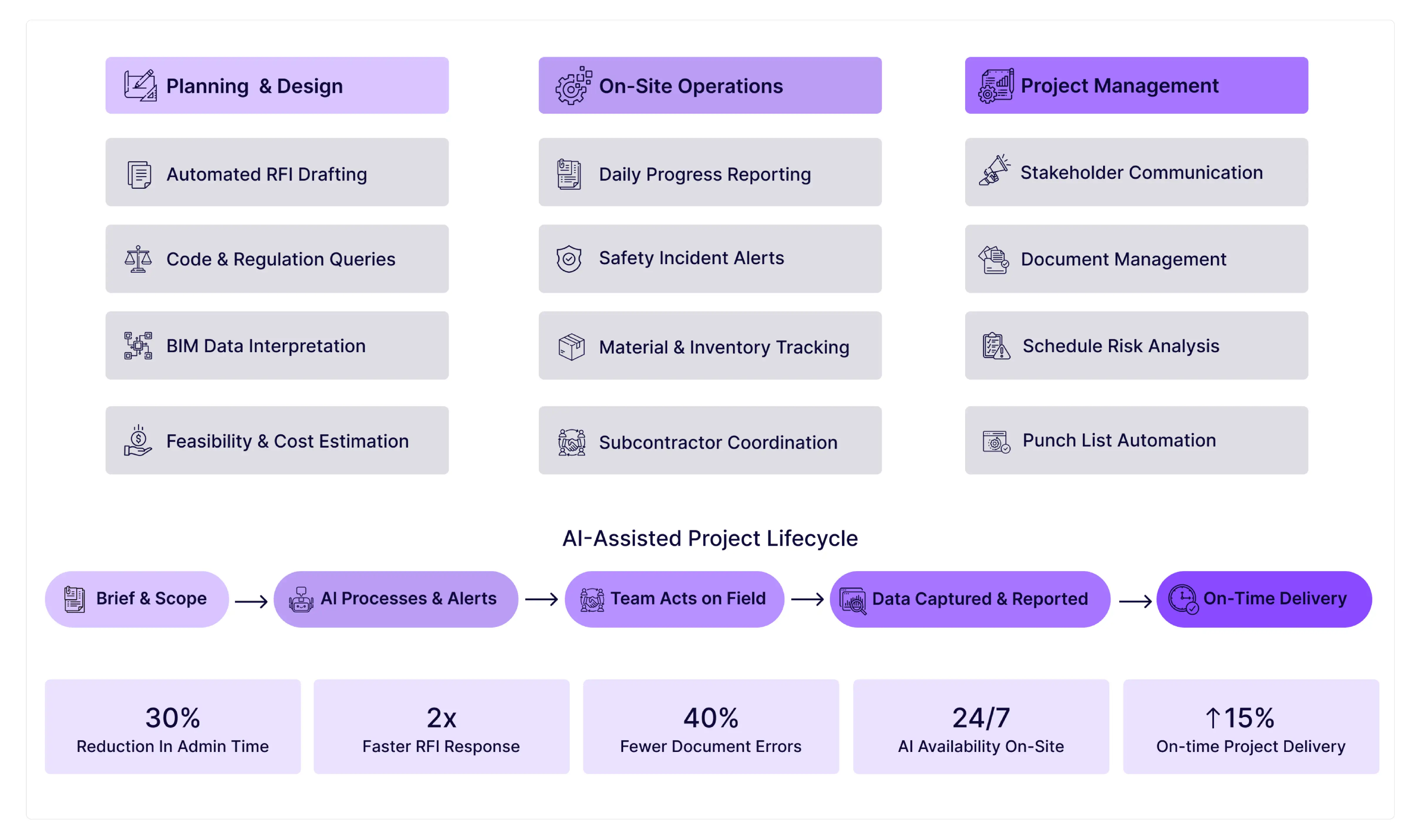
AI chatbots connect field data to office databases to manage complex construction projects. The system automates material orders and project schedules in real time. This workflow removes manual entry to stop small errors from turning into expensive delays—one of the key advantages of AI chatbots for the construction industry.
Digital process planners
Modern chatbots act as a hub for complex development processes. These tools connect office managers with field teams in real time. A field worker sends a voice message to update the status of the daily operation. The system quickly adjusts the project schedule for 200 subcontractors and provides purchase notifications. This automation eliminates the need for manual data entry between different software platforms. Digital programming managers refer technical questions to the appropriate engineer based on their expertise. Companies use AI chatbots for the construction industry to maintain a smooth process without administrative delays.
Digital workforce management
- A site manager reports a material shortage via voice command to AI chatbots for the construction industry.
- A chatbot finds the specified items and quantity from the project database.
- The system monitors inventory levels at nearby local stores.
- AI chatbots for the construction industry instantly process purchase orders.
- A digital schedule manager sends a notification to the project manager for approval.
- Accepted orders trigger an update in the central bank account manager.
- The chatbot notifies the logistics team to schedule a delivery truck.
- Added schedules adjust the manufacturer's arrival times based on the new delivery date.
- Field workers receive a phone notification with a new work plan for the day.
- When items arrive, AI chatbots for the construction industry close the production loop.
From solid tools to smart automation
Legacy data silos: Firms store project information in centralized spreadsheets and internal databases.
Dynamic integration: AI chatbots for the construction industry connect different data sources to a central interface.
Automatic Reporting: The system generates daily website updates without manual intervention by field staff.
Predictive logic: Algorithms within AI in construction detect schedule delays early to reduce project delays with AI.
Resource tracking: New software drives things online based on actual success rates.
Closing the loop: AI chatbots for the construction industry confirm completion and activate the next workflow step.
Forbes highlights how construction platforms are using AI assistants and chat-based tools. Conversational AI assistants are improving accessibility of project data and reducing time spent searching through specs and documents in construction. Customizable chatbot/agent builders are enabling tailored AI workflow automation in construction for specific teams and tasks.
How Do AI Chatbots Reduce Project Delays and Costs?
AI chatbots cut technical wait times from two weeks to under an hour. These tools save $50,000 in rework by finding the right blueprint in seconds. Automated safety checks powered by AI chatbots for the construction industry reduce site accidents by 20%.
Fast RFI solution
Challenges: Contractors often take days off for RFI responses from headquarters. These downtimes stop work and increase costs for the contractor.
Solution: An AI chatbot solves these questions by searching project data. The software sends the relevant details to the employee online using construction RFI automation.
Conclusion: This tool reduces RFI turnaround time from two weeks to less than an hour. Quick responses avoid project delays and save construction costs.
Quick web design
Problem: Field workers struggle with slow progress reporting and delays in project bills. Most managers only see site updates a few days after a job is done.
Solution: An AI chatbot allows employees to record progress through voice messages and images. The system processes this data and updates the master project schedule and budget via automated progress reporting in construction.
Conclusion: This automated system eliminates the 48-hour delay in reporting field events. Real-time information ensures that the office stays up-to-date with real-time construction speed.
Quick reference guide
Problem: Engineers spend 10 hours a week searching through 5,000 PDFs. Static files hide information such as pipe sizes and construction weight details.
Solution: AI chatbot indexes each project document into a central, searchable database. Instead of reading 500-page manuals, employees ask the bot for detailed information.
Conclusion: Organizations get data in seconds to keep construction on track. This system saves $50,000 in rework costs from using old versions of drawings.
Automated safety compliance
Problem: Construction firms face high insurance costs and legal risks from site safety violations. Manual inspections happen too rarely to catch daily hazards before accidents occur.
Solution: AI chatbots provide site crews with instant access to specific safety standards and local codes. Workers use the bot to report hazards and verify compliance via photo uploads in real time.
Conclusion: The automated check reduces on-site incidents by 20% on large-scale projects. Continuous monitoring builds a digital audit trail that lowers insurance premiums for the firm.
How Can AI Supplement Your Construction Data?
Construction companies are integrating AI chatbots into ML models and business tools to create instant web innovations. These bots combine field records with 3D designs to catch errors before work begins. The system reduced administrative work by 28% in field tests by 2026 through the use of AI integration with Procore and related systems.
Applied construction information
Construction companies are integrating AI chatbots directly into ERP and BIM models to integrate online data. Managers ask simple questions to get budget updates or 3D technical details straight from the model. Field workers use voice commands to record progress, which integrates with project management systems. The system reduced administrative work by 28% in field tests by 2026. The system detects design conflicts and supply chain gaps before they cause project delays. Centralized AI agents transform complex field messages into clear reports for your performance dashboard.
Smart building models
AI chatbots analyze Building Information Model (BIM) data directly and provide immediate answers on the spot. Field teams can directly query RFIs and submissions through a chatbot for construction project coordination to eliminate manual searches. This integration pulls data directly from Autodesk Revit models and Procore spreadsheets into one model. Field teams report daily progress via voice, and automated progress reporting for construction updates the schedule. Project managers use this information to catch construction conflicts before the cement is poured. Direct access to metadata saves engineers an estimated five hours of search time per week.
Integrative construction technology
Construction companies are connecting AI chatbots to Procore and Autodesk Construction Cloud for faster data acquisition. Field teams can directly query RFIs and submissions through AI chatbots for the construction industry to eliminate manual searches. This integration pulls data directly from Autodesk Revit models and Procore spreadsheets into one model. Field teams report daily progress via voice, and AI updates the schedule. Server bots have filled document gaps in both fields to reduce human error. Save your project managers 10 hours of admin work per week.
How Can AI Improve Your Construction Revenue?
AI chatbots can cut project documents to reduce your company's overhead costs. These tools allow managers to identify supply chain gaps to avoid costly project delays. Most businesses see full ROI within six months after implementing AI chatbots for the construction industry.
Reduce administrative waste: AI chatbots manage new tasks such as data entry and reporting to reduce operational costs. These tools can create field notes and web images in seconds. For example, a bot can scan a voice message and instantly update a project schedule. This change reduces the time project managers spend on documents by 40%. You get faster updates and lower overhead costs.
Avoiding real-time delays: AI chatbots provide instant web analytics to keep projects on track and within budget. This speed allows managers to fix supply chain gaps or schedule conflicts before the job is completed. For example, a bot can notify a site manager about a delay in cement delivery and quickly assign tasks to team members. Quick fixes avoid the cost of inefficient work. By converting data into quick and actionable tasks, you protect your project ROI.
Measuring AI benefits: Construction companies are calculating ROI by looking at the time saved on manual data entry and adjustments. As AI drives field reports and schedules, these savings can often reach six figures per project. For example, one company can save 400 hours of project management time per year by using a chatbot for delivery reviews. Reducing driver hours will directly reduce your overhead costs and improve your bottom line. You can see a clear payback period within the first six months of implementation.
How to Avoid AI Failures in Construction?
AI success with AI chatbots for the construction industry requires clean data and buy-in from your field team. You should avoid small program models with dedicated servers and strict access rules. These steps will help your organization trust the system and prevent financial errors.
It is leading to a cultural change
Field companies often resist AI because they fear job losses or difficult new technologies. You can solve this by training the field leaders first and showing them how bots can make their daily stories easier. A manager may find that voice reporting saves an hour of typing each evening. Clear communication about these needs can turn skeptical employees into strong supporters of the new system.
Editing of fragmented data
AI bots fail when they extract data from complex or fragmented spreadsheets. You should clean up your legacy data and use common naming conventions in all project files. Connecting your ERP and BIM systems through a central API ensures that AI has one source of truth. Data entry functions can prevent bots from giving your company financial advice or a schedule.
Hold field data
AI tools can show important programming applications and features without proper encryption. You should store these features on dedicated servers and set strict access rules for each subcontractor. Adhering to local building codes and data protection laws will keep your legal team engaged. Regular audits of the AI system ensure that only authorized personnel can view high-quality financial data.
Book a call to stay ahead in technology and use chatbot integration with project management software and AI-powered construction management tools to improve workflow in construction projects.
What Is the Future of Autonomous AI In Construction?
Construction firms are moving from simple tools to autonomous systems powered by AI construction management. These systems predict labor shortages and reorder materials without human prompts. This central data layer turns your fragmented tools into a single, self-correcting project engine that enables construction operations automation.
Beyond conversational AI
Construction technology now moves from simple chatbots toward autonomous AI agents. These systems carry out tasks across your ERP and BIM platforms. An agent reorders steel during a supply chain gap. The automation removes the need for human oversight of routine logistics. You gain a self-correcting project setup for better profit margins.
Autonomous site coordination
Future AI systems will transition from passive tools to active coordinators that manage AI construction workflow without human prompts. The autonomous agents use predictive analytics to spot labor shortages or material delays before they impact the critical path. The system can automatically rebook a crane rental or reassign crews to a different floor if weather data suggests a delay in concrete pouring. This self-correcting logic ensures the project stays on schedule even as field conditions change hourly. You shift your focus from constant firefighting to high-level strategic oversight of the entire portfolio.
AI as core infrastructure
AI now acts as a foundational layer that connects every piece of construction technology in your firm. This layer allows your ERP, BIM, and field apps to share data without manual intervention. You gain a central nervous system that powers a project decision—from bidding to closeout. This structure ensures that every tool in your tech stack works toward a goal. Your firm becomes more resilient because every decision is based on a unified data source and supported by enterprise AI solutions for construction.
BCG’s 2025 analysis of AI at work shows that companies actively reshaping workflows with AI tools experience significant value—employees spend less time on routine work and more on strategic activities. Workflow reshaping with AI (including conversational and agentic tools) leads to clear productivity benefits. Adoption still has barriers (training, scaling), but thoughtful integration boosts employee confidence and output.
How Can DATAFOREST Help You Automate Construction Workflows?
DATAFOREST provides custom AI chatbot development for construction that links directly to construction tools for faster site reporting. Our systems use mobile chatbots to help field workers update tasks and log issues from the site instantly. The team uses RAG technology to pull specific details from complex project files via simple text queries. These tools reduced manual workloads by 40% in recent field tests using AI chatbots for the construction industry. You get instant alerts about budget risks and schedule gaps through a unified messaging interface.
Please complete the form to start using AI chatbots to improve workflow in construction projects.
Questions about AI Chatbots for Construction
Can AI chatbots integrate with existing ERP systems?
New AI tools connect to your ERP through secure APIs to share data. Engineers use AI for the construction industry to pull financial reports, compliance logs, procurement records, and subcontractor data instantly. This link turns solid database records into a quick and clear source for field teams and enables construction ERP automation.
Are AI chatbots secure enough for enterprise-level developers?
Enterprise-grade AI for the construction industry and enterprise AI solutions for construction are deployed in dedicated and separate cloud environments. These systems use strong encryption and adhere to strict SOC2 and GDPR compliance standards to secure blueprints. With properly configured AI in the construction industry, users only access the documents relevant to their roles. This method prevents blocking and keeps your project tenders and important records private.
Which development processes are best suited for chatbot automation?
Chatbots for the construction industry manage advanced site functions, such as security checks and voice-activated logs. These tools also handle complex document searches for RFIs and submissions, saving project managers time on manual tasks. Bots can be deployed to track material deliveries and fix equipment shortages for quick resolution. By automating these processes, construction process optimization and construction workflow automation eliminate repetitive administrative tasks and help reduce construction project costs with AI.
How long does it take to implement an AI chatbot in development?
Full implementation of chatbots for the construction industry takes three to six months to move from initial design to operational-ready systems. Most companies start a trial program focused on the first eight weeks to ensure savings on a single website. The timeline for deploying AI integration with construction ERP and other tools depends on the complexity of your ERP, BIM, and project management integrations.
Are AI chatbots replacing human project managers or supporting them?
AI assistants for construction project managers are designed to support—not replace—project managers. By offloading repetitive tasks to AI-powered construction management tools, managers can focus on strategic planning, stakeholder communication, and risk mitigation across multiple projects. This collaboration improves the accuracy of project data and allows the human leader to manage multiple projects simultaneously.
What data sources do you need to build a well-built AI chatbot?
An effective construction AI chatbot for construction companies requires high-quality data from your ERP, BIM, and project management platforms. The system should include historical RFI records, technical submissions, and 3D model metadata to provide accurate site responses. When properly integrated, AI in construction chatbots combines these sources into a unified knowledge layer that delivers instant, accurate responses to field and office teams.

.svg)
.webp)

.webp)
.webp)


