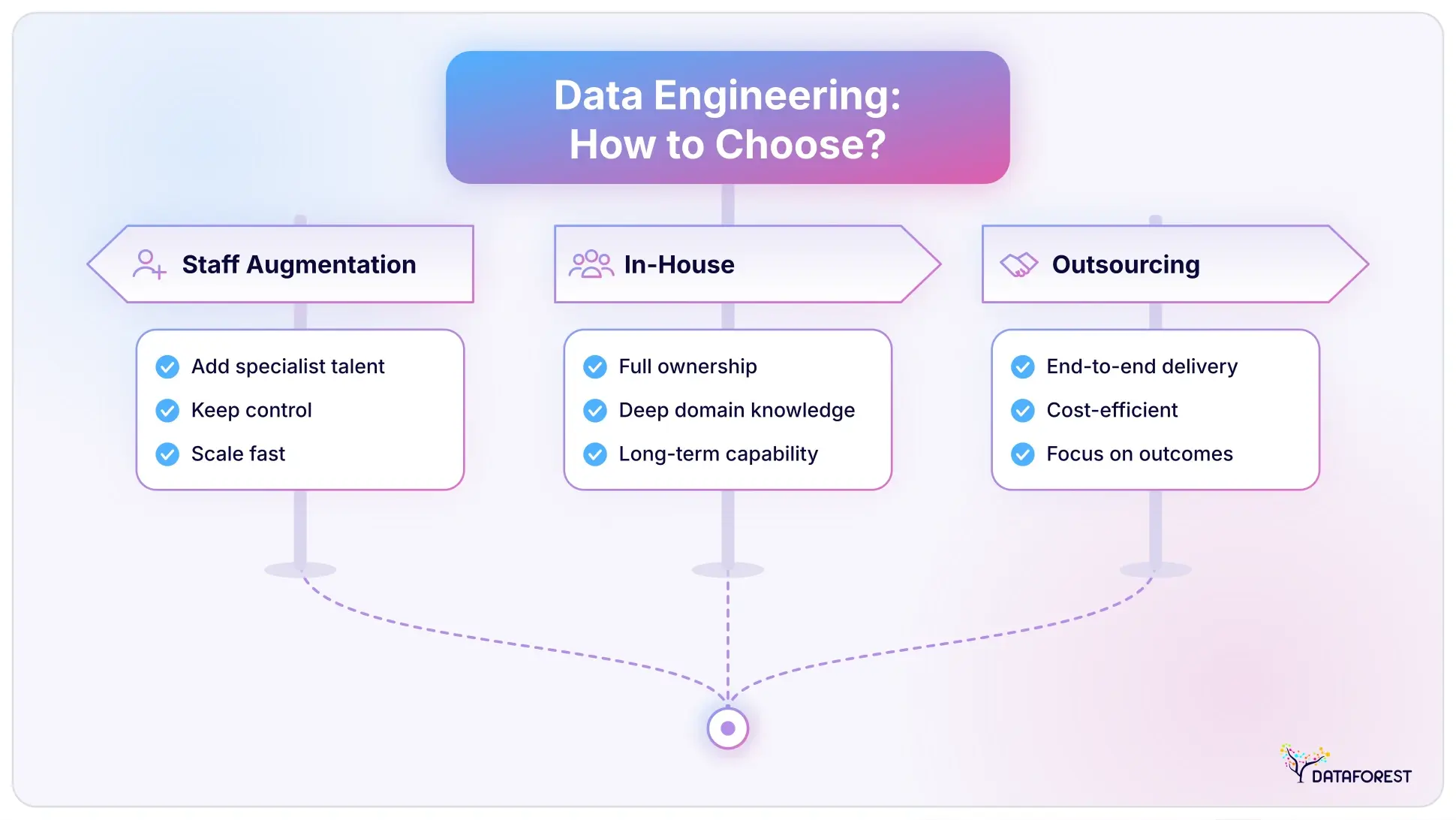
Build an in-house team for core data assets requiring long-term ownership.
Outsource projects with clear scope so a vendor owns delivery.
Choose data engineering staff augmentation to add capacity or niche skills fast under your internal lead.
Each model shifts control, cost, speed, and security in distinct ways.
Handing off data engineering is harder than handing off general software development. Pipelines carry core business logic, institutional knowledge, system dependencies, and direct access to sensitive records. Wrong staffing choices hurt fast — management overhead, knowledge gaps, broken workflows, and compliance risk. Comparing in-house vs. outsourced data engineering services alongside augmentation requires looking past hourly rates. Below, we examine pipeline ownership, true 12-month costs, ramp-up speed, and data security across all three models. You will get a four-question decision test and five practical scenarios to match your roadmap to the right delivery setup.
In-House vs Outsourced vs Staff Augmentation — How the Three Models Compare
The three engagement models differ in who manages the work, owns the outcome, and holds the knowledge afterward. Many guides compare staff augmentation vs outsourcing alone, but data teams usually weigh all three models side by side. The table below compares each setup across eight core dimensions without judging fit, which the decision section covers later.
| Dimension | In-house | Outsourced (project / managed) | Staff augmentation |
|---|---|---|---|
| Who manages the work | Your managers | Vendor’s project manager | Your managers |
| Who owns the outcome | You | Vendor, within contract scope | You |
| Cost structure | Fixed: salaries and overhead | Fixed price, T&M or retainer | Rate per engineer, per period |
| Speed to start | Slowest (hiring) | After a discovery phase | Fastest |
| Scalability | Slow in both directions | Vendor scales within the contract | Add or release engineers per notice terms |
| Knowledge retention | Stays in the company | Sits with the vendor without handover | Shared, leaves with people without documentation |
| Management overhead on your side | High | Low to medium (vendor management) | Medium to high |
| Security exposure | Lowest external access | Vendor staff and systems get access | External people inside your systems, under your controls |
If you need an individual approach to a solution, schedule a call.
Who Owns the Pipelines, the Data and the Knowledge in Each Model?
Accountability and knowledge placement separate these three models far more than rates or team location. Each delivery setup shifts daily control over code, pipelines, incidents, and domain context in a distinct direction.
Who manages the work? Internal engineering managers direct both in-house staff and augmented engineers inside your sprint cadence. Your team sets backlog priorities, enforces code review rules, manages releases, and approves pull requests. In outsourced projects, the vendor’s project manager assigns tasks and tracks milestones against a fixed scope.
Who is accountable for pipeline failures and data quality? Internal engineers carry on-call duty and fix broken jobs under in-house and staff augmentation models. Under managed outsourcing, the vendor owns incident response and resolves failed loads within agreed service windows.
Who holds the institutional knowledge when the engagement ends? Business logic in dbt transformations, undocumented edge cases, manual patches, and legacy ERP quirks shape daily engineering work. In-house staff keep this context inside your company. Augmented engineers build it beside your team, yet it leaves with them without written runbooks. Outsourced vendors hold that logic inside their delivery group without structured handover sessions.
In an illustrative scenario, a retailer outsourced Snowflake ingestion without requiring transformation documentation. Months after handoff, an upstream currency change skewed margin reports, forcing internal engineers to spend weeks reverse-engineering the SQL.
In-House Data Engineering Team — Full Control, Slowest to Scale
An in-house data engineering team is a permanent group of full-time employees hired onto your payroll to build and run your internal data infrastructure. Internal groups combine four core roles: a data engineer, an analytics engineer, a data architect, and a platform or DevOps engineer. Together, this team owns the codebase, production pipelines, core data models, and daily on-call duty. They sit inside your engineering organization. They shape technical standards over multi-year horizons.
Advantages
Institutional knowledge retention: Business logic, edge cases, schema history, and system quirks stay inside your company permanently.
Direct priority control: Engineering managers set sprint goals, coding standards, release schedules, and architectural rules without vendor negotiation.
Deep domain context: Full-time staff learn your product, customer lifecycle, revenue drivers, and operational workflows firsthand.
Simple security governance: Internal employees operate inside your existing identity controls, private networks, audit logs, and compliance boundaries.
Lower multi-year unit cost: Steady, predictable workloads cost less per delivered pipeline over several years than external retainers.
Disadvantages
Slow hiring cycles: Recruiting senior engineers takes months of sourcing, technical interviews, offer negotiations, and intense market competition.
Fixed payroll overhead: Salaries, benefits, payroll taxes, and tooling costs remain constant even during quiet roadmap periods.
Narrow skill coverage: One small team rarely covers real-time streaming, MLOps, governance tooling, and cloud migrations at the same time.
High attrition risk: Departing engineers take undocumented tribal knowledge with them and stall active projects.
Outsourced Data Engineering Services — Project Outsourcing vs Managed Services
Outsourced data engineering means handing a defined project or an ongoing function to an outsourcing vendor that manages the team, schedule, delivery, and quality.
Project outsourcing covers a fixed scope with a clear end date. For example, a vendor migrates an on-premises warehouse to Snowflake or Databricks. The external team designs the architecture, builds the workflows, runs validation tests, and hands over the finished system.
Managed services cover ongoing operations under a formal SLA. The team monitors daily runs, fixes failed jobs, tunes query costs, and maintains data pipeline services around the clock. Readers comparing external partners can review our shortlist of cloud data engineering companies.
Advantages
Vendor delivery ownership: The partner manages sprints, staffing, testing, and code quality against agreed milestones.
Immediate multi-skill teams: A vendor assembles data architects, data engineers, analytics engineers, and DevOps specialists at once.
Predictable project budgets: Fixed-price contracts lock in total spending for well-defined deliverables.
Lower internal management load: Your engineering leads review milestone outputs and skip daily task tracking.
SLA-backed daily operations: Dedicated on-call responders keep production jobs running inside contracted response windows.
Disadvantages
Vendor-held institutional knowledge: Business rules, edge cases, source quirks, and pipeline context stay with the external team without structured handover.
Expensive scope changes: New requirements on fixed-price agreements trigger formal change requests and added fees.
Reduced priority control: Your managers cannot reassign external engineers to urgent internal tasks mid-sprint.
Switching and exit costs: Moving pipelines back in-house requires transition time, code audits, staff retraining, and contract wind-down fees.
Strict upfront scope requirements: Fixed engagements stall without detailed specifications and clear acceptance criteria.
Data Engineering Staff Augmentation — Capacity Without Handing Over Ownership
Data engineering staff augmentation embeds external engineers into your internal team to work in your tools, follow your sprint cadence, pass your code reviews, and report to your managers.
Augmentation adds extra hands and specialist skills to your existing group. Responsibility for pipeline delivery and business outcomes stays with your internal leadership. Companies looking to hire data engineers use this model to clear backlogs without building a separate vendor hierarchy.
Advantages
Fast capacity expansion: Vendors assign vetted specialists within days instead of multi-month recruiting cycles.
Targeted technical skills: Teams gain immediate experience in Kafka, dbt, Spark, and cloud platform migrations.
Direct priority control: Engineering managers set sprint priorities, assign daily tickets, enforce coding standards, and approve every pull request.
Flexible team sizing: Leaders add or release contractors within agreed notice periods to match shifting roadmaps.
Internal codebase ownership: All commits, transformation logic, configuration files, and documentation remain inside your repositories.
Disadvantages
Heavy leadership demand: An internal tech lead must spend hours each week scoping tasks and reviewing code.
Upfront onboarding drag: External engineers need security clearances, tool permissions, environment setup, and schema walkthroughs before producing anything.
Fragile knowledge retention: Domain context leaves with departing contractors without strict documentation and runbook habits.
Unchanged delivery risk: Your organization carries full accountability for missed deadlines, broken loads, silent schema drift, and data quality issues.
Variable engineer quality: Technical output depends heavily on how rigorously the staffing partner screens candidates.
In-House vs Outsourced Data Engineering Services — What Each Model Really Costs
Hourly rates show only part of the cost of a data engineering team. The total depends on who manages delivery, which tools and infrastructure the work requires, and who handles maintenance after deployment. Compare each model across the same scope and expected engagement period. Include onboarding, internal management, knowledge transfer, and exit costs in your estimate.
The US Bureau of Labor Statistics reported a median annual wage of $139,500 for database architects in May 2025. The lowest 10% earned less than $86,240, while the highest 10% earned more than $204,000. These figures provide a labor-market benchmark for a related technical role. They don’t represent the full cost of an in-house data engineering team. Employer taxes, benefits, recruiting, equipment, and other overhead increase the employment cost.
| Model | What you pay for | Pricing basis | Figures |
|---|---|---|---|
| In-house | Salary, payroll taxes, benefits, recruiting, tools, training, and backfill | Fully loaded annual cost per engineer | Team size, seniority, location, recruitment time, and infrastructure requirements |
| Outsourced: fixed price | A defined deliverable | Per project | Number of pipelines, source complexity, compliance requirements, testing scope, and change requests |
| Outsourced: time and materials | Team hours on an evolving scope | Hourly or monthly per role | Driven by team seniority, role mix, region, and sprint duration |
| Outsourced: managed services | Ongoing operations under an SLA | Monthly retainer | Driven by data volume, uptime targets, incident response windows, and support hours |
| Staff augmentation | Engineer time | Hourly or monthly rate by seniority and region | Driven by engineer seniority, stack rarity, region, and engagement length |
Six hidden expenses shift the 12-month total:
Onboarding time: Weeks to months pass ahead of steady production output.
Internal management: Tech leads spend hours weekly on ticket scoping, architecture guidance, code reviews, and sprint planning.
Knowledge transfer: Teams budget dedicated sprints for runbooks, diagrams, pairing sessions, and handover workshops.
Rework: Unclear specifications cause schema rewrites, pipeline rebuilds, backfill runs, and validation fixes.
Change requests: New sources or shifting business logic add fees to fixed scopes.
Exit costs: Ending an engagement triggers handover labor, code audits, replacement recruiting, and re-learning.
How Fast Can Each Model Start Delivering?
Based on DATAFOREST delivery data, typical start ranges vary sharply. In-house hiring takes two to four months. Augmented engineers start within 48 hours to two weeks. Outsourcing vendors run a six-to-ten-week discovery phase ahead of full delivery.
Hiring speed alone never tells the whole story. Engineering leaders separate delivery timelines into stages.
Time to start: Recruiting full-time specialists stretches across sourcing, technical interviews, offer approvals, and notice periods. Augmentation partners assign vetted engineers from an active bench within days. Outsourcing vendors scope requirements and architecture ahead of writing production code.
Time to productivity: Signing a contract differs from shipping reliable pipelines. Every engineer needs security access, environment setup, schema context, and codebase familiarity before delivering consistently. Augmented engineers adopt workflows right away, and vendor teams build separate delivery routines.
Scalability: Roadmaps shift fast. Adding or releasing augmented engineers follows short contract notice periods. Outsourcing vendors adjust team size inside agreed milestones. In-house teams grow slowly through recruiting, and reducing headcount triggers costly restructuring.
Data Security, Compliance and Access Control in Each Model
All three models can operate securely. Data exposure stems from how your team grants, monitors, restricts, and revokes permissions, not from the staffing structure itself.
Access Controls
Apply least-privilege access across all internal and external accounts. Isolate local, development, staging, and production environments. Populate non-production sandboxes with masked data or synthetic data instead of raw customer records. Record every query and permission change in an automated audit log, and revoke credentials immediately during offboarding.
Contracts and Data Transfers
Sign an NDA and a data processing agreement (DPA) ahead of any repository or warehouse access. Hiring an external team outside the European Union triggers cross-border GDPR transfer rules. Organizations must execute Standard Contractual Clauses and complete transfer impact assessments.
Regulatory Standards
Regulated workloads demand verifiable safeguards. Processing US protected health information requires a signed Business Associate Agreement under HIPAA. For SOC 2, request the vendor’s full audit report and bridge letter rather than relying on a marketing badge. In DATAFOREST governance implementations, these mechanisms protect sensitive data and help companies meet GDPR, HIPAA, SOC 2, and PCI DSS standards.
Contractual Ownership
Spell out intellectual property rights in the master agreement. Require explicit IP assignment for all code, pipelines, schemas, and configurations. Keep source repositories, cloud accounts, CI/CD runners, and secret managers registered in your company’s name. List runbooks and architecture documentation among formal deliverables.
How to Choose — A Decision Framework for Data Engineering Work
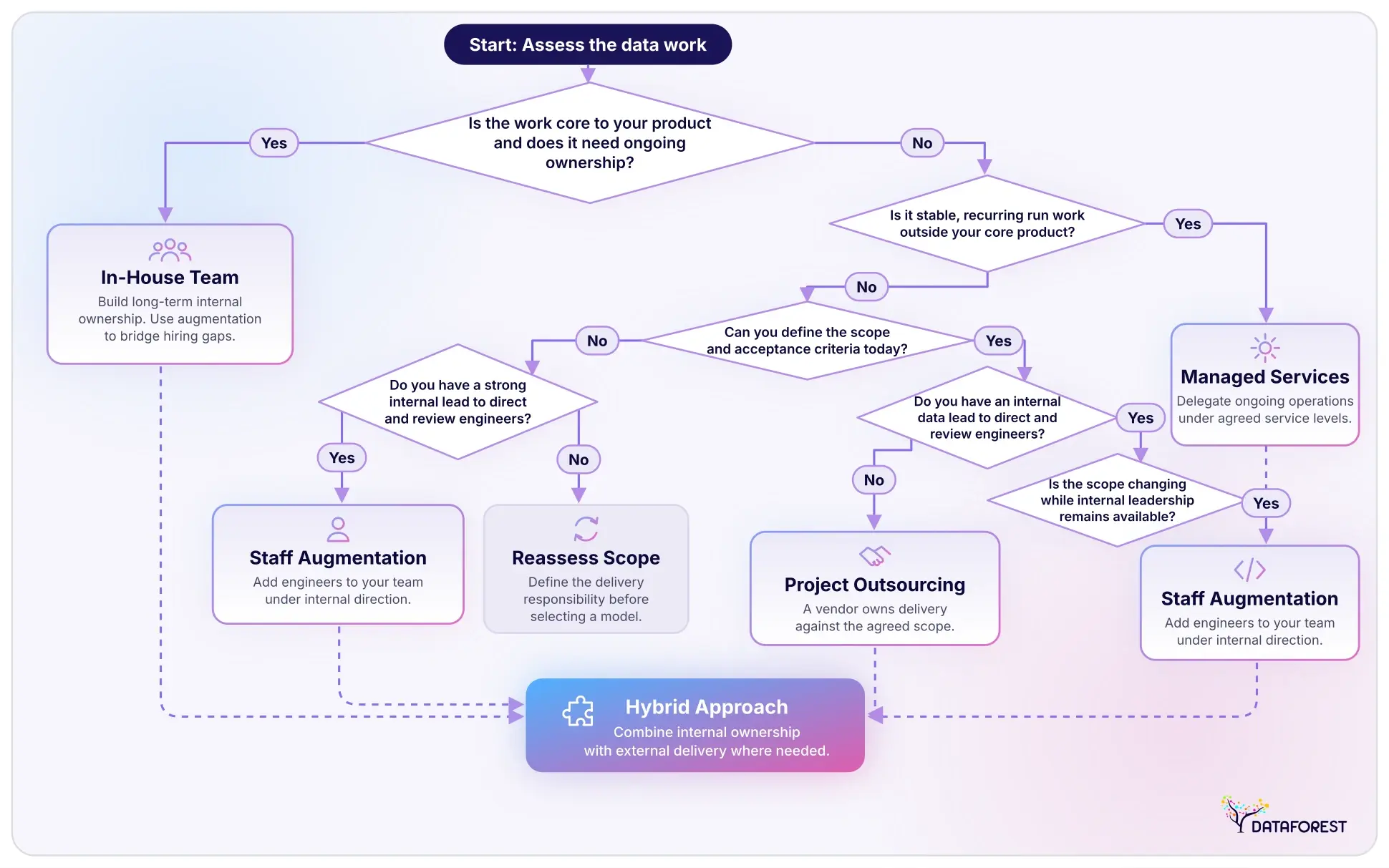
Choose your delivery model based on four factors: scope stability, internal data leadership, ongoing ownership needs, and core product value. These variables dictate whether an external team succeeds or stalls. Use the four-question test below to match your roadmap to the right structure. Then check the scenario matrix to see how five common data initiatives map to primary and secondary delivery options.
The Scope Stability Test
Answer four yes-or-no questions to narrow down your staffing model:
Can you write down the scope and acceptance criteria today?
Do you have a data lead with time to direct and review external engineers?
Is this data work core to your product or competitive advantage?
Will the result need ongoing ownership after the first delivery?
Your answers point directly to one primary model:
Stable scope and no internal lead: Choose project outsourcing.
Changing scope and a strong lead: Choose staff augmentation.
Core work and ongoing ownership: Build an in-house team, and use augmentation to bridge the hiring gap.
Stable run work outside your core product: Choose managed services.
Mixed answers point to a combination of models, which the hybrid team section covers next.
Decision-Flow Diagram Specification
Decision Matrix — Five Common Data Engineering Scenarios
Engineering leaders evaluate staffing options against active roadmap deliverables. The matrix below applies the framework to five typical data engineering projects. Each row lists the primary model, a practical runner-up, the operational driver, and relevant technical guides.
| Scenario | Recommended | Runner-up | Reason |
|---|---|---|---|
| Building a data platform from scratch | Outsourcing or hybrid | Staff augmentation | An architect-led vendor designs the foundation, and internal hires take over operations through data platform development. |
| Migrating to a cloud data warehouse or lakehouse | Project outsourcing | Staff augmentation | A defined scope and clear end date suit outsourcing, or choose augmentation for internal leadership comparing Databricks vs Snowflake. |
| Clearing a pipeline backlog for an existing team | Staff augmentation | Project outsourcing | The classic augmentation case where an internal lead and coding standards already exist. |
| Maintaining legacy ETL pipelines | Managed services | Staff augmentation | Frees internal engineers to focus on platform modernization work. |
| Launching an AI or ML initiative | Staff augmentation + in-house | Project outsourcing | Niche MLOps and feature store skills come from outside, and core foundations stay inside with modern data architecture services. |
Can You Combine Models? How a Hybrid Data Team Works
Mixing internal ownership with external delivery balances architectural control against execution speed.
In a typical hybrid model, an in-house data architect or engineering lead owns the technical roadmap, coding standards, and critical data models. Augmented engineers embed into daily sprints to add delivery capacity or niche skills like MLOps. Meanwhile, an outsourcing vendor runs a defined migration project or handles managed operations for legacy ETL pipelines.
Three operational rules keep a hybrid team running smoothly:
Assign one named owner per pipeline: Clear accountability prevents finger-pointing during production incidents or schema changes.
Enforce identical review and documentation rules: Every internal engineer, contractor, and vendor developer must pass the same pull-request checks.
Plan knowledge transfer from day 1: Schedule regular pairing sessions, live handover workshops, and runbook updates throughout each engagement instead of rushing them in the final week.
Red Flags That You Chose the Wrong Model
Delivery problems surface early in an engagement. Watch for these operational symptoms across each model, and adjust your setup fast.
In-house
Stalled hiring: Ticket backlogs grow for months without new hires. → Add staff augmentation to clear immediate work.
Single-person bottlenecks: One engineer alone understands your critical pipelines. → Pair them with augmented engineers to share context.
Outsourcing
Frequent change requests: Evolving requirements trigger extra fees every sprint. → Move fluid work to staff augmentation.
Heavy vendor dependency: Internal staff cannot run pipelines without vendor support. → Switch to a hybrid setup with structured handovers.
Post-acceptance failures: Deliverables pass sign-off tests, yet break in production. → Bring pipeline ownership inside your internal team.
Staff augmentation
Idle contractors: External engineers wait days for tasks and approvals. → Hand the project to an outsourcing vendor.
Overloaded leads: Your tech lead spends most of the week reviewing code. → Shift daily management to a vendor project manager.
Undocumented merges: Engineers merge code without runbooks or notes. → Enforce review standards, or move operations to managed services.
Single Source of Truth for Enterprise Pharmaceutical Data


Enterprise Data Integration Case Study | Pharma CRM & ERP
Choose the Right Data Engineering Model with DATAFOREST
DATAFOREST helps leaders match their roadmap to the right delivery structure without forcing a single staffing model. You keep full control.
Drawing on 18+ years of experience, 250+ completed projects, 100+ software engineers, and a 92% client retention rate, our team evaluates your current staff, technical debt, delivery goals, and security rules. We recommend a practical setup through our data engineering services. Depending on your gaps, we provide augmented data engineers, a full project team, managed pipeline operations, or a hybrid setup.
Review our guide on how to choose a data engineering company to vet any external partner on contracts, security, SLAs, and delivery governance.
Book a free consultation to choose your data engineering model.
Questions on Data Engineering Staff Augmentation vs Outsourcing vs In-House
How is data engineering staff augmentation different from hiring freelancers directly?
Staff augmentation provides pre-vetted engineers employed by a staffing partner rather than independent contractors. The vendor handles payroll, taxes, HR compliance, and bench replacements. Direct freelancers manage their own taxes and availability, so a sudden illness or competing client leaves your pipeline work unstaffed without backup support.
Can we hire augmented data engineers full-time later?
Staff augmentation contracts allow full-time conversion after a minimum engagement period and a buyout fee. Vendors set these terms in the master services agreement to recover recruiting and onboarding expenses. Negotiate the exact conversion window and buyout formula during contract signing rather than waiting until an engineer becomes irreplaceable.
What happens if an augmented engineer is not a good fit?
Staffing partners replace underperforming engineers at no extra recruiting fee under standard contract terms. You notify your account manager and review replacement candidates from the vendor bench. Most agreements define a formal replacement window, waive billing for early mismatches, cover handover overlap, and keep your sprint schedule intact.
How do we vet augmented data engineers before they start?
Run the same technical screening you use for senior internal hires, skipping only multi-round culture panels. Give candidates a realistic take-home task or live debugging session on messy schemas and query optimization. Review how they handle incremental loads, idempotency, partition pruning, and null edge cases in production SQL or Python.
How much time-zone overlap does an external data team need?
External data engineers need at least three to four overlapping hours with your core team each workday. That window covers daily standups, pull-request reviews, schema clarifications, and urgent incident triage. Asynchronous handoffs work for routine ETL tickets, but unresolved source-system questions stall pipeline builds for a full day without live overlap.
How do we measure whether an external data team is performing?
Track production reliability and delivery predictability rather than hours logged or lines of code written. Measure pipeline failure rates, data freshness against SLAs, pull-request cycle times, and post-deployment defect counts. Compare sprint velocity after week four against your internal baseline to spot review bottlenecks or unclear acceptance criteria early.
What should we prepare before the first external engineer starts?
Provision least-privilege cloud credentials, repository permissions, VPN access, and a working local development environment ahead of day one. Prepare masked sample datasets, an architecture diagram, data dictionary notes, and a prioritized two-week starter backlog. Waiting until onboarding day to request IT approvals wastes the first week of billable capacity.
Will agentic AI reduce the need to hire or outsource data engineers?
AI coding tools speed up boilerplate SQL and unit tests, but they don't remove the need for senior data engineers. Teams still need humans to define business logic, validate data quality, govern sensitive access, and debug silent failures. Deploying agentic AI in data engineering shifts demand toward architects and reviewers.