

The calculus of enterprise risk has radically changed. For decades, executive summaries revolved around application uptime and infrastructure resilience. Cyber Resilience: Today, corporate agility is threatened not by another server crash but by silent data destruction. With the rise of AI, ML & Advanced Analytics embedded into the fabric of key business processes, it has led to unprecedented levels of complexity in underlying data ecosystems. This is a high-stakes environment, and here, raw data should be thought of not as an afterthought to business activity but actually a first-class asset that needs to be engineered through strict standards.
Switching from a reactive stance to a proactive data strategy is not just about alerts; it is also about monitoring data pipelines and achieving deep observability. C-Level executives and enterprise architects: Making sure that data flows are not leaking, deviating, or degrading is no longer an IT Maintenance task but a prescription for preserving the flow of revenue, regulatory compliance, as well as continued competitive edge. A goldmine of knowledge on how to approach the architectural shifting, business impacts, and cutting-edge methodologies required to protect the enterprise data supply chain at scale, in this landmark report that dives deep into transitioning from monitoring optical basic operations to full-spectrum observability.
Data Reliability Is a Boardroom-Level Issue
The modern boardroom is painfully conscious that algorithms are only as good as the data that undergirds them. But when executives act on the basis of inaccurate dashboards, financial and reputational losses can be catastrophic. As a result, the data shift progressed from optimizing storage to reliability, trust, and data quality management.
What Bad Data Quality Is Hiding from You in Enterprise Decisions
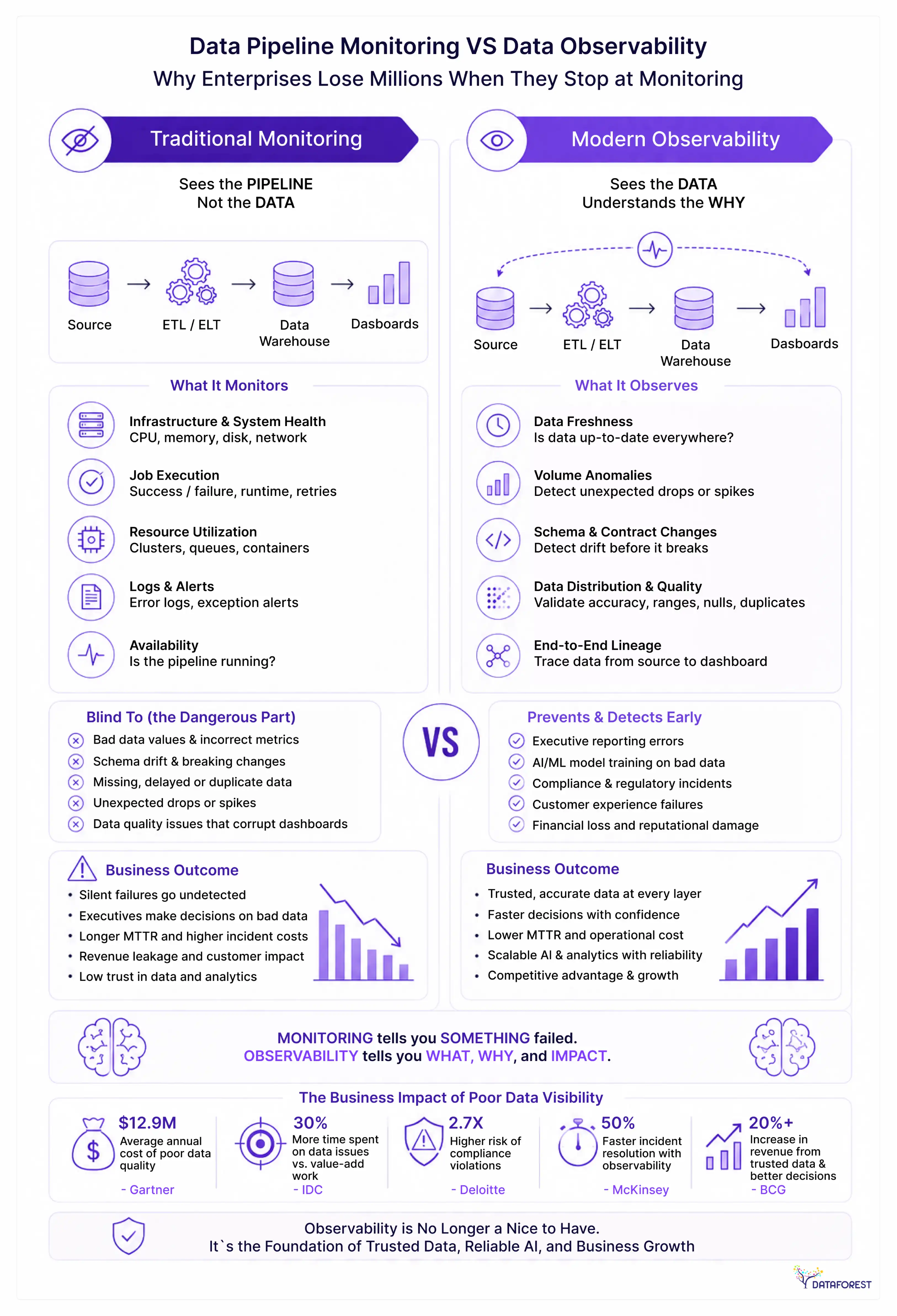
The silent margin killer is poor data quality. Gartner research on data quality indicates that trusted, but flawed data, hits organizations with an average of $12.9 million worth of financial impacts per annum. The direct costs arise from misallocated marketing budgets, supply chain disruptions, and lost revenue opportunities when decision-makers lean on inaccurate customer segmentation or flawed inventory forecasts, all driven by a lag in market intelligence. On top of these immediate financial impacts, sustained data unreliability undermines organizational confidence in business intelligence data quality, weakening data-driven decision making and pushing teams back toward gut-feeling decisions instead of the numbers.
From Data-Driven to Data-Dependent Organizations
The once-popular idea that companies should be "data-driven" has faded; Fortune 500 companies are now quintessentially data-dependent. When faulty data inputs cause an enterprise's pricing engine, fraud detection system, or recommendation algorithm to go offline, business operations hit a wall immediately. This dependence necessitates an immovable enterprise data strategy that regards data with the same tough SLA (Service Level Agreement) frameworks historically held for core software applications. In a data-driven company, maintaining a consistent and filter-free data stream is the equivalent of keeping the doors open.
Data systems are ever-increasing in complexity in the modern environment.
A fundamental architectural shift from monolithic on-premise databases to distributed, multi-cloud environments has introduced new levels of complexity. Pipelines today can ingest entire terabytes of data, spanning structured, semi-structured, and unstructured data collected through APIs or IoT sensors and third-party vendor integrations. To manage this maze, you need strong cloud data pipeline monitoring to keep an eye on the assets as they flow between platforms such as Snowflake, Databricks, or AWS Redshift. However, as organizations grow, getting a constant perspective of this scalable data architecture becomes exponentially challenging. To address this guidance gap, enterprises often seek cloud migration solutions that prevent integration blind spots during this transition period.
Data Pipeline Monitoring vs. Data Observability: What is the Difference?
Monitoring and observability are two different maturity levels in data engineering, often misused interchangeably. And when it comes to building resilient architectures, knowing the difference is key!
Data Pipeline Monitoring: Defense in Depth
In its simplest definition, data pipeline monitoring refers to the process of monitoring the operational state of data workflows. It only poses binary questions: Did the work run? Did it fail? How long did it take? This layer is largely dependent on data pipeline performance monitoring dashboards that monitor job execution times, resource utilization, and successful batch completions. Monitoring data pipelines in production is a must to detect instant operational errors, but its nature is inherently reactive. It informs an engineering team that a certain ETL pipeline broke at 2:00 AM, but it hardly reveals the reason why the data is faulty in the first place.
Data Observability: From Reactive Intelligence to Proactive Intelligence
Monitoring can tell you a system is broken, observability tells you why it's broken, and how to fix it—often before it reaches the end-user. A data observability platform goes beyond infrastructure metrics and begins to query the data itself, enabling data integrity monitoring across critical assets. Data observability combines automation, continuous testing, and machine learning for an understanding of the historical context and expected behavior of data assets. Includes Data Health — the health of the data at rest and motion, giving you deep diagnostics in schema changes, volume anomalies, and distribution shifts.
Key Pillars of Data Observability
Enterprise systems that achieve true observability usually sit on five pillars:
- Freshness: Is the data up-to-date? Stale data invalidates real-time analytics.
- Distribution: Does the data fall within accepted ranges? A surge in nulls is a problem.
- Volume: Is the number of rows what we expected?
- Schema: Has the data source structure changed? For example, has the type of a column in the API changed?
- Lineage: Who owns this data, and what downstream dashboards does it feed?
Real Life: Why Traditional Monitoring Fails
Older tools were developed for a world where data moved in simple, predictable batch jobs on a night-by-night basis. In the dynamic ecosystems of today, these older methodologies are constantly revealing their most fundamental shortcomings.
The Limits of Infrastructure-Centric Monitoring
Conventional big data monitoring tools have primarily been used to monitor compute and storage infrastructure. They check for CPU spikes, memory limits, and server ping frequency. That said, a pipeline can run like clockwork from a compute perspective — burning the minimal amount of resources and finishing on time — yet have processed 100% bad data. At the granularity of monitoring a container or server level, the application does not see the payload. What this infrastructure myopia creates is a business that primes itself for critical logical failures.
The Most Dangerous Risk: Silent Data Failures
A silent data failure happens when good and bad data are successfully ingested through a pipeline without raising any alarms in the infrastructure. For Data engineers, this is their worst nightmare. For example, a third-party vendor may change the format of 1 column for a date, or a software bug may start creating negative values in the revenue field without any warning. With no rigorous data validation in pipelines, such errors travel through executive dashboards and machine learning models, resulting in corrupted outputs without a word. Defending against this relies on constant, automated deep-inspection drill standards.
Lack of End-to-End Visibility
The data journeys of today are highly fragmented. An example of this flow might be data extracted via Fivetran, transformed through dbt, loaded into a cloud warehouse such as Snowflake, and visualized in Tableau. Very few traditional tools map this journey in a whole-body manner. If the end-to-end lineage does not exist, then an engineer fixing a broken dashboard must re-trace this error manually through many different systems, wasting crucial hours. At this point, the only logical way to preserve a holistic operational view across the entire tech stack is by implementing an ELT/ETL pipeline (from a well-architected vendor) with observability built in.

Business Impacts of Data Pipeline Failures
The impact of uncensored data architectures does not stop at the IT department, as they affect both the enterprise value and strategic position.
Operational Disruptions and Downtime
On the other hand, when data pipelines go down, the operational pain is instant. Marketing automation platforms lock up, dynamic pricing models revert to static bases, and supply chain logistics run blind. This "data downtime" is the point in time when a business can no longer leverage its data assets, resulting in a reversion to manual and inefficient processes. To bring critical operations back online at the earliest possible time, thorough ETL pipeline monitoring is needed to minimize Mean Time to Resolution (MTTR) for these incidents.
Financial Losses and Missed Opportunities
Bad data can have a financial cost in two ways: Direct losses and opportunity costs. A data error can result in millions in instant losses; this risk exists in algorithmic trading, or automated loan approvals, for instance. Or opportunity costs in the event that a wrong predictive model caused an unseen consumer trend to emerge, transferring market share capture from one retailer to others. In high-stakes circumstances, like those outlined in our finance industry solutions, dollars and cents demand 100% data fidelity.
Compliance and Regulatory Risks
On the data governance side, how companies handle processing and storing their data and then how they report on it is all governed by increasing global data privacy regulation (GDPR, CCPA, HIPAA, etc..) Enterprises will face costly audits and fines if regulatory reporting data is corrupted or PII (Personally Identifiable Information) is inadvertently exposed through a pipeline failure. Data comprehensiveness monitoring serves compliance with best practice and legal expectation. Additionally, this can be especially crucial in highly regulated industries; monitoring of data ecosystems is a must for healthcare!
Fundamental Elements of an Enterprise-Scale Observability Strategy
Mature data operations require mature practices, which means enabling new capabilities that provide a systematic approach to safeguard your enterprise-wide data assets.
Data Lineage and Dependency Tracking
Data lineage is the mapping of the entire enterprise data landscape. It graphically and programmatically traces where data came from, what transformations it has gone through, and where it ends up. When a column is dropped in an upstream database, lineage mapping automatically displays downstream BI reports and ML models that break. This dependency map changes incident management from a reactive hunt to a precision strike.
Automated Anomaly Detection with AI/ML
Using static thresholds (e.g., "Alert if rows < 1000") is a brittle approach that leads to an avalanche of alert fatigue. Enterprise architectures need real-time data monitoring powered by machine learning algorithms that learn the historical baseline of the data. AI-based systems simply adapt to the organic growth and seasonal trends, flagging true statistical outliers and avoiding common deviations. These complex systems are rarely deployed directly; they often require experienced data science teams to select and tune the correct models.
Real-Time Alerting and Incident Management
Detection is only useful if it leads to an effective response. Up-to-date observability works in harmony with incident management workflows (e.g., PagerDuty, Jira, or Slack). Alerts are rich in context, informing the on-call engineer of exactly which table is at risk, what kind of anomaly has occurred, what downstream impact it could have, and a high-level diagnostic. This simplifies triage, while guaranteeing that high-priority alerts are sent to the right data steward for that domain.
Root Cause Analysis at Scale
An observability platform needs to speed up the investigation when an incident occurs. The system can automatically detect the root-causing component via query logs, git commits, and historical pipeline runs (it could say: you are querying an upstream table that has been modified by this specific pull request of this software engineer). This eliminates a large fraction of the investigative footprint on data engineering teams and shifts their focus from investigation to resolution.
Key Technologies Powering Data Observability
The modern data stack is changing quickly and provides a technical underpinning for defining high-fidelity monitoring in enterprise workflows.
Modern Data Stack Components
The adoption of the ELT data pipeline pattern has moved transformation close to large cloud data warehouses, where they can be scaled as needed. It is an architecture that naturally leads to better observability — raw data never gets thrown away, and every transformation executed is available as code. Strong data warehouse development practices enable engineers to write modular, testable, and highly observable data models with frameworks such as dbt (data build tool) out of the box that support documentation and quality testing.
Observability Platforms and Emerging Tools
A new type of observability platform sits on top of the modern data stack. These tools connect via APIs to data warehouses, data lakes, and BI tools to continuously scan metadata, query logs, and data payloads. They serve as a single source of truth for data health — centralizing alerts and lineage across the whole ecosystem, but without having engineers write thousands of individual SQL tests manually.
AI Data Monitoring Handbook: The Role of AI in Data Monitoring
This is how Artificial Intelligence delivers value from being a mere consumer of data to a custodian. AI-powered agents automatically tag sensitive data, forecast near-term pipeline bottlenecks from historical load patterns, and auto-discover data quality rules through repeated computation of structural patterns. According to the industry standard, with the scaling of AI-driven digital transformation, enterprises are looking toward embedding AI within the monitoring layer itself as a step to ensure operational resilience.
Practices to Scale for Quality Data
Because data quality is an organizational problem, it needs to be solved through stringent processes and engineering discipline rather than through technology alone.
Set up Data SLAs and Quality Metrics
Data teams need to run like product teams and have SLAs relevant to the business. Data does not need 100% real-time accuracy. The data leaders, along with business stakeholders, can articulate acceptable thresholds around freshness, completeness, and accuracy. This allows them to prioritize engineering resources instead of chasing minor outliers on low-priority tables without compromising data assets.
Shift Left: Quality Integrated into Data Pipelines
Instead of processing all data in the warehouse, "shifting left" means that you process it as soon as possible.
Example: Strict data contracts between software engineering teams (who are generating the data) and data teams (who are consuming it). The deployment is blocked if any software update violates the contract schema.
Example: Integrate automated data quality checks into CI/CD - any code responsible for a data transformation should run against staging data before reaching production.
Automate Everything That Can Break
Processes that require human intervention within data pipelines have become a liability. Data Pipeline — Continuous optimization of the data pipeline with automation for testing, deployment, and remediation by the enterprises. Automated playbooks should be able to stop downstream processing when a pipeline fails, quarantine the bad data and kick off backfill operations once the code is fixed in order to reduce human error and promote faster recovery.
Foster Cross-Functional Ownership
Data quality is not just an IT problem. This necessitates a data mesh or decentralized stewardship model in which domain experts (for example, Marketing, Finance) take ownership of the data products specific to their area of expertise. By creating an alignment between business and tech teams, whenever a pipeline anomaly is detected, the business context is immediately available to know if it simply represents a system error or indeed a real business event.
Build Versus Buy: Determining the Right Model
As enterprise architects build observability as a practice, they also face the old question: build it in-house or buy it on a commercial SaaS platform?
When In-House Solutions Make Sense
Companies that have overly idiosyncratic data architectures, the most stringent security requirements or extensive engineering resources may prefer building their own observability tools from open-sourced libraries. This gives you complete power over your feature development and integration. That said though, it has a steep total cost of ownership. The creation of these types of systems can usually only be accomplished through collaborating closely with those experienced in custom software development to guarantee that the solution grows without overextending internal resources.
When to Adopt External Platforms
Indeed, for the overwhelming majority of enterprises, buying a dedicated commercial observability platform is the better option. They show fast time-to-value, ready integrations with modern data stacks and continuously updated ML models for anomaly detection. Buying puts internal data engineers in a position where they can focus on building data products that create revenue instead of maintaining internal monitoring infrastructure.
Hybrid Models for Enterprise Flexibility
The more advanced organizations use a hybrid approach. They use commercial platforms to establish broad metadatum level observability and anomaly detection across the data warehouse while also developing very bespoke, fine-grained data quality monitoring scripts purpose-built for particular mission critical proprietary ML pipelines. This adds pace to the go-to-market while keeping specialized control.
Data observability: How it drives competitive edge
Investing in strong pipeline tracking is inherently a growth play. The foundation of enterprise agility has been established through reliable data.
Faster, More Confident Decision-Making
And when executives trust that dashboard, the pace of business picks up. This automation of constant checking and manual verification of reports frees leaders to seize market opportunities decisively. This speed up—driven by enterprise data solutions that build the strongest confidence level—gives businesses their ability to outpace competition who are still struggling with internal disagreements.
Enhanced Customer Experience With a Trustworthy Data
In industries where the pipeline directly feeds consumers, structured data can impact user experience and engagement. When a recommendation engine breaks or an inventory system lags, it's the customer who pays the price; a lost sale. Reliable data makes sure that personalization algorithms work like a charm and drive engagement and loyalty. The saying can be seen more prominently in retail; you may check out our e-commerce industry solutions, where you will notice that a clean data pipeline directly correlates to higher conversion rates.
Enabling Advanced AI and Analytics Initiatives
Stable data is the bedrock: You cannot build generative AI or advanced predictive models on top of it. And data observability is a necessary precondition for advanced analytics. This ensures a robust deployment of highly sophisticated models by ensuring the data integrity and freshness of training datasets. To learn more about how these initiatives affect the business, check out enterprise digital transformation frameworks.
Why You Should Engage a Data Partner to Accelerate Your Observability Journey
Transitioning from legacy monitoring to modern data observability you would need specialized skills that are hard both to hire and retain in-house.
Bridging Strategy and Execution
An experienced technology partner brings the cross-industry perspective to your architecture. At DATAFOREST, we evaluate existing data maturities, establish accurate SLAs and design observability frameworks in a way that best accommodates your business objectives. Learn more about our strategic approach at DATAFOREST About Us page.
Data Monitoring: Tailor-Made AI/ML Solutions
Complex enterprise needs can be too much for standard tools. We engineer custom machine learning models to catch very business-relevant anomalies that off-the-shelf software cannot detect. MLOps: With strict MLOps practices, we can guarantee the accuracy and performance of your monitoring models as your data ecosystem evolves.
End-to-End Data Pipeline Optimization
Bringing in observability is often the starting point for larger efforts to redesign brittle architectures. We offer full data pipeline reliability audits, revamp old code, and move infrastructure as it scales, with a 100% guarantee. Read about how we have been able to execute these transformations in our business intelligence case studies.
Strategic Outlook
The age of data engineering is dead; "set and forget" era is gone for good. The limits (or the final trigger) for corporate growth will be the soundness of an organization's data infrastructure as we gaze at prospective future. Deploying strong streaming data monitoring and thorough observability is not an IT bolt-on — it is an enterprise-wide protection against truth decay. Transitioning from reactive to proactive intelligence allows businesses to finally achieve the full ROI of their data investments, making certain every algorithmic prediction and executive decision is based on an ironclad bedrock of high-fidelity data.
Get Started and Protect Your Enterprise Data Ecosystem. Schedule a consultation with a DATAFOREST principal architect
FAQ
How data observability prevents the risks of wrong analytics and reporting?
Data observability leverages automated, end-to-end verification over freshness, volume, distribution and schema. It catches more sophisticated anomalies before they reach the BI layer by utilizing machine learning to create historical baselines and detect changes in data that may be missed otherwise, such as an incorrectly formatted currency that was pushed through from a third-party API with no alerts raised. Hence executive dashboards are representative of threat in top-down manner preventing strategic blunders driven by faulty analytics at the root. Find out more from our data engineering blog articles on how to build solid BI layers.
The economic cost of undetected data pipeline failures
The financial ramifications are immense and manyfold. It can lead to direct revenue losses through broken algorithmic pricing and misallocated marketing spend through skewed attribution models, as well as regulatory fines resulting from a breach of compliance. Indirectly, silent failures lead to enormous engineering waste; top-dollar data scientists spend weeks debugging instead of working on predictive models. At the enterprise level, this collective cost can exceed millions each year.
With modern data pipelines, what one of these is most common cause of silent data errors?
Silent errors are generally an effect of changes coming from the external world rather than code bugs within the program. Examples include "schema drift" when a SaaS provider silently changes an API payload structure or format, duplicate records created by network retries, and stale data due to an upstream cron job failure that does not fire downstream infrastructure alerts. Observability platforms that are robust are intended to uncover these payload-level corruptions.
What are the most important data pipeline monitoring metrics for business leaders?
Engineers monitor for CPU and memory usage, whereas business leaders think Data SLAs. The key metrics are: Data Uptime (percent of time data is 100% available and accurate), Time to Detection (TTD) — how quickly does the system detects an anomaly, and Time to Resolution (TTR) — how fast the engineering team solves it. These operational KPIs are tracked to ensure the data team is in alignment with key objectives for core business continuity.
How does AI fit into contemporary data pipeline monitoring and anomaly detection?
Instead of brittle, manual rule-setting, AI can simply inject a level of dynamic and adaptive intelligence. Algorithms continuously learn from metadata and payload distributions to know what constitutes "normal" for each of your tables in your warehouse. If an anomaly happens, for example a 30% drop in transaction volume at a particular hour which was unexpected, the AI flags it contextually to drastically reduce alert fatigue and allow proactive remediation. Need to update your monitoring systems? Want to talk improved AI integrations — just hit us up with this contact form.


.webp)
.webp)
.webp)


