Companies should avoid a single build vs buy AI infrastructure choice. Teams buy commodity layers — compute, models, and managed tools. They build layers containing company data, business logic, and custom controls. A thin abstraction layer sits between your applications and external model providers. Teams can swap vendors easily.
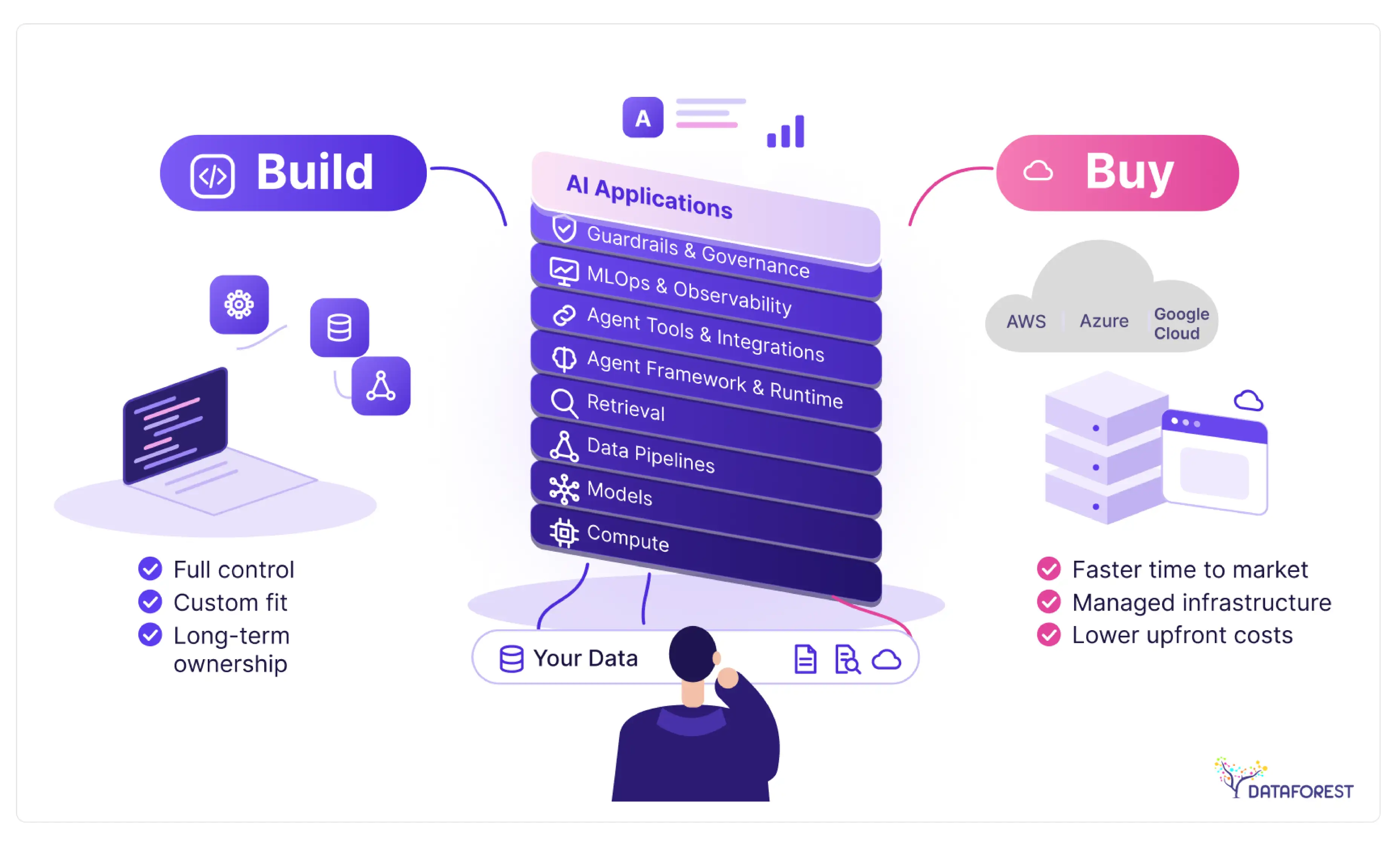
Companies face a difficult choice: “Should we build or buy our AI infrastructure?” The choice carries major risks — reversing the decision costs money; vendors release new tools every few months. A poor choice creates problems. An in-house platform requires constant maintenance. External software creates vendor lock-in and high usage fees. So, tech leaders need a practical plan. This guide maps the AI stack into eight layers, scores five decision factors, and splits the hybrid approach. It calculates three-year costs, manages lock-in, examines four company scenarios, and lists the decision steps.
What Counts as AI Infrastructure? The Layers You Actually Decide On
AI infrastructure is the stack between your data and your AI applications. Each layer can be built or bought separately. The industry uses the term for GPUs and data centers. In this framework, hardware represents only the compute layer. You must map the components before making a choice. The software stack consists of eight distinct layers. Engineering teams manage data movement, model selection, retrieval mechanisms, and governance controls. A map helps you evaluate costs and review internal skills. It clarifies security risks — a modular view keeps your options open.
Build vs Buy — What Each Option Gives You and What It Costs You
Building gives control and fits at the price of time and permanent ownership. Teams write custom code to match exact internal requirements. Buying provides speed and maintained software at the price of dependence and usage-based costs. Companies purchase access to external platforms to launch faster. Each path carries specific technical debts and financial commitments. Leaders must weigh these trade-offs against their internal engineering capacity.
The choice dictates team responsibilities for a long time.
Buying shifts the immediate operational burden to an external provider. Teams focus on configuration, API connections, security checks, and workflow integration.
Building means owning maintenance, platform upgrades, system repairs, and on-call duty for years. Internal engineers must patch vulnerabilities, scale servers, fix broken pipelines, and resolve midnight outages.
A custom platform requires a dedicated team just to keep it running. Companies often underestimate the permanent cost of in-house software ownership.
5 Factors That Decide Build or Buy
Every layer of the AI infrastructure stack requires individual evaluation. Decision makers score each layer from the map against five core factors. Evaluating across the criteria prevents blanket choices that waste capital. You identify where custom engineering adds value and where commercial software saves time.
Strategic Differentiation
Does this layer make your product or operations better than competitors? Unique workflows, proprietary logic, custom data models, and specialized processing engines create market advantages.
Building custom software for the core components protects company secrets and delivers distinct user experiences. Standard tasks offer zero competitive edge.
Buying off-the-shelf software for foundational utilities keeps engineering resources focused on high-impact features. If any rival purchases the exact same off-the-shelf tool, that component provides no market differentiation for your business.
Points to build when the layer creates unique competitive advantage, and points to buy when competitors purchase identical off-the-shelf capabilities.
Total Cost of Ownership
Software licensing fees or API pricing models represent only a fraction of total expenses. Financial evaluations must span a full three-year horizon. Calculations account for dedicated engineering staff, continuous system maintenance, expanding usage volume, and eventual platform migration.
Custom internal builds demand substantial upfront capital investment. High and predictable workload volumes make long-term in-house infrastructure cheaper over extended operational periods.
Points to build when high stable volume lowers long-term expenses, and points to buy when predictable subscription fees fit near-term budgets.
Time to Value
Speed of deployment defines market entry for AI initiatives. Purchasing software allows teams to integrate capabilities and deliver operational output in weeks.
In-house engineering requires months of architectural development before reaching initial production deployment. Executive teams must calculate the exact commercial penalty of a six-month launch delay. Slow rollouts risk lost revenue, missed customer acquisition opportunities, operational overhead, and weakened market positions. Rapid deployment validates business concepts before committing major technical budgets.
Points to build when market timing permits long development windows, and points to buy when immediate production launch yields fast revenue.
Team Skills and Capacity
Constructing custom software requires specialized machine learning platform architects, MLOps engineers, database administrators, and data engineering specialists. Professionals must construct the architecture and maintain daily system health for years. Small or heavily committed engineering groups face severe operational risk when undertaking complex platform construction.
Commercial solutions or external technical partners provide a safer path. Companies can hire AI agent developers to expand internal capability without adding long-term overhead.
Points to build when in-house engineering capacity remains available, and points to buy when lean internal teams require external support.
Data Control and Compliance
Data residency and processing locations dictate system design choices for enterprise architectures. Regulatory frameworks like GDPR, HIPAA, SOC 2, and the EU AI Act enforce governance rules. Organizations must maintain full audit capabilities across data pipelines. High compliance standards favor building custom software or self-hosting sensitive operational layers. Proprietary formats or closed vendor tools increase migration risks.
Points to build when strict rules require total data governance, and points to buy when standardized cloud compliance fulfills legal obligations.
Should We Build or Buy Our AI Infrastructure? Usually Both, Layer by Layer
Engineering teams usually buy raw compute capacity, foundation models via API, managed vector databases, and observability tools. Commercial vendors maintain complex software foundations at lower unit costs. In-house engineering groups build custom pipelines, proprietary retrieval engines over internal files, system integrations, and company guardrails. These proprietary components house internal domain rules, workflows, and trade secrets. Technical leaders apply the build thin principle across the entire system stack. Engineers write a lightweight abstraction layer over bought foundation models and commercial cloud platforms.
The custom software wrapper isolates internal applications from external vendor API changes. Companies change underlying model providers or database suppliers without rewriting core application code. Decoupling internal systems from commercial vendors preserves long-term negotiating leverage. Organizations maintain direct ownership over strategic data assets. Switching external vendors requires minimal engineering labor. CxOs follow this architectural framework when deciding to build vs. buy a CDP for customer data management.
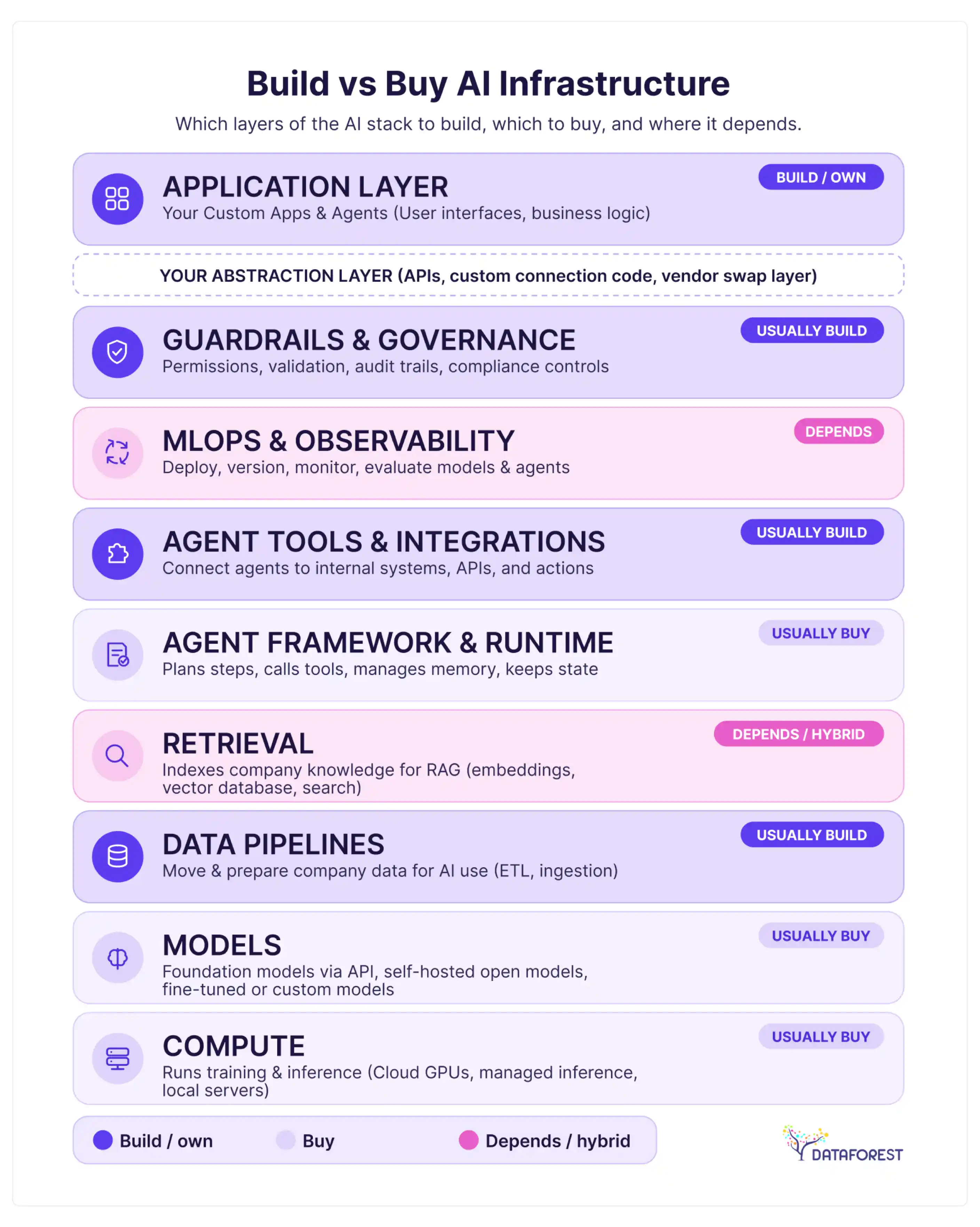
Build vs buy AI infrastructure by layer, showing eight layers from applications and the abstraction layer to agent tools, retrieval, MLOps, models, compute, and data infrastructure, with Build, Buy, or Combine recommendations and guidance for each.
Build vs Buy AI Agent Infrastructure: Frameworks, Tools and Guardrails
Engineering teams select commercial platforms or open-source libraries for core agent frameworks and execution runtimes. The software runtimes manage execution state, task planning, and memory storage.
Organizations build custom agent tools, system permissions, and internal connectors to encode proprietary business rules, user access policies, and legacy database schemas.
Off-the-shelf software cannot replicate internal operational logic. Companies scaling autonomous workflows partner with external specialists for custom AI agent development. Custom tools execute actions across enterprise systems securely. Internal engineering keeps security rules aligned with corporate compliance policies.
Engineering leaders implement specialized runtime controls for agents to enforce operational safety boundaries and compliance standards. These mechanisms validate outputs and prevent unauthorized database operations.
The True Cost of Building vs Buying AI Infrastructure
The cheaper option on paper is often not the same option after three years. Initial software licensing or development quotes hide long-term expenses. Platform maintenance, engineering headcount, and expansion fees accumulate over time. Data leaders must evaluate complete financial commitments across every stack layer before selecting a deployment path.
Hidden Costs of Building
Custom software requires recruiting specialized machine learning talent, backend developers, platform architects, and data engineers. Teams manage developer turnover, high-salary expectations, specialized training, and lengthy recruitment cycles. Continuous system maintenance and component upgrades consume technical hours weekly. Security audits, regulatory compliance, data access logs, and system patches add permanent labor. Senior engineers manage on-call support rotations to fix sudden system outages. In-house platform construction creates heavy opportunity costs by delaying revenue features, product improvements, customer tools, and application updates.
Hidden Costs of Buying
Commercial platforms force upgrades to expensive enterprise tiers for single sign-on, dedicated account managers, custom SLAs, and premium support packages. Cloud vendors charge extra for high data transfer rates, storage volumes, API queries, and network gateways. Tech teams write custom code wrappers to bypass missing vendor capabilities.
Buying commercial software still requires internal staff to configure APIs, build integrations, manage access permissions, and monitor vendor performance. In-house owners must continuously maintain connections as external platforms change. Unplanned usage spikes increase monthly subscription invoices unexpectedly.
3-Year TCO Formula (Copyable)
3-Year TCO = Initial Cost + (Yearly Running Costs × 3) + People Costs + Migration & Exit Costs
Apply this formula per layer across build, buy, hybrid, and custom options. Calculating total cost per layer prevents hidden expenses from distorting financial comparisons.
Example Calculation — Retrieval Layer
Build Option
Initial Cost: $50,000 (setup, tools, and initial engineering)
Yearly Running Costs: $20,000 / year × 3 years = $60,000 (compute, storage, component licenses)
People Costs: $90,000 (3-year MLOps and platform engineering time)
Migration & Exit Costs: $10,000 (rework when tools or models change)
Calculation: $50,000 + $60,000 + $90,000 + $10,000
3-Year TCO (Build): $210,000
Buy Option
Initial Cost: $10,000 (vendor configuration, integration, setup)
Yearly Running Costs: $35,000 / year × 3 years = $105,000 (SaaS subscription and API usage fees)
People Costs: $30,000 (internal owner time to configure, integrate, and manage)
Migration & Exit Costs: $20,000 (data export, contract terms, migration)
Calculation: $10,000 + $105,000 + $30,000 + $20,000
3-Year TCO (Buy): $165,000
Hybrid Option
Initial Cost: $25,000 (thin abstraction layer setup and custom wrapper integration)
Yearly Running Costs: $25,000 / year × 3 years = $75,000 (managed vector database and hosting)
People Costs: $50,000 (internal engineering to maintain integration wrappers)
Migration & Exit Costs: $5,000 (swapping underlying vendor APIs via abstraction layer)
Calculation: $25,000 + $75,000 + $50,000 + $5,000
3-Year TCO (Hybrid): $155,000
How to Avoid Vendor Lock-In When You Buy
Companies cannot eliminate vendor lock-in completely — smart system design limits long-term dependence. The lock-in occurs outside the foundation model itself. Real friction develops across stored data, written prompts, internal workflows, and system integrations. Engineering teams must protect these critical areas. Decoupling internal software from vendor infrastructure preserves strategic flexibility. Replacing underlying AI models remains simple when application logic stays independent from third-party cloud platforms.
- Keep enterprise data inside owned cloud storage systems using open data formats.
- Put an abstraction layer between internal applications and external model providers.
- Prefer open technical standards (Model Context Protocol (MCP) and OpenTelemetry)
- Negotiate explicit data export rights and exit terms inside commercial vendor contracts.
- Avoid proprietary vendor features inside core operational business workflows and application logic.
- Test a second AI model provider on production queries on a periodic schedule.
4 Scenarios — How Different Companies Decide
Organizations evaluate AI infrastructure choices through unique operational budgets, team capacities, regulatory requirements, and strategic priorities. The following four illustrative scenarios demonstrate how different companies assign build or buy decisions across individual stack layers.
Early-Stage Startup with a Small AI Team
In this illustrative scenario, a seed-stage software company operates with three full-stack developers and one data scientist. The team faces tight delivery deadlines, constrained payroll, small cash reserves, and urgent customer validation targets. Engineering leaders purchase cloud compute, foundation model access, managed vector databases, and commercial observability tools. The internal group builds only the retrieval layer over proprietary enterprise files. Writing custom retrieval mechanisms protects unique data assets without delaying initial product releases.
The main risk stems from ballooning monthly API usage costs during rapid customer query expansion. Uncapped API consumption creates sudden financial pressures prior to stable subscription revenue collection.
Mid-Size SaaS Company Adding AI Features
In this illustrative scenario, an established workflow software firm adds intelligent automation into its existing product suite. The business manages active customer subscriptions, fixed product roadmaps, strict security commitments, and legacy backend codebases. Engineering leaders buy foundation models through APIs and purchase third-party observability platforms. Developers build custom agent tools, system permissions, product integrations, and proprietary UI components inside their application. Building integrations retains full control over user workflows and database actions.
The primary risk involves provider dependence within a core product feature. Third-party API deprecations or sudden pricing changes disrupt user experiences. Unannounced vendor modifications threaten product reliability and gross profit margins.
Regulated Enterprise in Finance or Healthcare
In this illustrative scenario, a large financial institution or healthcare provider deploys intelligent processing tools. The organization faces data residency laws, mandatory HIPAA or GDPR rules, audit requirements, and zero-trust security policies. Leadership self-hosts open-source language models inside a private cloud tenant or secure local data center. Engineers build custom guardrails, permission rules, audit logging pipelines, and data anonymization wrappers. The enterprise purchases standard hardware and generic data orchestration software.
The main risk arises from underestimating internal compliance labor. Regulatory review cycles, governance sign-offs, continuous vulnerability scans, and security audits frequently delay production launch dates. Complex approval processes create unexpected engineering bottlenecks.
AI-Native Company Where AI Is the Product
In this illustrative scenario, a technology company sells specialized AI software to customers. The firm requires proprietary algorithmic advantages, custom model fine-tuning, automated evaluation benchmarks, and continuous model performance gains. Engineering teams build proprietary retrieval pipelines, agent execution runtimes, custom evaluation frameworks, and domain models. The organization still purchases underlying GPU compute infrastructure from major cloud vendors. Buying raw compute avoids massive capital expenditures in physical data center hardware.
The risk stems from internal platform maintenance crowding out core product development. Engineers spend valuable hours maintaining underlying infrastructure instead of shipping user features.
How to Make the Build vs Buy Decision in 5 Steps
- Map the specific layers of AI infrastructure your engineering team actually needs from the stack table. Identify which software components support core products, client features, internal workflows, and data pipelines.
- Score each layer against strategic differentiation, total cost, time to value, team capacity, and data control. Rating individual components against five factors prevents blanket software choices across the organization.
- Calculate a complete three-year total cost of ownership for build, buy, hybrid, and custom deployment options. Combine initial setup expenses, annual running fees, internal engineering salaries, and prospective migration costs.
- Select an architectural approach per individual layer instead of deciding for the whole software stack. Engineering groups purchase commodity cloud compute and build proprietary data retrieval mechanisms.
- Establish formal system review checkpoints every 6–12 months. Prepare data export routines, abstraction wrappers, contract exit clauses, and system migration blueprints.
The right answer changes as the company and the market change.
Decide What to Build and What to Buy With DATAFOREST
DATAFOREST helps companies decide what to build, what to buy, where to customize, and how to connect every layer. Our engineering team implements the chosen setup across data infrastructure, RAG pipelines, AI agents and integrations, and MLOps & governance controls. Leaders expand in-house execution capacity with dedicated AI developers and data engineers. Teams partner with specialized architects to deploy scalable data platform architectures without long recruitment cycles.
DATAFOREST provides 18+ years of engineering experience, 250+ completed projects, 100+ software engineers, and a 92 percent client retention rate. Production systems move from initial validation to production launch four to six months faster.
Book a free build vs buy consultation to evaluate your stack and select the correct deployment path.
Questions on Build vs Buy AI Infrastructure
Do we need GPUs to run our own AI infrastructure?
You don’t need GPUs with managed model APIs and standard cloud CPU servers for data pipelines. Teams purchase dedicated GPUs only for self-hosted open models or custom fine-tuning pipelines. Running a 70-billion parameter open model locally requires two NVIDIA H100 GPUs costing $60,000. API providers handle that hardware complexity for $0.0015 per 1,000 tokens. (Here and throughout: the figures are drawn from the results of a study of manufacturers' pricing documentation.)
Is open source a third option between building and buying?
Open source serves as a building block inside a custom architecture. Self-hosting open tools removes software subscription costs. It transfers operational, infrastructure, maintenance, and security tasks to internal engineers. Self-hosting an open-source vector database saves ~$12,000 in yearly SaaS fees. Internal platform engineers spend ~15 hours monthly running backups, software patches, security scans, and database upgrades.
Should we train our own foundation model?
Mid-size enterprise teams should avoid training foundation models from scratch — pre-training demands massive capital and specialized research talent. Fine-tuning open models or connecting commercial APIs delivers better results for enterprise workflows. Pre-training a base model costs $5 million to $50 million in GPU compute time. Fine-tuning an open model on proprietary company data costs under $2,000.
How do we compare AI infrastructure vendors fairly?
Evaluate them across token costs at full production scale, data security terms, uptime SLAs, and system exit portability. Compare pricing per million tokens or API calls rather than initial seat subscriptions. Run a two-week benchmark using 10,000 production queries. Measure response latency, token overage fees, data export speed, and system error rates across each platform.
Can we start by buying and move to building later?
You can purchase commercial software initially and build custom components later. Migration requires building a thin abstraction layer over third-party APIs during initial software setup. An API wrapper isolates internal applications from provider code. During model provider swaps, engineers modify the wrapper without rewriting application logic.
We already bought a solution and feel locked in. What should we do?
Extract stored data assets, system prompts, context files, and database schemas into owned storage buckets. Build an internal API wrapper to decouple application interfaces from vendor software. Store prompt templates and vector embeddings in open file formats on cloud storage. Route user traffic through your API wrapper to test alternative model providers without service interruptions.
How does the EU AI Act affect the build vs buy choice?
The EU AI Act assigns legal liability based on system deployment models and risk categories. Buying commercial software shifts base model compliance duties to external vendors. Building custom systems or fine-tuning models assigns full regulatory obligations to your organization. High-risk applications require automated event logging, technical documentation, risk management audits, and human oversight mechanisms.


%20(1).webp)