

A national retail chain needed a tracking system for customer sales across 500 stores in 2026. The internal IT team wanted to build a custom CDP platform. Their goal was a permanent reduction in monthly software bills. Leadership bought a proven commercial product for immediate deployment. This direct purchase saved two full years of engineering time. The retail company started targeted marketing campaigns three months later.
We can consider your case; just schedule a call.
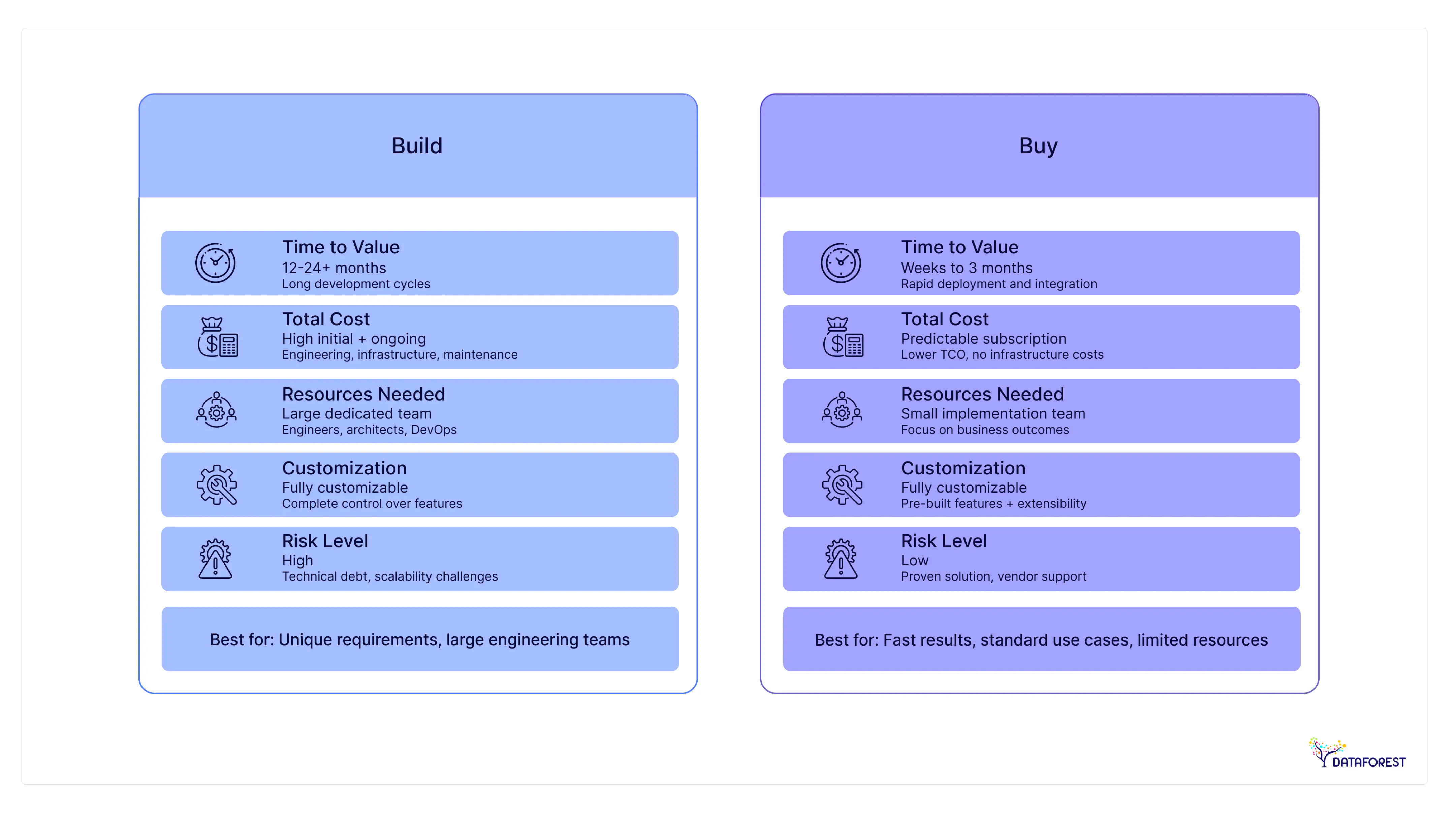
Build or Buy a CDP: Which Way to Secure the Future of Your Data?
The transition to 2026 will see customer data move from a sell-side product to a vital asset that drives revenue and is a critical platform.
The choice to build or buy a CDP is not only a technical issue, but also a strategic decision regarding long-term availability and cost efficiency. Understanding data platform development cost helps organizations evaluate whether building a custom platform or adopting an existing solution delivers data platform development better ROI.
A shift in data ownership
Customer data serves as a primary asset for modern corporate revenue. You face a strict choice between building or buying a data platform. This specific decision dictates your long-term budget and system availability. Leaders evaluate the exact cost of building a custom systeMany firms compare the build or buy choice to manage customer information. Engineering goals and budget limits guide the decision. A custom build handles hard sets with unique tools.m. Then they compare that expense against the price of a commercial product. This financial comparison determines the highest possible return on your investment.
Financial risks of errors
A poor choice in 2026 creates high costs for many years. Teams often find disconnected data across their various marketing tools. Fixing these gaps requires 40 hours of manual work every week. The build or buy CDP decision sets the price for future maintenance. Custom systems demand a team of five full-time engineers for daily upkeep. Slow service on outdated platforms cuts customer loyalty by 15%, proving that CDP building is a long-term strategic investment. CXOs track these losses for the sake of system health.
Performance Measurement


They easily understand industry-specific data and KPIs, and their efficiency as a team allows them to deliver results quickly.
Is a Custom CDP the Best Choice for Your Business?
Many firms compare the build or buy choice to manage customer information. Engineering goals and budget limits guide the decision. A custom build handles hard sets with unique tools.
Building a custom CDP
Complex data structures force a build or buy choice. Custom builds support proprietary logic. High volume drives vendor costs up. Engineering teams manage the build vs. buy CDP decision. Direct integration with legacy tools favors an in-house build. Strict security needs demand full control of the data stack.
Custom CDP architecture
The system starts with data collection from every customer touchpoint. Engineers use cloud storage to hold this raw information. Data processing tools clean and unify the records into single profiles. This layer solves the build vs. buy CDP choice by using existing cloud infrastructure. The next stage creates an identity graph to link users across devices. API layers then push the clean info to marketing tools.
In-house CDP pros and cons
Building a platform gives a company full control over data features. Teams avoid high monthly fees from vendors. A custom system fits specific workflows better. Development takes months of work and many engineering hours. Maintenance requires a dedicated team. Long-term costs for updates can exceed the price of a subscription.
Should You Buy an Off-the-Shelf CDP?
Buying a CDP platform offers speed and ease for busy marketing teams. These pre-built systems save time for the engineering department. Every business checks the risks in the build vs. buy CDP decision.
Selecting a vendor CDP
Small teams pick pre-made tools for a faster setup. These platforms offer tools for marketing campaigns and internal sales tracking. Large firms with small teams often buy these tools. This choice simplifies the build vs. buy CDP debate for growing firms. Standard tools connect to popular apps and business websites easily. Users receive constant support and regular updates for a monthly fee.
Limitations of vendor CDPs
Vendor software limits the types of data you can store. These tools fail to handle complex records from old systems. Monthly costs increase as your user count goes up. Rigid features restrict teams in the build vs. buy CDP choice. Fixed platforms make custom logic hard to add. Vendor locks make the path risky.
Consumer confidence and risks
Businesses often face high risks when they rely on a single software provider. Customers control prices and roadmaps for new features. Migrating data from a closed system can take months and is expensive. This lock-in affects the build-or-buy CDP decision for businesses. Security updates and uptime are completely dependent on an external party. These issues heavily influence CDP vendor evaluation. If a customer's business goes out of business, users will lose access to their data history. These threats make the build-or-buy CDP decision an important long-term one.
Gartner analysis highlights that organizations should measure urgency, competitive advantage, resources, and technology track record when choosing to build or buy a CDP. Buying suits leaner budgets and quicker rollout; building can yield competitive control for highly experienced teams.
Is a Hybrid CDP the Right Move for Your Business?
Mid-market firms seek a balance between building and buying their tools. A hybrid model uses cloud warehouses to keep data safe and private. This setup connects external apps to clean data for marketing tasks.
The hybrid CDP structure
A hybrid system uses cloud storage to keep raw data safe. Engineering teams build the core layer on internal servers. Third-party tools then connect to this layer for marketing tasks. This setup offers a balance in the build or buy choice. Companies keep control of their secrets while using fast vendor apps. Data stays in the warehouse but travels to external tools via APIs. The build vs. buy CDP decision becomes easier with this flexible model.
Mid-market hybrid benefits
Mid-sized firms often have limited budgets and small tech teams. A hybrid setup lets these companies use their existing cloud data. This model avoids the huge cost of building everything from scratch. It also removes the strict limits of a standard vendor platform. Teams solve the build or buy choice by choosing both paths. The system scales on the cloud account. Business owners gain speed and control with fewer staff members.
Hybrid CDP component layout
The structure relies on a central cloud data warehouse for storage. Engineers build data pipelines to move information from various sources. Transformation tools clean and format the data inside the warehouse. The build vs. buy CDP choice leads to using reverse ETLtools. They sync unified profiles to external marketing platforms. A thin layer of custom code manages unique business logic and rules. This design settles the build or buy debate with a flexible core.
How to choose the right CDP plan?
When choosing a computer system, you need to consider your budget and goals carefully. You should test how well a tool works with your current software. These factors will help you make the right choice.
Analyze long-term CDP costs: Teams calculate their total expenses over a five-year period. This financial calculation guides leaders toward the right data system. A custom build demands a dedicated internal technical team. This engineering team requires a high initial project budget. Companies pay ongoing monthly bills for external cloud storage. Commercial platforms charge more money for new customer accounts. A five-year model reveals the true total cost of ownership. This model includes the price of maintenance and technical support. These financial numbers dictate the final executive purchasing decision.
Speed versus future growth: Buying optimizes CDP time to value, while custom CDP development solves future CDP scalability challenges. Business owners must balance immediate needs against the risk of outgrowing a vendor. The build vs. buy CDP decision rests on how fast a company needs to move. Scaling a strategy requires a plan for data volume over three years.
MarTech and data integration: Companies check their current software before making a build vs. buy CDP choice. Strong CDP integration with the data warehouse prevents CDP operational complexity and broken data flows. Existing warehouses often work better with a custom or hybrid setup. Standard vendor platforms may struggle to connect with old legacy databases. Smooth data flow between tools is the main goal of the strategy. Teams must ensure every new tool talks to the existing marketing stack.
AI and future data needs: Future growth depends on how well a system handles predictive models and AI tools. Custom builds allow data scientists to run unique algorithms directly on raw data. Vendor platforms offer built-in AI features but often hide the underlying logic. Companies must decide if they need standard scores or proprietary machine learning models. This need for advanced math helps define the build vs. buy CDP path for the business. Custom systems avoid CDP customization limitations and enable advanced models.
Security and governance: Regulated industries must keep customer data inside their own secure cloud accounts. A custom build allows for total control over every data privacy rule. Vendors often store information on their own servers and create extra security risks. Compliance with global laws is easier when the team owns the entire data stack. Banks and healthcare firms require full CDP security and compliance, favoring in-house CDP development.

How Can You Avoid Common CDP Failures?
Many data projects fail. Teams often skip basic steps. These mistakes cost money and waste time. Poor CDP implementation strategy leads to rising CDP total cost of ownership and long-term CDP scalability challenges.
Book a call to stay ahead in technology.
How Can a Data Partner Help You Build a CDP?
Experts provide the technical skills and planning needed for a custom build. A data partner reduces CDP implementation risks by designing the right customer data platform architecture and hybrid CDP architecture. A solid plan makes your build vs. buy CDP strategy work.
Designing your data path
A data partner helps teams map out their technical needs and business goals. These experts bridge the gap between high-level plans and real engineering work. Following a clear path prevents expensive mistakes during the build or buy process.
- Assess your current data health and identify every source of customer information.
- Define the specific business goals that the build vs. buy CDP choice must solve.
- Map the flow of data from raw storage to final marketing and sales tools.
- Select the right cloud components or vendor apps based on your budget limits.
- Design a secure identity graph to link users across websites and mobile apps.
- Build a technical blueprint that handles both structured and unstructured data sets.
- Plan the integration steps for the build or buy strategy into your current stack.
Custom build and system integration
An expert partner handles the heavy lifting of custom coding and system work. They ensure that every data stream flows correctly into the central hub. The approach speeds up the build or buy process.
- Write custom code to pull data from internal databases and cloud apps.
- Configure the central data warehouse to store unified customer records securely.
- Build automated pipelines that clean and format raw data in real time.
- Set up identity resolution rules to link guest users to known customers.
- Connect the system to your marketing stack using secure API layers.
- Test every data flow to confirm the build vs. buy CDP choice meets your goals.
- Train your internal team to manage the new platform and run custom reports.
McKinsey research on personalization and martech repeatedly underscores the role of centralized customer data platforms as foundational to unified data and personalization (though not specifically focused on build vs buy). It highlights how the systems unify data across channels as part of a modern digital strategy.
What Can DATAFOREST Do as A Custom CDP Provider?
Is your customer data separated across multiple tracking tools? DATAFOREST builds custom customer data platforms for large enterprise clients. These platforms group all consumer records into a central database. Then we connect your CRM, e-commerce storefronts, marketing tools, and inventory databases. Every internal department reviews the exact same customer profile in real time.
We write distinct consumer segmentation rules for different demographic groups. Specific user actions trigger targeted digital marketing campaigns. So, your marketing team stops the daily management of manual contact lists. Our data engineers apply 18 years of direct architecture experience to every single enterprise retail project. We align the technology with corporate policies and new 2026 privacy laws.
These centralized data platforms increase your direct retail sales. They eliminate repetitive data entry tasks for your marketing staff. Customer response rates improve across all active digital communication channels. And DATAFOREST delivers a permanent technical foundation for your 2026 corporate expansion plans.
Please complete the form to make the right build vs. buy CDP choice.
Questions On Build or Buy CDP
How can we measure ROI after implementing a CDP?
Companies measure ROI by tracking the drop in customer acquisition costs over the first year. They also monitor the lift in conversion rates from more personalized marketing emails and ads. Improved data efficiency saves many hours of work for the engineering and marketing teams. This shift allows staff to focus on growth rather than fixing broken data sets. Comparing these gains against the total cost of ownership settles the build vs. buy CDP value debate.
Is a custom or hybrid system scalable across multiple regions and markets?
Cloud warehouses allow teams to scale data storage across different global regions easily. Custom code handles local privacy laws by keeping data in specific physical locations. A hybrid model uses local server instances to process regional user events without lag. Engineers add new markets by cloning existing data pipelines in new zones. This flexibility makes the build or buy choice ideal for firms with global users.
What are the main risks executives should be aware of when choosing the system?
Executives face high financial risks from hidden costs in the build vs. buy CDP decision. Poor data quality results in wrong user profiles and wastes marketing spend. Siloed departments often fail to adopt the tool because of a lack of shared goals. Legal risks involve security breaches and failure to follow international privacy rules. High vendor dependency can limit future tech growth in the build or buy path.
Do we need a large internal data team to build or maintain a CDP?
A custom build usually requires at least three dedicated data engineers to manage pipelines and cloud infrastructure. Hybrid models allow smaller teams to use pre-built connectors while maintaining the core data layer. Companies can reduce the need for internal staff by hiring a specialized data partner for the initial build. Ongoing maintenance involves monitoring data quality and updating APIs to match new marketing tools. The size of the team ultimately depends on the complexity of the build or buy choice.
How does a CDP support AI and advanced analytics initiatives?
A customer data platform builds a clean foundation for machine learning. Unified profiles provide the high-quality training data that AI models need. Data scientists use these rich sets to predict churn and customer lifetime value. The system runs real-time algorithms to pick the best offer for every visitor. This reliable information helps teams build smart segments without manual effort from engineers.
Can a CDP integrate with our existing CRM, BI tools, and data warehouse?
A modern CDP connects directly to your data warehouse to use it as a central source of truth. It pushes clean records to your CRM, so sales teams see updated customer activity. BI tools link to the platform to generate reports on user behavior and campaign success. This integration works through secure APIs and pre-built connectors in the build vs. buy CDP path. A well-designed system ensures that every department works with the same set of facts.


.webp)

.webp)
.webp)


