


A large retail brand moved its stock data to Databricks. The company received 10,000 sales updates every second across 500 stores. Databricks Spark Streaming read these numbers and updated the stock levels. Managers saw the exact stock count on their screens during the sales rush. This system cut the time for restock orders from four hours to five minutes. Delta Lake stored the info for the data team. Schedule a call, and we will build the same low-latency data pipelines.
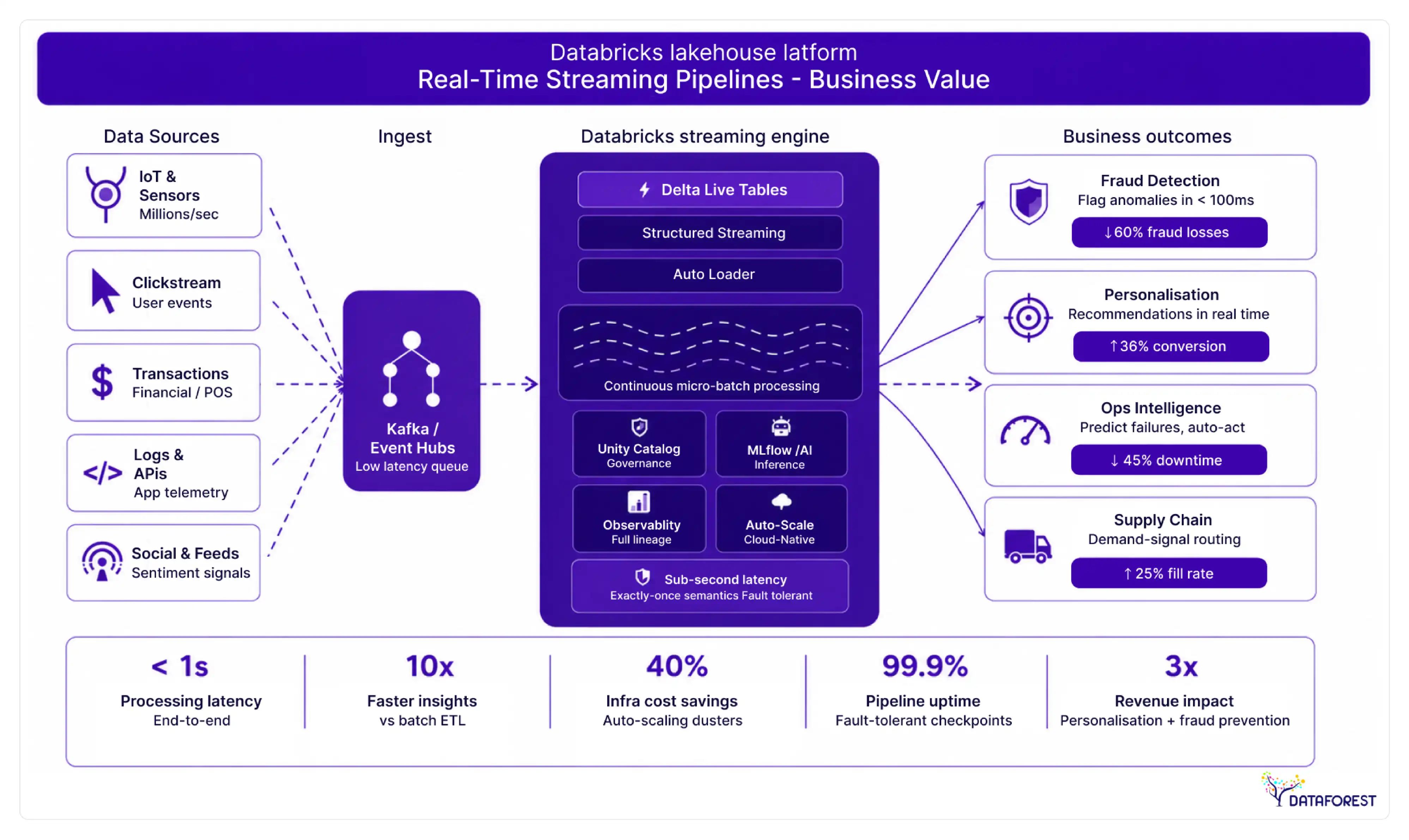
Why Move to Real-Time Data?
Old reports delay your best and fastest business moves. Modern systems show the latest numbers in one short second. Live pipelines turn every new sale into more cash for you through Databricks real-time analytics and faster decision cycles.
Better speed for faster actions
Batch systems process data in large groups during the late-night hours. Business leaders wait 12 hours or more for the morning report updates. Global markets move too fast for these long and costly delays. Event-driven data processing captures every point the second a new sale occurs. These systems analyze every event and flag high risks right away. A bank blocks a stolen credit card in less than 10 milliseconds. Speed turns raw data into a powerful tool for fast business decisions.
High value from fast data
Streaming pipelines with Databricks change how a company makes money and cuts costs. Real-time feeds help a factory catch machine faults before the parts break. This speed stops waste. Retailers track price shifts on other sites and change their own prices. A store wins 15% more sales by matching the market price. Logistics firms use live maps to send trucks on the shortest routes. These better routes cut fuel use so drivers reach goals early.
Store heatmap


DATAFOREST provides meaningful shopper-behavior Insights. They are very responsive and effective, trying to engineer and offer the best fit solution.
What Is Databricks Streaming?
Too many tools make your stack hard to manage. Databricks streaming combines all your live and batch tasks into one tool. This plan saves time and lets your team work much faster. It works as a real-time analytics platform built for both scale and speed.
One platform for all data
Databricks streaming unites batch and streaming data in one single place. Your team uses the same code for both types of flow. Why pay for two separate systems to handle this data? A unified plan removes the need for costly and extra tech stacks. Data architects manage one security model for all incoming sales streams. The platform handles the compute needs and scales up for high peaks. One tool covers everything from raw ingestion to the final dashboard.
This is where Databricks real-time data processing helps teams move from delay to action. It supports a streaming data architecture that keeps ingestion, transformation, and delivery in one operating model. Effective data platform development ensures these components work together as a scalable foundation for analytics, AI, and operational decision-making.
The process of live data
- The system connects to live sources like Kafka or cloud storage.
- Spark Structured Streaming reads every new bit immediately.
- Databricks pipeline orchestration and Delta Live Tables automate the steps to clean and fix the data.
- The engine writes every record into the Delta Lake storage layer.
- Automatic schema tracking prevents the pipeline from breaking on new data.
- The platform scales the computing power to match the speed.
- Users see the new records in their dashboards in one second.
What Powers Databricks Streaming?
Many tools create high costs for your business. The system processes millions of new records every second. This platform connects with your cloud for safe storage and supports scalable pipelines across departments.
The engine for live data
Apache Spark runs the engine for all tasks. It splits them across many small servers. Structured Streaming sits on top of this engine to manage live feeds. The system treats a live stream as an infinite table. This tech lets your team use simple SQL for real-time math. You get high speed for both batch and live data. This is also where the choice between traditional batch logic and micro-batch processing matters. Teams use micro-batches when they need a balance between throughput, latency, and operational simplicity.
Reliable storage for fast data
Delta Lake adds a layer of trust to your live data. It uses ACID transactions to prevent partial or broken data writes. Multiple users can read and write data at the same time. The system saves a full history of every change for fast audits. Data architects use these logs to fix errors without stopping the flow. This storage layer keeps your production info clean and ready for use.
Connected cloud tools
Databricks streaming runs on the three major cloud providers today. It connects to storage tools like AWS S3 and Azure Data Lake. The platform reads live data from cloud queues and message hubs. Your info stays inside your own cloud account to keep it safe. Teams use existing cloud logins to manage who sees the info. This direct link helps you move numbers across your whole business.
Deloitte’s Tech Trends identifies edge computing as the next evolutionary phase of cloud architecture, where processing occurs closer to the data source to minimize latency. Streaming pipelines are moving to the "edge" to support real-time AI inference, reducing the need to backhaul massive datasets to central data centers (Deloitte, 2025). Enterprises are increasingly using distributed streaming platforms (like Kafka and Flink) to synchronize data across multi-cloud environments, ensuring "single source of truth" consistency in real-time.
How Do You Build Databricks Streaming Pipelines?
A complex pipeline slows down your whole team. This platform handles the cleaning and sorting for you. You get clean features for your reports without manual work through a clear data ingestion pipeline and controlled data transformation in real time.
A map for data flows
Live sources send millions of records into a cloud message hub. Databricks streaming connects to this hub to pull the data into the platform. The pipeline uses three layers to clean and sort every new record. Delta Live Tables check for errors and fix the numbers in real time. Final facts land in storage for your teams to use for reports.
Ways to ingest live data
- Auto Loader scans cloud folders for new files as they arrive.
- Connectors read data from Kafka and Event Hubs for live feeds.
- Change Data Capture tracks every new row in your SQL databases.
- Partner tools send numbers from SaaS apps into your cloud storage.
- The system pulls info in small chunks to keep the speed high.
- Each method handles the schema so your pipelines do not fail.
- Data lands in the Bronze layer for the first stage of work.
These patterns support stream processing engine design and give teams more control over latency, cost, and reliability.
Hands-off data management
Databricks-streaming workflows manage the full life cycle of your tasks. The system starts and stops servers based on the size of the load. Automation tools watch the health of every pipeline and restart failed jobs. You set specific schedules or let the platform trigger tasks on new arrivals. These tools keep your data fresh for your team. Strong data pipeline monitoring matters here.
Which Industries Win with Databricks Streaming?
Databricks streaming builds its tools to fit the shape of your industry. The platform manages the unique data types of every major market in one place. Your team reaches goals fast with tools made for your own work.
Stopping fraud before the loss
Problem: Banks lose millions of dollars every year to credit card fraud. Old batch systems find these crimes many hours after the money is gone.
Solution: Databricks streaming reads every transaction live and runs them through a risk model. The platform flags suspicious activity in less than 50 milliseconds.
Result: This speed stops a thief from spending more at a second store. Financial firms save money and keep the trust of their customers.
Real-time personalization for higher retail sales
Problem: Retailers lose sales when they fail to show the right product at the right time. Customer info often sits in slow batch files until the shopper leaves the site.
Solution: Databricks streaming tracks every click and search in a live stream. The system matches these actions to unique rewards for each person.
Result: Shoppers receive custom deals on their screens in less than one second. This speed helps stores increase sales and build stronger brand loyalty.
Reducing downtime with live sensor data
Problem: Factory machines often break without warning. These sudden stops cost heavy industrial firms millions in lost output.
Solution: Databricks streaming ingests live sensor data from thousands of machines at once. The engine finds heat or vibration patterns that signal a fault.
Result: Engineers receive an alert to fix a part sooner. This plan cuts repair costs by 25%.
Higher returns from live ad tracking
Problem: Marketing teams waste money when they run ads that no one clicks on. Teams often wait for days to see which ads work and which fail.
Solution: Databricks streaming pulls every ad click and view into a live stream. The platform shows which ads bring in the most cash right now.
Result: Brands move their budget to the best ads in less than one minute. This fast change cuts ad waste and increases sales by 20%.
McKinsey: Real-time data becomes the execution layer. Pipelines shift from “delivery” to decision execution engines. Batch analytics cannot support AI agents. Streaming pipelines feed continuous context. The winning architecture exposes APIs + event streams + model inference endpoints. Teams must design pipelines for action latency, not query latency. This is why real-time data processing matters beyond reporting.
How Does Databricks Streaming Help Your Business?
Legacy tools fail to handle the sudden peaks of a busy sales day. This platform lowers your cloud bill by turning off when the work stops. You get the right numbers in time to beat your rivals.
Unlimited growth power. Enterprise leaders need systems that grow as the business information grows. Databricks streaming adds more servers automatically to handle millions of new data events. You pay only for the computing power you use during busy sales peaks. The platform maintains high speed even when your data volume doubles in one day. This elastic power keeps your reports fast and accurate for every team.
Lower business costs. Traditional stacks require many different servers that run all day and night. You pay for these systems even when no data moves through the pipes. Databricks streaming shuts down compute power the moment the task ends. This plan stops waste and cuts your cloud bill by 30% each month. You spend less money on hardware and more on your team.
Book a call today and keep your cash for your next big project.
Faster business facts. Old tools force your team to wait hours for simple answers. Databricks streaming processes new facts right after they enter your cloud account. Leaders see fresh metrics on their custom dashboards during the actual live event. This speed lets you change your plan to match the current market shift. You act on today's trends and beat your rivals to the finish line.
Fixing the Hardest Problems in Data Streaming
- Clean data flows: Messy or late data streams often break your final reports. Databricks streaming uses ACID transactions to prevent partial writes and broken records. Strict schema checks stop wrong formats from entering your storage layer.
- Simpler systems: Building and managing separate servers for live data creates heavy work for your team. Databricks streaming removes this burden by handling all the hardware and software updates in the cloud. This automation lets your team focus on the data.
- Closing skills gaps: Hiring experts for complex streaming tools is slow and costs too much. Many organizations choose to hire data engineers with experience in real-time pipelines and cloud data platforms instead of spending months searching for niche specialists. Databricks streaming lets your current team use standard SQL and Python to build streams. This familiar code removes the need to find rare and expensive niche engineers.
How to Launch Databricks Streaming Projects?
- Business link. Match your live plans to the top targets of the firm. This link turns technical tasks into real money for the business.
- Smart blueprints. Pick a data plan that fits the way your team works. Most firms use the Medallion model to sort their live data into layers.
- The partnering choice. Your team must choose between writing the code in-house and hiring an outside partner. A partner brings proven methods for data migration and modernization, helping organizations move legacy systems, integrate streaming architectures, and prevent costly implementation mistakes. These experts accelerate deployment timelines while reducing operational risk across complex data environments.

Expert Partner for Live Data
The DATAFOREST team builds real-time data pipelines for your business on the Databricks streaming platform. Our engineers connect your live sources, like Kafka or cloud hubs, to the main engine. We set up a Medallion architecture to clean and sort every new record as it arrives. The team uses Delta Live Tables to automate data quality checks for your reports. We install auto-scaling tools to keep your cloud costs low during slow hours. Your company gets a stable and fast system.
Please complete the form for Databricks streaming consultation.
Questions on the Databricks Streaming
What business problems can Databricks streaming solve?
Databricks stops credit card theft in less than one second. The platform finds machine faults to stop a full system break. Retailers send custom deals to phones inside the physical store. Logistics firms track trucks and find the best routes right now. Business leaders see the latest numbers and fix errors right away.
How does Databricks streaming differ from traditional batch processing?
Traditional batch systems process data in large chunks after a set time delay. Databricks streaming handles each new record the moment it reaches the cloud. Batch jobs often run overnight and show yesterday's facts to your team. Streaming gives you live metrics to fix issues as they happen on the site. This change turns stale reports into a tool for real action.
Is Databricks streaming suitable for large-scale enterprise environments?
Databricks handles millions of data events per second without a system crash. The engine adds more servers on its own for large data tasks. Large firms keep their data safe with built-in security and audit tools. Your team manages every live stream and batch job in one place. This single tool lowers the total costs for big companies.
How does Databricks ensure data quality in streaming pipelines?
Databricks uses the Delta Lake format for clean and accessible business records. ACID transactions stop partial writes to your cloud data storage. You set strict expectations for your data accuracy. The system blocks all failing data records from your storage. The rules give your team valid facts for every business report.
What skills are required to manage Databricks streaming infrastructure?
Your team needs a strong grasp of SQL and Python to write the stream logic. Engineers must know the Delta Lake format to keep records accurate. Knowledge of the Medallion architecture allows staff to sort facts into layers. The team should understand auto-scaling settings to keep your cloud bill low. Skilled staff manage access controls to keep all data safe and private.


.webp)


.webp)
.webp)


