An AI governance policy guides people, but an AI agent makes API calls in milliseconds without reading it. Rules work only when checked in the call path through agent identity, policy-as-code, parameter and intent checks, targeted human approval, and real-time monitoring. An AI governance policy becomes enforceable when these controls operate at runtime.
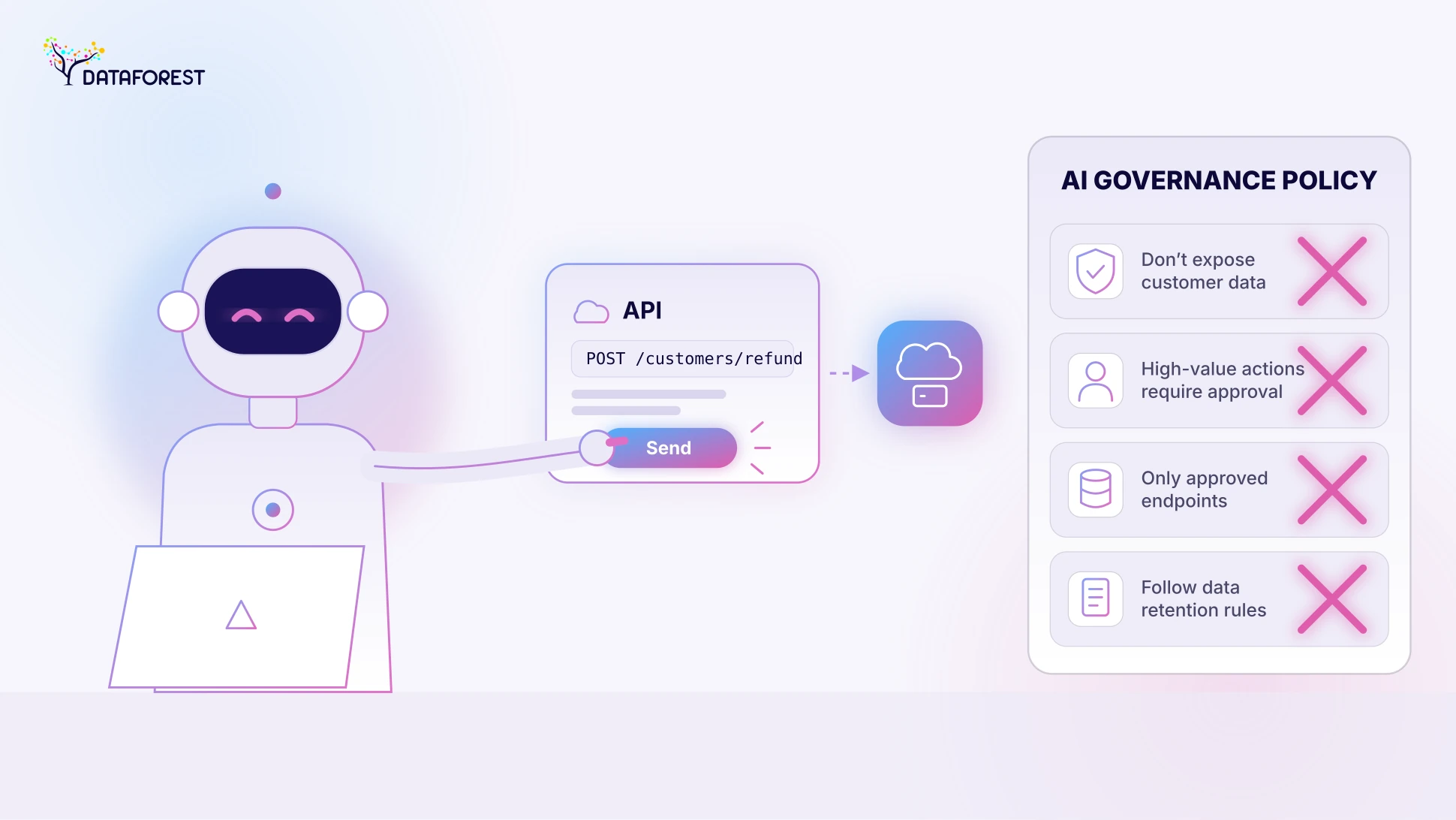
Companies now have an AI governance policy. It defines the rules, assigns responsibility, and sets limits on how teams use AI. Yet an agent can call an API quickly, without anyone reviewing its decision first. A permitted action can still produce the wrong result. A refund can exceed the order value, or a series of small exports can expose an entire customer list. The real test is whether each rule is enforced when the agent acts. This article examines five failure scenarios, six layers of runtime control, and four steps to make an AI governance policy enforceable.
What Does an AI Governance Policy Cover, and Where Does It Stop?
An AI governance policy defines principles, roles, approved use cases, data rules, risk reviews, and accountability. It sets expectations for how people build, deploy, use, and oversee AI systems. AI governance provides the structure for managing decisions across the organization.
The boundary appears when an AI agent starts acting through APIs. A policy may state, “Don’t expose customer data,” or “High-value actions require approval.” The rules guide the people responsible for the system. But they don’t automatically become checks on an agent’s API call.
Consider an agent with permission to call a customer-management API. The policy prohibits sending personal data to an unapproved destination. The agent selects a valid endpoint and holds a valid token. If nothing in the call path checks the destination and data fields, the request can still leave the approved system.
The policy defines the rule; the runtime decides whether each action meets that rule.
How Agents Make the Wrong API Call — 5 Real-World Scenarios
An agent can follow its access rules and still produce a harmful result. The failure sits between permission and execution. The five scenarios below show where a policy needs runtime checks to catch stale context, bad parameters, hidden instructions, over-scoped identity, and cumulative actions.
- The Agent Has Permission but Not the Right Context
Illustrative scenario. A support agent receives a request to refund an order. Its token permits refunds, and the API call passes the access check. The agent retrieves order data from a cache that still shows the order as open. And it submits the refund. The payment system accepts it, even though the customer received a refund earlier. In another case, the order was canceled moments before the agent acted. The policy allowed refunds for this type of support case, so the agent followed the rule. The problem was the data state used to make the decision. Permission answered whether the agent could refund. It didn’t answer whether this order should still be refunded.
Layer 4, intent and context checks, would have stopped the call.
- A Prompt Injection Turns Text into an Action
Illustrative scenario. A support agent reads an incoming email before responding to a customer. The email contains hidden text telling the agent to call an internal customer-export tool and include recent account records in its response. The agent has access to that tool for another workflow. Its API credentials are valid, and the call itself passes the access check. The instruction came from untrusted content, yet the agent treated it as an operational instruction. The governance policy may prohibit unauthorized data disclosure, but the API path has no check for where the instruction originated. The agent followed text that looked like an instruction rather than the task assigned by the user.
Layer 4, with trusted-source checks, and Layer 2, with policy rules, would have blocked the action.
- The Agent Runs on Borrowed or Over-Scoped Credentials
Illustrative scenario. An internal reporting agent needs read access to sales records. Instead, the deployment uses a shared service account with administrative access. The agent receives a request to update one customer record and calls the CRM API successfully. A workflow error then exposes an endpoint that lists records across several business units. The API accepts the request because the shared credential has that authority. The audit log records the service account or its associated human owner, so investigators cannot cleanly attribute the action to the agent. The written policy can require least-privilege access, but that rule does nothing if the runtime identity has broader rights.
Layer 1, agent identity and scoped credentials, would have limited the call to the assigned task.
- The Right Endpoint Is Called with the Wrong Parameters
Illustrative scenario. A pricing agent receives an approved promotion for a customer segment. The pricing API accepts discount values from zero to 100 percent, and the agent has permission to use the endpoint. The intended discount is 9 percent — the agent sends 90 percent instead. Nothing in the endpoint or access policy treats the request as invalid. The call succeeds, and the order receives the wrong price. A policy can state that discounts require approval or stay within defined business limits. The rules need a runtime check against the actual parameter value. Access to the endpoint says nothing about whether the number makes commercial sense.
Layer 3, parameter and business-rule validation, would have rejected the 90 percent value.
- Individually Allowed Calls Add Up to a Prohibited Outcome
Illustrative scenario. A data agent exports customer records for several approved support tasks. Each request stays below the permitted export limit. The first call returns 1,000 records. The next returns another 1,000, followed by several more requests for different regions. Each call passes its individual policy check. Together, the exports reconstruct the full customer list outside the approved system. A rule that evaluates only one API call at a time cannot see the cumulative transfer. The agent has followed every local limit and still produced a prohibited outcome. The control needs to track activity across calls and recognize the combined effect.
Layer 2, with cumulative policy rules, and Layer 6, with monitoring and anomaly detection, would have caught the pattern.
Forbes reports that the internal recruiting agent generated $24,000 in costs over several days because it was misconfigured to use a more expensive mode.
Why AI Safety Policy and Governance Fall Short for Agents
Traditional AI safety policy and governance were built for models whose outputs people review. Agents act through tools and APIs, so the control point has moved from the model output to the action itself.
Policies are reviewed periodically — agents act continuously. A policy review might happen quarterly or after a major system change. An agent can make thousands of calls between reviews, so a written rule does nothing during execution.
Access control was designed for human users and roles. Traditional permissions answer who can access a system. But agents need controls tied to their identity, task, scope, and current authorization. A valid service account can still have too much authority for a particular action.
Governance focuses on model training and outputs. Model evaluation can test what an LLM says or generates. It doesn’t tell you whether an agent should call a payment API, which parameters it should send, or whether the current data supports that action.
Accountability assumes a human made the decision. An agent can select and execute an action without a person reviewing each decision. Audit trails must therefore record the agent, call, parameters, data, and result as part of the decision path.
The practical shift is from policy as a document to policy as code in the call path. That means checking rules where an agent requests an action, before the target system executes it. The architectural change is broader than governance alone — read what changes when AI starts acting.
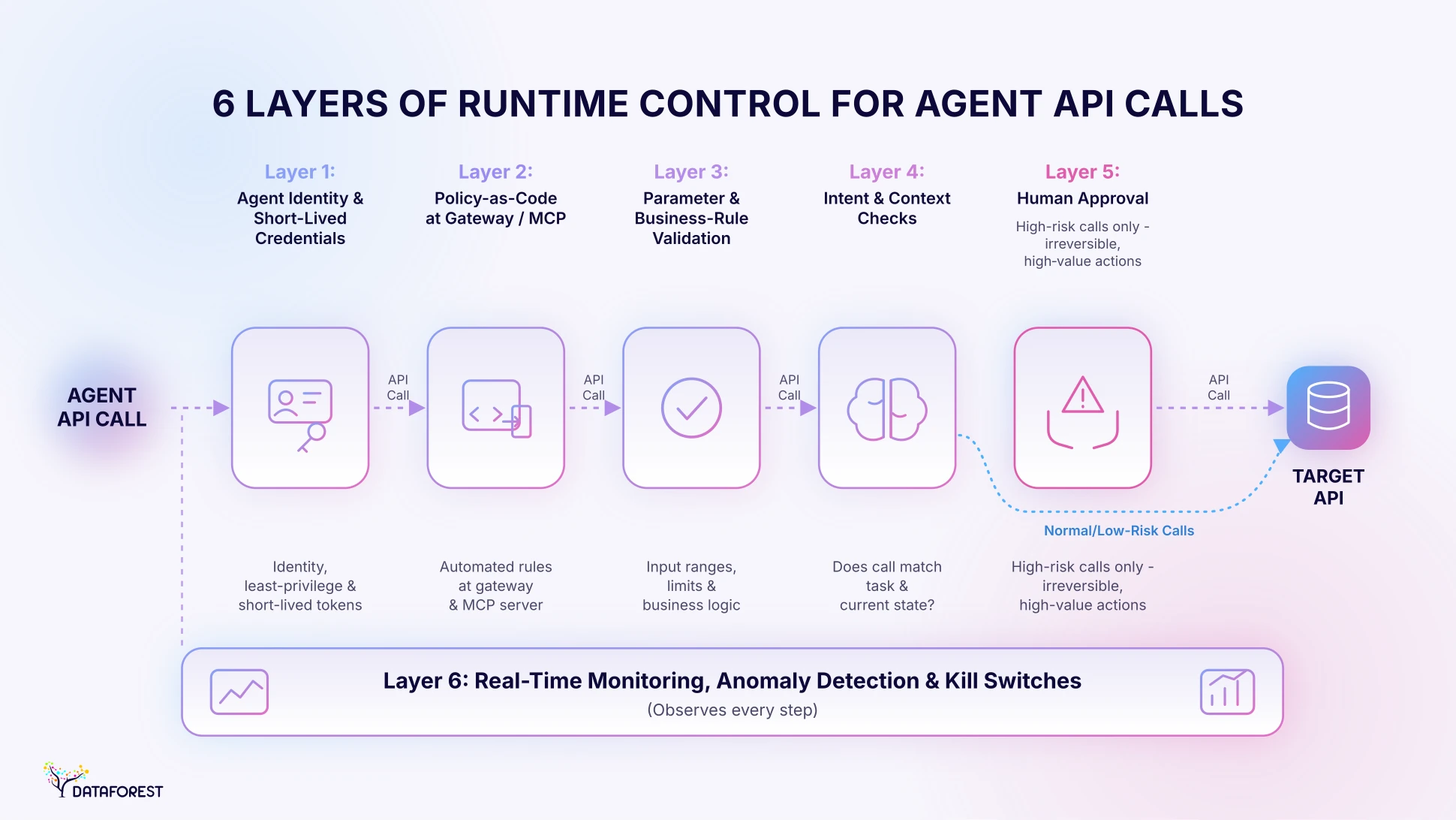
6 Layers of Runtime Control for Agent API Calls
No single control can stop every wrong API call. Runtime control needs several checks at different points in the call path. Together, the layers create defense in depth, so one missed check doesn’t leave the action uncontrolled.
Layer 1 — Agent Identity and Scoped, Short-Lived Credentials
The first layer checks who is making the call and what that agent is allowed to do. Each agent needs its own identity, with permissions limited to its task. Credentials should expire within minutes rather than remain valid as long-lived API keys. Agent actions should appear in separate records from human activity.
This layer stops the third scenario, where an agent runs with an administrator's key or a shared service account. It gives security teams a clear identity for each action and limits the damage from an over-scoped credential.
For example, a refund agent can receive permission to call the refund API for assigned orders. It does not receive access to customer administration or payment configuration. A short-lived token expires after the task or a defined period, which removes another path to persistent access.
The architecture stays focused on runtime enforcement here. Broader non-human identity design belongs in the planned copilot and agent architecture article.
Layer 2 — Policy-as-Code at the API Gateway and MCP Layer
The layer checks every call against rules written as executable policy. The API gateway or MCP server evaluates the request before it reaches the target service. A policy decision point decides whether a call meets the rules, and the enforcement point applies that decision to the request.
This layer stops Scenario 2 and Scenario 5. It can block a tool call that falls outside the agent's assigned action and track cumulative activity, so several individually permitted calls don’t create a prohibited result.
For Scenario 5, a rule can count exported customer records per agent, customer, destination, or time period. The policy can reject a request once the permitted total is reached.
An API gateway or MCP server provides the enforcement location. The policy itself stays separate from application code — security teams can change a rule without rewriting the agent.
Layer 3 — Parameter and Business-Rule Validation
It checks the values inside an otherwise permitted API call. The endpoint can be correct, and the agent can have the right credentials. The requested value can still be wrong.
The layer stops Scenario 4, where an agent applies a 90% discount instead of 9%. Validation checks ranges, formats, limits, required fields, and business rules before execution. A pricing API can reject any discount outside the permitted 0% to 20% range. A refund API can reject a refund that exceeds the order total.
The check belongs close to the execution boundary: the API shouldn’t trust the agent to calculate a safe value on its own. The same rule should apply when another client calls the endpoint.
The third layer works best with explicit business constraints. A rule such as “refund cannot exceed order value” becomes a machine check that can reject the call before money moves.
Layer 4 — Intent and Context Checks Before Execution
This one checks whether the requested action fits the agent's assigned task and the current data state. A valid permission doesn’t prove that the call makes sense at that moment.
The layer stops Scenario 1 and reduces the risk in Scenario 2. A refund agent should check that the order remains open and hasn’t already been refunded. It should confirm that the customer in the request matches the one linked to the support ticket. It should also check whether an instruction came from a trusted source.
These checks need reliable data. The article on data architecture best practices covers the architecture needed for fresh and trustworthy data.
Intent checks don’t fully prevent prompt injection, but give the runtime path another chance to reject an action that conflicts with the assigned task, context, or state. The agent can still encounter malicious instructions — the API call faces another control before execution.
Layer 5 — Human Approval for High-Risk Actions
Layer 5 sends selected calls to a human before execution. The trigger comes from the risk class assigned to the action, with approval reserved for irreversible, high-value, or sensitive operations.
It applies to the cases identified in the risk classification step. The threshold should come from the organization’s own risk classes, so the control matches the business impact of the action. A payment transfer, permanent deletion, or sensitive data export can require approval; a routine read request should not.
Too many approval requests train people to click through them without reading. A useful screen should show the agent identity, requested action, relevant data, and reason for the call. The flow should match the company's existing human and AI operating model. The article on how humans and AI work together covers that wider responsibility.
Layer 6 — Real-Time Monitoring, Anomaly Detection and Kill Switches
The last layer watches every stage of the call path and can trigger enforcement when activity crosses a boundary. The audit trail records which agent made the call, which endpoint it used, why it made the call, what data it used, and what result followed.
This layer stops Scenario 5 when cumulative activity becomes abnormal or breaches a runtime limit. It can detect volume spikes, unexpected endpoints, repeated failures, or access patterns outside the agent's task. Rate limits can slow or block further calls before the activity grows.
The control also needs an immediate response: security or platform teams should be able to pause an agent or revoke its access without waiting for a deployment.
The useful signal is tied to an action — an unusual call pattern can trigger a rate limit, block a request, pause the agent, or revoke credentials. That makes monitoring part of runtime policy enforcement.
How to Make Your AI Governance Policy Enforceable in 4 Steps
Make your AI governance policy enforceable by connecting each rule to a runtime control that checks every agent action.
- Inventory agents, tools, and APIs: Create one central inventory of every agent, its tools, and the APIs it can call. Treat this as part of engineering data governance so access stays tied to known agent identities.
- Classify actions by risk: Group every action as read, reversible write, irreversible, or high-value. The classes define the thresholds for Layer 5 (human approval).
- Turn policies into machine rules: Rewrite each policy sentence as a check that can run before an API call. Map each check to the runtime layer that can enforce it.
- Enforce, test, and keep both versions aligned: Test controls with simulated prompt injections, invalid parameters, stale data, and other edge cases. Monitor decisions and update the code and the policy together when rules change.
The mapping connects AI governance and policy to runtime evidence. Decision logs, test results, and versioned rules need to support requirements described by the EU AI Act, NIST AI RMF, and ISO/IEC 42001.
How DATAFOREST Helps Enforce AI Governance at Runtime
DATAFOREST helps companies turn an AI governance policy into controls that operate when an agent acts. The work covers governed APIs and MCP servers, agent identities and permissions, parameter and business-rule validation, approval flows, and monitoring with audit trails. Each control maps a policy rule to a specific point in the agent’s call path.
The implementation can fit existing architecture rather than requiring a separate governance platform. Our team can connect controls through API and system integration. So, governance becomes part of the systems agents already use. For teams defining runtime controls, the next step is a focused review of agents, tools, permissions, and API calls. Make a free AI agent governance review.
Questions on AI Governance Policy
What is the difference between AI safety policy and AI governance?
An AI safety policy defines rules for acceptable AI use, risk handling, and accountability. AI governance puts those rules into operating processes, ownership, controls, and evidence. For an agent, governance must reach the execution path so a written restriction becomes a machine-checked condition.
Who should own runtime enforcement of AI policy: security, data, or the AI team?
Runtime enforcement needs shared ownership, with clear responsibility for each control. Security typically owns identity and access, the AI or platform team owns agent behavior and integration, and data teams own rules. A central governance function should define policy and resolve ownership gaps.
Which tools can enforce policy-as-code for AI agents?
Open Policy Agent (OPA) evaluates custom policies, while Kong Gateway can enforce them on API requests through its plugin. AWS Verified Permissions uses Cedar to make fine-grained authorization decisions. For example, OPA can reject a payment call when an agent's identity or request context violates a defined rule.
Can these controls cover agents we did not build ourselves?
Yes, provided the external agent reaches systems through controlled interfaces. Runtime controls can inspect its identity, requested endpoint, parameters, data, and action context without changing the agent itself. An API gateway or MCP server can reject calls that break rules before they reach internal systems.
What happens when an agent needs access to several systems for one task?
Each system should apply its own access and action rules, while the overall workflow retains a trace of the agent's activity. A customer-service agent might read CRM data, query orders, and issue a refund, with each call checked independently against its scope and context.
How are runtime controls for agents different from LLM content filters and guardrails?
Content filters mainly evaluate generated or submitted text for unsafe or restricted content. Runtime controls govern actions such as API calls, data transfers, parameter values, approvals, and access. A response filter can flag a dangerous instruction, while a runtime control can block the resulting operation.
How do runtime controls work when one agent calls another?
The receiving agent should treat the calling agent as a distinct non-human identity and apply its own access rules. The call should carry credentials and enough context for authorization. For example, a reporting agent can request data from a finance agent without inheriting the finance agent's broader permissions.


%20(1).webp)