A data engineering platform integrates data ingestion, storage, processing, transformation, orchestration, governance, and delivery into a unified environment. Decisions around building, buying, or blending platform layers shape long-term cloud costs and team speed. Evaluating architectures requires a clear component map, an objective scorecard, and a time-boxed proof of concept.
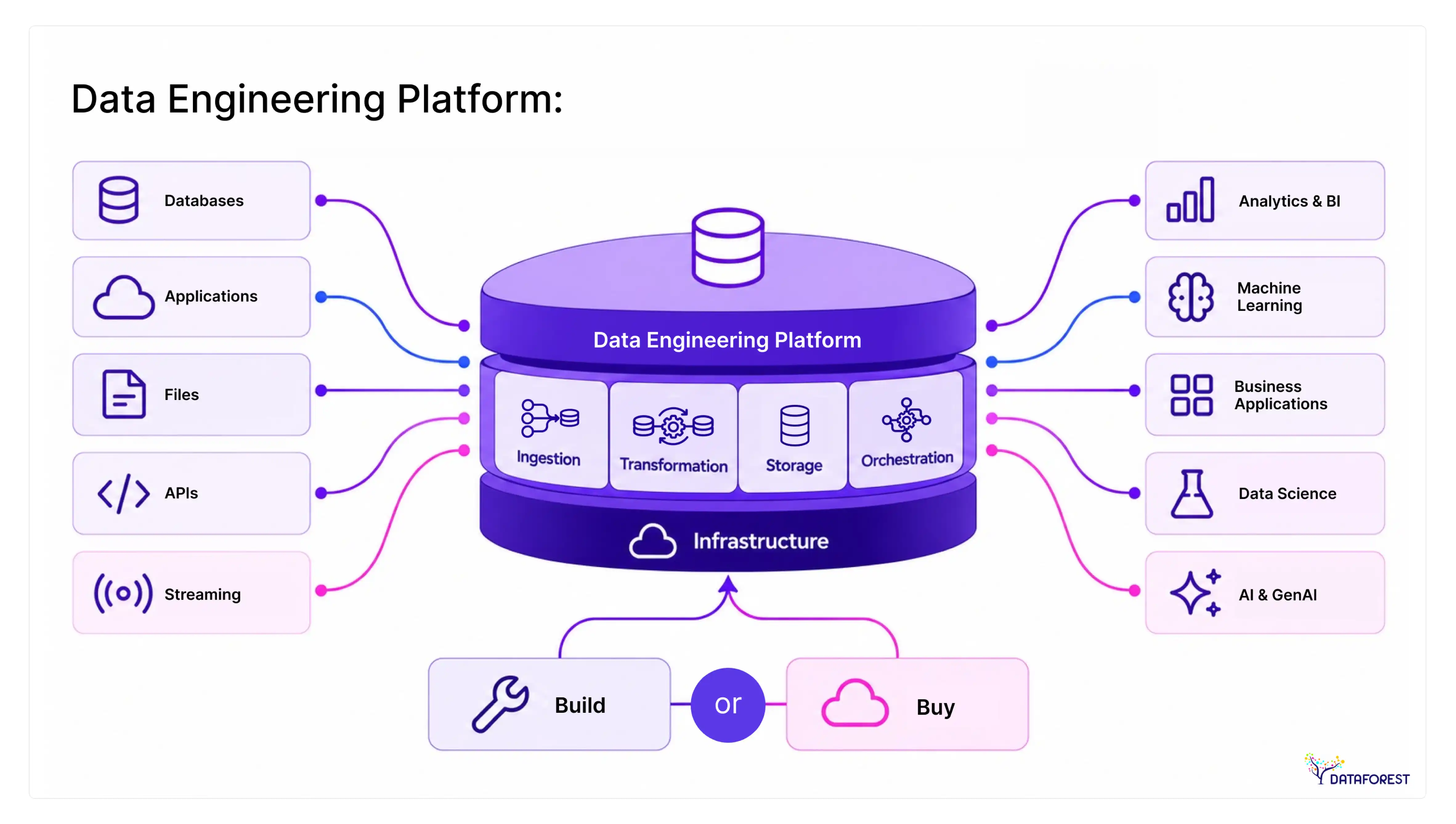
Data teams must choose between integrating individual tools or adopting a complete platform. The choice costs money to reverse. The wrong platform creates vendor lock-in, adds hidden costs, slows teams, and builds a stack that won't support AI later. Vendors label their products as the top option. A neutral evaluation model works better than a simple tool list. We outline the exact definition, core components, platform types, and the hybrid delivery model. This guide provides a process to choose the right data engineering platform.
TL;DR — Data Engineering Platform Strategy
- A data engineering platform is a unified system that handles data collection, transformation, storage, and delivery.
- The architecture includes distinct operational layers for data ingestion, processing, orchestration, and governance.
- Teams evaluate build and buy choices layer by layer across the technical stack.
- A hybrid stack pairs managed cloud services with custom engineering to control infrastructure costs.
- Engineering leaders select systems using technical criteria, workload limits, objective scorecards, and proofs of concept.
- Weighted scorecard: Assign weights to evaluation criteria, with scalability and performance carrying the highest weight at 25%, then score shortlisted platforms against your requirements and proof-of-concept results.
What is a Data Engineering Platform?
A data engineering platform is an integrated set of software layers that automates data collection, transformation, storage, and delivery. It differs from a single software tool — it does one specific job. A platform connects the entire lifecycle. A broader one can also include consumption tools such as BI dashboards, machine learning applications, and advanced analytics. Vendors use these terms differently, so this article focuses on the engineering layers and the decisions involved in selecting them.
The platform prepares raw information for downstream users. It replaces disconnected scripts with standardized workflows, unified access controls, central operational monitoring, and automated scheduling. You manage information from the first connection to the final warehouse.
Unified Data Engineering Platforms
They combine data ingestion, processing, governance, and monitoring into one product or an integrated suite. Teams avoid configuring separate standalone tools — you trade customization for operational simplicity. The unified model reduces the setup time. It increases your dependence on one vendor. Companies must weigh the value of easy maintenance against the risk of technical limits. A single vendor controls the feature roadmap, pricing updates, security patches, and support responses. This model works for many teams looking to avoid complex custom coding.
What Are the Core Components of a Data Engineering Platform?
A data engineering platform consists of distinct operational layers. Teams can build, buy, or license each layer independently based on internal skills and architecture requirements. For a broader discussion on architectural designs like lakehouses or meshes, review our guide on data architecture best practices.
BCG: Build when proprietary data and existing assets can create advantage; buy only when control of a scarce external asset protects a durable edge.
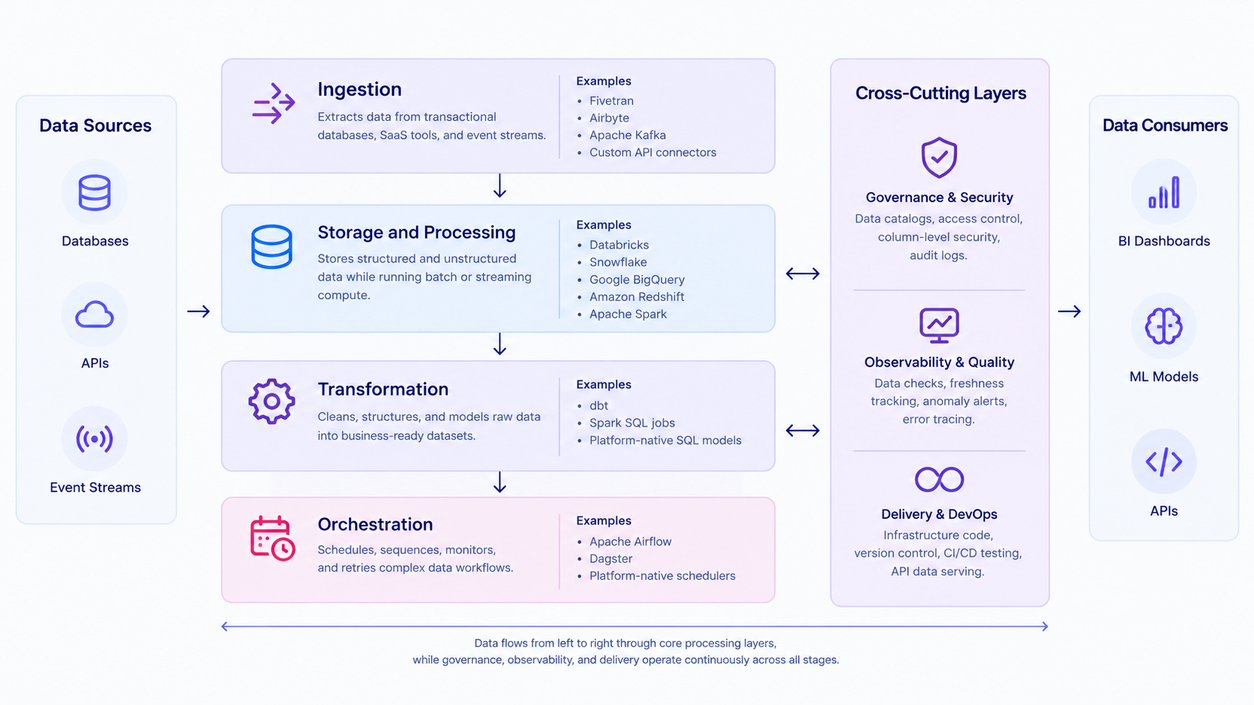
Benefits of a Data Engineering Platform
The benefits come from the coordinated system instead of ad hoc scripts. A structured platform delivers operational control: teams gain speed and reliability, and the system manages big data volumes without breaking. This structured environment improves core areas of your daily data operations.
Reliable and Scalable Data Pipelines
Centralized platforms handle pipeline failures automatically: they include retries and built-in alerts and make scaling easier during data volume growth. A company might process ten times more volume during a peak season without changing the underlying code. This serves as an example. The platform isolates resource allocation — heavy analytical queries do not slow down incoming data feeds. Engineering teams spend less time fixing broken scheduled jobs. They devote more time delivering useful features to the business.
Trusted Data — Quality, Lineage, and Governance
Integrated platforms run quality checks prior to production deployment. System-wide lineage charts map data origins. Teams see exactly where the information came from. They assess the exact impact of a schema change. Centralized governance enforces strict access control to maintain full auditability. A central catalog helps teams find approved datasets quickly. To learn more about pipeline verification, read our guide on data quality management.
Reduced Manual Overhead for Analytics and AI
Automated workflows remove the need for manual file transfers. They replace casual SQL adjustments. Clean datasets provide a dependable base for business intelligence projects and support artificial intelligence initiatives directly. Unstructured or poorly documented data blocks machine learning processes. Standardized data structures allow engineering teams to support intelligent applications easily because agentic systems need reliable metadata most. Read our article on agentic AI in data engineering for complete details.
Faster, Safer Delivery
Platform-level features introduce formal software engineering practices to data workflows. Developers test code changes in staging environments using version control systems. Automated testing pipelines catch errors prior to deployment. Teams manage their complete infrastructure as code, which speeds up release cycles and reduces critical production errors. AI assistants now help engineers write code, create automated tests, find bugs, and generate documentation.
Leading Data Engineering Platforms in 2026
We group the leading data engineering platforms based on their architecture types. They are selected by market adoption, product maturity, vendor support, and breadth across layers as of October, 2026. This is not a ranking. DATAFOREST is an official AWS partner and a Databricks Consulting Partner, and we work with other platforms equally. These options show technical design patterns — we omit performance scores.
All-in-One and Lakehouse Platforms
Lakehouse architectures combine object storage with compute engines to process structured and unstructured workloads in one environment.
Databricks: Integrates Apache Spark, Delta Lake storage, governance, and ML workflows into a unified lakehouse environment.
Snowflake: Provides a managed cloud data platform featuring separated storage and compute scaling, automated administration, and data sharing capabilities.
Dremio: The lakehouse platform queries data across open cloud storage and relational databases. The query engine accelerates analytical execution times for users.
The platform suits teams that want fast setup times and fewer moving parts. They consolidate technical tools into a single monthly bill. But this convenience brings high compute costs and limits your ability to switch vendors later. For a full technical breakdown, view our guide on Databricks vs Snowflake.
Cloud-Native Platforms from AWS, Google Cloud, and Azure
Hyperscaler cloud platforms offer native services that integrate with broader infrastructure.
AWS Data Stack: Pairs Amazon Redshift, AWS Glue, and Managed Workflows for Apache Airflow for scale.
Google Cloud Data Stack: Combines BigQuery, Dataflow, and Dataplex for serverless streaming and analytical workloads.
Microsoft Fabric: Merges Azure Data Factory, Azure Synapse Analytics, Azure Data Lake, and Power BI into an integrated SaaS workspace.
Using these native tools keeps network latency low. It simplifies billing through your existing enterprise cloud agreement and allows security control.
Modular Stack — Ingestion, Orchestration, and Transformation Tools
Modular stacks combine point tools to handle specific platform layers.
Fivetran & Airbyte: Managed ingestion tools that extract data from SaaS tools and databases with pre-built connectors.
dbt (data build tool): Transforms raw data inside analytical warehouses using SQL, software engineering practices, and automated testing.
Apache Airflow & Dagster: Orchestrates multi-system data workflows using code-based DAG definitions.
Teams choose combinations of the tools across needs. Fivetran or Airbyte handle data ingestion with pre-built connectors; the dbt software transforms raw data inside analytical warehouses using SQL; Apache Airflow or Dagster orchestrate complex workflows across multiple systems.
All-in-One and Lakehouse Platforms
These platforms combine multiple data engineering capabilities in a managed environment. They suit teams that want fewer separate systems to configure and maintain. Their trade-offs include dependence on the vendor's supported capabilities, pricing model, and integration options.
- Databricks: Combines data processing, lakehouse storage capabilities, governance, and machine learning workflows. It suits teams that need a shared environment for data engineering and AI workloads. Limitation: Teams must evaluate how its architecture and operational model fit their existing tools and workloads.
- Snowflake: Provides a managed cloud platform with independently scalable compute and storage, data sharing, and managed administration. It is for organizations that want to reduce infrastructure-management work. Limitation: Teams should assess how its supported processing patterns and platform-specific features affect portability.
- Dremio: Provides a lakehouse-oriented query platform for working with data across supported sources. It is better for teams that want to query data without moving every dataset into one warehouse. Limitation: Teams should verify connector support, query requirements, and the operational implications of the existing sources.
These platforms reduce the need to build every capability independently, but they don't eliminate integration work or vendor dependence. Compare their documented capabilities against your workloads rather than assuming that one platform covers every requirement.
For a detailed comparison of Databricks and Snowflake, see our Databricks vs. Snowflake guide.
Cloud-Native Platforms from AWS, Google Cloud, and Azure
Cloud-native data services integrate with their providers' infrastructure, identity systems, and operational tools. They suit teams with established cloud environments that want to use native services where they fit.
- AWS data stack: AWS Glue and Amazon Redshift provide data integration and analytical processing capabilities. AWS also supports managed orchestration options. Limitation: Teams combining multiple AWS services must account for cross-service configuration, permissions, monitoring, and billing.
- Google Cloud data stack: BigQuery and Dataflow support analytical processing and pipelines across batch and streaming workloads. Limitation: Teams should assess dependencies on Google Cloud services and the work required to operate equivalent workloads elsewhere.
- Microsoft Fabric: Integrates data engineering, analytics, data integration, and business intelligence capabilities in a shared environment. Limitation: Teams should verify whether its supported workloads, integration options, and operating model meet requirements that extend beyond the Microsoft ecosystem.
Native integration can simplify operations within an established cloud environment. But the team should evaluate cross-cloud portability, service dependencies, and the effort required to connect existing systems.
Modular Stack: Ingestion, Orchestration, and Transformation Tools
A modular stack combines specialized tools instead of relying on a single integrated platform. It suits teams that need flexibility across components or want to retain control over particular layers.
- Fivetran: Provides managed data ingestion through supported connectors. It suits teams that want to reduce the work involved in maintaining standard integrations. Limitation: Teams must verify connector coverage and determine whether unsupported sources require custom development.
- Airbyte: Provides data integration capabilities through a connector-based approach. It fits teams that need flexibility in how they deploy and manage ingestion. Limitation: Teams must account for the maintenance and operational requirements of their chosen deployment and connectors.
- dbt: Supports SQL-based data transformation, testing, and documentation workflows. It matches teams that want to apply software engineering practices to analytical data models. Limitation: It doesn't replace the storage, ingestion, and orchestration capabilities required elsewhere in the stack.
- Apache Airflow: Orchestrates workflows through code-defined tasks and dependencies. It goes well with teams coordinating jobs across multiple systems. Limitation: Teams operating it themselves must plan for deployment, upgrades, monitoring, and ongoing maintenance.
- Dagster: Provides orchestration and development workflows organized around data assets and their dependencies. It befits teams that want explicit visibility into assets and their production. Limitation: Teams should evaluate its operating model and integration requirements against their existing workflows.
A modular stack offers flexibility, but each additional component creates integration and ownership responsibilities. Evaluate the complete operating model.
Build vs Buy vs Hybrid: Which Approach Fits Your Team?
The build versus buy decision applies to individual platform layers rather than the platform as a whole. Engineering teams should buy tools for commodity components — ingestion connectors and orchestration engines. Custom engineering effort belongs on layers that create unique business value.

When to Build a Custom Platform
Building custom platform components makes sense in some exact situations.
- Highly specific technical requirements.
- Strict data residency laws might prevent public cloud usage.
- A large, experienced engineering team.
- The platform itself is a commercial product or strategic differentiator.
A custom build makes sense when the platform is the product or standard services cannot meet a hard requirement. Budget for upgrades, support, monitoring, security, documentation, and hiring.
When to Buy a Managed Platform
Buying a managed platform works best for teams with standard use cases. In that case, small data teams benefit from offloading routine operational work. Managed services provide immediate speed — you launch new data pipelines in days instead of months. This path helps organizations with limited engineering skills. The vendor handles server provisioning, software updates, network configurations, and basic security patching. The primary risks are usage-based cost growth at scale and vendor lock-in.
Hybrid Approach
It combines bought and built parts: managed services for commodity layers, your own engineering where a layer is differentiating; and usually takes one of two forms.
Open-source core with managed services. The team runs tools such as Airflow or dbt itself, which keeps control over logic and makes pipelines easier to move.
Managed platform with an implementation partner. The vendor runs the platform. The partner designs the architecture, connects existing systems, migrates workloads, and sets up production operations.
A U.S. medical laboratory applied this hybrid model by pairing Databricks and Medallion architecture with the DATAFOREST implementation team. The effort consolidated 21 separate data sources, ensured HIPAA compliance, automated analytics, and cut pay-per-use compute costs by 50%.
Medical Lab Achieves 50% Compute Savings via Databricks Migration


Medical Lab Achieves 50% Compute Savings via Databricks Migration
Total Cost of Ownership
Calculating TCO across a model requires tracking several factors:
- Software licensing fees and cloud usage bills.
- Engineering salaries allocated to platform maintenance.
- Migration expenditures and external implementation services.
- Team training, onboarding, and downtime recovery.
Learn more about managing platform transitions in our guide on data platform modernization.
How to Choose a Data Engineering Platform — Criteria and Process
There is no single best data engineering platform. The choice depends on data volume, engineering skills, existing cloud systems, and budget constraints.
Core Evaluation Criteria
Scalability and performance: Measures how well the platform handles sudden spikes in data volume and streaming demands.
Connectors and ecosystem: Verifies native support for critical source systems and analytical destinations.
Pricing predictability: Evaluates usage billing rules, compute scaling controls, and storage fees.
Security and compliance: Confirms compliance with SOC 2, HIPAA, GDPR, encryption standards, and role-based access rules.
Team alignment: Assesses whether the platform fits current team skills in SQL, Python, or Scala.
Operational support: Reviews vendor SLAs, documentation depth, and technical support access.
The 5-Step Selection Process
- Define workloads and constraints. Document daily data volumes, acceptable latency, existing team skills, and compliance rules to set your hard boundaries.
- Shortlist two or three options. Select candidates across the platform types mentioned above. Don’t waste time reviewing different tools — focus on the most viable architectural fits.
- Score each option against the criteria. Use specific numerical weights set by your business constraints. A healthcare firm might prioritize security over processing speed. Assign a percentage to each category to calculate a total score.
- Run a time-boxed proof of concept. Test one real production workload on the platform. Avoid using synthetic data. Measure the exact setup time, system bugs, query performance, and compute cost. Assign senior engineers to conduct the test over time.
- Select the platform, plan the rollout, sign the contract, and document the exit path. Commit to the chosen platform and plan a phased migration schedule. Record the exact steps required to export your data after termination — secure budget approval from the finance department before signing contracts.
Platform Evaluation Checklist
Use this platform evaluation checklist during vendor meetings. It reveals hidden operational risks before you sign the contract.

Build the Right Data Engineering Platform with DATAFOREST
DATAFOREST assesses your true technical needs. The engineering team evaluates custom builds, managed platforms, hybrid models, and open frameworks. Phased rollouts protect existing pipelines from disruption. This capability draws on 18+ years of direct experience. More than 100 dedicated software engineers have completed over 250+ projects. The resulting data platforms lower compute costs, improve query speed, enforce security, and unify corporate information.
Explore our data engineering services to review technical capabilities, or visit our data platform development services page to see how we build high-performance data systems.

Questions On Data Engineering Platform
Do we need a separate orchestration tool if our data platform has built-in workflows?
Built-in schedulers manage tasks inside a single environment. Teams buy separate orchestration software to manage job dependencies across different cloud providers. Dedicated orchestrators manage custom execution environments, control API trigger events, handle cross-system alerts, and maintain vendor independence.
Not always. Built-in workflows are sufficient when most jobs run within one platform, and their dependencies are straightforward. A separate orchestrator becomes more useful when pipelines span multiple systems, require complex cross-system dependencies, or need to remain portable across environments. Before adding another tool, compare the native scheduler's capabilities with your workflow requirements and the operational overhead of running an additional service.
What are the signs we have outgrown our current data stack?
Engineers spend more than half their week fixing broken scripts. Query execution times double without a matching increase in traffic. The team cannot trace data origin, map schema impacts, approve new user access, or deploy new extraction sources quickly. These technical limits require a platform upgrade.
Why do data platform bills grow faster than expected?
A lack of configuration rules inflates cloud data costs. Engineers leave compute clusters active overnight. The company pays for redundant processing loops, oversized analytical engines, hidden network egress fees, and forgotten data backups. Proper financial governance requires active monitoring dashboards.
What security certifications should we ask a platform vendor for?
Buyers must demand independent audit documentation. They also need to ignore basic website compliance badges. And you must verify data residency restrictions, column-level masking capabilities, encryption protocols, and single sign-on integration. A rigorous evaluation checks the actual control text.
Ask which independent security assessments and certifications apply to the services you intend to use. Common requests include a SOC 2 report and evidence of ISO 27001 certification, alongside documentation on data residency, encryption, and access controls. Ask for the report and check its scope, assessment period, and any stated exceptions. A certification or report is evidence to evaluate (but not proof) that every service or configuration meets your requirements.
Is a data engineering platform the same as a customer data platform?
A customer data platform (CDP) tracks website clicks, email opens, purchase histories, and user profiles for marketing departments. But a data engineering system handles every corporate data source. The engineering platform ingests marketing metrics, financial records, inventory logs, and factory sensor outputs for central analysis.
What is the fastest-growing data engineering platform?
No single technical product dominates every enterprise category. Market leadership depends completely on the chosen measurement metric. Technical leaders and CxOs track independent cloud provider financial reports, open-source download volumes, developer community interactions, and annual industry surveys.
Does a multi-cloud data platform make sense?
Government regulations force local data storage across multiple clouds. Sometimes corporate mergers combine two different cloud networks. This approach demands rare developer skills, doubles the network integration effort, increases security vulnerabilities, and creates massive network egress fees. Open data formats reduce this lock-in risk.
Does the platform choice change if we plan to use AI agents?
Artificial intelligence models fail without reliable internal company facts. The chosen platform must provide direct application programming interfaces. It must supply strict access permissions, detailed query logs, automated metadata descriptions, and clear data lineage graphs. Clean data governance feeds AI models accurate contextual data.
How long does it take to migrate to a new data platform?
Migration timelines depend on pipeline complexity, source system counts, data volume, and validation testing requirements. Teams shorten overall transition times through phased implementation steps. Engineers validate data accuracy, measure exact query speeds, test security protocols, and check financial billing limits. The migration process always starts with a high-value pilot project.
Who should own the data platform inside the company?
The corporate organizational chart divides technical responsibilities. The core engineering department maintains raw compute servers, network routing rules, firewall permissions, and cloud billing accounts. The business analytics groups build data models, track departmental KPIs, write SQL queries, and design executive dashboards. Clear ownership splits keep core infrastructure stable. This division gives analytics teams development speed.