ML-Based Identity Risk Scoring for a Cybersecurity Platform
The client helps businesses identify fraudulent users during onboarding and login. DATAFOREST developed an ML-based scoring solution that combines request data, historical activity, and connections between identities to flag identities associated with stolen or synthetic identity fraud. The solution achieves approximately 99.5% accuracy and produces 30% fewer false positives than the client’s previous solution, helping businesses identify suspicious activity while reducing unnecessary friction for legitimate customers.
30
%
fewer false positives compared with the client’s previous solution
~
99.5
%
accuracy in AI-based fraud identification
The client is a New York-based cybersecurity company providing identity intelligence to banks, fintech companies, and other businesses. Its activity-backed Identity Graph draws on more than 185 million identities and 1.5 billion authenticated events daily across 150,000+ websites and apps. By analyzing activity across digital contexts, it helps detect stolen and synthetic identities during account opening and within existing customer databases. Businesses access these insights through an API that integrates with their existing fraud prevention systems.

Python

Neo4j

PyTorch

AWS

Databricks
THE CHALLENGE
Identifying identity fraud from limited inputs while minimizing false positives
The client’s customers often submit identity assessment requests containing only an email address and an IP address. The challenge was to turn these limited inputs, together with available activity history and identity relationships, into reliable real-time risk assessments. The solution needed to flag suspicious identities while minimizing false positives that could lead to unnecessary verification or rejection of legitimate customers.

Assessing identity risk from minimal request data
Many requests contain only an email and an IP address. The system needed to build enough context around these identifiers to assess risk without requiring clients to supply extensive user information.

Turning activity history into fraud signals
Historical logs contain individual events, but fraud scoring requires patterns over time. The challenge was to translate this history into features that reveal unusual activity.

Uncovering suspicious relationships between identities
Fraud rings reuse contact details and infrastructure. Spotting a phone number tied to 100 users, or an IP logging in 1,000 times, requires analyzing relationships rather than single records.

Adding risk context beyond user behavior
Activity patterns and identity connections do not explain every risk. The system also needed information about the networks behind requests to make better-informed assessments.

Assessing identities with no history
Previously unseen email addresses have no behavioral history to assess. The system needed to account for this uncertainty without interpreting missing data as evidence of low fraud risk.

Fitting different client decision workflows
Some customers make decisions independently, while others rely on the platform to trigger user verification. The output had to work across all of these setups.
THE SOLUTION
Real-time identity risk scoring powered by behavioral and graph features
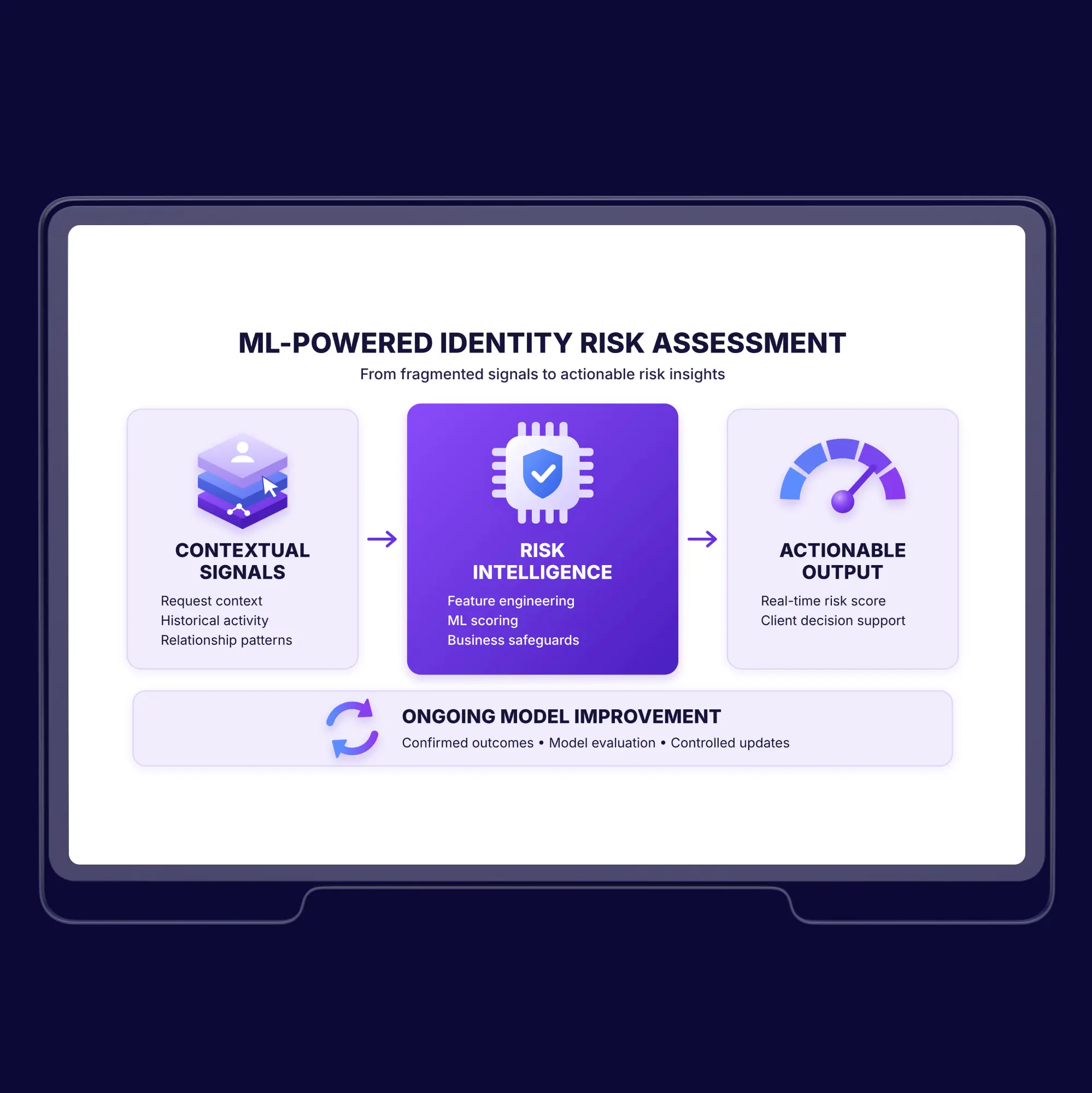
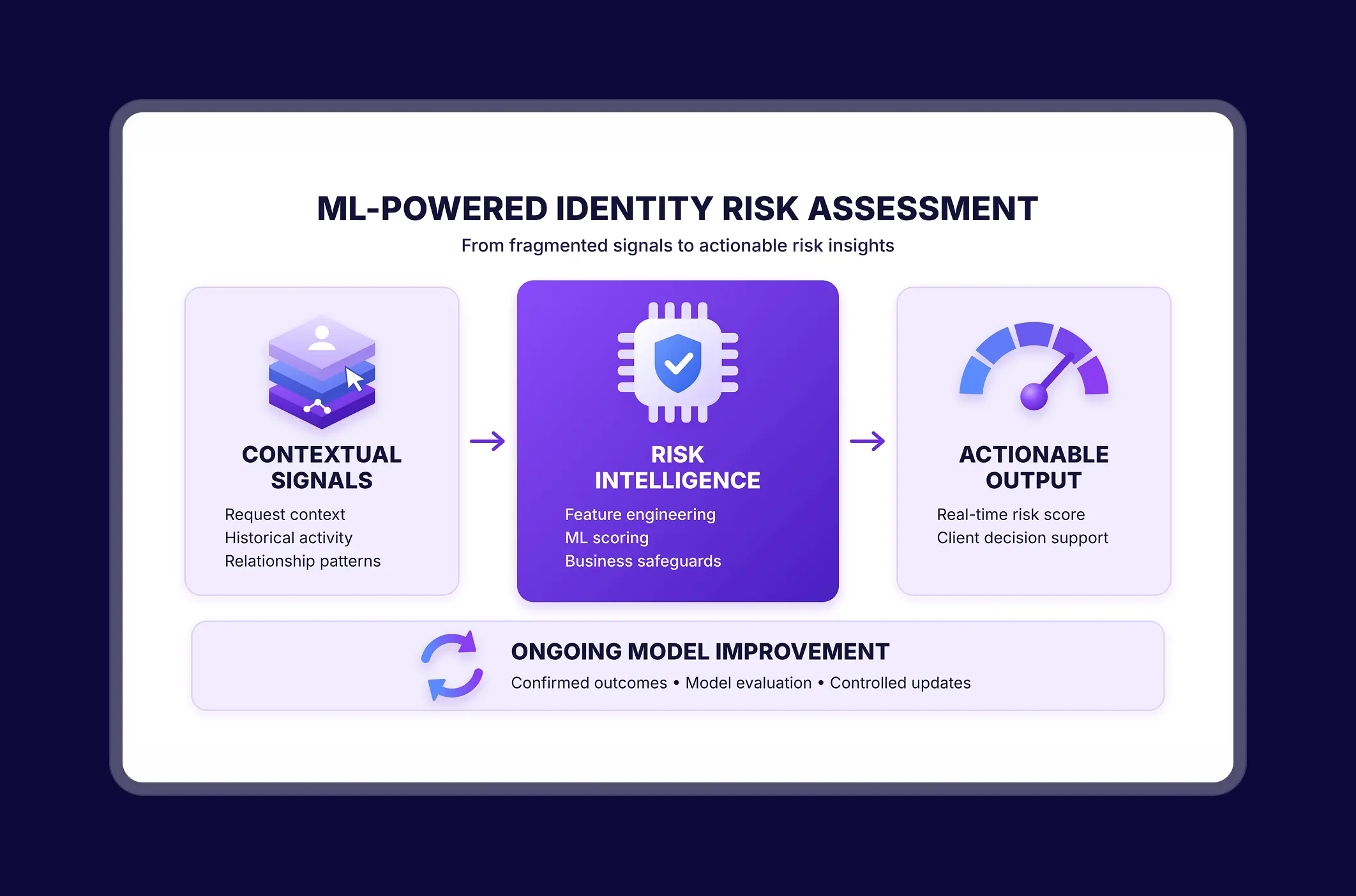
DATAFOREST developed an ML-based scoring solution that combines request details, historical activity and relationships between identities. For each request, the system calculates relevant features and returns a risk score, with higher scores indicating greater assessed fraud risk.
Data enrichment and business rules support the model, including safeguards for identities with no activity history. Customers use the score within their existing decision workflows to determine whether additional verification is needed. For suspicious logins, verification emails can be sent through the platform or the customer’s own system.
Model updates incorporate fresh activity and confirmed fraud feedback. Each candidate release is evaluated to check whether it improves detection performance while controlling false positives.

Four layers of signal for every request
The system enriches submitted identifiers with four groups of available signals: network data, device details, geographic history, and activity data. These complementary signals provide a broader basis for real-time fraud scoring, even when the original request contains little information.

Graph features that reveal identity connections
A graph database links all known emails, phones, and IPs. Features such as connection counts help flag unnatural patterns that single-record checks would miss.

Minimum risk thresholds for unknown identities
We added business rules alongside the model to enforce a minimum risk score for email addresses absent from the database. This prevents unknown identities from receiving low-risk scores simply because no suspicious history exists.

Behavioral features that reveal anomalies
We calculated features such as login frequency, typical login times, and sudden spikes in events per user. These measures help the model distinguish established activity patterns from potentially suspicious changes.

Reputation features and ongoing data enrichment
IP addresses are enriched with the reputation of their owning companies, and additional data is collected over time, improving the accuracy of the fraud probability.

Flexible integration and decision scenarios
We developed functionality that enables customers to submit user data and receive a trust score. Customers can use the score to make decisions within their own systems, trigger verification emails through the platform, or send them through their own website to confirm suspicious logins.
THE RESULT
A multi-layered scoring engine delivering ~99.5% accuracy in AI-based fraud identification
DATAFOREST helped a cybersecurity company catch more fake and stolen identities in real time while sending far fewer genuine customers through unnecessary checks.
The client provides identity intelligence to banks, fintech companies, and online businesses, analyzing activity from 185M+ identities to flag risky sign-ups and logins via API.
It needed to detect stolen and synthetic identities instantly, often from just an email and an IP address, without blocking honest users.
We built an AI-powered risk scoring solution that returns a real-time fraud score for every request and plugs into the fraud prevention tools customers already use.
How we did it
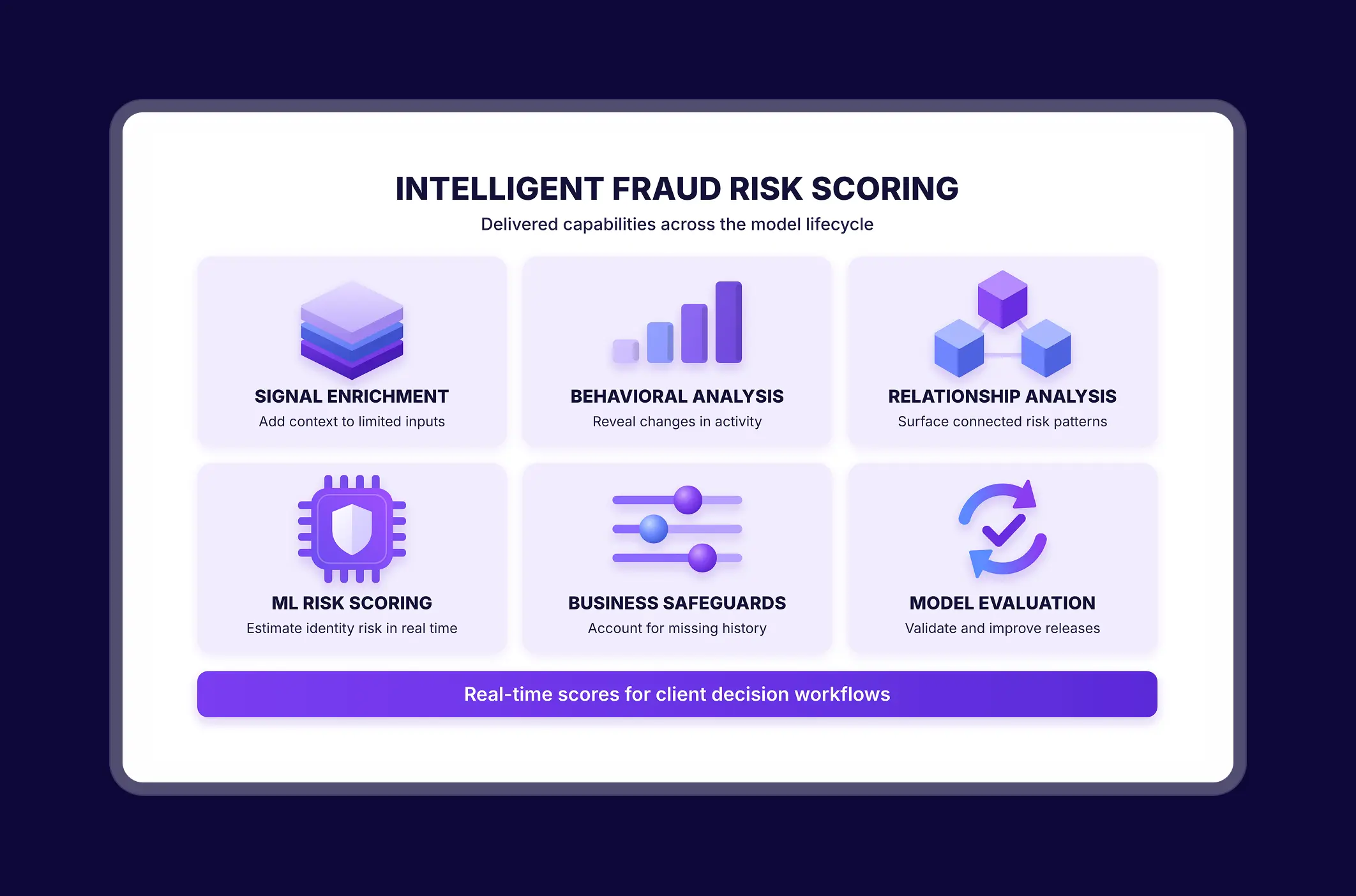
- Data enrichment: adds network, device, location, and activity signals to each email and IP.
- Behavior analysis: the model learns what normal activity looks like (login frequency, typical login times) and flags sudden, unusual changes.
- Identity graph (Neo4j): exposes fraud rings that reuse emails, phones, and IPs.
- ML models (Python, PyTorch, AWS, Databricks): regularly retrained on fresh data and confirmed fraud cases.
- Business rules: new, unknown identities are never treated as safe by default.
- Flexible integration: customers can act on the score inside their own systems or trigger verification emails through the platform.
Business impact
Customers stop more fraud at the door while legitimate users get smoother onboarding and fewer unnecessary verification steps.
Key Results:
- 30% fewer false positives compared with the client’s previous solution.
- ~99.5% accuracy in AI-based fraud identification
fewer false positives compared with the client’s previous solution
accuracy in AI-based fraud identification

ML-Based Identity Risk Scoring for a Cybersecurity Platform
The Way We Deal with Your Task and Help Achieve Results


Store heatmap

DATAFOREST provides meaningful shopper-behavior Insights. They are very responsive and effective, trying to engineer and offer the best fit solution.
Insurance Profitability Analysis Tool

Great work! The team provided an excellent solution for consolidating our data from multiple sources and creating valuable insights for our business.
Reporting & Analysis Automation with AI Chatbots

Automating Reporting and Analysis with Intelligent AI Chatbots
Store heatmap
DATAFOREST provides meaningful shopper-behavior Insights. They are very responsive and effective, trying to engineer and offer the best fit solution.
Insurance Profitability Analysis Tool
Great work! The team provided an excellent solution for consolidating our data from multiple sources and creating valuable insights for our business.
Reporting & Analysis Automation with AI Chatbots
Automating Reporting and Analysis with Intelligent AI Chatbots
AI Platform Revolutionizing Healthcare Insights

AI Platform Revolutionizing Healthcare Insights
Latest publications
All publications
Business Intelligence: Turning Raw Data Into Improved Performance
Predictive Maintenance in Utility Services: Sensor Data for ML
Build vs Buy AI Infrastructure in 2026: How to Decide — Layer by Layer
Latest publications
All publications
Data Readiness for AI: 7 Signs Your Data Platform Is Analytics-Ready but Not AI-Ready
AI Copilot vs AI Agent
Build vs Buy AI Infrastructure in 2026: How to Decide — Layer by Layer
We’d love to hear from you
Share project details, like scope or challenges. We'll review and follow up with next steps.

