Agentic AI in Data Engineering: Use Cases, Architecture and Guardrails
Agentic AI data engineering differs from a scaled copilot — it operates as a distinct practice. The core contrasts are structural. Data teams handle a growing volume of assets and frequent pipeline breakages. Engineers spend many hours fixing routine errors.
A production agent carries the exact risks as a human with write access, but the software makes decisions much faster. Engineering leaders must control these automated actions to protect the infrastructure. This article covers the main use cases, underlying architecture, and necessary guardrails.
Core Principles of Agentic Data Engineering (TL;DR)
- Agentic AI in data engineering involves software that plans and executes pipeline work through standard tools.
- Safe starting points. Teams begin with low-risk tasks that are easy to reverse.
- System safety. Least-privilege access, strict human approval, and complete audit logs protect the infrastructure.
- Context layer necessity. A reliable context layer prevents the software from executing destructive commands.
- Role evolution. The data engineer shifts from writing manual scripts to designing architectures and supervising automated agents.
What Is Agentic AI in Data Engineering?
Agentic AI in data engineering refers to software systems that autonomously plan and execute multi-step data tasks using existing tools. An AI copilot suggests code for a human to execute. Workflow tools like Airflow and dbt run fixed logic on a set schedule. An agent chooses its next step at runtime and calls tools to achieve a goal.
For example: a nightly data load fails. The agent reads the error log, identifies a changed column type in the source, proposes a mapping fix, and opens a pull request. It calls Airflow and dbt to do the actual work, but it doesn’t replace them. The technology acts as an orchestration layer sitting above your standard infrastructure. It “decides” the next tool command based on the live environment variables.

Why Are Data Teams Adopting AI Agents in Data Engineering Now?
Data teams face a rapidly growing volume of data assets. Engineers lose hours weekly to routine maintenance and pipeline breakages. Better reasoning models and standardized tool interfaces, such as the Model Context Protocol (MCP), make autonomous agents practical — businesses pressure data teams to ship data products faster than traditional methods allow.
AI agents in data engineering help clear the backlog of schema updates and failed loads. They handle the basic operational repairs automatically. This lets engineers focus on building a platform architecture because they stop fixing yesterday's broken ingestion feeds manually. The combination of better underlying language models, standard APIs, and acute business demand drives the adoption.
Key Use Cases of AI Agents for Data Engineering
The cases follow the data lifecycle from ingestion to daily monitoring. AI agents for data engineering operate within defined measures to resolve specific operational bottlenecks. Each example demonstrates automated capability alongside human control.
Data Ingestion and Schema Mapping
Upstream sources change frequently. These changes break downstream tables. A source adds a column — the pipeline fails. An agent detects new or changed fields indicating schema drift. It reads the source data dictionary, proposes a target mapping, and updates the ingestion configuration file via a direct pull request. The human engineering team reviews the pull request prior to the merge. The approach reduces the manual work needed to repair feeds. The agent relies on repository access and configuration APIs to complete the task.
Pipeline Creation and Transformation
Writing routine transformations takes hours of developer time because analysts wait days for basic metric aggregations. An agent generates SQL and code from a plain-language request. It also reads the code repository, learns the team naming conventions and structural rules. Then it opens a pull request containing the new logic. The code goes through the normal dbt testing and continuous integration review process. The engineering team maintains control over the main branch — the agent simply drafts the initial code block.
Data Quality Validation and Enrichment
Bad records reach executive dashboards undetected. An agent profiles incoming data batches, writes test assertions, and runs those tests automatically. And it flags statistical anomalies. Bad data stops prior to updating final reporting tables. This action makes data validation proactive. Teams incorporate this mechanism into their existing data quality management. The agent acts as a first-pass reviewer for every new data load. It catches unexpected nulls or range violations early.
Orchestration and Incident Response
A failed job normally requires an on-call engineer to read logs and trace dependencies. An agent reads the job execution logs and the data lineage graph to diagnose the root cause of the failure. It identifies temporary errors, drafts a code fix within set limits for persistent errors, and escalates complex failures to a human. In an illustrative scenario, an agent identifies a missing partition in ten minutes instead of the two hours a human might spend. These capabilities improve standard data pipeline services.
Documentation, Testing and Monitoring
Technical documentation and monitoring rules sometimes fall behind the actual codebase. An agent generates technical docs from the committed code and database metadata. A table structure changes in production — the agent updates monitoring rules automatically. Engineers review the generated text rather than writing it from scratch. The data catalog stays accurate and up to date, and teams avoid manual updates following every development sprint. The agent reads the commit history and the metadata API to draft the updates.
How Agents Work Inside a Data Stack
An agent operates in a continuous cycle. The loop repeats on every assigned task; the system reads the environment, plans a specific response, executes a tool, and evaluates the final result. The perceive-reason-act architecture moves the software from a static script to an autonomous process.
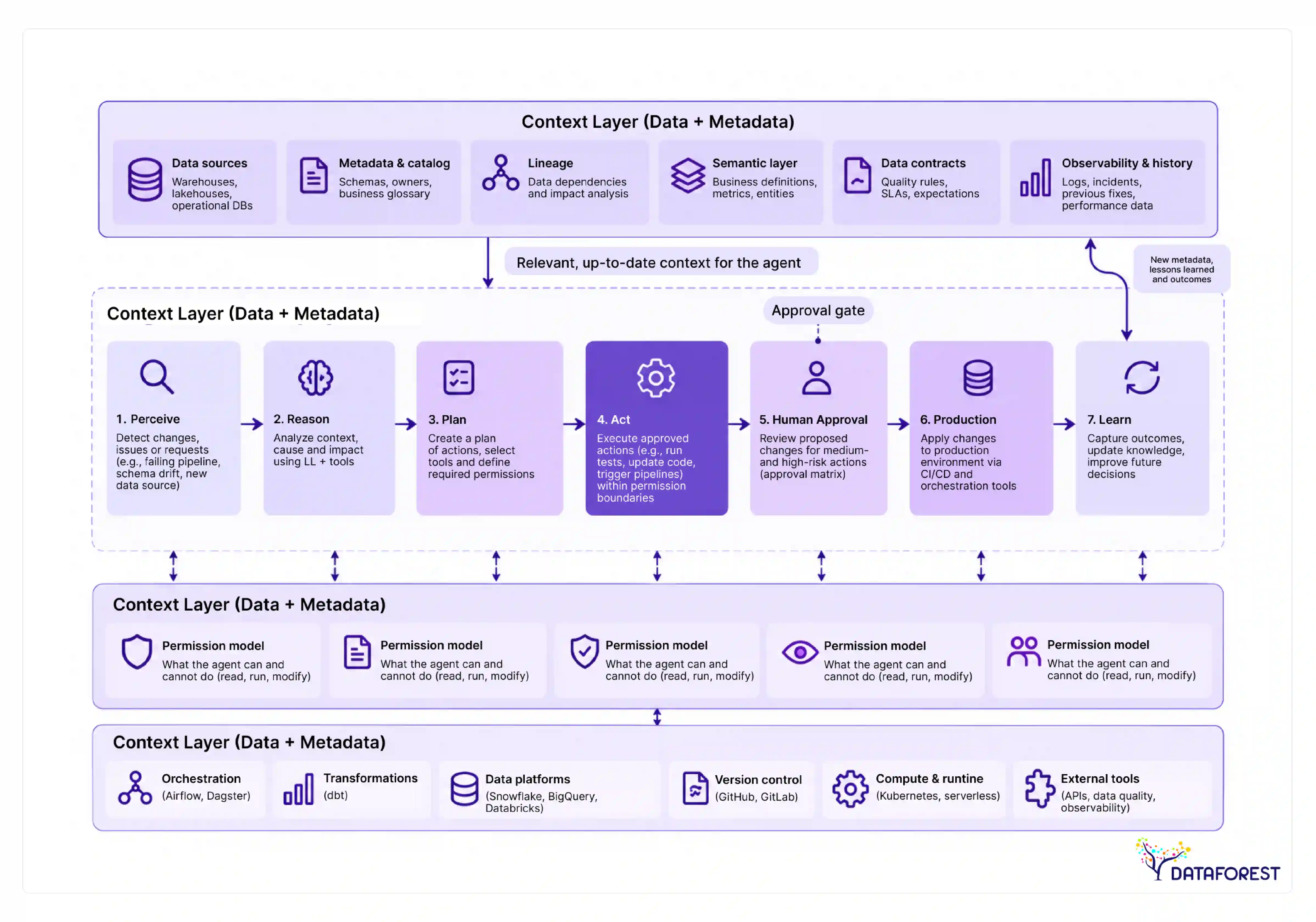
Perceive
The agent ingests context from the environment: it reads execution logs, database schemas, and data lineage maps; and it receives alerts from orchestration tools and reads tickets from issue trackers. The sensory input gives the agent an accurate picture of the data pipeline.
Reason
The AI agent uses a large language model to analyze the incoming signals. It combines the technical alerts with documented business rules and historical data context. The model plans the next step based on this information and makes the next tool call.
Act
The agent executes the plan by interacting with external systems. It runs SQL queries, edits repository code, triggers Airflow jobs, or opens pull requests. All actions occur within configured permissions. The agent accesses tools through standard APIs or the Model Context Protocol.
Learn
The agent evaluates the outcome of its action — human feedback and job success metrics inform future decisions. Learning in this practical context means updating prompt instructions, expanding system memory, and refining rules set by the engineering team. It doesn’t mean retraining the foundational model.
Context Layer and Key Technologies: Metadata, Lineage and Data Catalog
Agents are only as good as the context they can read. They require accurate metadata, complete lineage, a populated catalog, and past incident history. The basic stack includes large language models, agent frameworks, orchestration tools like Airflow, and catalog solutions.
Weak metadata makes an agent act confidently on wrong numbers. So, it cannot fix a failed pipeline with hidden downstream table dependencies — it will guess and make mistakes. Companies with disorganized metadata need comprehensive data platform modernization. They must modernize prior to deploying autonomous agents. The context layer turns logs into signals for the model. You build the context layer to give the agent a map of your environment. A reliable metadata layer prevents the agent from executing destructive commands on critical tables.
Guardrails for AI Agents in Production Data Systems
Autonomy without limits introduces production risks. Guardrails keep production data safe and make AI agents usable for enterprise engineering. A tech boundary prevents the agent from executing destructive commands. You need to define authority limits to manage operational safety.
Governance and Agent Authority Boundaries
Engineering teams define what an agent may and may not do. Autonomous systems operate under least-privilege service accounts. They possess read-only access by default and receive rights per specific task. AI entities make no direct production changes without test suites, continuous integration checks, and human approval. The system maintains an immutable audit log of every action. It records the logical reasoning and the evidence used by the agent. Administrators then enforce cost and time limits per task. They maintain a hard kill switch: the AI module masks sensitive data and personally identifiable information automatically.
Prompts and logs never contain secrets.
When to Require Human-in-the-Loop Approval
Teams configure different approval modes based on the potential impact of an action. Thresholds, such as the maximum retry cap or maximum query cost, are set per team. You don’t apply universal numbers across the entire business.
McKinsey identifies data limitations as a major obstacle to scaling agents. Its article reports that eight in ten companies cite data limitations as a barrier to scaling agentic AI.
Maturity Ladder 🪜 From Copilot to Governed Agent
Autonomy is an operational state that a team earns step by step. It’s not a feature you switch on/off. Teams advance an agent up the maturity ladder as it proves reliable on lower-tier tasks.
Challenges of Agentic AI in Data Engineering
- Deploying agents exposes underlying system flaws rapidly — the model misinterprets a complex error log; hallucinated actions occur. Teams reduce this risk by scoping the AI-driven operators to narrow tasks.
- Weak metadata and poor data quality break agent logic quickly. Companies must build the context layer prior to activating agents. Broad service account permissions create security and access risks. Teams fix this by enforcing the boundaries described in the guardrails section.
- Unclear accountability happens without a clear owner. Organizations solve this by assigning a named human owner to every automated workflow.
- The cost and monitoring of the agents themselves add operational overhead. Engineers must track API usage and token costs per task carefully.
- Team skill requirements shift rapidly. Data engineers have to learn how to evaluate AI output and design system prompts.
Benefits of Agentic AI in Data Engineering
- Agents reduce pipeline toil by handling routine maintenance and error recovery. The triage leads to better pipeline reliability and fewer missed SLAs.
- Routine schema changes and basic transformations clear the engineering backlog quickly. Data consumers experience a faster time to a usable data product.
- Senior engineers are freed for higher-value work (architecture design or complex data modeling). Organizations achieve better internal compliance through automatic validation and lineage tracking.
- The agent records every step, keeping the data catalog accurate without manual intervention. The improvements justify the initial engineering effort required to build the context layer.
- Agents stop bad data from reaching CxOs dashboards. The system profiles incoming batches and flags statistical anomalies. The early detection improves trust.
AI Agents for Data Engineering Modernization: Implementation Roadmap
AI agents for data engineering modernization work best as part of a structured plan. They aren’t a quick addition to a messy technology stack. So, a gradual rollout plan is recommended. You can read our data platform modernization guide for details on architecture choices. But here is the implementation roadmap.
1. Identify High-Impact Workflows
Teams select repetitive, low-risk, and well-understood tasks first. Good initial candidates include straightforward schema mapping, basic test generation, and simple incident triage. The task must have a measurable success condition, and it must occur frequently. A wrong answer mustn’t corrupt production data. Starting small builds team confidence and proves the core technical concept in a safe environment. Engineers observe the API interactions, then they trust the agent with complex pipeline dependencies.
2. Build the Context Layer and Set Guardrails
The agent needs accurate information and operational limits. Engineers build the context layer by organizing metadata, establishing clear data lineage, and updating system documentation. Next, the team configures permissions for the new agent service accounts. They define human approval rules in the continuous integration pipeline. The team sets up audit logging to record every decision and API call. These foundations prevent the software from making destructive changes and provide full visibility into automated actions.
3. Test in Staging, Deploy to Production and Iterate
Engineers test the agent against real incident scenarios in a staging environment. They execute a gradual rollout to production following consistent test passes. The team measures success using specific business metrics — the agent error rate, hours of engineering time saved, and average incident resolution time. The agent proves reliable on initial tasks. The engineers expand its scope to handle more pipeline needs. The iterative process prevents disruptions to the data flow.
How Agentic AI Changes the Role of the Data Engineer
The daily work of a data engineer shifts from writing scripts to designing systems and supervising agents. Engineers spend less time fixing broken feeds and more time reviewing automated pull requests. They take direct ownership of system governance and data contracts.
Crucial skills now include: architecture design, complex data modeling, output evaluation, and strict security implementation. The ability to evaluate AI output becomes a core engineering competency.
Will agents replace data engineers? No.
Intelligent agents replace the maintenance tasks that keep engineers away from an architecture. The human engineer remains responsible for defining the business logic, setting the guardrails, and approving production changes.
The job becomes more strategic and less focused on repetitive operational repairs.
Where Agentic Data Engineering Is Headed Next
There are shifts in how teams deploy the technology expected.
- Multi-agent systems will divide tasks by engineering specialty: one agent will write SQL transformations, and another focuses solely on quality testing.
- Presumably, agents will function as the operational layer across the entire data platform, bridging the orchestrator, the code repository, the issue tracker, and the data warehouse.
- Stronger standards for agent governance will emerge. Large enterprises demand formal compliance frameworks.
- Tighter links to front-end analytics are expected, too. Agents will resolve upstream pipeline errors and notify downstream business analysts of potential dashboard delays.
Build Safe, Production-Ready AI Data Pipelines with DATAFOREST
DATAFOREST helps companies select appropriate use cases for agentic AI in data engineering and prepare the underlying data foundation. We implement agents with strict guardrails and roll them out in measured phases without disrupting existing pipelines.
With 18+ years of experience and 250+ completed projects, our team focuses on production stability. We have developed AI agents for a no-code chatbot platform, integrating an AI copilot, LLM architecture, RAG, and intent-based routing. In our experience, there is a real-time voice agent for an affiliate CPA network.
Explore our AI agent development capabilities for needs beyond standard workflow automation.

Questions on Agentic AI In Data Engineering
What happens when an AI agent makes a wrong change to a pipeline?
You revert the pull request or restore the versioned configuration from your repository. You then re-run the pipeline from the last known good state. Engineers review the audit trail to identify the flawed logic and adjust the system prompt rules to prevent recurrence.
Do we need to replace our current orchestrator or warehouse to use AI agents?
No. Agents work through existing APIs to manage tools like Airflow or Snowflake. What matters is reliable API access, correct permission settings, and readable metadata. A complete lack of version control is a major dependency that will block initial agent implementation.
Is it safe to send our data to an LLM?
Safety depends on where the model runs and what context is used. You send metadata and table structures, not full customer records — engineers apply masking to sensitive fields. You must verify vendor data-use terms to confirm models don’t train on your logs.
How do we choose an LLM or agent framework for data work?
Evaluate models based on the tool-calling reliability and JSON output consistency. Check the hosting options to align with your internal security policies. Calculate the expected cost per run. You must test the framework on your own specific pipeline tasks to make a decision.
How much does it cost to run AI agents on data pipelines?
The main cost drivers are the model token usage per run and the context window size. High-frequency runs increase cloud expenses. You must account for the required system monitoring tools and the engineering time spent building and reviewing the agent infrastructure.
How long does it take to pilot an agent on a data pipeline?
Teams deploy the agent on one scoped workflow in a staging environment first. The implementation speed depends on the current state of your metadata and testing coverage. We define the specific rollout schedule after a technical architecture assessment.
Can AI agents work with streaming pipelines, or only batch jobs?
Agents operate around the streaming pipeline rather than inside the real-time event path. They handle monitoring, incident triage, and configuration updates. For instance, an agent reads Kafka lag metrics, identifies consumer group errors, and alerts the team with a proposed fix.
Do AI agents meet GDPR, SOC 2, or HIPAA requirements?
The agent software lacks built-in compliance. Your surrounding infrastructure determines security. You must configure access scopes, audit logging, data retention limits, and masking rules. The architecture isolates the reasoning engine from protected health records.
Is agentic AI only worth it for large data teams?
Smaller teams feel pipeline toil more acutely than large enterprises. The primary limit is technical readiness. Clean metadata and comprehensive test coverage dictate success. A small team with strong engineering discipline gains value from agent automation.
How is this different from the AI assistants already built into Snowflake or Databricks?
Built-in assistants require a human to type prompts in a console. An independent agent runs in the background. It reads a Jira ticket. It writes the SQL fix. It opens a pull request.