Data Engineering Trends 2026: What to Act On, Pilot, or Watch
Artificial intelligence is driving changes across corporate data operations in 2026. Engineering leaders face a flood of predictions, software demos, analyst reports, and vendor claims. The noise makes it difficult to separate practical tools from market hype. It leaves tech teams unsure about which tools to implement. Chasing the wrong trend wastes a budget and team capacity. Ignoring structural shifts leaves your system architecture unprepared for modern AI workloads. This guide evaluates data engineering trends in 2026 using direct production evidence from real deployments. We assign every major shift an “Act now,” “Pilot,” or “Watch” rating based on performance data. You can build a practical roadmap and protect your money.
What Data Engineering Teams Should Prioritize (TL; DR)
- The strongest evidence supports investment in proven engineering practices that improve reliability, observability, testing, and delivery.
- AI is moving deeper into data engineering, but most AI-driven capabilities need controlled pilots and human ownership.
- Real-time processing earns priority where fresh data affects decisions, customer experiences, risk controls, or AI workloads.
- Adoption slows when teams lack clear data ownership, governance rules, technical skills, or a defined AI strategy.
- The best starting point is to strengthen data quality and platform foundations before adding automation layers.
- Teams should fund new capabilities in small steps, measure operational results, and review their priorities as workloads change.
What Are the Latest Developments in Data Engineering in 2026?
They point to four shifts in how teams build and manage data systems.
- AI is moving into data platforms, with generative AI assistants helping engineers write SQL, document pipelines, and create tests.
- Real-time processing is gaining ground in workloads that need fresh data, such as fraud detection and personalization.
- Open table formats and lakehouse architectures are supporting work with structured data alongside images, audio, and other media.
- The data engineer’s role is also moving toward system architecture, data quality, security, and governance.
The changes are at different stages of maturity, so teams need to assess each trend against their workloads and technical constraints.
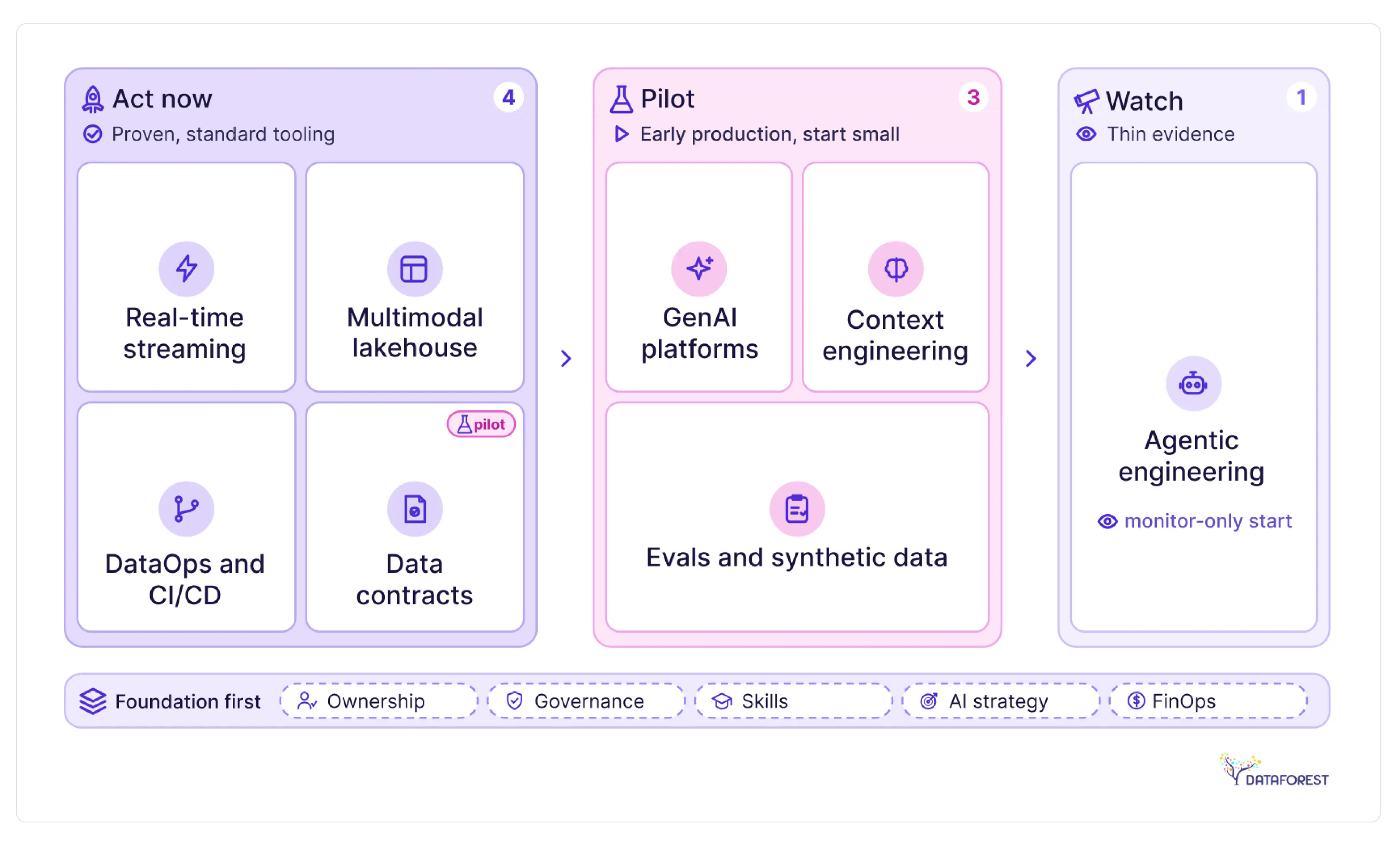
The table rates trends by evidence, tooling maturity, and readiness for practical adoption.
Evidence-Based Adoption Verdicts
What the verdicts mean
8 Data Engineering Trends in 2026, Rated by Maturity
We selected these trends based on market shifts, tool adoption, and independent research published in 2025–2026. Sources include Gartner’s 2026 data and analytics trends, the Apache Airflow 2025 survey, and Gartner’s research on context engineering. The selection favors developments with engineering implications and practical adoption paths. The order is editorial — it’s not a ranking. Each verdict reflects current maturity and the strength of evidence.
AI-Native Data Platforms and Generative AI
AI-native data platforms integrate artificial intelligence into ingestion, transformation, quality checks, and querying. Generative AI helps engineers write SQL and pipeline code, produce documentation, generate tests, and investigate failures. Feature stores and MLOps workflows use the same underlying pipelines to support machine learning.
The main benefit is faster development and less repetitive work.
The main risk is incorrect generated code entering production without adequate review.
Verdict: Pilot. Start with code assistance and documentation, then measure review time and defect rates. See AI-ready data for the data foundation required by AI workloads.
Agentic Data Engineering
Agentic data engineering uses AI agents to plan and execute pipeline tasks through tools such as query engines, monitoring systems, and code repositories. It attracts more hype because it promises to automate work beyond code generation. Yet reliable, autonomous operation remains harder to establish than assisted engineering. Agents need dependable data, clear ownership, and review for consequential changes. Verdict: Watch. Production evidence for broad autonomy remains limited. Start with monitoring-only agents that detect failures, explain likely causes, and recommend actions without changing pipelines. See the planned article on agentic AI in data engineering.
Real-Time Data Streaming and Processing
Batch processing can’t meet every workload’s freshness requirement. Fraud detection, personalization, and AI applications that depend on current events need data within seconds or minutes.
Kafka handles event streaming, and Flink supports stateful stream processing. Streaming adds infrastructure, monitoring, and operational complexity, so costs rise when workloads do not need low latency.
Most firms need both batch and streaming, each matched to its workload.
Verdict: Act now where latency matters. Identify one use case with a clear cost of stale data. See the modern data pipeline architecture guide for pipeline design choices.
Multimodal Lakehouses and Open Table Formats
Multimodal lakehouses bring text, images, audio, and video alongside structured tables.
Apache Iceberg and Delta Lake provide open-table formats for managing data on object storage. The formats help teams work with big data without locking every workload into one proprietary storage structure. The lakehouse versus warehouse debate matters less than workload fit, governance, and operating costs.
Verdict: Act now for new AI and multimodal workloads. Check whether your current platform can manage unstructured data without unnecessary copies. Compare the options in Databricks vs Snowflake and the modern data architecture benchmark report.
DataOps, Orchestration and Automation
DataOps applies DevOps practices to data pipelines through CI/CD, automated testing, monitoring, and version control. Teams treat pipeline definitions as maintained software, with controlled releases and clear failure signals. Consolidating orchestration reduces duplicated scheduling logic and makes dependencies easier to manage. Automated incident handling can retry recoverable tasks, flag persistent failures, and route alerts to the right owner.
The intended outcome is fewer broken pipelines and faster delivery.
Verdict: Act now. Start with version-controlled pipeline definitions, automated tests, and monitoring for one critical workflow.
Context Engineering for LLMs
Context engineering determines which data, documents, tools, and memory an LLM receives for a task. Prompt engineering focuses on instructions, while context engineering focuses on the information available to the model.
Gartner identifies context engineering as a core discipline for improving the reliability and performance of enterprise AI systems.
Data engineers build the retrieval pipelines, vector stores, freshness controls, and access rules behind that context. Consider a support assistant that needs current account records, approved policies, and recent case history. The system must retrieve relevant information and restrict access to records the employee is authorized to see. Good context reduces stale answers, irrelevant retrieval, and data exposure.
Verdict: Pilot. Start with one retrieval-augmented generation workflow. Measure retrieval quality, data freshness, access violations, and answer accuracy before expanding.
Data Contracts and Data Products
A data contract defines an agreed schema, quality expectations, and ownership responsibilities between a producer and a consumer. It makes schema changes visible before they break downstream reports, models, or applications. Teams can validate contracts automatically during pipeline execution and reject incompatible changes before release.
A data product adds a maintained interface, a named owner, documentation, and measurable quality targets. It gives consumers a clear way to access data and understand its limitations. The contract defines what consumers can rely on, and the product provides the data service they use.
Verdict: Act now for shared and business-critical datasets. Start with the high-value domain, document its schema, assign an owner, and define change rules. See data quality management for practices that support reliable data products.
Evaluation-Driven Development and Synthetic Data
EDD builds data and AI systems around continuous testing and measurable quality. Teams define automated checks, quality metrics, representative test sets, and benchmarks early in development. They rerun these evaluations as data, code, models, and retrieval logic change. Traditional testing checks whether a fixed implementation passes predefined cases. Evaluation-driven development tracks whether the system continues to meet its intended quality targets under changing conditions.
The practice gives teams faster feedback, earlier regression detection, clearer release decisions, and comparable results across system changes.
Synthetic data helps when real examples are scarce, sensitive, expensive to label, or weak at covering edge cases. Teams can generate controlled examples and add them to evaluation suites alongside real cases.
The risks include unrealistic samples, repeated patterns, and biases inherited from the generation process. Synthetic results can look strong without reflecting production conditions.
Verdict: Pilot. Combine real examples with synthetic edge cases, then review failures by type and check whether the evaluation set represents actual use.
Why Governance and Ownership (Not Technology!) Limit Most Trends
The main barriers to data engineering progress are organizational. Teams can adopt new tools quickly, but unclear ownership, weak governance, skills gaps, and an unfocused AI strategy stall adoption before it reaches production.
Start with accountability. Every critical dataset needs a business owner who understands its purpose and a technical owner responsible for its reliability and access. AI systems need the same clarity. Someone must approve their use cases, define acceptable risks, and decide who can access sensitive data.
Data governance sets the rules for quality, access, retention, and permitted use. AI adds further requirements. Security teams must control exposure of sensitive information, and compliance teams must address privacy laws, auditability, and sector-specific regulations. These decisions need named owners and a clear approval process.
Skills matter just as much. Teams need enough AI literacy to assess new capabilities, identify risks, and choose appropriate use cases. Without a clear AI strategy, individual teams can launch disconnected pilots that compete for resources without serving shared business goals.
Cost control needs the same discipline. FinOps helps teams track spending and connect infrastructure costs to business value. The modern data architecture benchmark report provides the context.
Before adopting another trend, assign decision rights, close skills gaps, and agree on the business outcome.
The Future of Data Engineering — What to Expect Beyond 2026
The next three to five years will likely push data engineering toward more automated, governed, and product-oriented systems.
Routine pipeline work becomes automated. Repetitive ingestion, schema checks, testing, documentation, and incident triage are likely to move into managed automation. Engineers will spend more time defining rules and reviewing exceptions.
Agents operate pipelines under governance. Data agents are expected to handle bounded operational tasks — investigating failures or proposing pipeline changes. Human approval, access controls, audit trails, and rollback rules will remain part of the design.
Platforms converge. Teams are likely to manage ingestion, transformation, quality, orchestration, observability, and governance through fewer connected platform layers. The goal is simpler ownership and lower operational overhead.
Data becomes a product. More teams are expected to assign owners, quality targets, interfaces, and service expectations to datasets. This shifts data work toward maintained assets with clear consumers.
For the deep forecast, see the benchmark report.
How the Data Engineer’s Role Is Changing
The data engineer’s job is changing from writing pipelines to designing and running systems. Code still matters, but the work now spans architecture, reliability, governance, and AI-assisted development.
Architecture becomes a core skill: engineers need to choose storage, processing, orchestration, and access patterns that fit the workload. Streaming knowledge matters as more systems depend on fresh events rather than scheduled batches. Data quality needs equal attention — from validation rules to lineage and observability.
Evaluation is becoming part of engineering work too. Teams need ways to test data products, AI inputs, and generated outputs against measures. AI literacy rounds out the skill set. Engineers need to understand model limits, retrieval, context, evaluation, and the operational risks of AI-assisted code.
The profession is moving toward system design and technical judgment.
How to Prepare Your Data Team
- Audit the current stack against the verdict table. Mark every Act now item already covered, then list the gaps. This gives the team a starting point instead of a broad technology shopping list.
- Fix data quality and observability first. Reliable pipelines need checks, lineage, freshness signals, and useful alerts. Review the data quality management guidance before adding advanced tooling.
- Upskill around the Pilot rows that match your workloads. Pick the skills tied to real problems. A team handling event-heavy workloads needs different training from a team focused on batch analytics.
- Run one AI pilot with a measurable outcome. Choose a narrow workflow, define a baseline, and set a metric before development starts. The AI-ready data guide covers the foundation such a pilot needs.
- Set ownership and governance rules before wider adoption. Define who owns data, access, quality, incidents, and platform decisions. Review the data engineering platform options alongside cost and performance optimization guidance before committing to larger changes.
Follow Data Engineering Trends with DATAFOREST
DATAFOREST helps companies decide which engineering trends deserve action now, which need a pilot, and which are better left on the watch list. We start with the existing platform, pipelines, workloads, and team capabilities. This gives a starting line before new technology enters the stack.
Changes can then happen in phases: a focused pilot can test a new capability without putting core pipelines at risk; proven changes can move into production once the team has clear ownership, quality controls, and operating requirements.
Your data platform should support current workloads and leave room for new ones. A trend only matters when it solves a real business problem.
If you are reviewing your data platform or planning its next stage, try our data engineering services or talk to an expert.
Questions on Data Engineering Trends
Is data engineering still a good career in 2026?
Yes. Data engineering remains a strong path, but the work is changing to higher-level system ownership and AI-assisted delivery. The 2026 Stack Overflow Developer Survey lists data engineers among its established professional roles, with 426 respondents identifying as data engineers. A 2025 dbt Labs survey found that 40% of respondents reported data-team headcount growth, up from 14% the previous year.
Do small teams need to follow these trends, or only enterprises?
Small teams should follow the trends that solve an existing reliability or delivery problem. Team size and data volume matter less than the cost of failures, manual work, and unreliable information. Start with low-effort Act now practices that fit the current stack. Skip Watch items until stronger evidence or a real workload makes them relevant.
How do we split effort between new trends and keeping current pipelines running?
Protect the capacity needed to keep production services reliable, then ring-fence one small pilot for a promising change. A pilot should have a clear owner, limited scope, and an agreed stopping point.
For example, a team can test automated pipeline monitoring on one critical workflow without changing its production architecture.
How often should we revisit our data engineering roadmap?
Use triggers rather than a fixed calendar. Revisit the roadmap after a major platform renewal, a sharp cost increase, a new AI workload, or a material change in business requirements. A light annual review still makes sense even without a trigger — it catches stale priorities and confirms that deferred initiatives remain relevant.
What is the difference between data engineering and analytics engineering?
Data engineering focuses on the systems that collect, move, store, and serve data. Analytics engineering focuses on creating modeled, tested datasets that analysts and business users can work with, using tools such as dbt. The measure is rather fluid. An analytics engineer may handle transformation logic, while a data engineer may own parts of that same workflow.
How do we know whether adopting a trend paid off?
Measure the operational change you expected before starting the pilot. Useful measures include pipeline failure rate, delivery lead time, cost per workload, and data incidents that reach users. For example, establish the current rate for a critical pipeline, then compare it with the rate after introducing the new practice. A baseline makes the result testable.
How much does it cost to prepare a data stack for AI workloads?
There is no universal price. The main cost drivers are data cleanup, platform changes, new tooling, engineering time, and ongoing compute or storage costs. A team with well-documented, reliable data may need modest platform changes. A fragmented stack with inconsistent definitions can require substantial engineering work before an AI workload is ready.
Where can we find reliable benchmarks instead of vendor predictions?
Start with research that publishes its methodology, respondent profile, collection dates, and raw or detailed results. Useful examples include the 2026 dbt Labs State of Analytics Engineering survey, the 2026 Stack Overflow Developer Survey, and the 2025 Apache Airflow Survey. For broader engineering practice, DevOps Research and Assessment publishes dated research with explicit methods and measurement frameworks.
Can we skip a trend and still stay competitive?
Yes. Skipping a Watch item is the sensible choice when evidence remains thin, or the tooling keeps changing. The risk is different for Act now items, where delay can leave teams with rising maintenance costs and weaker readiness for new workloads. A practical rule: fund proven needs first, test uncertain ideas cheaply, and defer hypothetical ones.