


A global logistics firm struggled to track ten language models across five regional teams. They moved all model testing and deployment to one system on Databricks for LLMops. This change cut the time to launch new features from months to days. Teams now track model accuracy and compute costs on a single dashboard. Book a call to turn scattered model work into a scalable system.
How To Turn AI Tests into Profit?
Messy data and high compute costs kill many pilots early. A smooth demo fails on the first day of real customer use. Companies earn money with a system like Databricks for LLMOps to track every cost and error.
Moving models into real action
Companies used to treat LLMs as small lab tests. But these early experiments had no clear path to revenue. This year, technology leaders want these tools to serve the real needs of consumers. They need systems like Databricks for LLMOps that show stable and accurate prices. Therefore, data engineers develop rules to check for errors in each response. A bank has saved tens of millions of dollars by streamlining half of its customer service calls using Databricks for LLMOps. Then the movement turned into a good practice that became part of the daily routine.
Why models die in the lab
Many large firms buy expensive AI licenses for their technical teams. But these new tools fail during real work with customers. Engineers build small tests on their own office laptops instead of using Databricks for LLMOps. These weak tests break under the heavy load of many users. Teams do not track the high-dollar cost of every chat. Then, wrong facts and security holes scare the company board members. So, the project stops with zero money in the bank.
AI demos meet data reality
CEOs see a fast demo of a new bot or agent. They expect a quick win for every office in the firm. But moving a tool to a real system takes six months of work without Databricks for LLMOps. A small test run works on exactly one clean file.
Then real data arrives with messy parts and missing facts. Security teams stop the work to protect ten thousand private names. The board sees a million-dollar cost and a low gain.
Reporting Solution for the Financial Company


Enra Group is the UK's leading provider and distributor of specialist property finance.
Why Should You Run Your Models on Databricks?
Putting AI into daily work needs a single home for data and code. But splitting tasks between different tools slows down teams and wastes money. So, Databricks for LLMops keeps files safe and lets your tech teams build faster.
A single home for data and AI
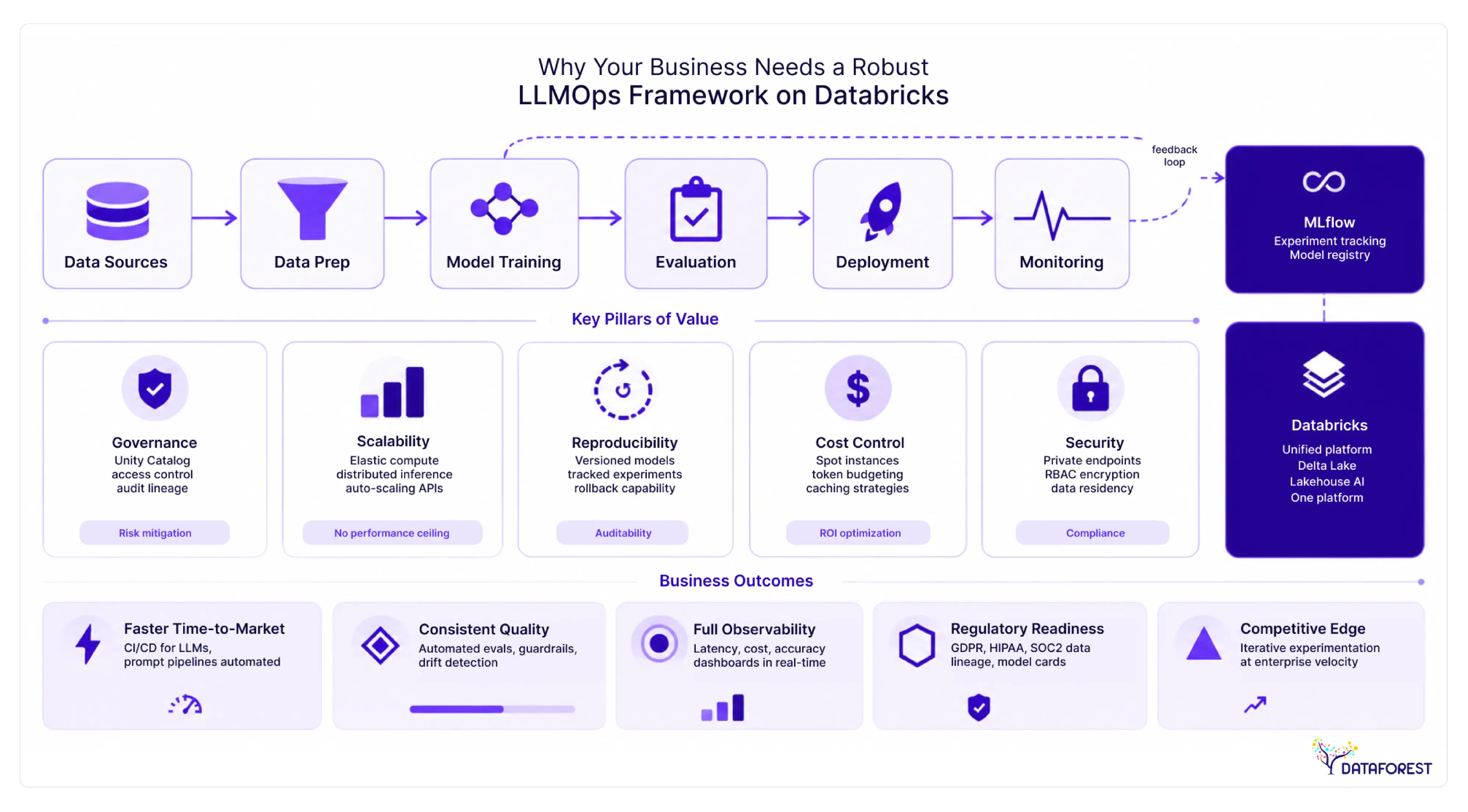
Databricks for LLMops integrates data processing and AI workloads on a single platform. It prevents your teams from buying and training different tools. All business data is in one place for learning and modeling. Organizations often begin with data migration and modernization to consolidate legacy systems, improve data quality, and create a reliable foundation for enterprise AI initiatives. Security teams manage all file access from a single point of control. Teams complete projects faster by using the same files. The platform tracks financial costs and modeling in real time with Databricks for LLMops.
Tools for promoting modeling
The platform allows building and running large models. Engineers use one interface to track model controls and each data source. Safety rules cover every stage of the activity, from training to live broadcasting. The software manages the hardware needed to serve multiple live users at the same time. These built-in features of Databricks for LLMops work together without the need for additional software or complex code. Organizations can see model speed and costs on a single central dashboard.
Secure and ready systems
The platform protects private data with a single identity system. Leaders control all file and model access from one central spot. The system adds more compute power during peak times for many active users. Cloud storage keeps large data sets safe without extra file moves. High uptime and fast replies keep the business active all day. A single dashboard in Databricks for LLMops shows all spending.
Deloitte: From experimentation → production discipline. In 2026, the focus shifted to “move from experimentation to impact”. LLMOps becomes:
Measurement layer (accuracy, cost, latency dashboards)
Control layer (risk, compliance, auditability)
Execution layer (CI/CD for prompts and models)
Dashboards are not optional. If you cannot measure hallucination or cost per query, you cannot run production AI.
How to Build a Secure AI System on Databricks?
Leaders find it hard to turn AI experiments into stable company tools. Databricks for LLMops combines data storage and model tracking in one secure site. These steps help you run a fast and safe AI for your business.
Data paths for LLMs
The system pulls raw text into a Delta Lake storage site first within Databricks for LLMops. Data teams clean this information using the Databricks medallion structure. An automated process converts these clean files into math vectors for fast search. Unity Catalog tracks every piece of data to maintain safety and privacy rules. Engineers push the final model to production while watching for errors in real time.
Prompt management and version records
Engineers test different text instructions inside the Databricks Prompt Lab. MLflow records every prompt change to track performance over several weeks. Teams save these prompt files in Git to manage code updates for the whole year. Automated pipelines inside Databricks for LLMops check new versions. Unity Catalog controls which staff can view or edit the final prompt history.
Databricks RAG pipeline control
The system finds relevant facts from the internal database to answer a user's question. Databricks Vector Search looks for the best match in a fraction of a second. The software combines this specific information with the original user prompt. This step improves accuracy within the LLMOps Databricks architecture. Data architects use Unity Catalog to secure the private documents in the search index.
Monitoring and feedback cycles
Lakehouse Monitoring tracks model inputs and outputs to find errors. Data scientists compare model responses against human labels to measure accuracy. Inference tables record every live chat for later review and debugging. Users flag bad answers to send data back to the training team. This cycle improves models inside Databricks for LLMops.
Databricks security and data governance
Unity Catalog manages access in Databricks for LLMops. The system logs every user action to meet strict audit rules. Data architects set specific permissions to keep private files from the public internet. Built-in tools check for private info to prevent data leaks during model training. Your security team views the full history of every model version for total control.
Why Should Your Company Use Databricks for LLMOps?
- Rapid AI launch: Databricks for LLMops automates the path from a raw idea to a working AI product. Software engineers skip manual setup tasks to build new tools in days instead of months. This fast work schedule puts your product in the market ahead of your rivals.
- Cut server costs: Databricks tracks every dollar spent on cloud servers for AI tasks. The system turns off idle machines to stop waste and save money. Teams share the same data files to keep storage bills low.
- High model quality: Databricks for LLMops monitors model health and reliability every hour of the workday. These tools catch errors and bias before the customer sees a wrong answer. Better performance builds trust with your team and your clients.
- Unified team goals: Business leaders and data experts share a single view of all AI projects. Shared dashboards show the value of AI work to everyone in the company. These tools help everyone agree on the next steps for business growth.
AI Risks Without a System
Enterprises fail to launch AI, and they keep data in separate silos. What stops these projects from working for the entire firm? Teams struggle to track costs and model errors on several different screens every day. A system like Databricks for LLMops secures data and saves millions. So, these changes let your company ship new AI tools to users in three days.
Book a call to turn challenges into benefits.
Where do you use Databricks LLMOps in your business?
Big companies use this platform to leverage AI across every department. The software manages millions of accounts for global marketing and finance companies. Your local pilot can be expanded to a full system for ten countries.
Manage financial processes
The problem: Financial institutions spend hundreds of thousands of dollars each month reading thousands of paper invoices and bank statements. Tired eyes lead to many small mistakes in important business spreadsheets.
The solution: Databricks for LLMOps uses language models to find important numbers and names in seconds. The software then organizes this data into neat tables for your accounting software.
The advantage: A large insurance company processes claims in ten minutes instead of four days. For example, this change saved the company $2 million in operating costs each year.
Automated marketing support
Problem: Support teams receive thousands of simple tickets from angry customers every day.
Human agents did not miss many calls during peak hours.
The solution: Databricks for LLMOps creates an automatic agent based on your organization's manuals. This tool provides fast and consistent responses to each user.
Benefit: Reduced resolution times for a global marketing campaign by 60%. For example, the change saved the company $5 million in operating costs.
Analyzing global e-commerce
Problem: Companies struggle to keep up with the daily price changes of their global competitors. Manual web searches are time-consuming and miss important market changes.
The Solution: Databricks for LLMOps uses automated bots to pull raw data from thousands of sites. Language models then transform this complex information into clear reports for the marketing team.
Benefit: A technology company discovers new competitive products two weeks earlier than before. For example, the marketing team adjusts prices in real time to increase overall sales.
Special energy project
Problem: Leaders spend hours reading hundreds of local reports each week. Large spreadsheets often hide the most valuable market trends.
Solution: Databricks for LLMops integrates AI functionality directly into your organization's own data files. This tool allows managers to ask questions and get clear answers in plain English.
Benefit: An energy company cut its strategic review time in half this year. For example, managers make better decisions using live data instead of past forecasts.
How To Start with LLMOps on Databricks?
- Assess AI capability. Start by reviewing your company’s data and AI capabilities. This assessment shows whether your company has the right files and systems in place for LLMOps in Databricks.
- Design the system. Plan a site for all your data and model code in Databricks. This strategy helps your organization deploy multiple AI tools at work.
- Choose high performance. Look for a high-paying or long-term job. Solve this one problem first to show real value in your class this year.
- Stick to the plan’s goals. Choose clear metrics, such as costs or hours, that the team will track. Give a manager full control over every aspect of the AI design.
- Hire AI experts. Hire a professional with extensive experience in LLMOps with Databricks. These skills will help your team avoid technical mistakes and get the job done faster.
Why Hire an Expert Partner for Databricks LLMOps?
Building complex AI systems on your own often feels like trying to assemble a jet engine with a basic instruction manual. A specialized partner closes the gap between a cool experiment and a profitable business engine by handling the heavy technical lifting.
Expert execution: Experts turn your broad ideas into working software on the Databricks platform. They build the technical steps needed to reach your company's goals this quarter. This helps prevent your project from stalling in the planning phase.
Tailored tools: Data experts build AI tools that fit your own company data and workflows. These custom models solve your unique problems better than generic software. This work helps the final product meet the exact needs of your customers and staff.
Total support: Partners manage the entire build from the first data clean to the final live model. They provide constant help to fix bugs and keep the system running fast. This long-term care keeps your AI tools stable and productive for the business.
Databricks positions LLMOps as a system, not a feature:
Data layer → Lakehouse
Model layer → Mosaic AI
Ops layer → MLflow + monitoring + governance
Most failures come from stitching tools. Databricks wins when the pipeline, model, and governance share one control plane.
How does DATAFOREST implement LLMOps on Databricks?
DATAFOREST engineers develop automated methods to move your AI models from testing to production on Databricks. Our team builds code to stop idle cloud servers and reduce your monthly bills. We use the Unity Catalog to track each data file and maintain your personal records. These systems allow your technical staff to release new products in days instead of months.
Complete the form to turn your Databricks LLMOps framework tests into a scalable, cost-effective engine.
Questions on Databricks LLMOps
What is LLMOps, and how is it different from traditional MLOps?
LLMOps is the system used to build and run large language models for your company. Traditional MLOps handles simple data, and LLMOps manages complex text and high server costs. These tools track every prompt and stop your AI from giving wrong facts to users.
Why do enterprises need a dedicated LLMOps framework instead of ad hoc AI solutions?
Ad hoc setups fail to move tools from a small test to a real system. A dedicated LLMOps on Databricks framework tracks cloud spending and keeps your private files safe in one spot. This system helps your team fix errors across many models and saves time on manual tasks.
How does Databricks support LLMOps implementation?
Databricks keeps your data and model code in a single, secure platform. The system uses Unity Catalog to control access to specific files and track each change to the model. Tools like MLflow and Lakehouse Monitoring catch errors in real time and prevent server downtime.
What are the key components of the LLMOps strategy at Databricks?
Databricks stores your raw text and records in Delta Lake. Unity Catalog manages security policies for your data and AI features. MLflow tracks every version of your model, keeping your workflow organized and secure.
What are the main challenges of promoting LLMs without LLMOps?
Unmanaged features can run up huge cloud bills and eat up your monthly budget. None of these systems has the necessary rules to prevent wrong answers and protect your personal files. Your employees waste hours on manual corrections for errors found in an automated tool.


.webp)

.webp)
.webp)


