


Large firms struggle with moving machine learning models into production. One global enterprise adopted MLflow for its model lifecycle. This shift created a more end-to-end MLOps Databricks operating model and cut deployment times from months to days. Unity Catalog now tracks every prediction for the compliance audit team. Request a call, and our team will do the same.
Why Do AI models Fail in Production?
Enterprise machine learning models never leave the local laptop of a scientist. They waste budget and drain engineering hours. You must adopt a unified platform to turn these experiments into business profit with Databricks MLOps.
Escaping the laptop
Data scientists usually build their machine learning models on local laptops. This experimental code often fails upon contact with live company data. Engineering teams struggle with this code on production servers. Manual handoffs cause errors and weekly delays in project timelines. Older models lose their accuracy over time without constant updates. Databricks notebooks for ML help teams work in one shared environment and reduce the gap between research and production.
The price of guessing
Companies waste millions on machine learning projects left in the lab. Stale models cost the firm money every single hour. Legal teams face heavy risks without a clear audit trail. Senior engineers quit after months of manual data fixes. Rival firms gain market share by shipping updates fast. Maintenance costs grow fast in systems without a plan. Standard operations stop AI projects from becoming expensive failures with Databricks for MLOps.
Fixing data silos
Databricks puts your data and machine learning tools into one single place. Many enterprises begin with data migration and modernization to consolidate legacy systems, eliminate data silos, and prepare trusted datasets for machine learning initiatives. MLflow tracks every model version for your audit team. This tool breaks the heavy wall between your data scientists and the engineering teams. Unity Catalog keeps your data secure during the training phase. Shared cloud hardware lowers the bills for training your models. Architects see the full history of every prediction in one log. Reliable data pipelines speed up software updates for the business in a Databricks with MLOps setup.
Optimise e-commerce with modern data management solutions


We are extremely satisfied with the automated and streamlined process that DATAFOREST has provided for us.
What Is Databricks for MLOps?
Companies struggle to keep their machine learning projects organized. Databricks MLOps brings your data and models into a single workspace. This setup helps you track results and cut your cloud costs.
The machine learning factory
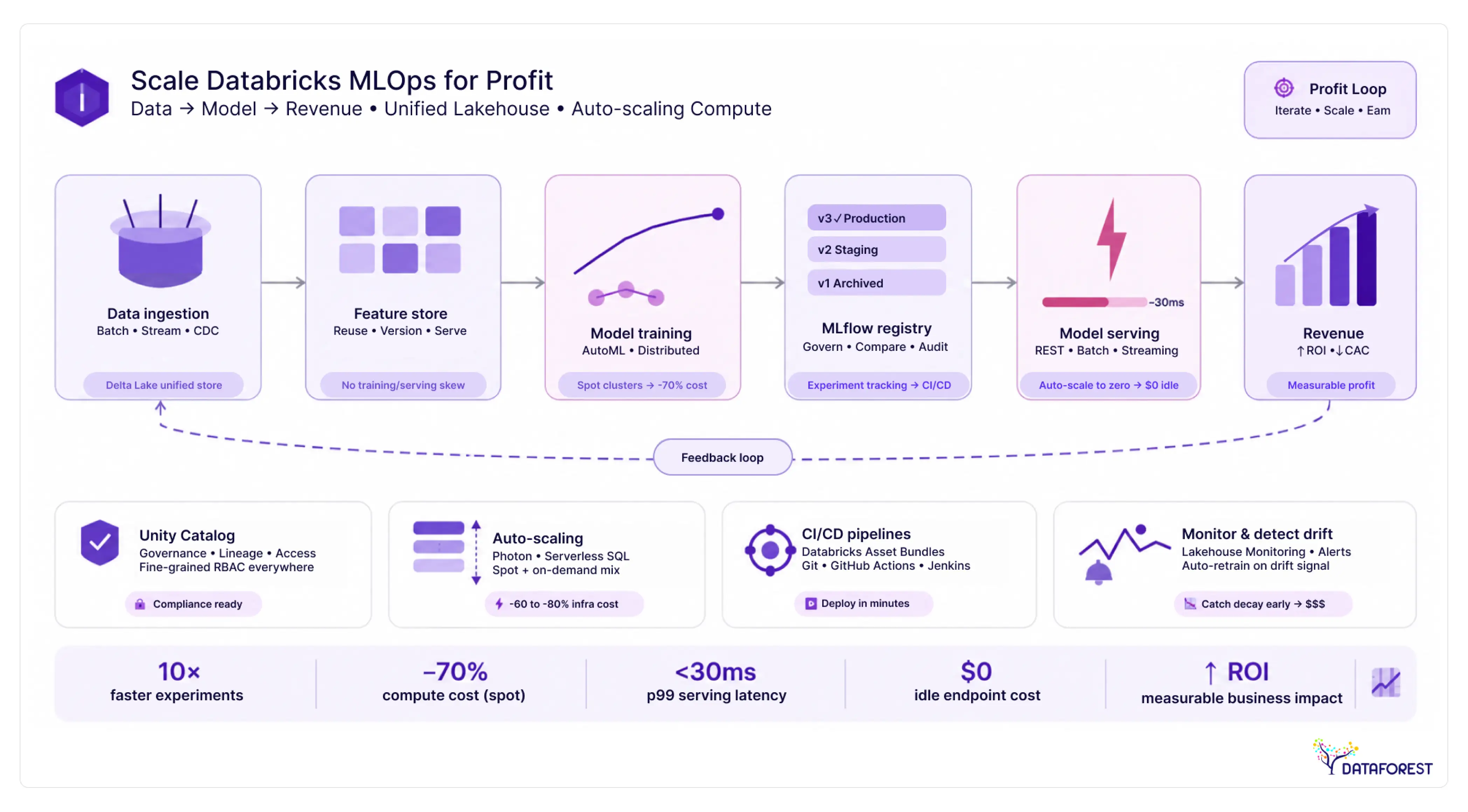
- MLflow tracks every model version and the code used for training.
- Unity Catalog manages data access and keeps a log of data lineage.
- The Databricks Feature Store lets different teams share clean data for their models.
- Databricks Model Serving hosts models on servers to give answers to live apps.
- Databricks Workflows runs the full path from raw data to a final prediction.
Unified platforms vs Legacy silos
Choose what is important to you and order a call.
How Does Databricks MLOps Architecture Work?
Enterprise data stacks often feel fragmented and hard to manage. You need a clear plan to connect your cloud storage with machine learning models. This architecture links your existing security tools to a unified data platform with Databricks for MLOps.
The Databricks MLOps architecture path
- Raw data enters the Delta Lake storage layer.
- Data pipelines clean the files for training.
- Scientists build models using the clean tables.
- MLflow logs the scores and code for each test.
- Unity Catalog manages security and data logs.
- The registry stores the final code for the app.
- The serving tool gives predictions to the business users.
The universal plug with Databricks MLOps
Databricks connects to your cloud storage on AWS or Azure. It uses your current identity providers, like Active Directory, for security. Data teams pull information from SQL servers and legacy databases. You can send model results to Power BI for executive reports. DevOps teams link their Git tools to the Databricks workspace. This setup keeps your existing security rules across the whole company to prevent data leaks in Databricks MLOps.
BCG finds that only 5% of firms gain real money from AI. 70% of the value comes from people and workforce changes. Leaders must link AI tasks to firm priorities and clear goals.
How to Implement MLOps on Databricks?
Your team needs a clear plan to move machine learning into production. You can follow these stages to turn raw data into live predictions. The steps keep models reliable and data safe with MLOps with Databricks.
Step 1: Filtering the raw data
Engineers first collect raw data in a central Delta lake. Many enterprises hire data engineers to design reliable ingestion pipelines and prepare data for large-scale machine learning workloads. Your team cleans these files to remove errors and duplicates. The Unity Catalog defines precisely what can be accessed in each content layer. These security rules protect your data during training. Robust data preparation supports Delta Lake machine learning by keeping training tables clean and trusted.
Step 2: From labs to prototypes
Data scientists start by testing different machine learning models on a shared workspace. MLflow records the results for each set of parameters and each run. Companies use these records to select the best version to use in production. Collaborative notebooks allow professionals to work on the same code in real time. This process creates a clear path from a rough idea to a practical tool in Databricks ML pipeline work.
Step 3: Standard edition
Each model undergoes rigorous testing for safety and accuracy. Lead scientists review primary project goals, economic metrics, and performance numbers. The system follows these permissions for a clear audit trail. Legal and emergency organizations then sign off on the final version. These checks help protect customers during release and strengthen Databricks workflows orchestration across teams.
Step 4: Automatic job submission
Engineers commit their code to Git repositories for control. Automated tests are run every time a team member makes a change. This software checks for errors before the model is pushed to the production server. Automation eliminates the need for manual and slow transfers between teams. These pipelines help your organization deliver updates multiple times a day with Databricks ML workflow discipline.
Step 5: Turn on the switch
The model moves into production to respond to live applications. Databricks Model Serving automatically adjusts hardware to match user needs. Apps call the API to get instant predictions for their users. This speeds up the system and reduces operating costs. Now, your business makes decisions based on real-time data results.
Step 6: The eternal engine
Organizations use dashboards to track how models are performing with new data. The system sends notifications if the forecast quality decreases. Automatic boosters start new training sessions to fix the exact problems quickly. MLflow keeps a record of every change made to the model throughout its lifetime. Regular monitoring prevents AI tools from losing value over time in a stable MLOps lifecycle Databricks model.
Why Can Databricks MLOps Fail?
Gaps between teams and manual tasks break most machine learning pipelines. These errors stop your models from reaching production on time. Automated workflows fix these blocks for your annual budget in MLOps on Databricks programs.
End team gaps: Data scientists and software engineers work in separate silos across the company. This gap creates friction during the model release and testing process. Teams must adopt shared Git folders with common testing standards inside the Databricks workspace. These shared practices prevent long delays and high operational costs.
Standardize ML work: Teams build machine learning models using different coding styles and tools. This lack of consistency makes it hard for engineers to manage multiple models at once. Architects should mandate the use of MLflow and Unity Catalog for all projects. Establishing an executive mandate for AI infrastructure ensures technical consistency and alignment across all development teams. Unified rules and a single registry help the business move models into production faster.
Grow large systems: Pilot models fail under heavy traffic and high data loads. Manual steps in small projects break under the weight of large data volumes. Leaders use Databricks Workflows to automate model training and deployment. Automated pipelines handle 100 times more data than manual methods.
Control ML spend: Idle clusters waste thousands of dollars every single month. This wasteful computing spend drains 30% of the annual data budget. CTOs must set auto-termination policies for every serverless compute cluster. Tracking tags link every dollar to a single project or department.
Deloitte notes that 54% of firms will put many models in production soon. Strict rules help teams move fast and stop stalling. 34% of firms use AI to change their business deeply.
What Are the Databricks MLOps Best Practices?
You must link every model to profit and automate your code. Merging data pods into single teams stops delays and removes blind spots. Strong governance keeps your data safe and helps the business grow with Databricks MLOps capabilities.
Trial programs before earning money
Tech companies build features without a clear path to revenue. Leaders should define key performance metrics for each Databricks project. These measures relate the accuracy of the model to actual business growth and cost reduction. Success equates to a 20% increase in customer sales or faster lead times. Data organizations build trust by solving the biggest business problems first.
Merge pods
Different teams create blind spots to prevent features from reaching users. Managers should include data scientists and DevOps experts in the same pod. These workers share a single Databricks database and use common rules. This company reduces startup time by 50% in the first year. Teams build quality tools and maintain the data engine.
Kill manual steps
Manual work adds broken code and errors to every new model release. These slow tasks stop the speed of the data pipeline for your company. Engineers write Databricks Asset Bundles for automated code deployment across all accounts. This tool runs setup tasks without any human help from the engineering team. Teams save 40 hours of labor on every single project.
Guard the gates
Unclear rules lead to data leaks and slow project approvals. Data architects use Unity Catalog to track data access and lineage. Teams must set clear targets for model drift and system uptime. These hard numbers show the board that your data systems stay safe. Good rules cut risk by 25% in Databricks with MLOps programs.

How to Start Databricks MLOps?
Starting a machine learning project requires a clear plan for your data and teams. Ask hard questions about technical skills and profit goals to avoid buying the wrong tools. The 90-day roadmap helps you pick the right team for your first model.
First hard questions
- Does this model solve a clear business pain that costs us money?
Every project needs a direct path to profit.
- Have we prepared our data in Delta Lake for training?
You cannot build a good model on messy data.
- Can our team write Python and manage code in Git?
Any growth requires these technical skills, and we must fill gaps early.
- Do we have a plan to automate cluster setups with code?
Clicks in the console slow down the whole team, so we must use automation.
- Will Unity Catalog track all data access for our security board?
This tool keeps your records safe and legal.
Win the quarter
- In the first 30 days, the team selects a single high-value use case and audits data quality.
- By day sixty, engineers build a basic CI/CD pipeline using Databricks Asset Bundles.
- Engineers then link the model to Unity Catalog for tracking and security.
- Teams spend the final month on live deployment and monitoring for model drift.
- This ninety-day plan proves the value of Databricks ML architecture and justifies future funding.
Build or hire
If you need an individual approach to a solution, schedule a call.
How Does DATAFOREST Build DatabricksMLOps Solutions?
DATAFOREST engineers build automated pipelines to move your machine learning models from code into a live production environment. We use Databricks Asset Bundles to remove manual steps and speed up your release cycle. Our team sets up Unity Catalog to keep your data safe and meet audit rules. We configure serverless compute with auto-stop rules to cut your cloud bills by 30%. You get a ready pod of experts to fill skill gaps in Python and Git. This partnership helps your business earn money from AI. Please complete the form to use machine learning on Databricks in production.
Questions on Databricks MLOps
What are the key components of Databricks MLOps architecture?
Databricks MLOps runs on a data lakehouse architecture ML foundation. Unity Catalog governs every data access request and all security rules. MLflow tracks every model version or training run for your team. Delta Lake stores clean data for your training cycles. Databricks Workflows automate training tasks and model deployments for the team. Model Serving provides fast access to live predictions for your customers. This is the core of MLOps architecture in Databricks.
How long does it typically take to implement Databricks MLOps in an enterprise?
Enterprise implementation usually spans three to six months for a full setup. The first thirty days focus on a single use case to show value quickly. Teams then build the automation layers for testing and security over the next sixty days. Complex companies with many legacy systems need more time to clean their data. Firms reach a mature state with full automation by the end of the first year.
How does Databricks support end-to-end machine learning lifecycle management?
Databricks provides one platform to manage every stage of a machine learning model. Teams use Delta Lake to clean and store massive data sets for training. MLflow tracks every code change and model version in a single place. Automated workflows move these models from the lab into live apps. Unity Catalog keeps the data safe and tracks how models perform over time. That is Databricks model lifecycle management in action.
What tools are included in Databricks MLOps ecosystem?
MLflow tracks every model version and training run in one place. Unity Catalog manages data access and security for all your users. Feature Store saves and shares data traits for many different models. Engineers use Databricks Asset Bundles to deploy code through automation. Databricks Workflows run your training jobs on a set schedule. This is the practical toolkit for MLOps in Databricks.
What are the benefits of using Databricks for MLOps compared to other platforms?
Databricks unites data engineering and machine learning in one workspace. This single platform removes the need to move data between five different tools. The system scales compute instantly for large tasks to speed up training. Unity Catalog provides better security than many older cloud tools. Teams use shared Git folders and open standards like MLflow. That is the promise of scalable ML infrastructure Databricks built for production.


.webp)

.webp)
.webp)


