

A retail bank used three disconnected AI models to check credit scores, verify income, and approve loans. Staff manually copied text from one system into the next, so the average loan approval took 4 days. The team built a multi-agent orchestration architecture, a patterns-based system, and the models began triggering one another directly. Loan processing dropped from 4 days to 9 minutes, and the bank cut labor costs by 40%. Request a call, and our team will do the same.
Why Do 80% of Commercial Enterprise AI Implementation Pilots Stop at the Test Stage
An engineering team built a working AI prototype in four weeks, but the company abandoned it after six months. The test was run on over five thousand clean and stable models. Functional databases are alive with empty fields and variables. Five hundred workers began to print the instructions, and the daily cloud computing price jumped from $40 to $4,000. Data scientists wrote Python scripts, but the source code company refused to support them. Security checks revealed unencrypted client names in external log files. The finished device saved an employee three minutes a day, but the $150,000 development cost would never be recouped, failing to improve operational efficiency. Employees don't trust the answers they're getting and are still using their old Excel spreadsheets. The CFO saw no return and cut the budget. The testing team was successful in the sandbox, but the full deployment required a multi-agent orchestration architecture.
Improving Chatbot Builder with AI Agents


Improve chatbot efficiency and usability with AI Agent
What Is Multi‑Agent AI Orchestration?
You cannot run a ten‑step enterprise workflow through a single chat window without multi-agent orchestration. The model drops the initial context and invents the remaining steps. Multi‑agent orchestration replaces that lone bot with a network of specialized AI agents.
How to stop your agents from arguing
A single autonomous AI agent executes one narrow task, such as database querying or PDF summarization. A multi‑step project traps that solo model in an infinite processing loop. Engineers divide the work among three specialized agents: a coder, a tester, and a compliance checker. Redundant queries from these uncoordinated bots double your daily API costs. A multi‑agent orchestration architecture routes user requests to the correct specialized bot. It then transfers the completed work of the first bot into the prompt of the second bot. This orchestrated ecosystem resolves ten‑stage enterprise workflows in twelve seconds.
How to give your AI assistants a middle manager
Multi‑agent orchestration directs a network of separate AI models toward a single business goal. Instead of feeding a massive prompt to one bot, engineers break the work into distinct jobs. The master software hands the incoming prompt to a specialized planning agent. This planner splits the big assignment into five smaller tasks. It then dispatches each piece to a separate neural network. The working agents deposit their finished text into a shared temporary memory. A final synthesis bot merges those gathered pieces into the delivered document. The structure turns an unpredictable chat window into a digital assembly line.
Organization manual for non-sleep workers
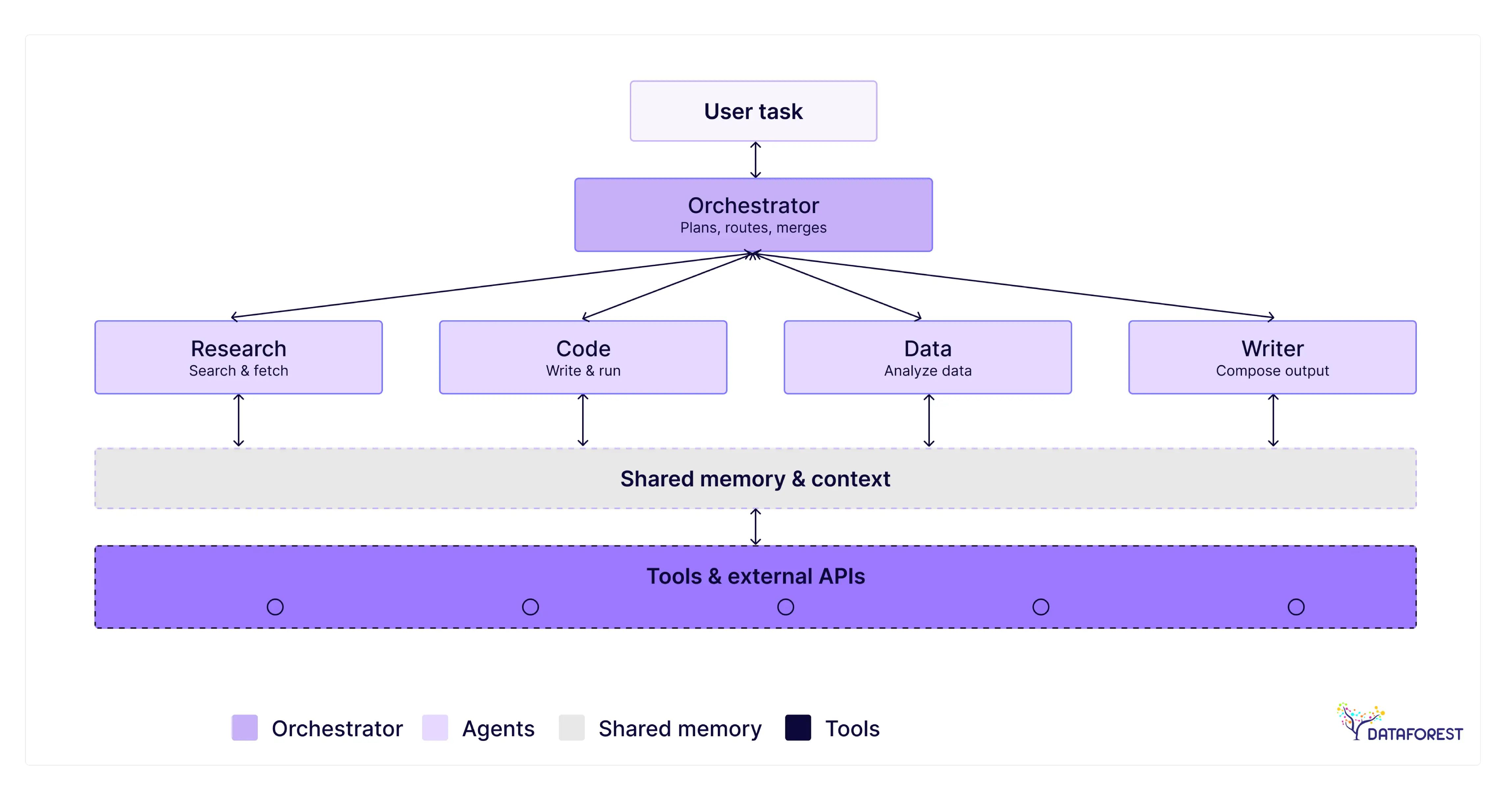
A multi-agent orchestration system architecture involving five different software components is required.
- Orchestrator: This central router reads the message and assigns the first action. It directs the work to the right delegate and follows the deadline.
- Action Agent: These models work best when they are dedicated to a single action. One agent writes SQL queries, a second edits Python code, and a third edits customer emails.
- Shared Memory: Agents need a safe place to store their completed work. This unified data platform stores chat history and sends raw data between features.
- Tool Storage: Language models cannot do math or analyze real estate costs. External tools connect agents to software such as Salesforce and corporate databases.
- Screens: A dedicated agent reviews the collected text. It catches errors, removes personal data of customers, and allows the release.
McKinsey: Governance maturity remains the largest barrier to enterprise-scale agent deployment. Multi-agent environments require stronger trust, oversight, and risk controls. Enterprises increasingly view orchestration and governance as inseparable disciplines. Agent systems introduce new operational risks that traditional AI governance cannot fully address.
Why Does Enterprise AI adoption Need AI agent orchestration
Companies deploy dozens of separate AI models to handle their daily work. These disconnected tools duplicate databases and generate thousands of redundant API calls. A multi-agent orchestration architecture organizes these scattered agents into a single automated pipeline.
How to build a digital tower
Marketing buys a copy generation tool, and finance builds a custom forecasting bot. Both systems pull customer records from the central database but store them in separate cloud buckets. The company pays two separate cloud vendors to process the exact same numbers. A regional director asks both agents for the quarterly sales total and gets two different figures. Each department trained its software on a local spreadsheet rather than the master ledger. Data architects lose track of where private customer names travel across these isolated networks. The lack of proper enterprise AI architecture multiplies your software costs and scatters your company data.
Paying engineers six figures to copy and paste
An analyst generates a financial forecast in one AI tool. They manually copy that text into a separate agent to format a client report. This human handoff wastes ten minutes per routine transaction. A team of forty analysts spends four hundred hours a week moving text between windows. The business pays skilled staff ninety dollars an hour to act as basic software connectors. Multi-agent orchestration deletes these expensive manual steps and moves the data directly.
Hiring twenty interns without a manager
A company deploys fifteen specialized agents to handle customer service, billing, and technical support. When a user asks about a refund, the billing and support agents both answer at the same time. They trigger each other in an open loop and generate four hundred useless API calls in three seconds. The database loses track of the transaction, so the customer receives three contradictory emails. Software engineers spend their mornings reading raw logs to find which model broke the chain. Security teams cannot verify which specific agent sent a credit card number to an external server. Adding uncoordinated models without a multi-agent orchestration architecture slows down the job and multiplies your points of failure.

What Are the Core Layers of Multi-Agent Systems
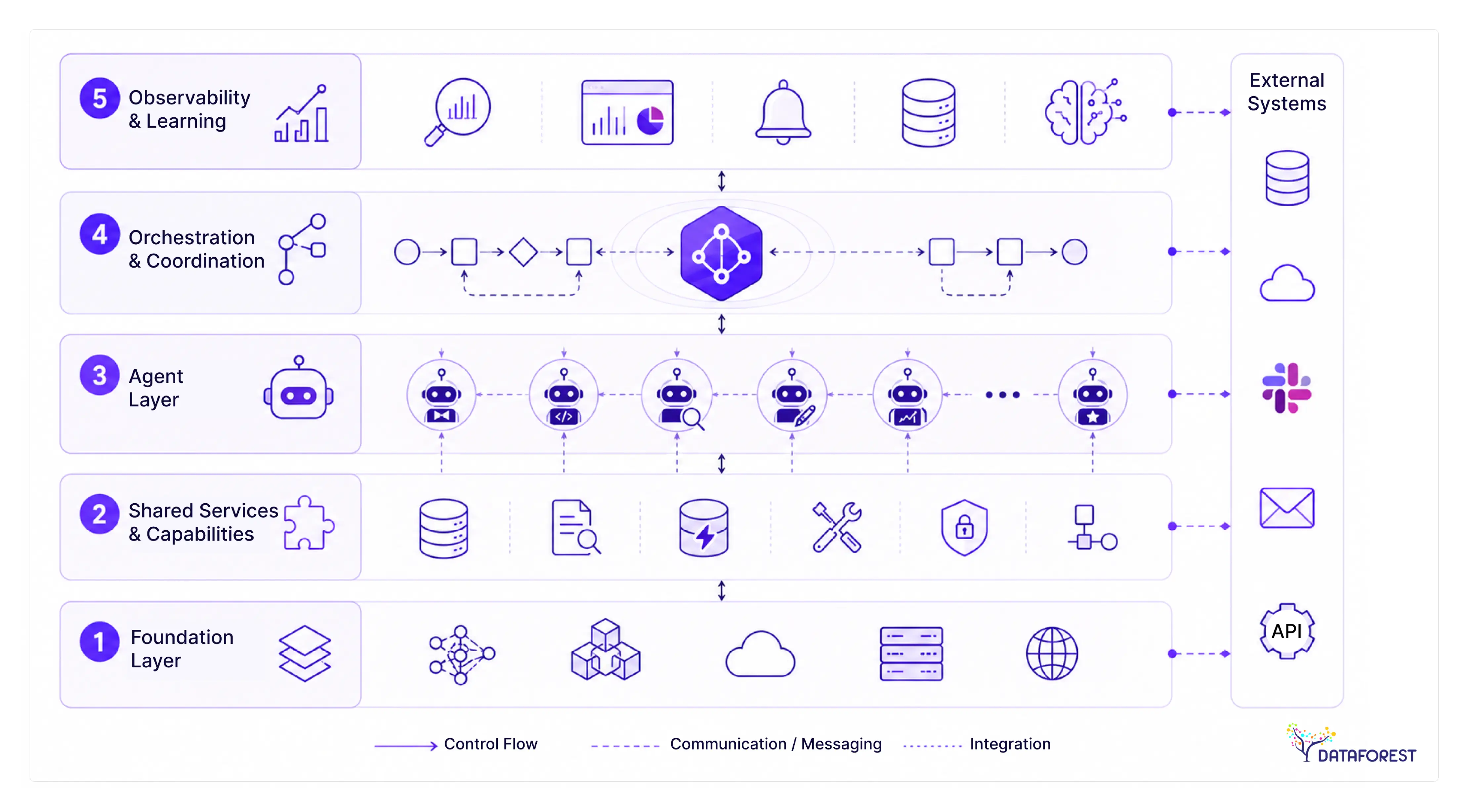
Enterprise AI requires a multi-agent orchestration architecture to perform reliably. You cannot manage a complex network of agents without strict data controls and defined authority. This architectural model organizes your AI workforce into a stable production system.
Data foundation
The data foundation layer connects raw enterprise data architecture to the active neural networks. It combines standard relational databases with vector stores and internal API feeds. Without this shared ground truth provided by the multi-agent orchestration architecture, autonomous models invent fake product numbers and quote outdated pricing. The layer translates an agent’s natural language question into a secure SQL query. Data architects can update the underlying tables without breaking the logic of the top-level agents.
Knowledge and retrieval layer
This layer converts unstructured PDFs, contracts, and company emails into mathematical vectors. An active agent demands a pricing rule, so the retrieval engine fetches the exact paragraph in milliseconds. The system feeds these confirmed facts into the active agent's prompt. This hard context prevents the language model from hallucinating product dimensions or outdated prices. Data architects update the document storage without rewriting the core reasoning logic of the multi-agent orchestration architecture.
The agent layers
It contains individual models trained for specific business operations utilizing an agentic AI architecture. One agent parses legal contracts while a second one calculates production schedules. These agents access the tool library to interact with external enterprise software. They maintain their own state and monitor for errors during the execution of a task. The orchestrator delegates jobs to this layer based on the current requirements of the business workflow within the multi-agent orchestration architecture.
Orchestration
The orchestration layer acts as the primary brain that governs the entire agent network. It receives the high-level business goal and breaks the assignment into logical sub-tasks. This controller monitors agent performance and redirects incomplete jobs to different models if needed. It holds the final authority on task sequence and ensures that every agent follows the correct security protocols. The layer prevents system loops by forcing models to report their status to a central log before starting the next step.
Governance and security
This layer enforces strict access restrictions on each agent interacting with the company's critical records. Agents are only allowed to see the data they are authorized to see. The system records every decision, tool call, and data transfer for internal security checks. A model quickly detects and blocks the routine before executing an unsafe command. Data processors rely on these safeguards within the multi-agent orchestration architecture to prevent personal customer details from being leaked into external training settings.
How Does Multi-Agent Orchestration Work?
Global logistics example—Realignment of private assets
Hurt: A storm shut down the Port of Seattle, holding 50 boxes of winter electronics. Database planners have three days to consult five separate ERP databases to find replacement databases.
Solution: The multi-agent orchestration tool addresses this specific problem in a group of autonomous AI agents using seamless agent communication. A warehouse agent requests 50 available boxes in Dallas, and a transportation agent arranges the trains.
Conclusion: The seller fulfills 98% of the affected customers' orders without manual data entry. The company saves sixty hours of work per event and saves $2 million in quarterly revenue.
Business plan—Zero-day vulnerability remediation
Pain: A software vendor introduces a critical security flaw in an open-source database in the middle of the night. Without automation, ten engineers spend forty hours scanning three thousand codebases to identify affected modules.
Response: The security multi-agent orchestration reads the threat bulletin and deploys three special AI agents. The detection agent finds weak dependencies, and the patching agent writes replacement code. The test agent then runs the regression suite and submits a clean pull request to the lead designer.
Result: The engineering team closed 80 work requests in 12 minutes, avoiding $5 million in repair costs.
How Do Different Industries Use Multi‑Agent Orchestration
Manual handoffs between isolated software departments cost companies millions of hours. Multi‑agent orchestration ends this delay by assigning complex workflows to teams of AI. Five different sectors use this exact model to turn weeks of waiting into minutes.
Commercial banking
A regional bank takes fourteen days to verify tax returns and property appraisals for a $5 million commercial loan using AI-powered decision-making. A credit orchestrator breaks the application into parallel tasks and alerts three AI agents. An extraction agent pulls the revenue figures, and a risk agent models the default probability against historical market data. A compliance agent cross‑references the federal watchlist and builds a verified approval package. The loan officer issues a binding term sheet in twenty minutes and beats three competing banks to the deal using a multi-agent orchestration architecture.
Business marketing
A successful Fortune 500 company issues a request for proposal for 200 questions (RFP) with a three-day deadline. Ten sales engineers spend 40 hours searching for product managers for security certifications. A sales planner sends document requests to three AI agents. A product representative designs acceptable responses, and a security representative applies current certifications. An appraiser continues with the big discounts and writes the final estimate. The sales lead was sold in two hours and won the $4 million contract through multi-agent orchestration.
Global retail
An international sportswear brand spends three weeks hand-editing product copy and adapting a range of display ads for 12 European markets. An advertising designer reads a British press release and sends four special AI agents. A copywriter writes local slogans, and a design representative creates local banner images. A media agent purchases the ad inventory, and a legal agent ensures compliance with local trademark laws. The marketing team launches a global campaign in ten minutes, reducing the company's operating costs by $150,000 using a multi-agent orchestration architecture.
Semiconductor manufacturing
A warning light signals a pressure drop in a primary cooling valve at a semiconductor facility. A plant orchestrator intercepts the telemetry and deploys five specialized AI agents. A diagnostic agent identifies a ruptured seal, an inventory agent reserves the replacement kit, and a safety agent cuts the local nitrogen supply. A dispatch agent pages the nearest mechanic, and a routing agent shifts the live wafer load to an adjacent production line. The maintenance crew replaces the valve in twelve minutes and prevents a $3 million total batch loss thanks to multi-agent orchestration.
Corporate M&A
A retail board faces a forty‑eight‑hour deadline to approve a $300 million factory acquisition in Mexico. Human analysts require three weeks for manual calculations of cross‑border taxes, union contracts, and tariff shifts. An executive orchestrator splits this due diligence across six specialized AI agents. These six specialists deliver instant risk reports on local currency stability, water rights, wage laws, and antitrust regulations. These verified facts save the conglomerate $25 million during the morning price negotiations due to the efficiency of the multi-agent orchestration architecture.
Why Do Multi-Agent Architectures Fail in Enterprise AI Systems
Your team built a working multi-agent orchestration demo on a clean test dataset. You plug those agents into real enterprise databases, and the workflows stop. Live operations expose distinct structural flaws.
- Disconnected data sources: Enterprise data sits in separate SQL databases, third-party software, and flat files. Individual agents pull conflicting records for the exact same customer. So, the master orchestrator feeds these mismatches into downstream tasks.
- Missing master records: Autonomous agents fetch different answers to the same question from separate databases. One agent approves a customer refund, but another one marks that same account for fraud. The orchestration engine then serves contradictory instructions to the human operator.
- Clashing decisions: A warehouse agent reserves the goods for an order, but an invoicing agent stops that purchase. The intermediate controller finds these inconsistent commands and stops the process. The human operator reads the conflicting result and rejects the entire request.
- Uncontrolled data exposure: A support agent reads a credit card number from a restricted database. It then passes that unmasked record to an external booking agent. This unmonitored exchange breaches your standard SOC 2 protocols.
- Production overload: Five test agents handle ten internal requests without a single error. Ten thousand live users then flood the language models with simultaneous queries. These overlapping calls cause cascading timeouts across the entire agent network.
How Do You Prove Multi-Agent Value
Multi-agent orchestration architectures fail quickly when the data is overwhelming, the rules are unclear, or when success is measured by actions rather than results. The strongest projects start with clean data, clear management, and the most cost-effective processes. Then they track revenue, costs, uptime, and scale from day one.
Make data a priority. Coordination between multiple agents quickly breaks down when agents read different fields, encounter outdated records, or have conflicting interpretations. A clean database gives every agent a single source of truth. This reduces rework, prevents bad deliveries, and makes it easier to track defects through the system using a multi-agent orchestration architecture.
Start where you can see the value. Start with procedures that show the most profit to drive workflow optimization. This gives the project a clear goal and a measurable benchmark. It allows companies to focus on work that delivers value quickly, rather than deploying agents on menial tasks without a multi-agent orchestration architecture.
Set the rules. Implement data governance to provide agents with clear limits on data access. Without it, organizations can become fragile. Weak controls and hard-to-track errors are common. The first rule makes the system secure, consistent, and easy to upgrade.
Add agent performance to revenue, cost, and turnaround time. First measure business results, such as lower service times, higher conversions, fewer errors, or faster resolution of issues. Follow the agent's activity as a support indicator only, as the number of calls, steps, or letters does not necessarily indicate the value. Set a baseline before starting and compare each workflow weekly so managers can see if the organization is changing the business using a multi-agent orchestration architecture.
Build for improvement before it's too late. Design agent workflows as standalone services that teams can deploy, update, and monitor independently. Separate configuration, memory, data access, and model execution layers to allow for component growth without creating bottlenecks throughout the system. Test performance under high workloads from the start, then set realistic goals for response time, throughput, and system costs.
Deloitte: Agent orchestration is emerging as the control layer that coordinates specialized AI workers. Market growth depends less on individual agents and more on orchestration quality. Enterprises that solve orchestration and governance challenges could unlock significantly larger economic value. Orchestration platforms are expected to become a strategic enterprise software category.
What is the future of Agent Workflow Management?
Enterprise AI is moving beyond isolated chatbots to structured systems that can manage performance, resolve discrepancies, and keep operations moving. The next wave will be defined by agent-driven models, self-improving networks, and control towers that provide real-time monitoring of business processes. This transition will be driven by companies that are skilled at transforming AI from a test-bed tool to a machine at scale.
Processes that work with low latency and low handoff
Self-improving business processes enable agents to handle routine tasks from delivery to completion with minimal human intervention. They read the data, choose the next course of action, and only increase the variances when they need to make a decision or for approval. In Enterprise AI, this transforms organizations from manual execution to control, analysis, and automated service through multi-agent orchestration.
Agent sites that adjust under stress
Self-improving proxy sites monitor their latency, error rate, and throughput rates in real time. Then, as demand changes, routing, retry logic, and workloads are adjusted to maintain consistent performance. In Enterprise AI, this reduces manual coordination and keeps complex workflows running with less friction using a multi-agent orchestration architecture.
Functional models for enterprise-scale coordinated AI
Agent AI models describe how multiple specialized agents, shared memory, tools, and governance can work together in a single workflow. In the future of multi-agent orchestration architecture, the winning model will look like a managed control surface that manages tasks, monitors results, and manages data, not like a chatbot. Companies that build this operating model will move from isolated test-beds to scalable iterative systems across finance, operations, marketing, and execution.
Order center for agent companies
Enterprise AI control centers are emerging as a middle class for AI agent collaboration and government. They provide managers with a single view of agent activity, data access, exceptions, and performance, so automation is seamless. In the future of multi-agent orchestration, control towers will become the operational nerve center, organizing agents, analyzing, and enforcing business rules.
How DATAFOREST can build a multi-agent setup for your business
DATAFOREST can help you build an AI-ready data infrastructure that integrates legacy systems, databases, and APIs into a platform for agent workflows. Our multi-agent orchestration architecture distributes complex work between specialized agents and uses orchestration to manage scheduling, retries, and context-aware deliveries. The company integrates these systems with existing ERPs, data centers, and API locations to track latency, error rates, and conflict resolution to predict workflow under load. For a business, this means a smooth transition from pilot to production, rapid decision-making, robust management, and scalable automation across operations, finance, and customer-facing processes.
Complete the form to implement a multi-agent orchestration strategy in an enterprise.
Questions on Multi-Agent Orchestration System Architecture
What business problems can multi-agent orchestration solve that a single AI agent cannot?
A multi-agent orchestration handles workflows that require multiple specialized steps, such as pulling data from one system, validating it in another, and routing the results for validation. A single AI agent often fails during long, multi-step processes because it loses context, repeats tasks, or fails to coordinate properly with other tools and models. Coordinating helps to effectively manage complex business processes such as credit processing, compliance reviews, incident response, and RFP responses by integrating handoffs, shared reminders, and governance, rather than relying on a single bot working in a trench coat.
How does a multi-agent orchestration architecture reduce operational inefficiencies and manual coordination costs?
A multi-agent orchestration architecture reduces operational inefficiency by breaking a workflow into specialized steps, so agents can pass data, decisions, and exceptions automatically instead of making people copy, paste, and reconcile across systems. It cuts manual coordination costs by routing tasks through shared memory, tool access, and governance, which reduces handoffs, duplicate work, and the constant chase for who owns the next step.
What role does a data lake or data warehouse play in a successful multi-agent orchestration architecture?
A data lake or data warehouse acts as the trusted backbone for multi-agent orchestration, giving agents a shared source of clean, governed, and consistent data to work from. It reduces conflicting outputs and broken handoffs by centralizing historical records, business logic, and access controls so that each agent can pull the right context at the right step.
How does multi-agent orchestration help eliminate data silos across departments?
Multi-agent orchestration eliminates data silos by connecting department-specific systems through a shared workflow layer, so agents can read, pass, and update the same business context instead of trapping it inside separate tools. It also enforces common rules for memory, access, and handoffs, which keeps marketing, finance, operations, and support aligned on one version of the truth.
How do orchestrated AI agents resolve conflicting outputs and recommendations?
Orchestrated AI agents resolve conflicting outputs by assigning each agent a clear role, then comparing results against shared data, rules, and a central coordinator before anything is released. When recommendations still disagree, the multi-agent orchestration layer can rank confidence, trigger another verification step, or escalate the case to a human reviewer instead of letting the system drift into contradiction.

.svg)
.webp)
.webp)
.webp)


