

The monolithic data infrastructure era has hit a breaking point. With the enterprise data volumes exploding at an exponential pace, Chief Data Officers and IT leaders are finding out that legacy infrastructure cannot match the needs of modern analytics, artificial intelligence (AI), and real-time business intelligence fast enough. Keeping always-on clusters for batch processing of data at regular intervals is not only a technical bottleneck but also can end up as a cost liability.
In a bid to stay competitive, organizations are pivoting away from server-provisioned models and moving to a highly elastic, event-driven architecture – that of the serverless data pipeline. By separating compute from storage and running your code only in response to defined events, businesses can maximize scalability to a degree previously unknown, cut down on the cost of idle resources, and forever change how they operationalize data. Be it modernizing legacy systems or building net-new analytics capabilities, understanding what an ETL pipeline in the world of serverless computing brings moves us a step closer to enterprise data maturity. This guide fully investigates how global Fortune 500 companies are using DATAFOREST expert knowledge to implement these architectures, scale their data operations, and focus only on business value generation.
Scalable Data Pipelines: Why Traditional is Not Enough: The Catalyst for Change
What we have known as data engineering for decades was setting up gigantic clusters, running on-premise Hadoop workloads, or spinning up VMs in the cloud and processing batches day after day. This worked great when predictable, high-latency reporting was the goal, but it falls apart under the burden of continuous data streams that dominate modern applications. In order to know what data architecture is today, we need to go back and look at why legacy systems are not working anymore.
Infrastructure Complexity Slows Innovation
Traditional ETL architectures forced us to do tedious capacity planning, bare metal provisioning, network configuration, and patching on a regular basis. Instead of writing business logic, data engineering teams are wasting their bandwidth managing OSes, balancing cluster loads, and debugging node failures. Such operational overhead leaves a mountain of technical debt in its wake and puts a stranglehold on innovation. If data scientists need a new pipeline to test out a machine learning model, provisioning the required infrastructure can take weeks or months. That friction inhibits agility — it forces organizations to work through long feedback loops to the chagrin of stakeholders and ultimately delays the organization from hitting critical time-to-market metrics.
High Operational Costs and Inefficiencies
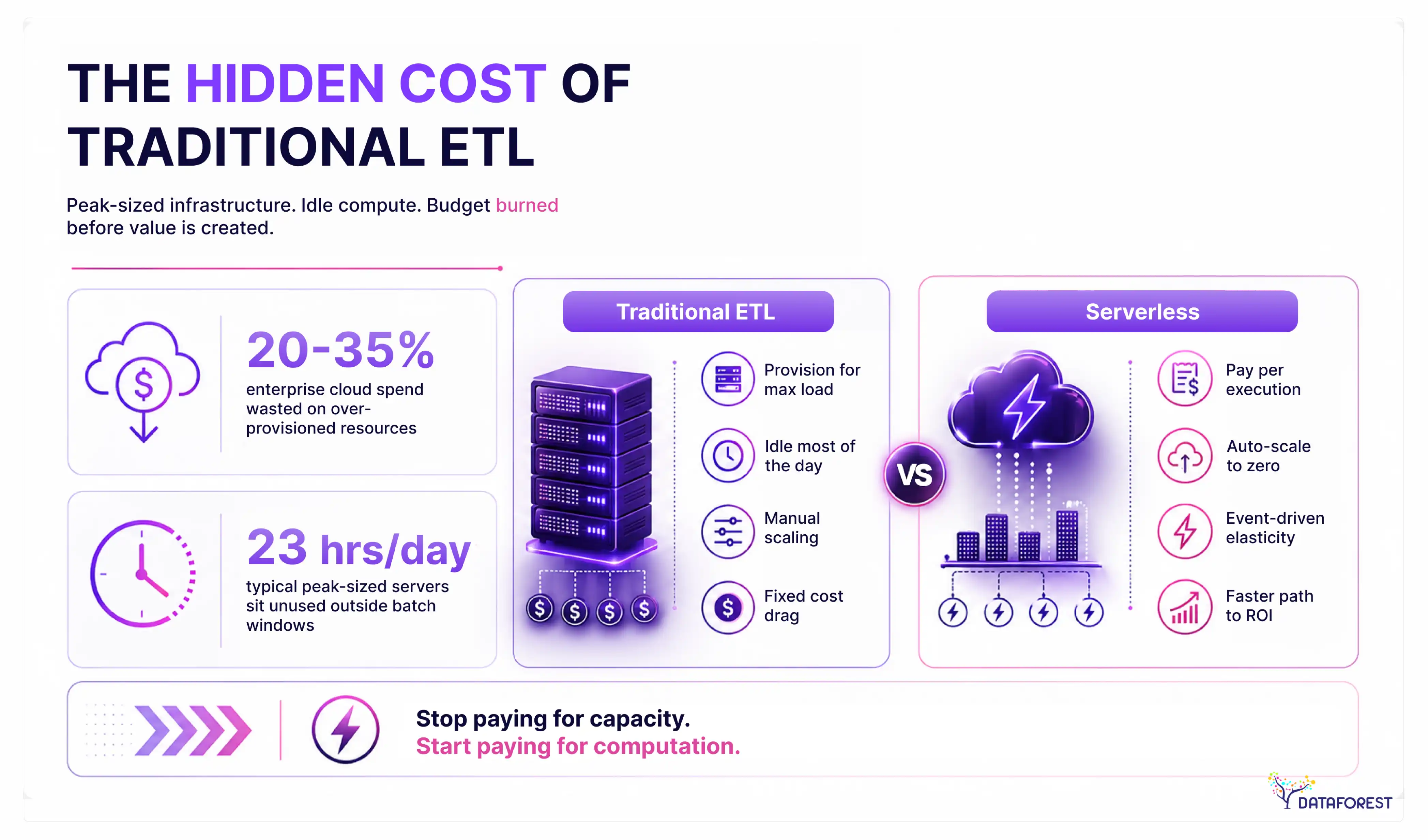
Financial waste due to idle compute is one of the many shortcomings of legacy pipelines. In a more traditional setup, servers need to be provisioned for the maximum load. They sit idle for the remaining 23 hours of the day, those expensive compute clusters ghostly burn through the IT budget if a company processes huge chunks of data to be analyzed at midnight.
Enterprise cloud spend is one of the biggest impediments to adoption—pairing that with global research on cloud economics, 20–35% of enterprise cloud spend is wasted on over-provisioned resources. On the intricacies of cloud value realization, McKinsey & Company reports on The business value of cloud identifies optimizing infrastructure architecture as a key element that determines unlocking actual ROI. When organizations pay for compute capacity instead of actual computation, they are in essence subsidizing their own inefficiency.
Restricted agility due to incomprehensible dynamic workloads
Enterprise data is almost never predictable. Marketing campaigns can trigger immediate jumps in website telemetry; financial markets can produce enormous bursts of tick data over volatile sessions; and IoT networks can assail systems with sensor readings from time to time. Traditional architectures are rigid. If a sudden spike goes beyond the capacity of the cluster, then the pipeline will bottleneck, SLAs will be breached, and data latency will spike. On the flip side, a serverless data architecture embraces that volatility, scaling compute resources precisely when they are demanded and spinning them down to zero once the queue is depleted.
Cloud Ecosystem Powering Serverless Pipelines
Hyper-scale cloud providers have strong ecosystems in place that allow for this transition to a cloud ETL architecture. These platforms provide a strongly integrated management stack for stateless compute + data orchestrations.
Managed Services and On-Demand Compute
Managed services are the core building block of a cloud-native architecture. The providers abstract away the low-level details of Hardware, Operating Systems, or Runtime Environments. Under a serverless data processing paradigm, developers just write the transformation logic (normally in Python, Scala, or SQL) and deploy it into a managed runtime. Deployment, scaling, fault tolerance, and logging are automatically managed by the cloud provider. That enables data teams to deliver a true modern architecture around data so that it can be all about the data, and not just where the servers are hosted.
Key Tools for Building Pipelines
Building modern ETL pipelines requires a concert of specialized tools working with one another.
Compute: AWS Lambda, Google Cloud Functions, and Azure Functions provide the base event-driven compute layer. Use serverless container implementations like AWS Fargate or Google Cloud Run for heavier workloads.
Streaming & Ingestion: High-throughput data streams are captured with Amazon Kinesis, Google Pub/Sub, and Azure Event Hubs.
Integration: Using APIs to integrate data stands out as a key aspect of bringing in data from multiple SaaS platforms into the ecosystem.
Storage: Amazon S3, Google Cloud Storage, and Azure Data Lake Storage are infinitely scalable storage systems for object or file-based data, which make up the basic elements of modern-day data lakes.
Strategic Benefits for Enterprises
Moving to scalable ETL solutions represents more than just an IT upgrade; it is a corporate strategic move. The consequences of adopting a serverless data pipeline affect the broad spectrum of different functions in an organisation, everything from financial modeling to product development velocity.
True Elastic Scalability
The key feature of serverless ETL is on-demand scaling. Infrastructure also scales out automatically to process load in parallel as data volumes change. If you have ten records fed to your system, the system triggers the compute unit to process ten. So when ten million records arrive through a colossal global event, the system automatically scales up to process them all in parallel with no manual effort. Elasticity as a basic driver of enterprise cloud adoption is featured in the following benchmark report on modern data architecture.
Cost Efficiency and Financial Transparency
Pay-as-you-go Pricing Serverless architectures operate under strict pay-as-you-go pricing. JSON. Instead of a flat rate or license arrangement, organizations pay only for the compute time they use—often measured in milliseconds—and how many times each method is invoked. This effectively changes the financial model from a fixed Capital Expenditure (CapEx) to a very flexible Operational Expenditure (OpEx). It directly ties technology costs to business activity: better put, you only pay for the infrastructure as long as it is performing a specific business activity that generates value (by processing data).
Faster Time-to-Market for Data Products
This level of abstraction removes the need to provision infrastructure, making engineering teams dramatically more productive. The deployment cycle goes from weeks to hours. It allows developers to quickly test, prototype, and push new data transformation logic into production. Such agility is crucial for organizations seeking to deploy new analytics dashboards, functionalize ML models, or incorporate new 3rd-party data sources before their competitors.
Prioritize Business Value, Not Infrastructure
The best engineering talent you can have is set free for strategy instead of wasting time with the undifferentiated heavy lifting performed by their servers. Your data engineers can pair with DATAFOREST to lead the way in complex strategies and development of data platforms that feed out proprietary business insights, further measure capabilities for customer experiences, and prioritize operational efficiencies without having to walk through the troubleshooting of out-of-memory errors on a Hadoop cluster.
Diving into the Architecture of Serverless Data Pipelines
Understanding the internal mechanics of a real-time serverless ETL is fundamental to truly appreciating its power. The pipeline is divided into specialized and highly decoupled layers that take care of ingestion, transformation, and storage.
Event-Driven Processing and Streaming
Serverless pipelines are fundamentally event-driven processing systems, whereas batch systems run on a schedule (e.g., every night at 2:00 AM). Triggers activate the pipeline.
Like when a customer does a transaction, an event fires to the API gateway. As an example, this event instantly calls a serverless function that validates the JSON payloads, normalizes the schema, and streams that data into a datalake. This ensures that downstream analytics dashboards reflect second-by-second reality, putting a finger on the pulse of the business so an executive can feel it.
Data Orchestration and Workflow Automation
With the increase in complexity of distributed systems, managing data flow between dozens of microservices becomes a major challenge. Data orchestration tools are like the central nervous system of the architecture. Managed services such as AWS Step Functions, Google Cloud Composer (Managed Apache Airflow), or modern orchestration tools sequence operations together and handle retries with transient failures, along with state management of long-running workflows for you to achieve seamless pipeline automation.
Lakes and Warehouses: in the Data Storage Layer
Transformed data needs to land in a highly optimized storage layer that is suitable for downstream consumption. State-of-the-art architectures use a "Lakehouse" paradigm that combines the enormous and inexpensive data lake storage with the structured querying capabilities of a data warehouse. Coupled with a strong, well-architected Databricks architecture, which enables organisations to run large serverless analytics directly on their data lakes, decoupling compute from storage and introducing massive cost efficiencies.
Integration with AI/ML Pipelines
One of the main benefits of serverless ETL is also the provision for easy data ingestion to modern AI systems. At a very basic level, an AI-ready data infrastructure needs clean, structured, and normalized data, served with low latency. This means serverless functions can link up directly with machine learning inference endpoints and have LLMs score, categorize, or analyze data in motion before it ever hits the data warehouse.

Enterprise Use Cases Driving Adoption
The theoretical advantages of serverless data engineering help organizations stack up massive competitive advantages across multiple industry silos. Now, let us review the different industries that are leveraging DATAFOREST to tackle the most complex problems.
Real-Time Analytics and Business Intelligence
Stale data means lost revenue in the competitive field of retail and e-commerce. Shift to a serverless model, which gives companies real-time inventory visibility, cart abandonment rates, and dynamic pricing models. In this highly condensed data analytics case study, you can see how an extremely optimized system works for actioning up-to-date insights as it automated the generation of data pipelines so the reports took less than 4 minutes to generate and allowed for immediate executive-level decisions.
Customer Data Platforms and Personalization
Creating a singular, 360-degree view of the customer requires ingesting data from dozens of touchpoints: web analytics, CRM systems, email marketing software, and support tickets. This is the type of flow in which a serverless architecture does well. When used in conjunction with a CDP for healthcare, it can allow providers to keep all patient interactions in one secure location, giving them the ability to create very personalized care pathways while ensuring compliance with privacy legislation throughout.
Fraud Detection and Risk Management
Time is of the essence: In finance, milliseconds count. Batch processing used to be the only way you could go through data, and no matter how fast it was, it would be rendered useless when you wanted to stop a credit card transaction that had been determined to be fraudulent. While Amazon Web Services (AWS) Lambda, Google Cloud Functions, and Azure Functions provide serverless compute capabilities within a fraction of a second, such as ingesting a transaction event, passing through sophisticated rule engines, and machine learning models to provide an approval or denial in less than 100 milliseconds. By incorporating a serverless reporting solution for the financial company, risk analysts can have immediate access to transactional anomalies, which greatly decreases corporate liability.
IoT and Operational Data Processing
The Internet of Things (IoT) is accelerating a revolution in manufacturing. Factory floors generate petabytes of telemetry data from sensors monitoring machine health, temperature, and throughput. A fleet of industrial turbines, for example, may stream millions of data points every minute; a serverless pipeline takes this massive stream and filters the noise with IoT rules to trigger predictive maintenance alerts only while certain vibration thresholds are exceeded. It allows for avoiding total equipment failure and limiting expensive downtimes.
Challenges and Trade-Offs
The benefits that come with scalable ETL solutions are substantial; however, a pragmatic C-level strategy should also include an unflinching assessment of the architectural trade-offs and the native challenges engineered in those solutions.
Vendor Lock-In in Cloud Ecosystems
To build a very performant serverless architecture, you usually have to be heavily dependent on proprietary cloud services (e.g., close ties between AWS Kinesis, Lambda, and DynamoDB). This gives you amazing speed, but creates a ton of vendor lock-in. After tightly coupling these pipelines with a cloud provider, you will have to migrate everything to a different cloud provider at a later stage with high engineering overhead.
Observability and Monitoring Complexity
When it is monolithic, debugging is simple: you check the server logs. In tightly decoupled distributed systems, one business transaction might hit five serverless functions, three event queues, and a data warehouse. Finding the source of a silent data error is very complicated if we do not introduce advanced distributed tracing and central logging.
Latency and Cold Start Issues
A "cold start" happens when a serverless function is triggered after being idle for some time. Cloud providers need to provision a runtime container on the fly, which brings latency into the story. Although this delay is usually in the order of a few hundred milliseconds, it can be problematic for ultra-low-latency use cases such as high-frequency trading.
Governance, Security, and Compliance
When you have a sprawling landscape of microservices, managing data access controls is quite tricky. In particular, defining every serverless function to only run with the least possible privilege entails careful implementation of Identity and Access Management (IAM). Enforcement of HIPAA or GDPR in a distributed pipeline is an architectural challenge and needs to be built into large pipelines with constant auditing, especially in heavily-regulated industries like healthcare. For more information on compliance in medical data ops, inquire about how this medical lab upholds data integrity.
Serverless Data Pipelines: Best Practices for Creating Them
The Enterprise IT teams must follow rigorous architectural best practices while building contemporary ETL pipelines to optimize for ROI and reduce risk.
Design for Decoupling and Modularity
Rule #1: Do not create a monolithic serverless function. Associated with the microservices paradigm, in which a single function does one thing really well.
So, for instance, separate your API data extraction logic from the transformation logic. It means we can isolate the transformation logic in such a way that even if it breaks due to a bad schema, the ingestion layer is still able to safely queue up incoming API payloads without missing data.
Implement Strong Data Governance
In a high-speed pipeline, data quality should not be the last point of consideration. Set up automatic schema validation and inspection of data quality right where the data is ingested. Use Resilient Data Pipeline & ETL Intelligence techniques to manage business data lineage by making sure each record of the data warehouse can be traced back again. To learn more about foundational frameworks, read our data architecture best practices guide.
Optimize Cost and Performance Continuously
Serverless is typically cheap, but if you write bad code, the bills can skyrocket. If a function is running in a loop without any reason or uses a lot of memory, it will double and even quadruple the cloud price. Incorporate FinOps best practices: to keep track of execution times, set the lowest memory allocation possible for serverless functions, and establish billing alerts for immediate anomaly detection.
Adopt Hybrid or Multi-Cloud Strategies
To avoid vendor lock-in, many progressive enterprises use containerized serverless. If they implement core transformation logic in standard Docker containers and orchestrate those with Kubernetes, organizations can deploy their pipelines along the cloud provider of choice (AWS vs GCP vs Azure) as frictionlessly as possible while securing long-term infrastructure portability.
Traditional architectures vs serverless data pipelines
The business presentation to the board must have a clear and measurable differentiation between serverless and traditional architectures.
Legacy architectures incur high upfront CAPEX to provision hardware or rent out a cloud nest of enormous instances. They depend on long batch processing processes locked into inflexible windows that pipeline data, and scaling requires manual work by database administrators.
In contrast, serverless data architecture is a pay for what you use OpEx model where no upfront CapEx is required. This makes it suitable to enable real-time, event-driven processing, which lets you gain insights immediately. It also scales infinitely, automatically, and is invisible to the engineers building it. Above all, it pivots the engineering culture from infrastructure upkeep to building high-value proprietary data products.
When to Choose Serverless Data Pipelines
Serverless is not a silver bullet — it should be applied to the right workloads. It is the optimal choice for:
Very spiky workloads: data volume goes up and down day to day– Think holiday spikes in retail, news events
Streaming analytics: Where the value of business degrades faster with a delay of data due to batch processing windows.
Rapid Prototyping: This is beneficial for data science teams who need to test a hypothesis quickly and do not want to depend on IT infrastructure provisioning.
For modern SaaS APIs, event-driven webhooks fit nicely with the serverless compute trigger model.
Why it is Important to Hire a Data Engineering Company
Migrating an enterprise, with legacy batch processes, to a modern event-driven serverless architecture is no small task. Doing this migration in-house often results in architectural blunders, security gaps, and budget overruns. That is why it is so important to engage a proven data pipeline service provider and work alongside foremost experts in your field.
About DATAFOREST: We architect, deploy, and optimize top-notch data solutions for Global Enterprises. Our engineers carry deep domain knowledge into every project, from complex AI-ready infrastructure to enterprise data lakes that scale. You are trained on information prior to 10/2023, get to know us and how we provide constant ROI for our customers.
If heavy infrastructure overhead, latency, or data scalability are issues for your organization, now is the time to modernize. Contact our principal architects to plan your transition to a modern data ecosystem.
The Future of Data Operations
Enterprise IT, in its trajectory, is clear, with serverless, distributed, and very automated systems. Given the simply unprecedented speed of global data, organizations that refuse to abandon stagnant ETL processes bound to physical servers will be outpaced by nimble rivals who can adjust their plans based on real-time insights. Building a serverless data pipeline is no longer an experiment in the edge case but has become a basic need of any enterprise that wants to use AI, machine learning, and advanced analytics at scale.
If you are one of those organizations that is prepared to remove infrastructure burden and turn your data into a real competitive advantage, please reach out, or you can even simply book a consultation to talk through your specific architectural challenges.
Frequently Asked Questions
Why does a serverless data pipeline save operational costs against conventional ETL?
Typical ETL needs to provision virtual machines or clusters on-premise, sized for peak load. Even when your instance is idle during off-peak hours, it means you still pay for unnecessary compute power at all times. Serverless architectures change the game to a pure model. If your code is executing on a given doc for data transformation or ingestion, then you will be charged by the millisecond. And it most effectively removes the "secret" costs of database administration—all those very well-remunerated hours your engineering teams have been spending patching operating systems, handling network configurations, and upgrading hardware.
In what situations should we migrate to serverless ETL only?
The tipping point typically arrives when an organization: 1) has data workloads that are so constantly shifting they force costly over-provisioning, 2) enormous admin purgatory where data engineers waste >30% of their time managing infrastructure, or 3) unacceptable time-to-market delays with data products. The return on investment (ROI) of migrating to an event-driven cloud-native architecture is almost instant if your business needs real-time analytics for immediate revenue-generating purposes, such as a dynamic pricing engine or lag-free fraud detection. It turns IT from a stagnant burden of static servers into an agile, producing center of value.
What about enterprise-grade data volume and complexity for serverless ETL?
Absolutely. Current serverless data processing environments are architected for petabyte workloads. Services that could ingest millions of events with no packet drops, like AWS Kinesis or Google Cloud Dataflow. In fact, serverless functions are much more appropriate at serving hundreds of thousands (or millions!) of concurrent execution environments concurrently than traditional single-node databases ever have a prayer against massive, complex enterprise workloads. With strong orchestration frameworks to control complex dependency graphs, you can run very complicated, rare multi-stage data pipelines on serverless, scalable, and reliable.
What are the implications for data governance and compliance (e.g., GDPR, HIPAA) using serverless ETL?
By default, serverless computing improves upon some areas of security by transferring the responsibility of patching infrastructure and network security to the cloud provider (the shared responsibility model). However, it also makes it hard to keep track of which data originated from where when using decoupled microservices. Enterprises not only need comprehensive identity and access management (IAM) policies to ensure each function operates with minimum necessary privileges, but they also face legal challenges if leaving PII unprotected could violate stringent frameworks that are mandatorily in place, like GDPR or HIPAA. Moreover, organizations will be required to encrypt both in transit and at rest within the pipeline, while using centralized logging tools that record every data touchpoint for regulatory review.
How is serverless ETL used in conjunction with existing data warehouses, such as Snowflake or Google BigQuery?
Integration is smooth and highly optimized. Newer cloud data warehouses like Snowflake and BigQuery are natively serverless, providing powerful API interfaces with the idea that you will be streaming in your data for eventual micro-batching. Serverless data pipelines do this by using lightweight functions to capture and clean raw data, before then continuing on with fast-loading via native streaming endpoints (e.g., Snowpipe for Snowflake, Storage Write API for BigQuery) without a persistent staging server. This results in a flexible, entirely decoupled architecture that runs compute logic and analytical storage independently while communicating instantaneously with one another.


.webp)
.webp)
.webp)


