

The Strategic Necessity of Next-Generation Data Flows
We are in an epoch of never-before-seen data gravity. Once enterprises shift to AI and real-time operational analytics, the infrastructure that drives how we move our data, process it, and consume it has become more central than ever. More traditional, monolithic batch-processing systems—the gold standard for business-intelligence purposes—are simply unfit for the total latency and volume demands of AI workloads today.
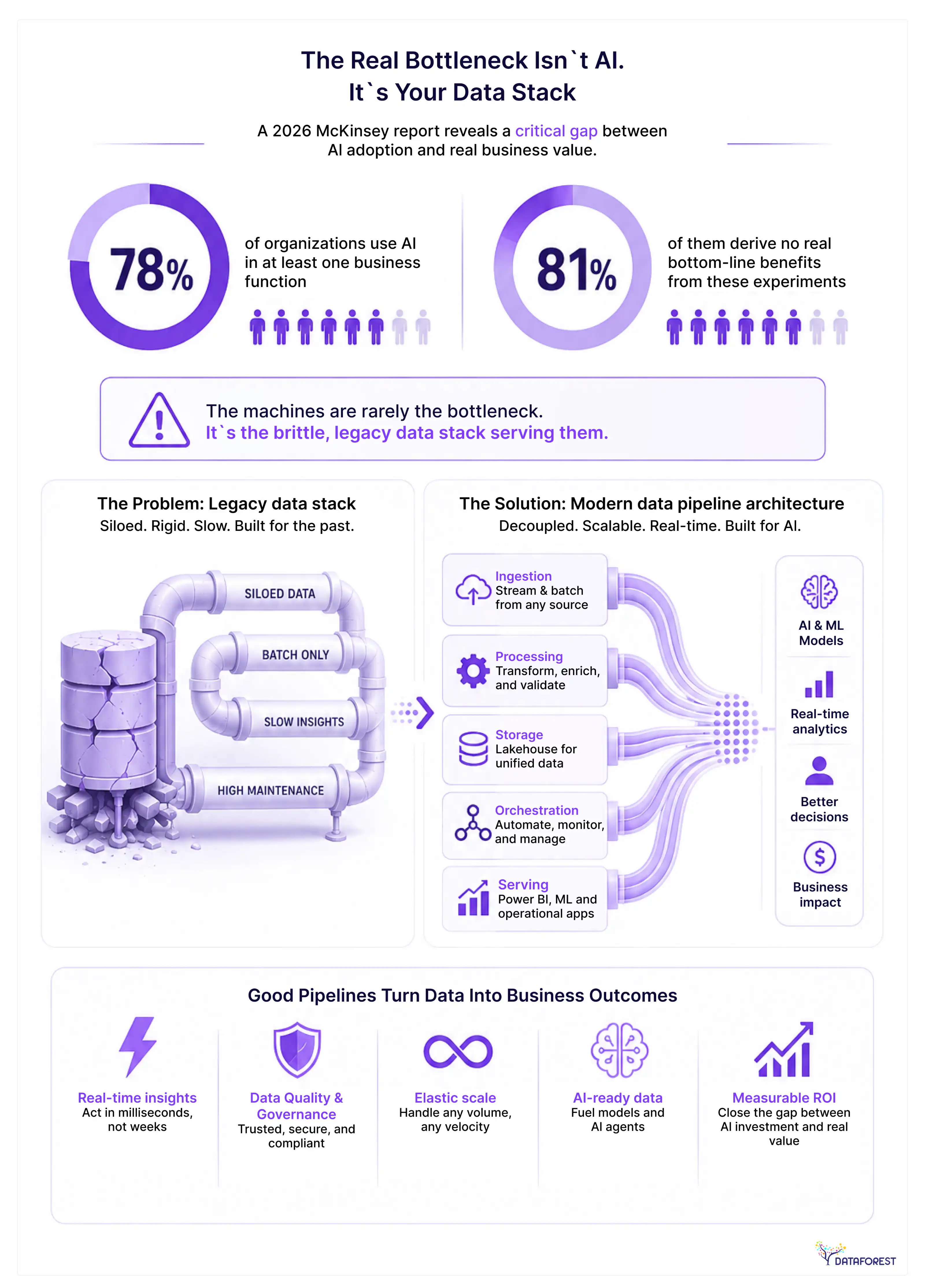
A 2026 McKinsey report about just this found that 78% of organizations use AI in at least one business function — but startlingly, 81% do not derive any real bottom-line benefits from these experiments. The machines are rarely the bottleneck: it is the brittle, legacy data stack serving them.
Closing the gap between AI experimentation and scaled enterprise value requires organizations to rethink their engineering fundamentals. DATAFOREST CEO Michael Allen believes the move to a more genuine modern data pipeline architecture is no longer an IT upgrade, but rather a matter of core business survival. Really good pipelines turn the unclean, ungoverned mess of data lakes into clean, governed high-fidelity data products that kickstart everything from generative AI agents to automated operational decisions.
What a Modern data Pipeline architecture means.
In essence, a data pipeline architecture is the architectural layout of automated processes that pull from different sources, sometimes transform this data to a usable state, and load it on a centralized platform or operational application. But modern data pipeline architecture does not use a hard-wired point-to-point configuration to create rigid connections between components. Facing new cloud-oriented frameworks built using modularized and decoupled strategies that automatically scale on demand.
Main Ingredients of a Data Pipeline
Enterprise IT leaders must realize that each of the layers that comprise modern workflows is different to create a resilient infrastructure. These layers work together to guarantee a consistent data stream from source to consumption.
Ingestion Layer: This is the first stage that enters data from transactional databases, external APIs, IoT sensors, or application logs. Modern ingestion deals with both streaming events and batch loads transparently while still supporting legacy ingestion.
Processing and Transformation Layer: This is the layer where raw data becomes cleansed, enriched, and structured. The compute-heavy engine of the pipeline converts raw signals into business-ready metrics.
Storage Layer: The lasting storage layer, which has progressed from legacy data warehouses in the past to flexible data lakes today—and now to an integrated lakehouse architecture.
Orchestration Layer: For synchronisation, management, and dependency of pipeline tasks — this is the control plane
Serving Layer: This is the last stage where transformed data is exposed to tools for BI, models for machine learning, or reverse-ETL processes feeding apps (CRMs/ERPs) back with operational data.
Learn how these pillars fit together in a modern data architecture that aligns with your strategic priorities.
Transitioning from traditional ETL to modern ELT and Streaming
ETL (Extract, Transform, Load) dominated the paradigm for decades. Some data was extracted from a source, transformed into an intermediary server to fit into a rigid schema, and then loaded into the data warehouse. This methodology relied heavily on the computing power of the transformation server, which consequently created major bottlenecks as volumes of data increased.
With the explosion of inexpensive cloud storage with highly elastic cloud compute, this paradigm flipped to ELT (Extract, Load, Transform). With ELT, raw data is ingested directly to a cloud data warehouse or a data lake. This transformation occurs natively within the storage layer and uses the horizontal scale of modern cloud engines like Snowflake or Databricks.
Fast forward to 2026 (plus or minus a year, depending on whether you prefer blue sky) — we are seeing the next chapter: continuous event-streaming merged with ELT. Such a hybrid architecture (for example, "medallion architecture" or "kappa architecture") allows businesses to perform both historical batch analysis and real-time operational AI. To get a complete comparison of these paradigms, have a look at our technical breakdown about ETL vs ELT in modern data pipelines.
Key Architecture Patterns for 2026
Having the right design architecture requires mapping technical patterns to the respective business use case. Sub-second latency is not a goal for all enterprises, and on the other hand, daily batch jobs should not be the only method of work for every organization.
Batch, Real-Time, and Hybrid Pipelines
By 2026, the batch vs streaming data pipelines debate has mostly come to a close: in enterprise architecture, you need both.
Batch Processing: best for huge, historical datasets without strict real-time constraints. Back-office processes such as financial reconciliations, end-of-month reporting, and deep-learning model training rely on scheduled batch jobs. They are affordable and operationally sustainable.
Real-Time Data Pipelines: Critical for operational responses to be instantaneous. For real-time data pipeline architecture, we are talking about scenarios like fraud detection, dynamic pricing, and real-time recommendation engines. This pattern processes data as soon as it is produced in real-time with milliseconds of latency.
Hybrid Data Pipeline Architecture– The modern-day standard. Different organizations process real-time streams for instant operational needs, as well as store raw data for heavy batch-based historical analysis through a "Lambda" or "Kappa" architecture.
Event-Driven Data Architecture
The idea for an event-driven data architecture is to turn the traditional pipeline upside down. Instead of a single central scheduler polling "Is there new data?" over and over again, a systems-based model lets an "event" cause an immediate reaction of the system (eg, customer clicks on a button, sensor detects temperature change, transaction is cleared).
In event-driven data pipelines, an event broker (Apache Kafka or Redpanda) decouples the data from consuming applications.
Example: In a scenario such as e-commerce price monitoring, an event would be represented by some change to the price of a competitor. The pipeline immediately consumes this event, runs it through a pricing algorithm, and initiates an automated repricing in the retailer's system with no human interaction or scheduled batch jobs.
Lakehouse-Based Pipelines
Organizations can run slow queries much faster, and when it comes to data organization, the Data Lakehouse combines the ACID compliance, governance, and structural reliability of a Data Warehouse with the vast scale and flexibility of a data lake. Enterprises run BI queries and heavy machine learning workloads directly on cheap object storage under open table formats standardization, such as Apache Iceberg/Delta Lake/Apache Hudi. This helps minimize data duplication and manage the global structure of your pipeline.
Data Mesh vs Centralized Architecture
At large organizations, centralized data engineering teams often become a bottleneck as the organization scales. A Data Mesh is a sociotechnical paradigm that decentralizes data ownership from an overarching IT team into individual domain-based business units (e.g., Marketing, HR, Finance).
In a Data Mesh, pipelines are not centralized. Now, each domain team is building its own pipeline and maintaining it as a Data Product, a self-serve infrastructure available over a centralized governance team, which enforces interoperability standards. This works brilliantly for many Fortune 500 companies with more complex organizational structures; smaller firms may be better suited to a centralised and well-governed approach.

Whether you use off-the-shelf tools or custom-built solutions, there are some best practices that can be followed for building data pipelines in a robust and reusable manner.
No shortcuts — to achieve high ROI on data infrastructure, one way or another, you have to follow the engineering best practices. Badly designed pipelines lead to a phase of "data downtime"—where data is missing, wrong, or stale, which breaks trust across the organization.
Be Prepared To Scale From The Get Go
Future volume is something a scalable data pipeline architecture accounts for. If a system has hard-coded limitations or is built on single-node processing systems, it will fail these economies at a systemic level.
Decouple compute vs storage: Your processing engines should scale and be independent of your data repositories.
Resist the urge to use a monolithic architecture: Distributed data pipeline systems like Apache Spark or Ray can limit single points of failure; cluster across hundreds/thousands of machines. Enterprise-scale workloads are impossible without distributed data pipelines.
Implement Data Pipeline Observability
An alert tells you that there is something wrong with a pipeline; observability can tell you what is wrong. This predicted growth in data observability was recently included in a larger trend forecast from IT research and advisory company Gartner, which states that by 2026, half of businesses using distributed data architectures will use some form of data observability tool, compared to less than 20% in 2024.
Data pipeline observability or data pipeline monitoring are the bulk terms used to track data freshness, volume anomalies, schema drift, and lineage. When there is a failure on the dashboard, observability tools enable engineers to pinpoint the source system where it went wrong. For an in-depth understanding of how one would go about implementing these systems, check out our data pipeline monitoring best practices.
Ensure Data Quality and Reliability
The principle "garbage in, garbage out" still holds true across the field of analytics. By running automated data quality checks in pipelines, polluted data cannot leak into downstream systems.
For Instance: Circuit breakers in the pipeline. The pipeline should stop instead of loading bad data into the warehouse when a data ingestion job starts pulling 90% null values for an important column in the dataset, e.g., "Customer ID", so that it can alert the engineer to take remediation steps in time.
Optimize for Performance and Cost
Cloud computing provides infinite last-mile scalability but also infinite cost if not managed appropriately. Abstracting out portions of a data pipeline into modules allows teams to have the flexibility to optimize smaller components without having to redesign an entire system, which is the core idea behind modular data pipeline design. Use autoscaling smartly, kill clusters that are not doing work, use the cheapest engine (do not spin an expensive Spark cluster just to do some JSON parsing; rather, use a lightweight serverless function).
Security, Governance, and Compliance
The regulatory environments around data privacy are tighter than ever before in 2026. Pipelines need to encrypt data in transit and at rest. ULEDB should combine Role-Based Access Control (RBAC) and attribute-based masking for pipelines, so PII( Personally Identifiable Information) is masked downstream before reaching analysts or data scientists.
Technology Stack: The Engines Driving the Modern Data Pipeline
It's paramount to select the correct tooling. The modern data stack is a fragmented space with some assemblies requiring skilled architects to glue things together as a proper solution.
Orchestration and Workflow Tools
At the core of the architecture is data pipeline orchestration. Apache Airflow, Dagster, and Prefect are some tools that orchestrate complex DAGs (Directed Acyclic Graphs) of tasks. They take care of scheduling, retries, and dependency management, making workflow automation for data pipelines much easier.
Data Processing Engines
The industry is dependent on distributed computing mainly for heavy transformation. In addition to Apache Spark, a new generation of fast engines (e.g., Polars) has emerged. Dataprocessing Cloud native applications, such as DBT (data build tool), have changed the game in this space and allow for modular SQL transformations to be written and managed (version/ deploy changes) in Place. Data integration: choosing the right tools for navigating the complexities of integration tooling.
Streaming and Messaging Systems
Apache Kafka is the enterprise standard when it comes to high-throughput event messaging for streaming data architecture. New managed services (e.g., Confluent, Amazon Kinesis, Google Pub/Sub) make deploying these distributed logs straightforward. Actually, the frameworks we use to compute aggregations over streams of data in motion are heavily dependent on real-time processing for those streams, such as Apache Flink.
Storage Solutions
It is cloud data warehouses(Snowflake, Google BigQuery, Amazon Redshift) and lakehouse platforms(Databricks) that rule the core repos. The selection of either option highly depends on an organization's unique combination of BI and Machine Learning workloads.
Cloud-Native and Serverless Approaches
With the help of DevOps & Cloud Solutions, enterprises are noticeably moving toward serverless pipeline components. From serverless compute such as AWS Lambda and Google Cloud Functions, to fully managed data warehouses that are executed in a serverless manner, these solutions take the pain away of infrastructure provisioning and allow data engineering teams to only worry about pipeline logic and quality.
Advanced Analytics and AI Data Pipelines
Modernizing pipeline architecture paves the road towards operationalization of analytics and AI. An AI enterprise will have infrastructural needs that are completely different from traditional BI reporting practices.
Supporting Machine Learning Workloads
For example, machine learning models need very well-engineered "feature stores" which are centralized repositories that contain curated raw or processed data features for easy and consistent serving of feature sets for model training (batch) or model inference (real-time). For these feature stores to be managed, a modern pipeline should also provide them with high-fidelity, historical, and point-in-time correct data. Our Data science services are specifically designed to provide the middle ground between low-level engineering and high-performance machine learning models.
Real-Time Data for AI Applications
A lot of modern AI applications need real-time context. An example is a dynamic pricing model that requires real-time supply chain data and competitor pricing information to make the best recommendation. This requires the streaming pipeline architecture to be tightly integrated with the AI inference engine, so that the inputs to our model can never be stale.
Data Preparation for LLM and Generative AI Systems
Over recent months, the explosive growth of Large Language Models (LLMs) and Retrieval-Augmented Generation (RAG) applications has introduced additional architectural needs. A Large Language Model (LLM) pipeline needs a massive amount of unstructured data (PDFs, text documents, internal wikis) that can be ingested, chunked up, embedded via vectorization, and loaded into Vector Databases (Pinecone or Milvus).
Example A legal firm deploying internal AI counsel needs ingestion pipelines to literally suck in case law each day, convert the documents into vector embeddings, and almost immediately sync this with their RAG architecture. Check out our Generative AI services if you have proprietary AI solutions to build.
Common Mistakes Enterprises Make
Data transformation initiatives often fail, even with a big budget. Identifying anti-patterns in data pipeline design patterns is critical for protecting tech investments at the C-level.
Overcomplicating Architecture Too Early
Over-engineering is a trap many startups and mid-market firms fall into. Full Data Mesh is overkill, and deploying a complex Kubernetes-based streaming infrastructure when a simple ELT batch pipeline suffices creates crippling technical debt and maintenance pain. Only adopt that scale of complexity when the business use case truly demands it.
Ignoring Data Quality and Governance
It is a critical mistake to treat data quality as an afterthought. Managing high-speed pipelines that carry corrupted data just means you will get to non-productive business conclusions faster. Governance frameworks should be integrated directly into the pipeline's CI/CD deployment process.
Lack of Observability and Monitoring
Without data pipeline observability, engineering teams are flying blind. Without automated alerting, businesses learn about data outages when the CEO sees something strange in a quarterly dashboard. At this point, the trust is already broken on the data platform.
Choosing Tools Before Defining Strategy
A poorly designed architecture leads to a fragmented and costly tech stack, as you buy the latest SaaS tool with all the buzzwords around it. Strategy has to drive tooling, not the other way around. Before signing enterprise software contracts, organizations need to audit their data sources, assess their latency requirements, and know how technical the team is already.
Underestimating Operational Costs
Cloud computing is metered. Cloud bills can go haywire if poorly written SQL queries are run inside a cloud data warehouse, or if there are too many cross-region data transfers within a pipeline. Cost governance, FinOps practices, and pipeline optimization are needs you will have for the long term – as opposed to a configuration you set up once and forget.
Beyond 2026: What the Future Holds For Data Pipelines
The data engineering landscape for the rest of the decade will be characterized by automation and convergence. This is now known as "Zero-ETL" integrations, where cloud providers provide native connections from operational databases to analytical warehouses, eliminating the need for custom ingestion code. Moreover, AI itself is now auto-generating, optimizing, and healing data pipelines. Check out our analysis of data engineering trends 2026 for more on where the industry is going.
Choosing the Right Data Partner
It simply does not make sense for the vast majority of enterprises to invest in building world-class data engineering in-house — it is expensive and time-consuming. This time-to-value is expedited when partnered with an advisory, as it greatly derisks the architectural transformation.
How Do You Identify the Right Data Engineering Partner?
C-level executives should not just evaluate a vendor on their basic coding capability. A premium partner must possess:
Deep expertise in modern data pipeline architecture and distributed systems.
History of aligning technical infrastructure with measurable business KPIs.
Expertise in cross-domain knowledge, including cloud DevOps, Platform Engineering, and advanced AI implementations.
If you want to know about our methodology and engineering pedigree, check us out at DATAFOREST.
Framework for Alternative Build vs Buy vs Partner Decision
The traditional model of "Build vs Buy" has shifted to a model of "Build, Buy, and Partner." You purchase the core cloud infrastructure and SaaS orchestration tools; you collaborate with experts to architect it, and build your custom pipelines that are your secret sauce. Regardless of whether you are looking to modernize an old system (see our Data Warehouse Modernization case study) or build a greenfield platform, getting guidance from experts always helps.
Want to improve your infrastructure information? Book a consultation with our principal architects.
Conclusion: How to Ensure Your Data Infrastructure Will Last
The neural network of the modern enterprise is a modern data pipeline. Moving from fragile, outdated ETL bulk processes to robust, scalable data pipeline architecture helps organizations bring out the full potential of their data assets. And by making a case for the modularity of your design, tight governance over data quality, and full-scale observability can make sure that your infrastructure does not just power BI dashboards today but also seamlessly drives the autonomous AI agents and real-time operational app systems of tomorrow! The surest way to gain a real competitive advantage with data is to team up with top-tier engineering teams, such as that at DATAFOREST, offering its Data Engineering services.
If you have any immediate questions regarding architectural audits or the implementation of pipelines, please contact us through our contact form.


.webp)
.webp)
.webp)


